From "Ceasefire Agreement" to the Methane Revolution: The Battle for Bitcoin's Soul and Its Future
TechFlow Selected TechFlow Selected
From "Ceasefire Agreement" to the Methane Revolution: The Battle for Bitcoin's Soul and Its Future
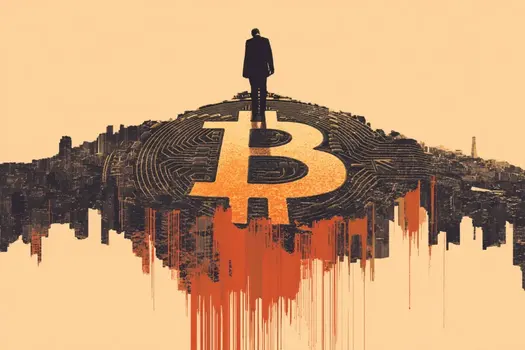
Recently, the Bitcoin community has been engaged in heated debates over "Inscriptions" and the Ordinals theory. Supporters view them as bringing innovation and wealth effects to the Bitcoin ecosystem, while opponents express concerns that they may undermine decentralization and the network's purity.
 Navigating Web3 tides with focused insights
Author: Luke, Mars Finance
In the clamor of the crypto world, market attention is always drawn to price fluctuations. Yet recently, a quietly circulated open letter among Bitcoin Core developers has landed like a stone in a deep lake—though it hasn't immediately triggered towering waves, it may be profoundly redirecting the entire tide of the Bitcoin ecosystem. This letter does not directly discuss wealth, yet it could determine where future wealth will emerge. More than anything, it resembles a "ceasefire agreement," attempting to bring an end to a long-standing civil war over the soul of Bitcoin.
"Spam" or "Renaissance"? A Debate That Split the Community
At the heart of this "war" lies "Inscriptions" and the underlying Ordinals theory, which exploded onto the Bitcoin network in recent years. When developer Casey Rodarmor ingeniously leveraged a long-overlooked corner of Bitcoin transactions—the witness data—to permanently etch images, text, and other non-financial data onto the smallest unit of Bitcoin, the satoshi, he likely had no idea he was unleashing a Pandora's box brimming with opportunity and controversy.
Inscriptions ignited the Bitcoin ecosystem in unprecedented ways. Suddenly, massive numbers of BRC-20 tokens and NFTs flooded this chain renowned for its "purity," generating astonishing wealth effects and bringing much-needed relief to miners whose revenues had been dwindling—transaction fees surged, at times even surpassing the fixed block subsidy. Supporters hailed it as a "Bitcoin Renaissance," arguing that it proved Bitcoin’s network could build rich, diverse application ecosystems without relying on complex smart contract virtual machines, thus attracting vast users and capital.
Yet on the flip side, Bitcoin purists and some core developers reacted with anger and concern. To them, these so-called "financial graffiti" were a serious abuse of Bitcoin blockchain's precious space. Most notably, veteran Bitcoin Core developer Luke Dashjr denounced Inscriptions as a "spam attack" exploiting a "bug" in the Bitcoin Core client.
His logic was solid and clear: Bitcoin was designed as a peer-to-peer electronic cash system, and every byte of its blockchain should serve this primary purpose. By permanently inscribing large volumes of irrelevant data onto the ledger, Inscriptions caused the blockchain to balloon at an unprecedented rate—raising hardware requirements for running full nodes and, over time, threatening the very foundation of decentralization upon which Bitcoin depends. He believed such actions severely deviated from Bitcoin’s ultimate vision as sound money. Consequently, Luke and like-minded developers began exploring software upgrades—so-called "soft forks"—to "fix" this bug and stop Inscriptions at their root. The atmosphere grew tense, and the nascent Inscriptions ecosystem found itself under the shadow of potential eradication at any moment.
The debate quickly escalated into a profound philosophical and ideological rift, splitting the Bitcoin community into two camps. On one side are the "minimalists," who believe Bitcoin must remain in its simplest, purest form—focused solely on being digital gold and a store of value—and that any "impurities" interfering with this goal should be removed. On the other are the "maximalists" (in this context, expansionists), who argue that Bitcoin is humanity’s most secure computing and consensus platform, and its immense security budget should not be wasted on simple transfers alone. Using Bitcoin as a settlement layer for broader applications would not only enhance its utility but also generate sustainable miner income through a thriving on-chain economy, ensuring long-term network security as block rewards halve every four years.
The "Grand Strategy" Behind the Open Letter
Just as the conflict seemed irreconcilable, this open letter arrived as a turning point. Its signatories lend it immediate credibility—not only including Ordinals creator Casey Rodarmor and respected core developer b10c, but also influential projects within the Inscriptions ecosystem like Taproot Wizards. This marks a shift: builders once seen as "heretics" are now engaging the broader community, especially miners and developers, in a more mature and constructive dialogue about their vision.
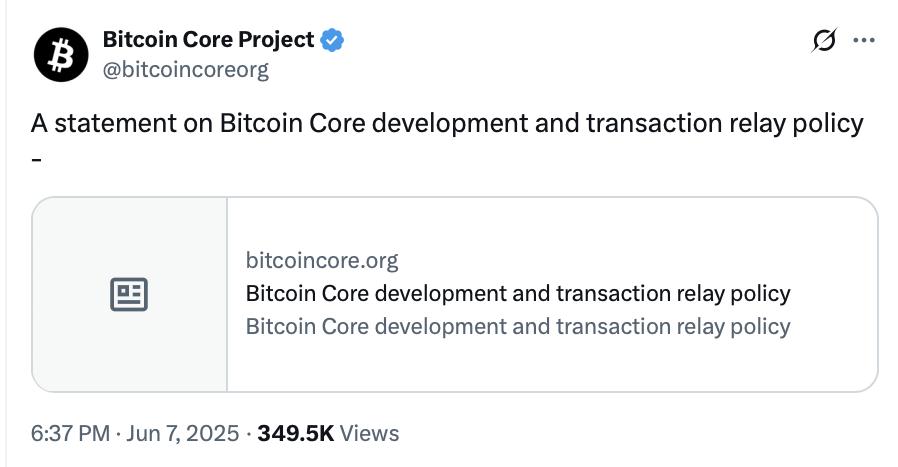
The letter's central argument skillfully sidesteps the subjective question of whether Inscriptions are "useful" and instead targets Bitcoin’s most fundamental, unquestionable principle: censorship resistance. It emphasizes that Bitcoin’s greatness lies in being a permissionless, neutral platform. As long as a transaction complies with consensus rules (valid format, rightful UTXO ownership, sufficient fee payment), it must be included—regardless of intent or content—without review by any developer, miner, or group. Rejecting inscription transactions today because "we don’t like JPEGs" opens the door tomorrow to rejecting any transaction deemed "undesirable," creating a dangerous precedent that fundamentally undermines Bitcoin’s value proposition.
This is less a defense than a high-level checkmate move. It shifts the burden back onto those seeking to "fix" the bug: Are you willing to sacrifice Bitcoin’s foundational principle of censorship resistance to preserve your ideal of a "pure" Bitcoin?
Furthermore, the letter boldly highlights an unavoidable reality: Bitcoin’s economic security model. With block rewards halving every four years, miner income will increasingly depend on transaction fees. A dormant Bitcoin network with only minimal transfer activity cannot sustain the multi-trillion-dollar security budget needed to resist nation-state attacks. Inscriptions and future non-financial applications are precisely the strongest engine for Bitcoin’s fee market. The letter makes it clear: helping miners earn fees means helping keep the Bitcoin network alive and secure. This is undeniably a strategic appeal to miners’ core economic interests, forcing them to choose between ideological purity and economic survival.
From "Block" to "Channel": The Three-Act Evolution of Bitcoin Metaprotocols
The deeper significance of this open letter lies in marking a transition within the Bitcoin community—from confrontation to integration, from blunt suppression to intelligent channeling. It doesn’t end the debate, but sets a healthy boundary for it. Once the question of “whether we should build” is settled, the community’s creativity naturally shifts toward “how to build better.” History is already bearing this out: when blocking is off the table, pathways for innovation suddenly open wide.
A wave of innovation surges through Bitcoin’s ancient river, and the evolution of metaprotocols has become the most compelling three-act drama in this story.
Act One: Genesis – The Thunderous Birth of Ordinals
Ordinals and Inscriptions mark the beginning of this evolution—an audacious "proof of concept" that, though crude, powerfully demonstrated the feasibility of issuing non-fungible tokens (NFTs) and fungible tokens (BRC-20) on Bitcoin. Despite causing issues like UTXO set bloat, it lit the first fire, revealing a previously hidden dimension of Bitcoin. But its limitations were equally apparent: functionality largely limited to token issuance and basic peer-to-peer transfers, lacking broader programmability. After the initial hype, further innovation in the ecosystem appeared to stall.
Act Two: Refined Progress – Runes’ Elegant Pivot
Against this backdrop, the Runes protocol emerged, crafted personally by Ordinals founder Casey Rodarmor. Like a meticulous engineer, Runes precisely addressed the inefficiency of BRC-20, which generated excessive "junk" UTXOs during transactions. Through a more efficient, more "Bitcoin-native" UTXO model, Runes offers an elegant solution for fungible token issuance. Runes represents the logical next step in metaprotocol evolution—moving from "possible" to "better." It makes asset issuance cleaner and more efficient, but ultimately remains within the framework of asset creation, falling short of deeper transformation.
Act Three: Paradigm Leap – Alkanes’ Astonishing Jump
But both Ordinals and Runes still answer the same question: “How can we issue assets on Bitcoin?” The real breakthrough comes when addressing a far more fundamental question: “Can Bitcoin become a decentralized computer capable of hosting complex applications?” The latest development—the Alkanes protocol—is attempting exactly this leap, pushing the narrative to new heights.
Alkanes goes beyond patching existing protocols. It ambitiously introduces a full smart contract environment built on WASM (WebAssembly) atop Bitcoin’s foundation. WASM is an efficient binary instruction format enabling developers to write complex applications in multiple high-level languages (like Rust or C++) and execute them securely on the Bitcoin network. In theory, this embeds an entire "operating system" directly into Bitcoin’s base layer.
This leap is revolutionary. For the first time, developers can build truly autonomous decentralized applications (DApps) directly on Bitcoin’s mainchain—such as automated market makers (AMMs), trustless lending protocols, on-chain derivatives, and sophisticated yield aggregators. This is no longer just about minting a "tiny image" or launching another meme coin; it’s about constructing a complete, composable DeFi Lego universe.
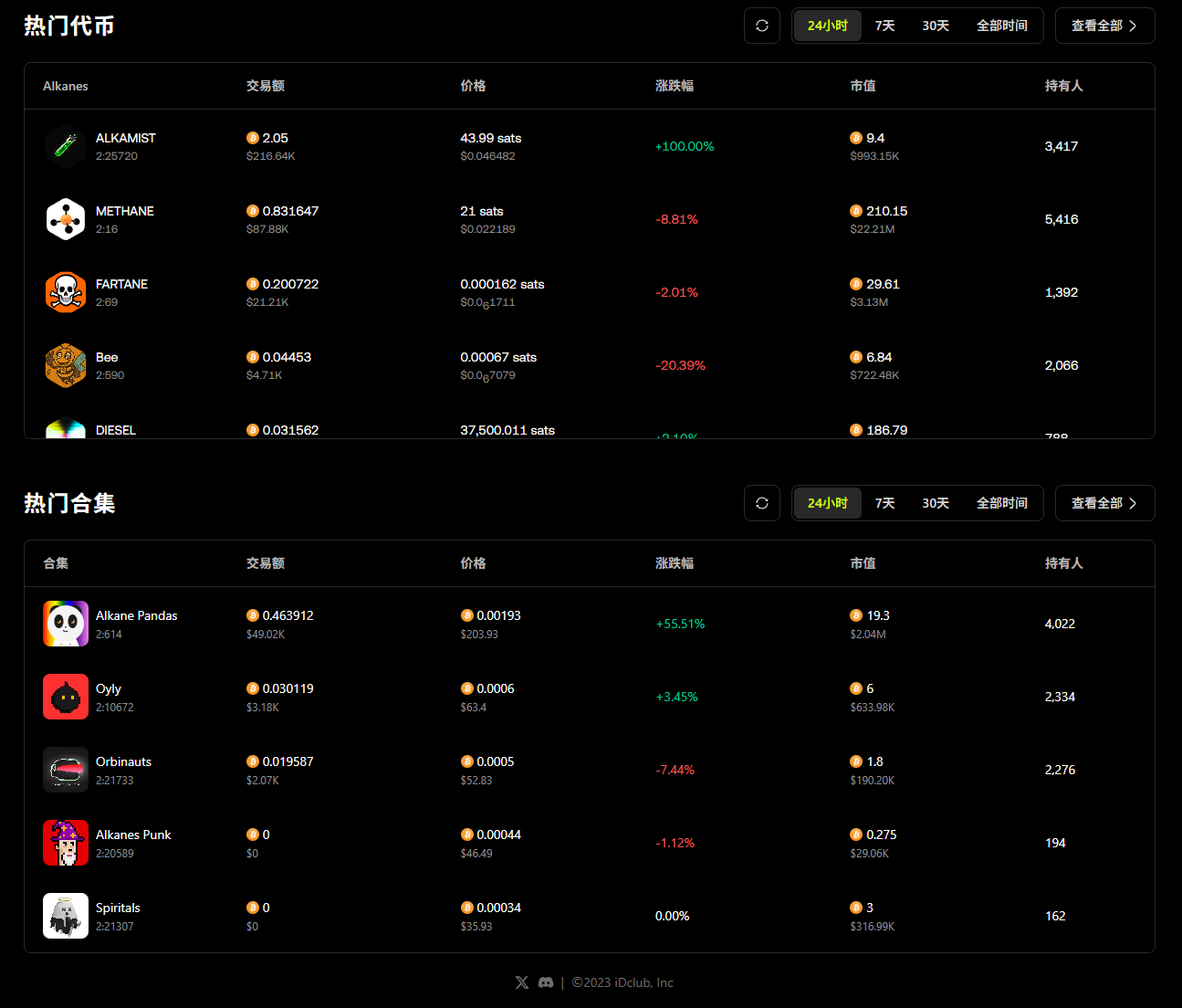
Since its launch in January 2025, Alkanes remained quiet for months before gaining momentum. Data shows that transaction fees generated by exchanges interacting with Alkanes reached 11.5 BTC in just three months from March to May. While this figure still lags behind Runes (41.7 BTC) and BRC-20 (35.2 BTC), it has already significantly surpassed同期 Ordinals NFTs (6.2 BTC), demonstrating strong growth potential.
Alkanes’ true game-changer is its upcoming native AMM DEX. Once live, it will completely transform the trading experience for Bitcoin-native assets. Users will no longer need to manually place orders and wait for counterparty matching. Instead, they can interact directly with smart contract-powered liquidity pools, enabling instant, seamless trades. This is not just a giant leap in user experience—it’s a fundamental functional breakthrough. It means the Bitcoin ecosystem can finally bridge the gap with modern smart contract platforms like Ethereum, laying the groundwork for expressive, native DeFi activities. Alkanes signals the next phase of Bitcoin metaprotocol evolution, shifting the narrative from static "asset issuance" to dynamic "application deployment." Behind the door it opens lies a world full of imagination.
Evolution Never Stops
Bitcoin’s story, from day one, has never been a perfect script written by a single "god," but an evolving epic co-authored by countless developers, miners, and users through debate, compromise, and consensus. From the early "block size wars" to today’s "Inscriptions debate," every major conflict has ultimately served as a catalyst propelling Bitcoin forward. This seemingly modest open letter is yet another pivotal chapter in that ongoing saga.
It reminds us that Bitcoin’s greatest strength isn’t rigid, unchanging code, but the resilience and self-correcting power of its consensus mechanism. A truly decentralized system will eventually find a way to embrace diversity and sustain perpetual growth. From the groundbreaking birth of Ordinals, to Runes’ refined improvements, to Alkanes’ revolutionary stride into the smart contract era—we are witnessing this evolution accelerate before our eyes.
For those following this space, perhaps it’s time to lift our gaze from the price charts and spend more time observing this ancient yet youthful blockchain. Within the seemingly dull code and forum debates, inside new protocols like Alkanes, the seeds of the next paradigm shift are quietly germinating. Bitcoin’s future may be far broader than we ever imagined.
Join TechFlow official community to stay tuned
Telegram:https://t.me/TechFlowDaily
X (Twitter):https://x.com/TechFlowPost
X (Twitter) EN:https://x.com/BlockFlow_News