








Forget about class solidification—the new "Great Divergence" has already arrived
TechFlow Selected TechFlow Selected
Forget about class solidification—the new "Great Divergence" has already arrived
The cost of being in the middle of the middle class has never been so severe.
 Navigating Web3 tides with focused insights
Introduction: "Class solidification," "the underprivileged can hardly rise to prominence," "middle-class regression into poverty"... These phrases permeate the Chinese-speaking world, forming a collective anxiety. We worry about an invisible yet solid starting line and fear the helplessness of a "daddy competition" era.
But what if I told you we might be stockpiling the wrong ammunition for a war that has already ended? While people are still fiercely debating the old world’s “class structure,” a new, AI-driven, more thorough, and far harsher era of the “Great Divergence” has quietly begun.
This time, what determines a person's position is no longer wealth or background, but dimensions of cognition, judgment, and creativity.
Over the past decade, perhaps no topic on the Chinese internet has been as enduring as “class solidification.” Countless articles, discussions, and memes have repeated the same narrative: the ladder of social mobility is narrowing; individual effort pales in comparison to the wealth and resources inherited from previous generations.
From “It took me eighteen years of struggle to sit with you and drink coffee,” to discussions on “Runxue” (the study of emigration), to lamentations over the fragility of the middle class after mass layoffs at big tech firms—this anxiety is real, rooted in the acute pain of competing in a zero-sum game of limited resources.
We seem to have accepted a default premise: the world’s structure is relatively stable, like a pyramid already built, where all we can do is climb within predefined slots, praying not to fall. We calculate how many generations it will take to secure a foothold in a first-tier city; we agonize over how to pave an expensive path to elite education for our children.
Yet we must guard against cognitive inertia—using old maps to navigate a completely new world. Because while we worry about “solidification,” an unprecedented technological force—like magma deep within the Earth’s crust—is gathering energy powerful enough to reshape the entire landscape. That force is artificial intelligence.
AI is not just another “Internet+” trend or another round of technological upgrade. It is a paradigm shift—a catalyst potent enough to dissolve existing social structures. What it is doing is making the very concept of “class” tremble.
The accelerating arrival of a new Great Divergence
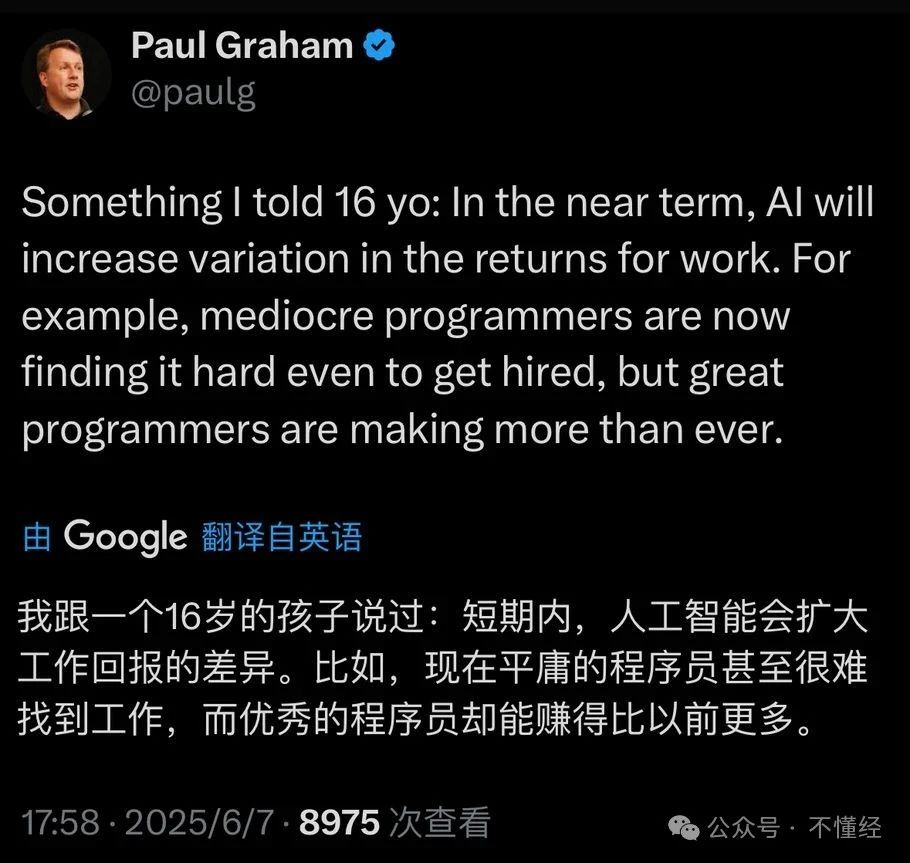 Recently, Silicon Valley venture capital guru Paul Graham posted: "For a period, artificial intelligence will widen the gap in job returns. Average programmers now find it hard even to get jobs, while top-tier programmers earn more than ever."
He also said: "This trend started in the Stone Age. Technological progress always widens disparities in work returns. The bottom earners’ income can drop to zero, while technology enables those at the top to break through limits again and again."
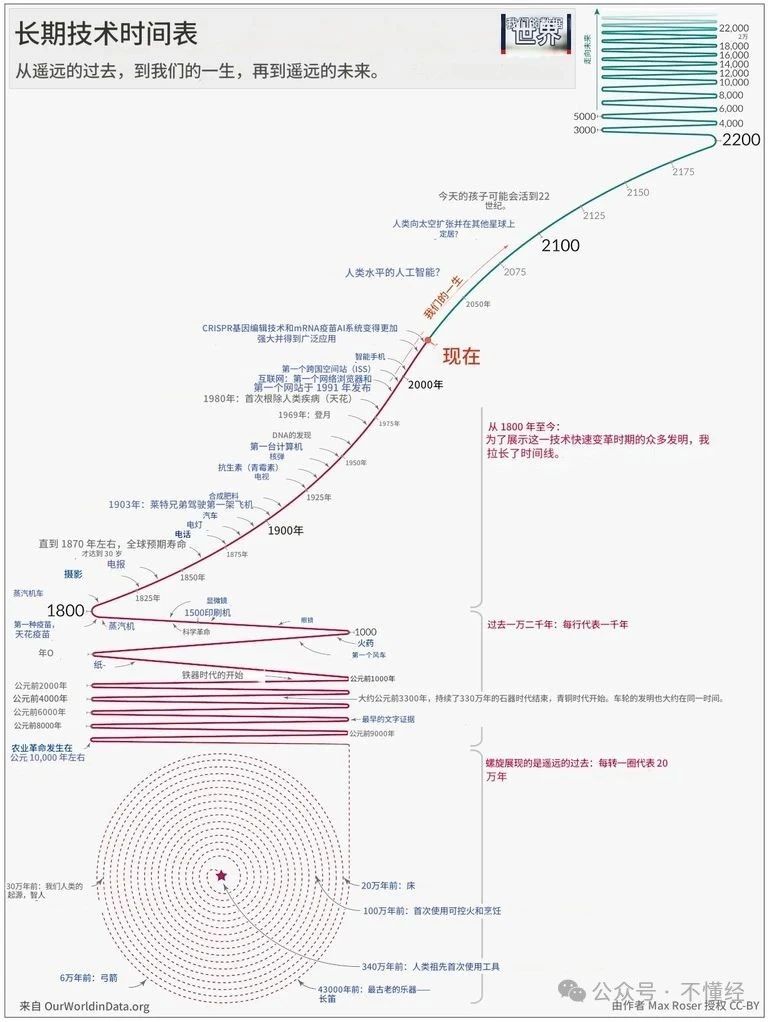
Now look at this timeline depicting human technological development.
Millions of years of near-flat progression, then a slight uptick after the Industrial Revolution, and now, in our current moment, the red line abruptly turns into a vertical cliff. Behind this cliff lies the insane acceleration of technological evolution—transformations that once took a century to digest now iterate in five years, or even one.
This exponential power, forged by the twilight of Moore's Law and the dawn of the Law of Accelerating Returns, renders all attempts at "solidification" futile.
In such a violently changing environment, those seemingly solid "class barriers"—whether based on capital, information asymmetry, or specific licenses—could be shattered overnight. A century-old bank may be disrupted by a financial app built by a few genius programmers using AI; an education conglomerate relying on a massive teaching staff could be challenged by a platform offering personalized AI tutors.
Advantages of the old world are rapidly depreciating. When AI can generate legal documents, business contracts, code, and design blueprints at nearly zero cost, the traditional "middle-class" moats built on licenses and procedural knowledge are instantly flattened.
In the past, wealth could be inherited. But in this age, the ability to understand and harness AI cannot be directly passed down. A second-generation rich kid numb and slow to adapt to the new world may be far less competitive than a small-town test-taker who skillfully wields AI tools.
Thus, the core issue has changed. Our central challenge is no longer climbing within a rigid class system, but navigating a completely new, massive divergence centered around "cognition" and "creation." To understand the rules of this divergence, we should revisit history and listen to a tragic parable about human value amid the roar of steam and steel.
Most people are running a race destined to fail
Let’s consider a classic story set in post-American Civil War America, the 1870s.
It was an era of pioneering spirit and iron will, when vast railway networks were spreading wildly across North America, cutting through mountains and filling valleys. In the rugged hills of West Virginia, a railroad company needed to bore a one-mile-long tunnel known as Big Bend Tunnel.
At that time, mountain excavation relied primarily on manual labor. Workers—mostly recently emancipated African Americans—used heavy steel drills and hammers to chip away at solid rock inch by inch. Among them, the strongest were known as "Steel Drivers."
John Henry was their legend. Said to stand two meters tall with immense strength, he could wield two 14-pound hammers simultaneously, alternating blows with unmatched efficiency and rhythm. His song and hammer strikes formed the most inspiring symphony on the construction site.
But then came the product of the Industrial Revolution—the steam-powered drill. This steel beast consumed coal and water, roared deafeningly, and promised drilling speeds far beyond human capacity. The workers' livelihoods were directly threatened.
To defend human dignity and worth, John Henry challenged the machine. This man-versus-machine contest drew everyone’s attention. In a 35-minute race, the steam drill bored nine feet deep, while John Henry, driven by extraordinary physique and willpower, swung his hammer, drenched in sweat, and astonishingly drilled 14 feet.
The crowd erupted in cheers—John Henry won the race. But as soon as he put down his hammer, his heart burst, and he died from exhaustion. He proved with his life that humans could surpass machines in a short span, yet his death became a cruel allegory: on a track defined by machine efficiency, trying to outperform with flesh and blood is itself a tragedy doomed to fail.
The reason John Henry’s story endures is because it touches an eternal theme: when waves of technology crash ashore, where does the value of ordinary labor lie?
John Henry’s mistake was attempting to compete with the steam engine on its own terms—on the dimension of "strength and endurance," which happened to be the machine’s core advantage. He won a battle but lost the war. History soon showed that future value did not belong to stronger "Steel Drivers," but to those who could design, build, maintain, and operate steam drills.
Those who truly defined the era were not men stronger than John Henry, but those who understood how to design, manufacture, deploy, and leverage steam drills—railroad tycoons, engineers, inventors. They didn’t "race" the machine; they stood on its shoulders, gaining unprecedented leverage to reshape the world.
More than a century later, we all stand at John Henry’s crossroads. Only now, our "steam drill" is the intangible artificial intelligence. What it challenges is not our muscles, but our brains.
Now, look around. Artificial intelligence is our era’s “cognitive steam engine.” It is already, and will increasingly, demonstrate overwhelming superiority in mid-level intellectual labor.
- When AI can generate 100 “acceptable” marketing copies in a minute, a regular copywriter who merely competes on “writing faster and more” becomes a modern-day John Henry.
- When AI can instantly analyze tens of thousands of legal cases and draft summaries, a junior lawyer competing only on “better memory and faster retrieval” is a modern-day John Henry.
- When AI can produce countless “beautiful” designs upon command, a production-line artist competing solely on “more skilled technique” is equally a modern-day John Henry.
Competing with AI on “efficiency” and “standard output” is a dead end. On this track, its progress is exponential—we are not. The essence of this competition is to dehumanize oneself, conforming to machine logic, only to be ruthlessly discarded by the machine.
This is precisely the brutal beginning of the “Great Divergence”: Are you becoming a “better” ox or machine, or are you becoming a “more unique” human being?
The cost of mediocrity has never been higher, but the rewards of excellence have never been greater
AI is turning “average-level” cognitive output into an infinitely replicable, near-zero-cost commodity.
When an AI model can freely provide “70-point” translations, “75-point” designs, and “80-point” code, the value of human-provided “85-point” services plummets. The market no longer pays for “good”—because it’s almost free.
If your skills can be clearly described, quantitatively evaluated, and trained on abundant successful examples accessible to AI, then your abilities lie right on the red line of commoditization. This doesn't just mean lower salaries—it means the erosion of value, the risk of being replaced anytime by an API endpoint.
This is the harshest penalty ever imposed on “averageness.” In the past, occupying the middle ground meant stability. In the future, the middle ground is collapsing.
Yet, while AI crushes “average,” it simultaneously provides an unprecedented amplifier for true “excellence.” To understand how AI fuels this “Great Divergence,” we must introduce another crucial sociological and economic theory: Power Law, also known as Pareto distribution or the 80/20 rule.
Simply put, Power Law describes a "Winner-Take-All" phenomenon. In a system following a power-law distribution, a small number of top individuals capture the vast majority of resources or rewards. For example:
- A few best-selling authors dominate most of the book market’s sales.
- A handful of top celebrities receive nearly all the income and attention in the entertainment industry.
- A few internet giants (like Google, Amazon) capture the lion’s share of market profits.
The emergence of AI is pushing the effect of Power Law to the extreme, transforming the gap between “winners” and “ordinary people” from a crack into a bottomless chasm. There are three reasons:
1. Extreme Scalability: Products of the industrial age, such as cars, face physical constraints in production and distribution. AI-powered software or services, however, have virtually no marginal cost. A top-tier AI translation model serving 1,000 users versus 1 billion users sees negligible increase in core costs.
This means that if an AI product is just 5% better than its competitors, it could rapidly seize 95%, or even 100%, of the market through network effects and data flywheels. The space for second and third place shrinks drastically—or vanishes entirely.
2. Massive Leverage Effect: AI is an unprecedented "capability amplifier." In the past, a top architect’s influence was limited to projects they personally worked on. Today, a leading AI algorithm engineer can create an AI design tool that boosts the productivity of millions of junior designers worldwide tenfold—or replaces them altogether.
This engineer and their small team, wielding AI as a lever, shift the value distribution across an entire industry. The enormous value they create flows back to them in disproportionate measure.
3. The Complete Devaluation of the “Average”: This is the cruelest aspect of the “Great Divergence.” Steam engines in John Henry’s era replaced repetitive physical labor. The previous wave of software and internet automation replaced routine, rule-based mental tasks (e.g., calculations, data entry). Today’s generative AI is conquering “mid-level” cognitive tasks requiring some degree of creativity at an unprecedented pace.
How to achieve excellence and amplify success in the AI era
Excellence here does not mean being “better” than AI on a single dimension, but possessing top-tier human capabilities that AI cannot access.
1. Problem-defining ability and unique insight: AI excels at solving problems, but it cannot identify a “problem worth solving.” In business, science, and art, the ability to penetrate surface appearances—to detect unmet needs, undiscovered patterns, unexpressed emotions—is the origin of all value creation. If you can ask a crucial question that AI cannot answer, your value is infinite.
2. Supreme aesthetic sense, taste, and creativity: AI can mimic Picasso, but it cannot become Picasso. It lacks Picasso’s revolutionary artistic intuition and singular life experience. In content creation, product design, and brand building, the rare ability to lead trends and define “beauty” and “style” will become the scarcest and most valuable asset. Your work becomes priceless because it embodies irreplaceable humanity, emotion, and worldview.
3. Cross-domain integration and systems thinking: AI’s deep learning in vertical domains is astonishing, but innovatively “connecting” knowledge, resources, and talent across different fields to build complex, novel value systems remains the core competency of human entrepreneurs. Can you, like Steve Jobs, seamlessly fuse technology, art, and business into a disruptive product? Such systemic top-level design is beyond AI’s reach.
4. Genuine emotional connection and leadership: AI can simulate conversation, but cannot establish real trust or offer heartfelt inspiration. Leading a team of top talent, unlocking their potential, and uniting them around a shared vision—this leadership grounded in deep empathy and human brilliance will become the core engine driving organizations forward in a human-AI collaborative future.
Individuals possessing these “excellent” capabilities can use AI—an unprecedented lever—to magnify their impact by millions of times. A creator with a unique artistic style can use AI tools to complete in one day an animation project that would have taken a team a year. A researcher with a breakthrough scientific idea can command AI clusters to run hundreds of millions of simulations, validating or refuting theories at unprecedented speed.
This is the return on “excellence”: you are no longer just yourself—you become a “human + AI” superindividual, your thoughts directly transformed into forces that shape the world. This return will no longer be linear, but explosive.
All that is solid melts into air
Let us return to the initial anxiety. Yes, “class solidification” was a real dilemma in the industrial and information ages. But in a future where AI takes over all “routine tasks,” this issue is rapidly becoming obsolete.
The old world’s rule was: where you’re born largely determined how far you could go. The new world’s rule is: how you think determines whether you plummet or ascend in the Great Divergence.
This Great Divergence will mercilessly punish mediocrity and average performance, generously rewarding excellence and distinction; it will punish intellectual laziness and outdated skills, and reward those who embrace change, commit to lifelong learning, and cultivate their unique “humanity.” It offers everyone a chance to re-choose their “starting line.”
This new starting line isn’t in your parents’ bank account, nor in the location of your school district home, not even in which prestigious university you graduated from. It exists every morning, the moment you unlock your phone or turn on your computer:
Will you choose to use AI to kill time, complete repetitive tasks, and turn yourself into a more efficient “gear”? Or will you leverage AI to learn new knowledge, explore the unknown, and create unprecedented things—making yourself the unique “engine”?
Forget about class solidification. That wall we once desperately tried to climb may already be dissolving in the tide of history. What truly decides the future is the clearer, steeper fork in the road ahead of you.
Will you keep staring anxiously at the crumbling wall of the old world, or will you turn around, face the stormy waves of AI, and begin learning how to build your own ark? 【Understood】
Join TechFlow official community to stay tuned
Telegram:https://t.me/TechFlowDaily
X (Twitter):https://x.com/TechFlowPost
X (Twitter) EN:https://x.com/BlockFlow_News


