
Bitcoin's "100,000 USD Dilemma": A Comprehensive Perspective on Market Undercurrents, Institutional Ambitions, and Macro Variables Amid Bull-Bear Confrontation
TechFlow Selected TechFlow Selected
Bitcoin's "100,000 USD Dilemma": A Comprehensive Perspective on Market Undercurrents, Institutional Ambitions, and Macro Variables Amid Bull-Bear Confrontation
Institutional funds continue to flow in, driving the market, but retail investors remain cautious.
 Navigating Web3 tides with focused insights
Author: White55, Mars Finance
1. Price Stalemate: The Dual Battle Between Technicals and Market Sentiment
(1) The $110,000 "Psychological Curse": Misalignment Between Historical Highs and Market Expectations
After Bitcoin broke through $100,000 in April 2025, it entered a new bullish cycle, briefly reaching a record high of $111,957 in mid-May. However, since then, prices have oscillated within the $105,000–$112,000 range without achieving a decisive breakout. This contrasts sharply with the rapid price surge seen when Bitcoin surpassed $100,000 in December 2024, reflecting the market's current complex contradictions.
On the technical side, Bitcoin’s weekly RSI has entered overbought territory, while the MACD histogram continues to narrow, indicating weakening upward momentum in the short term. On-chain data shows that the holdings of long-term holders (LTH) have declined from 76% at the beginning of the year to 72%, as some “old miners” and early investors begin taking profits, leading to increased net inflows into exchanges. This token distribution shift resembles patterns observed during the late stages of the 2021 bull market.
However, derivatives markets are signaling something different. As of May 26, the annualized basis rate for Bitcoin futures stood at 8%, far below the 20% extreme seen during the $100,000 breakout in December 2024, suggesting leveraged long positions are not excessively aggressive. Meanwhile, the options market’s Delta skew index (-6%) indicates put options are trading at a discount—a hallmark of bullish market structure, contrasting with the +15% skew observed during the bear market in 2024.
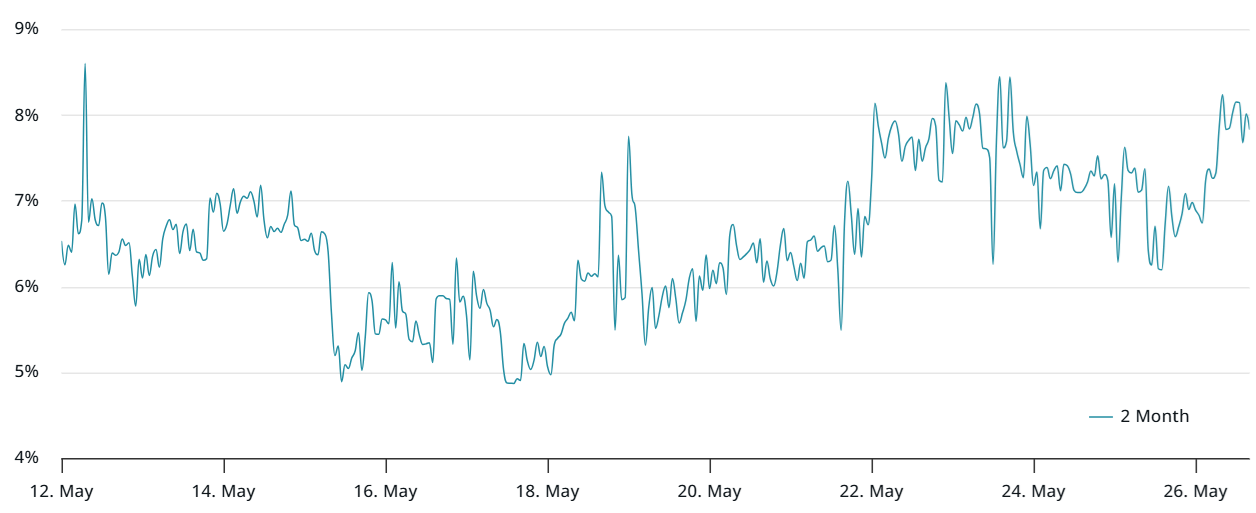 Figure 1: Two-month annualized Bitcoin futures basis rate.
(2) Market Sentiment in "Hot and Cold": Institutional Inflows vs. Retail Caution
Institutional capital inflows continue to serve as the core support for the market. Data shows that during the week of May 19–25, net inflows into U.S. spot Bitcoin ETFs reached $2.75 billion, marking the highest weekly inflow since December 2024 when Trump won the election. BlackRock’s IBIT and Fidelity’s FBTC alone accounted for 80% of this volume, highlighting how traditional asset managers are becoming dominant players in Bitcoin price discovery.
Notably, on May 19, JPMorgan announced it would allow clients to purchase spot Bitcoin ETFs through brokerage accounts. While this does not involve direct custody services, it opens a potential gateway for its $6 trillion in client deposits, potentially triggering a "catfish effect"—prompting other institutions like Goldman Sachs and Citigroup to follow suit to remain competitive.
In contrast, retail investors remain cautious. The Crypto Fear & Greed Index dropped from 78 ("extreme greed") in early May to 65 ("greed"), while Google searches for "Bitcoin bubble" surged 320% year-on-year. This divergence reflects ordinary investors’ anxiety about prolonged price consolidation, contrasting sharply with institutions’ "buy-the-dip" strategy.
2. Macro Variables: The Trio of Trump Policies, Fed Pivot, and Tech Stock Correlation
(1) Trump’s "Tariff Game": How Geopolitics Is Reshaping Crypto Pricing Logic
On May 26, Trump announced a delay in imposing 50% tariffs on EU imports until July 9. While this decision appears to ease trade war tensions, it masks deeper political maneuvering. Historical data shows that tariff policies under Trump have been highly volatile—for example, his surprise announcement in February 2025 imposing 25% tariffs on EU cars triggered a 12% single-day drop in Bitcoin.

The market is now more focused on progress regarding his cryptocurrency strategic reserve plan. Although the March White House summit only proposed a stablecoin regulatory framework, Senator Lummis’s draft National Bitcoin Reserve Act has entered the legislative process. The bill mandates the U.S. Treasury to purchase 5% of Bitcoin’s circulating supply (approximately 1.05 million BTC) over five years—potentially creating nearly $1 trillion in direct demand if enacted.
(2) The Fed’s "Inflation Puzzle": PCE Data as a Potential Breakout Catalyst
The market is highly sensitive to the PCE inflation data released on May 30. Current CME interest rate futures indicate a 68% probability of a 25-basis-point rate cut by the Fed in June. However, if core PCE inflation exceeds 2.9% (previous: 2.8%), it could reverse dovish expectations. Notably, Bitcoin’s 90-day correlation with the Nasdaq Composite has dropped from 0.75 at the start of the year to 0.32, suggesting it is decoupling from traditional risk assets and aligning more closely with the "digital gold" narrative.
(3) Nvidia Earnings’ "Butterfly Effect": The Hidden Link Between AI Compute Revolution and Crypto Markets
Nvidia will release its quarterly earnings on May 28, and its performance may impact Bitcoin through two channels:
-
Compute competition: If demand for next-generation AI chips exceeds expectations, GPU prices could rise, indirectly increasing Bitcoin mining hardware upgrade costs and squeezing miner profit margins;
-
Capital diversion: If tech stocks rally on positive earnings, they may draw capital away from crypto markets, exacerbating Bitcoin’s short-term volatility.
3. Institutional Battles: MicroStrategy’s "Hodl Economics" and the Evolution of the ETF Ecosystem
(1) MicroStrategy’s "Extreme Move": Strategic Ambition Behind Balance Sheet Restructuring
Michael Saylor’s MicroStrategy added 4,018 Bitcoin at an average price of $106,237 between May 19 and 25, bringing its total holdings to 324,000 BTC (worth approximately $34.5 billion). Intriguingly, the coupon rate on its convertible bonds has surged from 0.625% in 2024 to 6.25%, reflecting shifting market perceptions of risk around its aggressive strategy.
This "debt-fueled hodling" model is gaining traction. Data shows that as of May, 17 S&P 500 companies have publicly disclosed Bitcoin holdings totaling $48.7 billion. Companies like Tesla and Block are even exploring using Bitcoin for supply chain payments, pushing its evolution from a store of value toward a medium of exchange.
(2) The ETF Ecosystem’s "Matthew Effect": Market Restructuring Under the BlackRock-Fidelity Duopoly
Since their approval in January 2024, U.S. spot Bitcoin ETFs have surpassed $120 billion in total assets under management (AUM). BlackRock’s IBIT ($48.6B) and Fidelity’s FBTC ($39.2B) together control 72% of the market, forming an absolute duopoly. This concentration may trigger regulatory scrutiny—SEC is reportedly considering new rules requiring ETF issuers to disclose custodial addresses and implement on-chain verification mechanisms for "reserve transparency."
A deeper implication is that ETFs are altering Bitcoin’s volatility profile. Based on daily net inflow/outflow data, ETF flows now explain 38% of Bitcoin’s price movements, meaning traditional financial market hours (9:30–16:00 ET) are becoming the primary battleground for price action—contradicting Bitcoin’s original "decentralized," 24/7 trading nature.
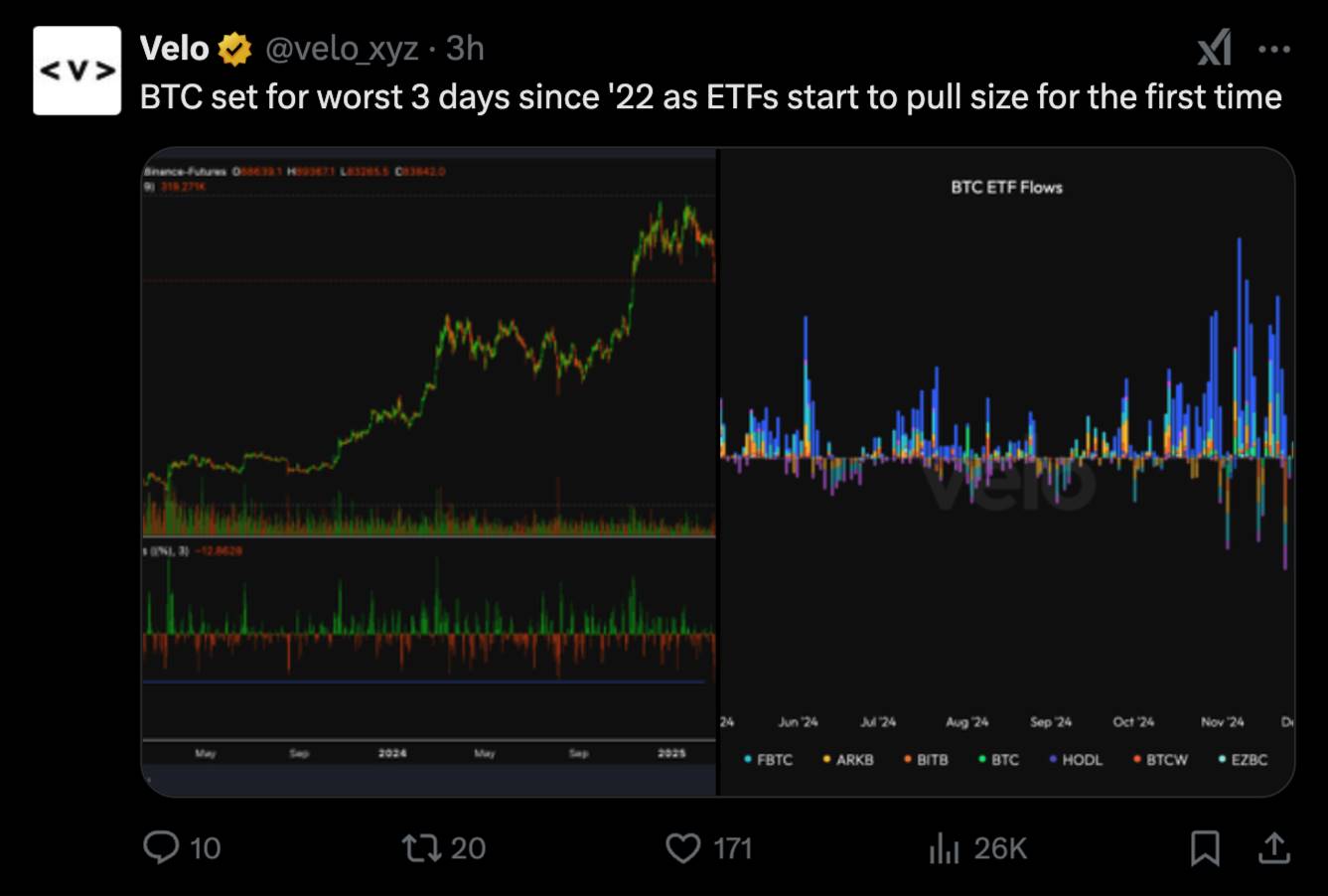 Figure 3: Bitcoin price declines following outflows from spot Bitcoin ETFs
4. Technological Revolution: Layer2 Ecosystem Boom and the Feasibility Test of "Bitcoin Standard"
(1) Lightning Network 2.0: The "Singularity Moment" in Payments
Lightning Network’s upgraded version (LN2.0), a Bitcoin Layer2 solution, achieved major breakthroughs in May:
-
Channel capacity exceeded 8,000 BTC, up 320% year-on-year;
-
Support for Atomic Multipath Payments (AMP), increasing single transaction capacity to 0.1 BTC;
-
Pilot cross-border remittance program with Visa, reducing fees to under 0.3%.
These developments are expanding Bitcoin’s utility. The Salvadoran government announced that 20% of civil servant salaries will be paid via the Lightning Network, while Amazon Mexico now accepts Bitcoin Lightning payments. If this dual function of "small, frequent payments + value storage" solidifies, Bitcoin could genuinely challenge traditional payment giants like Visa and PayPal.
(2) RGB Protocol’s "Smart Contract Breakthrough": The Silent War Against Ethereum
The RGB protocol, built on Bitcoin’s UTXO model, completed its v0.5 upgrade in May, achieving Turing-complete smart contract functionality for the first time. Though still small in scale (total value locked: $120 million), its client-side validation and off-chain computation architecture offer unique advantages in privacy and scalability. Notably, MakerDAO founder Rune Christensen has announced plans to explore transferring part of DAI’s reserves into the RGB protocol—an event that could mark a turning point for DeFi capital flowing back into the Bitcoin ecosystem.
5. Future Scenario Analysis: Three Paths for Bitcoin’s Fate
(1) Bull Market Scenario (Year-end 2025 Target: $180,000–$250,000)
Trigger conditions:
-
U.S. PCE inflation falls below 2.6%, prompting Fed rate cuts in June;
-
National Bitcoin Reserve Act passes, launching monthly Treasury purchases;
-
Bitcoin Layer2 ecosystems surpass $10 billion in total value locked, with over 50 million users in payment applications;
-
Technical pattern: Weekly chart forms a "cup-with-handle" pattern, accelerating after breaking above $112,000, replicating the momentum seen during the $100,000 breakout in December 2024.
(2) Sideways Scenario (Price Range: $100,000–$140,000)
Key variables:
-
Nvidia earnings reveal weak AI chip demand, dragging down tech stocks and risk assets;
-
Trump’s inconsistent tariff policies reignite market risk aversion;
-
ETF inflows slow to under $1 billion per week;
-
Market traits: Increased selling pressure from miners, extended mining difficulty adjustment cycles, persistently low derivative funding rates.
(3) Bear Market Scenario (Pullback Target: $74,000–$85,000)
Risk catalysts:
-
U.S. SEC launches surprise investigation into ETF custodial reserves, triggering trust crisis;
-
Escalating Middle East conflicts drive oil prices higher, reversing global inflation expectations;
-
Breakthroughs in quantum computing raise concerns about Bitcoin’s cryptographic security;
-
On-chain signals: Exchange net inflows exceed 50,000 BTC for three consecutive weeks; long-term holder supply drops below 70%.
Conclusion: Finding Certainty Amid Uncertainty
Bitcoin’s struggle around $110,000 is essentially a microcosm of the clash between old and new financial orders. From Trump’s tariff maneuvers to MicroStrategy’s balance sheet revolution, from Lightning Network’s payment penetration to ETF-driven institutionalization, multiple forces are reshaping the economic significance of this experiment. History shows that whenever media headlines proclaim Bitcoin’s "death," it often marks a prime opportunity for long-term investors to build positions contrarily. When the market loses direction amid noise, perhaps we should return to Satoshi Nakamoto’s original vision—a "pure peer-to-peer electronic cash system." In this sense, 2025’s price fluctuations are merely footnotes to a grand social experiment, with the real revolution already quietly growing within code and consensus.
Join TechFlow official community to stay tuned
Telegram:https://t.me/TechFlowDaily
X (Twitter):https://x.com/TechFlowPost
X (Twitter) EN:https://x.com/BlockFlow_News