Deep Dive into AI Agents: Where Do We Go After the Hype?
TechFlow Selected TechFlow Selected
Deep Dive into AI Agents: Where Do We Go After the Hype?
The future of agent innovation requires not only intelligence but also substantial infrastructure and trust.
 Navigating Web3 tides with focused insights
Author: Outlier Ventures
Translation: Felix, PANews
The accelerating convergence of AI and decentralized technological infrastructure is fundamentally transforming the entire internet landscape.
This powerful synergy is giving rise to a new era where autonomous AI agents are no longer just a futuristic concept but an imminent reality, redefining how we interact with the internet and conduct economic activities.
Yet hype around agents is everywhere today—the real question is: where do we go from here?
Agents as a New Interface Designed for Delegation
These intelligent systems can interpret user intent and execute complex tasks with minimal human intervention, marking a significant shift that unlocks vast possibilities for innovation across industries. The "The Post Web" research framework and its vision for the evolution of current web paradigms provide critical context for understanding and leveraging the rapidly evolving AI agent landscape.
At the core of this thesis lies delegation. Instead of manually clicking and browsing the web, users delegate their intent to AI agents, which then act on their behalf across services, infrastructures, and markets.
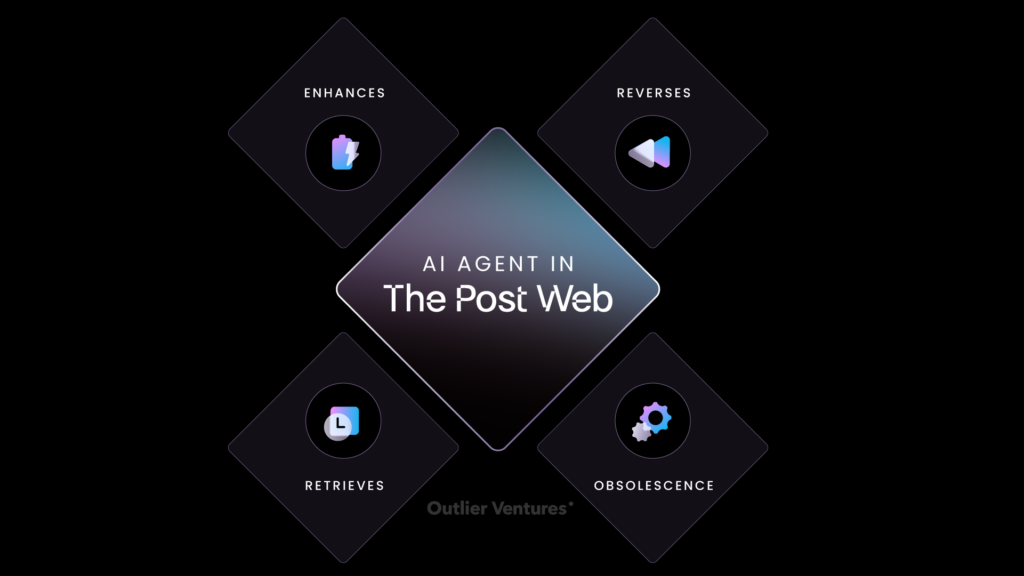
This shift opens immense opportunities—starting with the tools and infrastructure needed to power agent systems. We expect strong demand for:
-
Agent software development kits and training frameworks
-
Orchestration layers for multi-agent coordination
-
Secure deployment environments
-
Tools for defining, verifying, and monitoring agent behavior
-
As the number and diversity of agents grow, so does the need for systems capable of managing complexity and ensuring trust
Building Trust in Autonomous Agents
The successful adoption of autonomous agents hinges on establishing unwavering trust. This requires developing robust security protocols and transparent verification mechanisms, potentially leveraging the immutable nature of distributed ledger technology (DLT) to ensure agents act according to user intent and effectively mitigate risks of malicious behavior. On-chain verification of agent actions will enable:
-
Transparent audit trails
-
Cryptographic assurance of compliance
-
Mitigation of malicious behavior
-
Agent reputation and accountability
The intention economy relies on these mechanisms, as trust is key to achieving scale.
The Rise of Specialized AI Agents
In the envisioned intention economy, the internet will be optimized around fulfilling user intent, driving massive demand for specialized AI agents tailored to specific needs and use cases.
-
Personal delegation agents: handling everything from scheduling to finances
-
Financial agents: executing decentralized finance transactions and managing digital assets
-
Data and research agents: gathering and curating high-quality data
-
DAO governance agents: participating in voting and decentralized decision-making
Each specialization creates new opportunities for entrepreneurs.
The Agent Stack
Agents don’t appear out of thin air. They require a full ecosystem to operate, evolve, and unlock real economic value. For entrepreneurs, this is the true frontier: building the tools and tooling for the agent economy. Here are some of the biggest opportunities:
Agent Marketplaces and Reputation Systems
The rise of AI agents will create a Wild West of online services—not every agent will be trustworthy.
Founders who build platforms where users can discover, verify, and deploy reliable agents will gain a major first-mover advantage. Imagine an “app store” built specifically for autonomous agents:
-
Comparing actual agent performance (speed, success rate, security), not just what they claim
-
On-chain reputations that prove long-term agent performance, making it easy to identify reliable versus high-risk services
-
Smart matching engines that connect users with the right agents for their task in real time
Trust is paramount—marketplaces that can verify it will win.
Personalized Interfaces and the Role of the "Thin Web"
Even in an agent-driven world, humans still crave interaction. This creates huge demand for dynamic, personalized interfaces that adapt in real time to user intent, preferences, and needs.
Enter the "Thin Web": unique interfaces generated instantly by AI agents, customized for each individual user.
Imagine shopping experiences like personal consultations, games that adapt in real time to player styles, or social apps that surface connections or communities based on deeper signals of intent.
Entrepreneurs building these human-centered layers atop agent infrastructure will shape the emotional and social fabric of the new era.
Infrastructure Behind the Agents
Agents require resources to operate: compute, storage, bandwidth, and identity. Centralized solutions face scalability and trust bottlenecks—this is where DePIN comes in:
-
Distributed computing for agent training and inference.
-
Decentralized storage for agent memory and data persistence.
-
Ubiquitous, resilient connectivity layers for inter-agent coordination.
Building APIs, smart contracts, and dApps that allow agents to autonomously and securely access decentralized infrastructure represents a vast open design space. Smart entrepreneurs are already getting started.
Together, these layers form the new digital backbone—the unseen engine room of the agent economy. Building for this stack is not just a technical challenge, but a once-in-a-decade opportunity to lay the foundation for the future web and define a new era of living.
What’s Next for Agent Innovation?
Unlocking the full potential of AI agents depends on continuous advancements in their core capabilities.
Progress in learning paradigms such as reinforcement learning (RL) and retrieval-augmented generation (RAG) will drive improvements in decision-making, contextual awareness, and reasoning. As agents begin collaborating to solve complex problems, secure and efficient inter-agent communication and coordination protocols will become essential, fueling the emergence of sophisticated multi-agent systems.
But innovation cannot happen in isolation. Solving foundational challenges will unlock entirely new frontiers.
First, digital identity and reputation systems for agents must be built from the ground up to ensure accountability and foster trust. As agents become embedded in areas ranging from personal finance to enterprise operations, clear governance frameworks will be crucial to prevent misuse and protect users.
Meanwhile, breakthroughs in privacy-enhancing technologies (PETs) and secure communication protocols are vital for enabling delegation of sensitive tasks without exposing user data.
The future of agent innovation demands not just intelligence, but substantial infrastructure and trust. Those who build the tools, systems, and standards for this emerging layer will not only shape the future of AI, but the future of life itself.
Join TechFlow official community to stay tuned
Telegram:https://t.me/TechFlowDaily
X (Twitter):https://x.com/TechFlowPost
X (Twitter) EN:https://x.com/BlockFlow_News
 Outlier Ventures