









With the tariff suspension window opening, can the crypto market finally clear the clouds and see the sun?
TechFlow Selected TechFlow Selected
With the tariff suspension window opening, can the crypto market finally clear the clouds and see the sun?
The market is in turmoil as it swings with Trump's banner.
 Navigating Web3 tides with focused insights
Author: Pzai, Foresight News
The market is rocking as Trump waves his tariff flag.
On April 9, after Trump announced a 90-day suspension of tariffs on other countries and reduced reciprocal tariffs to 10%, the crypto market reacted swiftly, with major assets broadly rising. Meanwhile, with the U.S. Senate confirming Paul Atkins as the new SEC chair, and Commodity Futures Trading Commission (CFTC) acting chair Caroline D. Pham stating that the agency will no longer bring enforcement actions against registration violations related to digital assets, the future of America’s crypto market is becoming increasingly clear.
Market Sentiment Overview
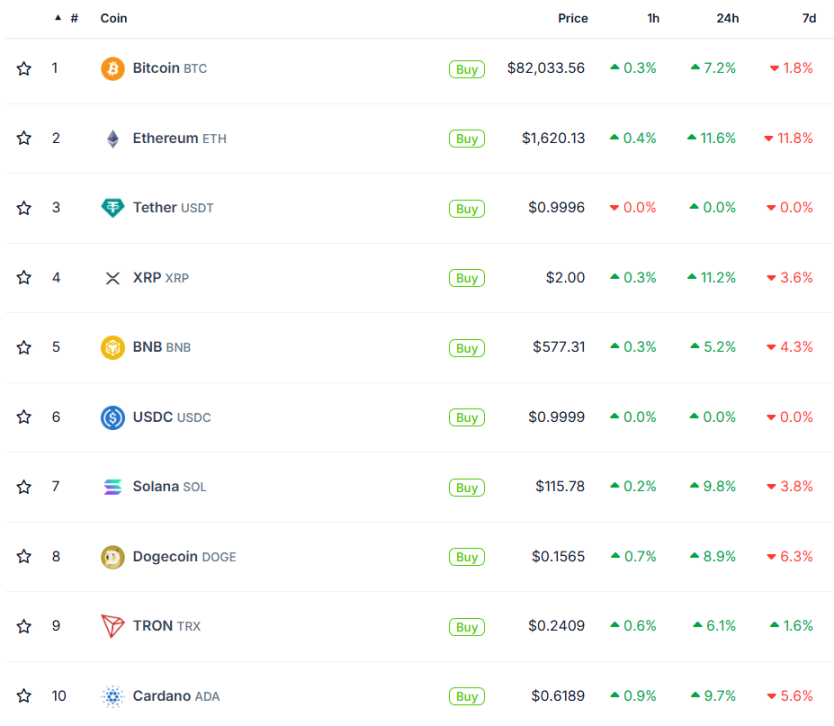
Among major assets, the top ten cryptocurrencies all posted single-day gains exceeding 5%, partially recovering from earlier weekly losses. Bitcoin rebounded to the $82,000 level, while Ethereum climbed back above $1,600. Although it remains unclear exactly which countries are exempted from tariffs or whether Trump still plans to significantly escalate the trade war, crypto assets have benefited from expectations of a "cooling trade war" combined with regulatory easing. This surge in short-term positive sentiment has allowed the market to effectively recover from prior pessimism.
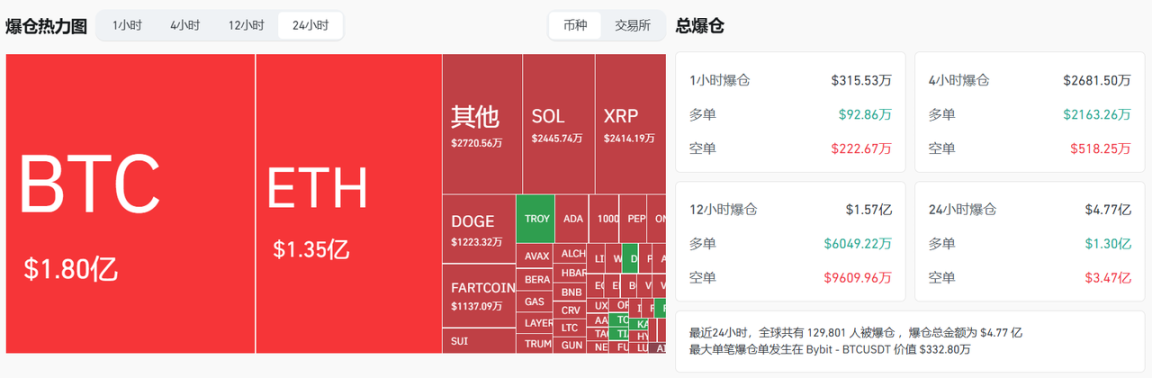
Amid such volatility, Coinglass data shows $477 million in liquidations across the market in the past 24 hours, including $130 million in long positions and $347 million in short positions. Bitcoin accounted for $180 million in liquidations, while Ethereum saw $135 million. In this environment, Bitwise Chief Investment Officer Matt Hougan said, “Bitcoin bulls should be inspired by its performance… Once market volatility settles, we’ll see it return to new highs—and beyond.”
Tariff Suspension Expected—How Is the Market Reacting?
With the delay in tariff implementation, multiple scenarios are emerging. On the macro front, markets had already priced in potential Fed rate cuts in the second half of 2025. However, Fed analysts suggest that if the tariff pause persists, inflationary pressures would ease, though the threshold for rate cuts remains high. If Trump extends the tariff suspension within 90 days or announces exemptions for more countries (such as Europe, Japan, and South Korea), global trade tensions could further subside. Combined with regulatory relaxation and capital repatriation expectations, this could help sustain strength in the crypto market. Yet following China’s retaliatory tariffs, Trump explicitly raised tariffs on Chinese goods to 125%, reigniting concerns over a new round of Sino-U.S. trade friction and lifting global risk aversion. Rising global safe-haven demand may pressure risk assets—including cryptocurrencies—in the near term.
Most analysts believe that if the tariff pause significantly reduces imported inflation, the Fed might relatively delay rate cuts over the medium to long term. Conversely, if global trade tensions persist or escalate further, risk assets could face greater downward pressure in the short run, placing the Fed in a more complex monetary policy dilemma. Given internal divisions within the U.S. over tariff policy, repeated policy shifts are likely, potentially causing continued market volatility. Going forward, investors should closely monitor the Fed's monetary policy trajectory—particularly the June and September FOMC meetings. If market expectations gradually shift toward a “dovish-to-neutral” stance, the recent recovery in crypto markets may continue. But if conditions worsen and the Fed turns more hawkish, pressure on risk assets could quickly accumulate.
Multiple Agencies Advance Compliance—Crypto Stocks Rebound Strongly
Even amid market fluctuations, progress on regulatory compliance in the U.S. crypto market continues steadily.
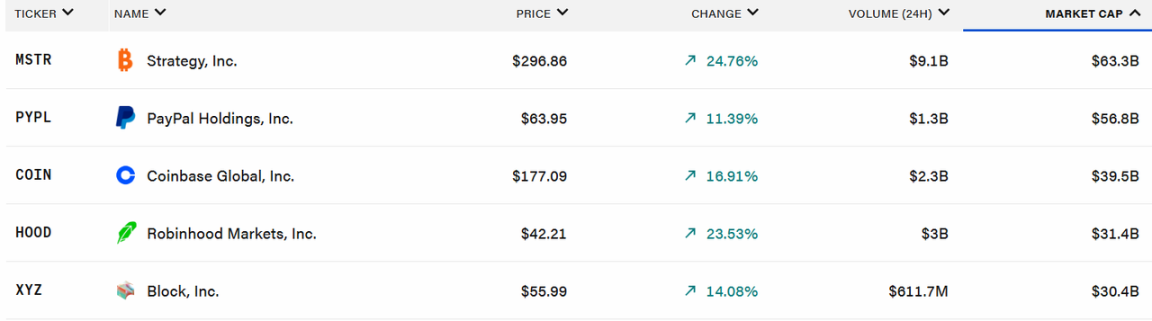
On April 8, according to Fortune magazine, Deputy Attorney General Todd Blanche ordered the immediate shutdown of the Justice Department’s National Cryptocurrency Enforcement Team (NCET), established in 2021 and responsible for landmark cases including Tornado Cash and the Mango Markets exploit. Blanche stated that the previous administration used the Justice Department with a "reckless strategy," over-regulating the crypto industry through aggressive enforcement. On the same day, CFTC acting chair Caroline D. Pham echoed the DOJ’s move, announcing the agency will no longer pursue litigation over registration violations involving digital assets and launching an initiative to quickly resolve backlogged compliance issues. These regulatory developments, combined with favorable tariff news from Trump, fueled a strong rebound in crypto stocks on April 9. MSTR rose to nearly $300, closing at $296.86—a single-day gain of 24.76%.
At the March 2025 Senate Banking Committee hearing, newly confirmed SEC Chair Paul Atkins testified that establishing a regulatory framework for digital assets would be his “top priority,” emphasizing the urgency of creating clear digital asset rules, with momentum building behind bills like FIT 21. While bipartisan progress has been made, some Democrats criticized the Justice Department’s retreat from crypto enforcement due to the complexity of oversight, expressing concern over who will regulate the space and whether outdated legal frameworks remain applicable. When regulatory policies become clearer and more consistent, market uncertainty declines significantly. Recent compliance moves send a signal—the U.S. regulatory apparatus is actively building a long-term management mechanism for digital assets. For investors focused on compliance and regulation, this helps reduce volatility risks stemming from “regulatory vacuums.” Companies that have long faced high compliance costs and legal risks may now gain greater room for growth.
In an era of Trump’s deepening engagement with crypto, these regulatory relaxations are not isolated events but key components of America’s “crypto national strategy”—the Justice Department stepping back to relieve industry burdens, the CFTC adopting softer enforcement to expand market participation, and the SEC establishing rules to attract mainstream capital. The coordination among these agencies reflects a U.S. effort to build a three-pronged crypto market system centered on “regulatory friendliness, market scale, and strategic reserves.” As this system deepens, we have good reason to believe that the crypto market is gradually drawing in more investors.
Join TechFlow official community to stay tuned
Telegram:https://t.me/TechFlowDaily
X (Twitter):https://x.com/TechFlowPost
X (Twitter) EN:https://x.com/BlockFlow_News
 Foresight News






