OpenAI's New Rising Star Pluralis: This All-Ph.D. Team Is No Ordinary Crew
TechFlow Selected TechFlow Selected
OpenAI's New Rising Star Pluralis: This All-Ph.D. Team Is No Ordinary Crew
All-PhD team, all members except interns from Amazon—what's special about the open AI project Pluralis?
 Navigating Web3 tides with focused insights
Today, AI technology continues to break new ground, and innovations in AI training paradigms are becoming increasingly profound. In this wave, the monopolistic risks of centralized models and the lack of incentive mechanisms for open-source models urgently demand better solutions.
Against this backdrop, the Pluralis project has emerged. The team consists entirely of PhDs, all from Amazon except for an intern. This article introduces Pluralis’ core technical vision, team composition, funding status, and its innovative protocol learning training paradigm in the field of decentralized AI training.
What is Pluralis?
Pluralis Research is dedicated to building a decentralized, open-source AI development model through "protocol learning." This approach aggregates computing resources from multiple parties in a decentralized manner to collaboratively train models, while ensuring that no single participant can obtain the complete model weights.
The core innovation of Pluralis' protocol learning lies in the protocol model, which leverages a key property of neural networks: no individual participant can extract its full set of weights. This design ensures value flows back to contributors while protecting model ownership, effectively balancing openness and monetization needs in AI development.
Within Pluralis, model designers can propose their architectural ideas, while compute and data providers contribute the resources needed for training. These protocol models are open, developed publicly, and grant participants partial ownership of the trained model—effectively incentivizing contributions and advancing toward the goal of truly open-source artificial intelligence.
Pluralis Background
The Pluralis team is highly accomplished. Among the eight members listed on the official website, all except one intern previously worked at Amazon's AI research division, and every member holds a PhD.
-
Founder Alexander Long: Holds a PhD in Computer Science from the University of New South Wales. He worked as an Applied Scientist at Amazon from March 2021 to May 2024. His doctoral research focused on sample-efficient reinforcement learning and non-parametric memory in deep learning.
-
Founding Scientist Gil Avraham: Holds a PhD in Machine Learning from Monash University, Australia. He served as an Applied Scientist at Amazon from December 2021 to August 2024, later promoted to Senior Applied Scientist, and joined Pluralis in October 2024.
-
Founding Scientist Yan Zuo: Holds a PhD in Electrical and Electronic Engineering from Monash University, Australia. His interests include large-scale optimization, statistical modeling, machine learning, and computer vision. He worked as an Applied Scientist at Amazon from August 2021 to October 2024.
-
Founding Scientist Ajanthan Thalaiyasingam: Holds a PhD in Computer Science from the Australian National University. He was a Machine Learning Scientist at Amazon from December 2020 to March 2024, later promoted to Senior Machine Learning Scientist, and joined Pluralis in October 2024.
-
Founding Scientist Sameera Ramasinghe: Holds a PhD in Machine Learning and 3D Vision from the Australian National University. He is also co-founder and CTO of AI company ConscientAI, and served as an Applied Scientist at Amazon from May 2022 to November 2024.
It is evident that Pluralis’ founders, founding scientists, and research scientists all have backgrounds at Amazon, with expertise spanning machine learning, computer vision, and large language models (LLMs). Some team members have also held postdoctoral researcher positions.
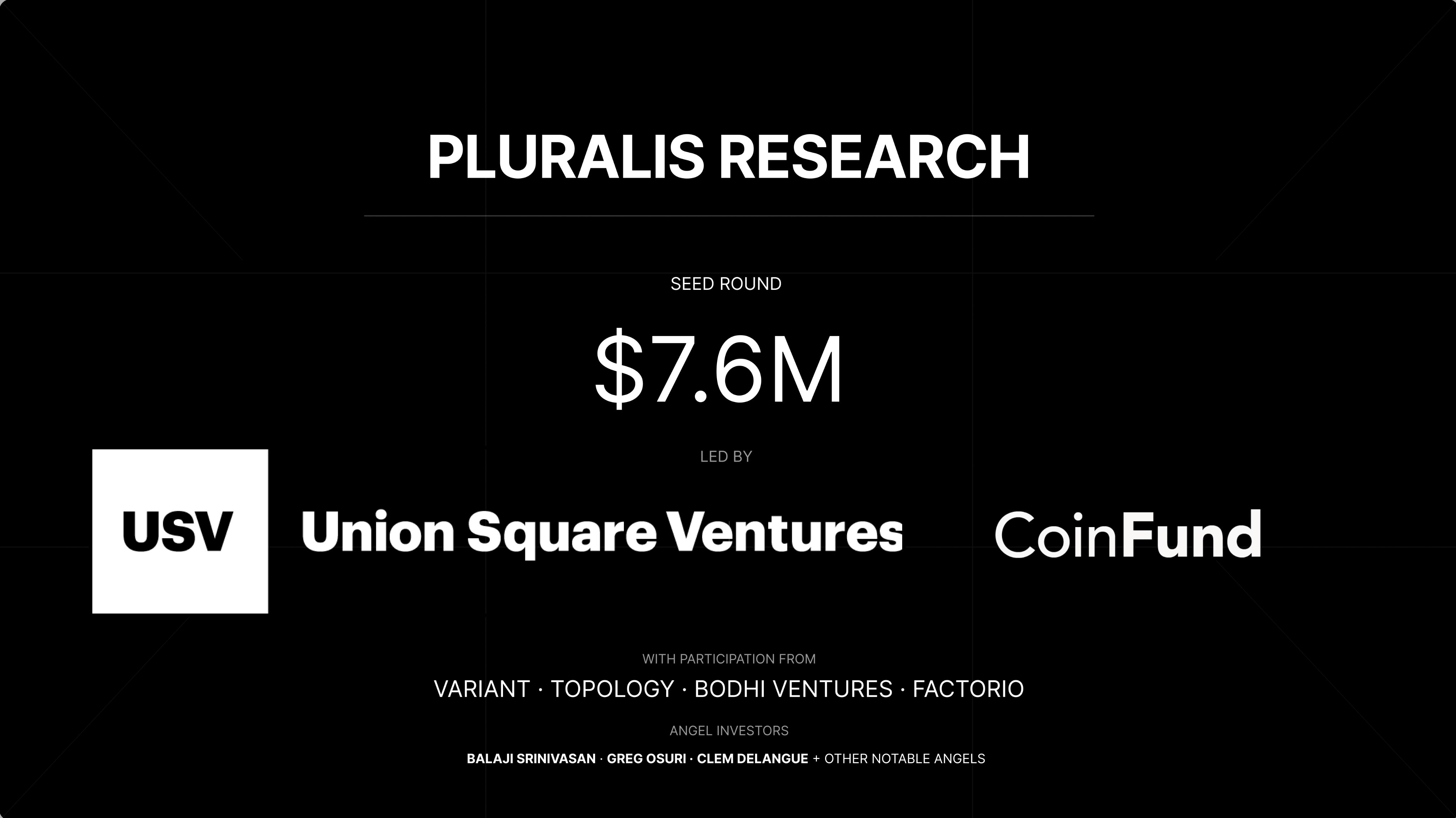
In terms of funding, Pluralis raised $7.6 million in March 2025. The round was led by CoinFund and Union Square Ventures, with participation from Topology, Variant, Eden Block, and Bodhi Ventures. The financing was structured as equity investment, accompanied by warrants for future cryptocurrency tokens.
What is Protocol Learning?
In his paper titled "Protocol Learning, Decentralized Frontier Risk and the No-Off Problem," Alexander Long introduced a novel AI model training paradigm—protocol learning. Its goal is to leverage a decentralized incentive network to collaboratively train models, overcoming limitations of current centralized and open-source approaches.
Alexander Long points out that while centralized models are efficient, they carry monopolistic risks and suffer from opaque governance. Open-source models, on the other hand, lack sustainable incentive mechanisms. Protocol learning serves as a middle ground—by incentivizing participants to contribute computing resources, it builds a decentralized training network capable, in theory, of aggregating orders of magnitude more computational power than centralized training.
From a technical feasibility standpoint, decentralized training must meet requirements such as efficient communication, model sharding, elastic training, Byzantine fault tolerance, and support for heterogeneous nodes. While progress has been made in distributed training, pipeline parallelism, and fault-tolerant mechanisms, these have not yet been fully integrated into large-scale models (100B+ parameters). Furthermore, allocating ownership based on computational contribution creates economic incentives, but challenges remain in verifying computation—potentially addressed via techniques like game-theoretic staking or zero-knowledge proofs.
Of course, protocol learning also introduces new risks. Decentralized models cannot be unilaterally terminated; if a model becomes uncontrollable or misused, halting it would require coordination across the entire network—an extremely difficult task. Moreover, a balance must be struck between incentives, security, and controllability to guard against malicious behavior.
Pluralis believes the future of artificial intelligence is not merely distributed, but fundamentally decentralized. The technical barriers to decentralized training are surmountable, and the potential benefits are immense.
In summary, Pluralis is building decentralized AI training infrastructure aimed at enabling collective creation of frontier models through protocol learning, democratizing both the production and access to foundational AI models at a fundamental level.
Join TechFlow official community to stay tuned
Telegram:https://t.me/TechFlowDaily
X (Twitter):https://x.com/TechFlowPost
X (Twitter) EN:https://x.com/BlockFlow_News
 Foresight News