15 Crypto Projects Launch Token Buyback Surge: A Market Rescue or Capital Illusion?
TechFlow Selected TechFlow Selected
15 Crypto Projects Launch Token Buyback Surge: A Market Rescue or Capital Illusion?
Many of these projects have conducted buybacks worth tens of millions of dollars, but execution transparency varies significantly, and amid bearish market conditions, the impact of buybacks on token prices has mostly remained muted.
 Navigating Web3 tides with focused insights
Author: Nancy, PANews
In recent months, the crypto market has continued to decline, leaving investor confidence hanging by a thread. Amid this prolonged bearish sentiment, a "buyback wave" has quietly emerged, with projects attempting to boost market confidence and drive token values upward through real financial commitments. This article by PANews reviews 15 cryptocurrency projects that have initiated or announced token buyback programs in 2025, with DeFi projects being the most active. Many of these buybacks amount to tens of millions of dollars, yet transparency varies significantly across projects. Moreover, despite such efforts, token price reactions have largely remained muted amid ongoing market downturns.
DeFi Leads Token Buybacks, Market Reactions Diverge
To some extent, buybacks are not merely short-term crisis measures but are also seen as strategic moves for projects to reshape their tokenomics and establish long-term value.
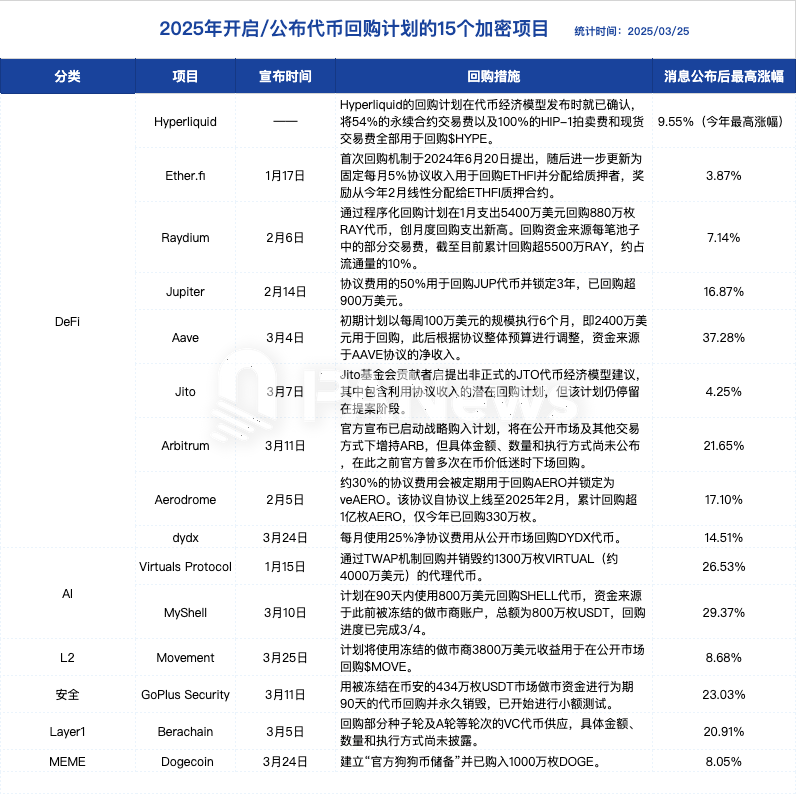
Among the 15 projects, DeFi remains the main driver of token buybacks, with seven DeFi protocols launching or planning to launch buyback initiatives—Hyperliquid, Ether.fi, Raydium, Jupiter, Aave, Jito, and Arbitrum. This reflects the urgent need within the DeFi sector to optimize token economic models. That said, projects in AI, security, Layer1, Layer2, and MEME sectors are also beginning to explore buyback mechanisms.
In terms of scale, Hyperliquid, Raydium, Jupiter, Aave, Aerodrome, and Virtual Protocol stand out. For instance, Raydium allocates a portion of trading fees from each pool toward RAY buybacks, having repurchased over 55 million RAY tokens to date—approximately 10% of circulating supply—with $54 million spent on buybacks in January alone, marking a new monthly high. Jupiter dedicates 50% of protocol fees to buying back and locking JUP tokens for three years; based on last year’s revenue, this could amount to around $50 million in buybacks, with over $9 million already executed within roughly one month. Aave initially plans to conduct buybacks at a rate of $1 million per week for six months (totaling $24 million), subject to adjustments based on overall protocol budgeting. Virtuals Protocol uses a TWAP mechanism to buy back and burn approximately $40 million worth of VIRTUAL tokens.
Additionally, three projects affected by Binance's investigation into market makers have announced buyback plans. Movement will use $38 million recovered from market makers over three months to buy back MOVE tokens. In contrast, MyShell and GoPlus Security have relatively smaller buyback scales.
From an execution standpoint, many projects have already launched and consistently carried out their buyback programs, demonstrating high levels of transparency and operational discipline. For example, Hyperliquid began buying back its HYPE tokens after TGE. According to HYPEBurn data, more than 189,000 HYPE tokens—valued at over $3.026 million—have been burned as of March 25. Aerodrome has been burning tokens since launch, accumulating over 100 million AERO repurchases to date. However, some projects’ buyback plans remain partially undisclosed or unimplemented, creating uncertainty. Jito’s proposal is still under discussion, Berachain has only indicated future buybacks without specifying amounts or methods, and Arbitrum has officially announced a strategic acquisition program to increase ARB holdings via public markets and other channels, though exact figures, quantities, and execution details remain unpublished—though the team has previously conducted multiple buy-ins during periods of low prices.
Market responses have varied. Some projects saw positive price movements following buyback announcements. From announcement to peak price during this period, Aave, MyShell, and Virtuals Protocol posted relatively strong gains. However, about one-third of the projects experienced less than 10% maximum price increases post-announcement, indicating tepid market reactions. This divergence may stem from differences in buyback scale, execution quality, project fundamentals, and broader market declines.
Behind the Buyback Frenzy: Value Bet or Survival Tactic?
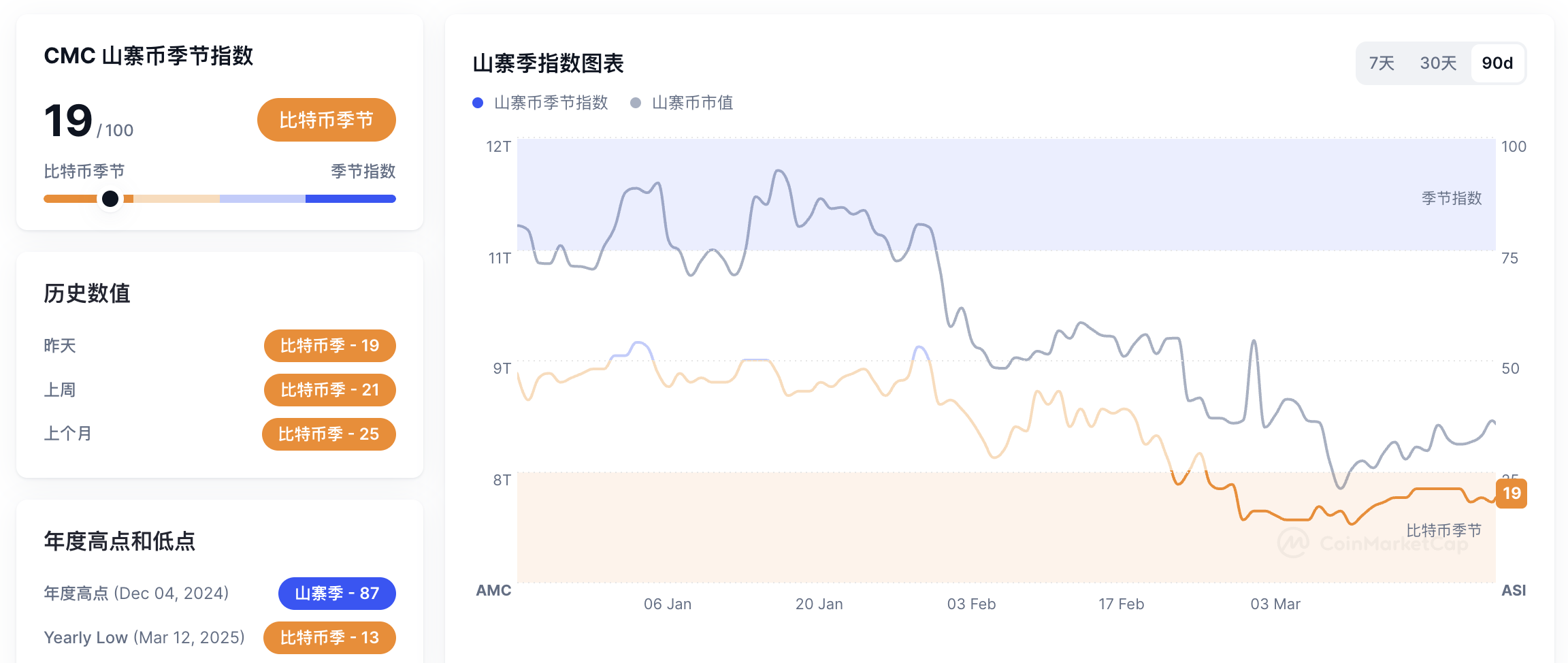
During this crypto cycle, Bitcoin’s market dominance has persistently exceeded 60%, while most altcoins have lost half or more of their market capitalization—sparking repeated debates over whether the “altcoin season” is dead. Coinmarketcap data shows that as of March 25, the Altcoin Season Index had dropped to 19, the lowest since December 4, 2024. Among the top 100 cryptocurrencies by market cap, only 19 have outperformed Bitcoin.
Under intense market pressure, token buybacks have increasingly become a standard strategy for many projects—but opinions remain divided. Supporters argue that buybacks signal confidence in intrinsic value and send bullish signals. Skeptics counter that buybacks must align with a project’s organic growth capacity. Others go further, suggesting buybacks may devolve into tools for teams to offload tokens ("dump") or provide temporary liquidity, failing to address core development challenges.
As @qinbafrank observes, the aggressive purge of small-cap tokens over the past year has forced market evolution: projects must either focus on delivering real innovation, abandon inflated valuations from early funding rounds and start from lower market caps (allowing secondary market investors to benefit from growth rather than just early insiders), or begin channeling part of revenues into strengthening token economics to enhance per-token value. To him, this shift marks a positive beginning for the crypto market. Meanwhile, crypto KOL Rain Sleeping in the Rain argues that when every project treats buybacks as the solution to token pricing, they lose their original meaning—becoming little more than exit liquidity sought by teams looking to dump. Blindly conducting buybacks cannot solve issues of sustainable development and growth. Buybacks should serve a project’s long-term vision. KOL @cryptowolfin adds that price movements ultimately depend on income growth and compelling narratives—buybacks alone cannot determine long-term trends. When market conditions are favorable, projects may spend heavily to buy back tokens at high prices, driving up costs. But when both token prices and revenues fall, they lack sufficient funds to innovate or pivot strategies, leading to continuous downward price pressure. Ultimately, what projects should prioritize is investing in growth and value distribution—not burning cash at inopportune times.
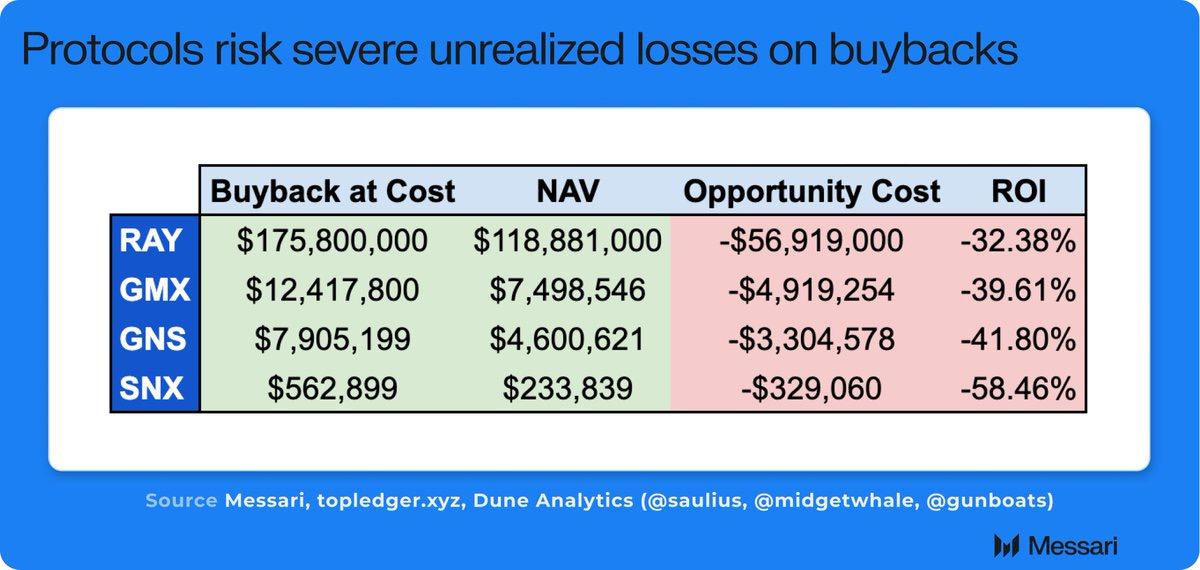
Messari researcher MONK recently pointed out that projects like RAY, GMX, GNS, and SNX previously conducted systematic buybacks of millions of dollars’ worth of tokens, but those tokens are now trading far below their purchase cost. He identifies three major flaws in current crypto buyback practices: First, buybacks do not correlate with price performance, which is primarily driven by revenue growth and narrative strength. Second, when revenues are strong and prices rise, projects end up spending excessive cash reserves to buy back tokens at unfavorable prices. Third, when both prices and revenues decline, projects lack the necessary capital to invest in innovation or restructuring, often facing large unrealized losses. Therefore, current systematic buyback strategies represent poor capital allocation. Instead, MONK suggests projects should focus entirely on growth or distribute tangible value to holders via stablecoins or major cryptocurrencies.
Whether buybacks can truly serve as an effective market stimulus—or are merely another form of capital game—may only be answered by time. For investors, however, the impact of buyback programs is rarely immediate. Beyond focusing on buyback amounts, greater attention should be paid to a project’s long-term roadmap and actual execution track record.
Join TechFlow official community to stay tuned
Telegram:https://t.me/TechFlowDaily
X (Twitter):https://x.com/TechFlowPost
X (Twitter) EN:https://x.com/BlockFlow_News
 PANews