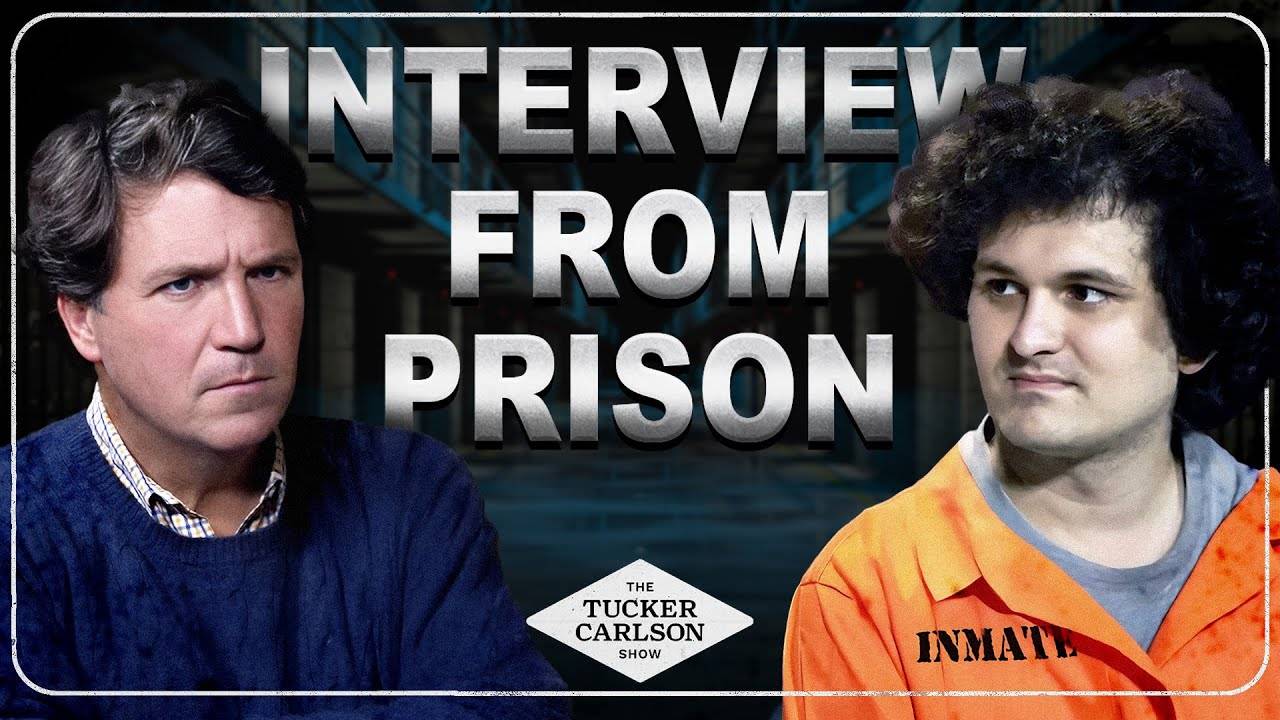
"I'm Not a Criminal" – SBF's Prison Interview: From Crypto Empire to Lonely Trial
TechFlow Selected TechFlow Selected
"I'm Not a Criminal" – SBF's Prison Interview: From Crypto Empire to Lonely Trial
"The Department of Justice might think I am, but to be honest, I don't care about their opinion."
 Navigating Web3 tides with focused insights
Compiled & Translated: TechFlow
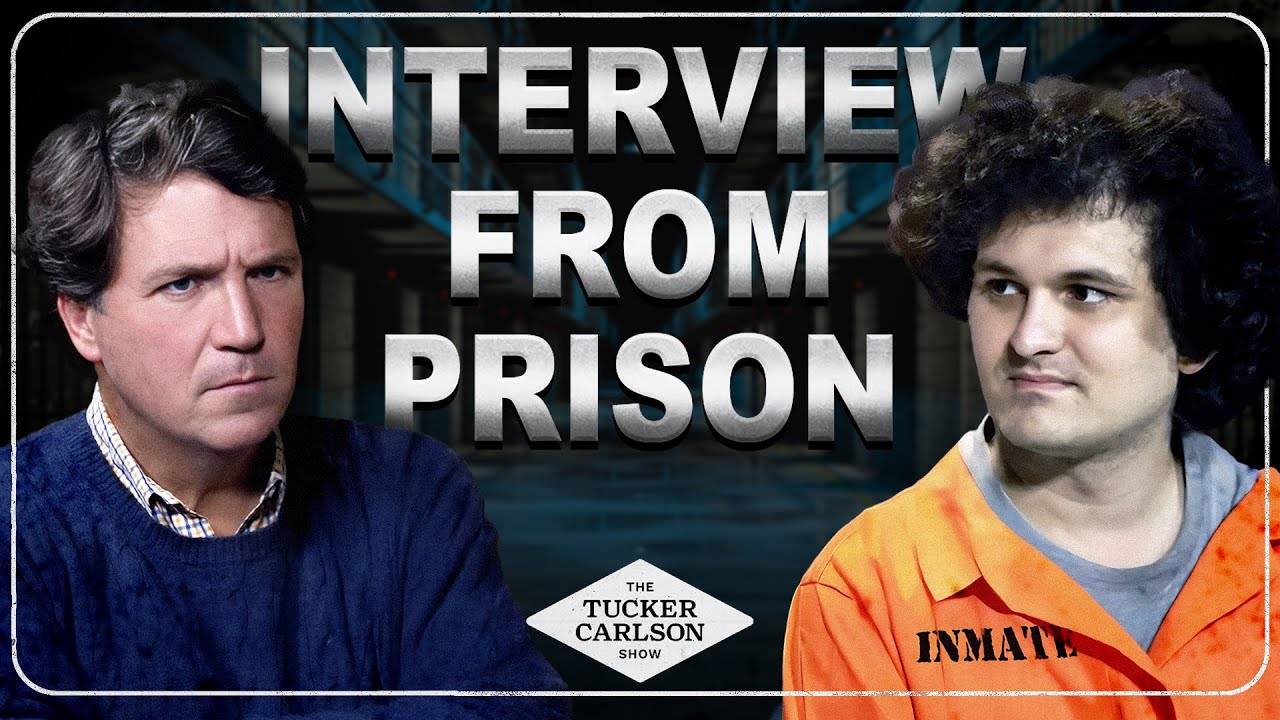
Guest: Sam Bankman-Fried, Founder of FTX
Host: Tucker Carlson
Podcast Source: Tucker Carlson
Original Title: Sam Bankman-Fried on Life in Prison With Diddy, and How Democrats Stole His Money and Betrayed Him
Air Date: March 7, 2025
Key Takeaways
Sam Bankman-Fried is serving a 25-year prison sentence and shares a unit with Diddy. SBF is currently incarcerated, living in the same unit as Diddy. He joined us from prison to share updates about his new life.
Highlights from the Interview
-
I don't consider myself a criminal. I know the Department of Justice might think I am, but honestly, I don't care about their opinion.
-
The Securities and Exchange Commission (SEC) led by Gary Gensler has been an absolute nightmare.
-
By 2022, my private donations to Republicans had matched those to Democrats. Coincidentally, this fact came to light around the time FTX collapsed.
-
Even before I relinquished control of FTX—before the company even filed for bankruptcy—the DOJ seemed already determined to take action.
-
The key question is whether the government will take necessary steps to overcome obstacles when truly challenged.
-
Certain systems in our country hold immense power and can subtly exert pressure and intimidation, influencing people’s decisions.
-
They lacked prestigious backgrounds or relevant experience, yet they outperformed nearly everyone else in the company—because they had resilience, intuition, dedication, knew how to work, collaborate, and find solutions.
-
Sometimes people assume they know how to help without understanding others’ real needs—an attitude that can come across as arrogant. In fact, many foreign aid projects end up completely wasting resources because no one truly understands what the people they aim to help actually need.
-
If the industry could stay focused on technological progress rather than market price fluctuations, within five to ten years we might see a new world where anyone can easily own a crypto wallet, enabling billions to transact daily—privately, securely, quickly, at low cost, and seamlessly across borders. These were the original promises of cryptocurrency, but unfortunately, the industry's attention has been diverted elsewhere over the past years.
What Is Prison Life Like?
Tucker: How long have you been there? What’s life like inside?
SBF:
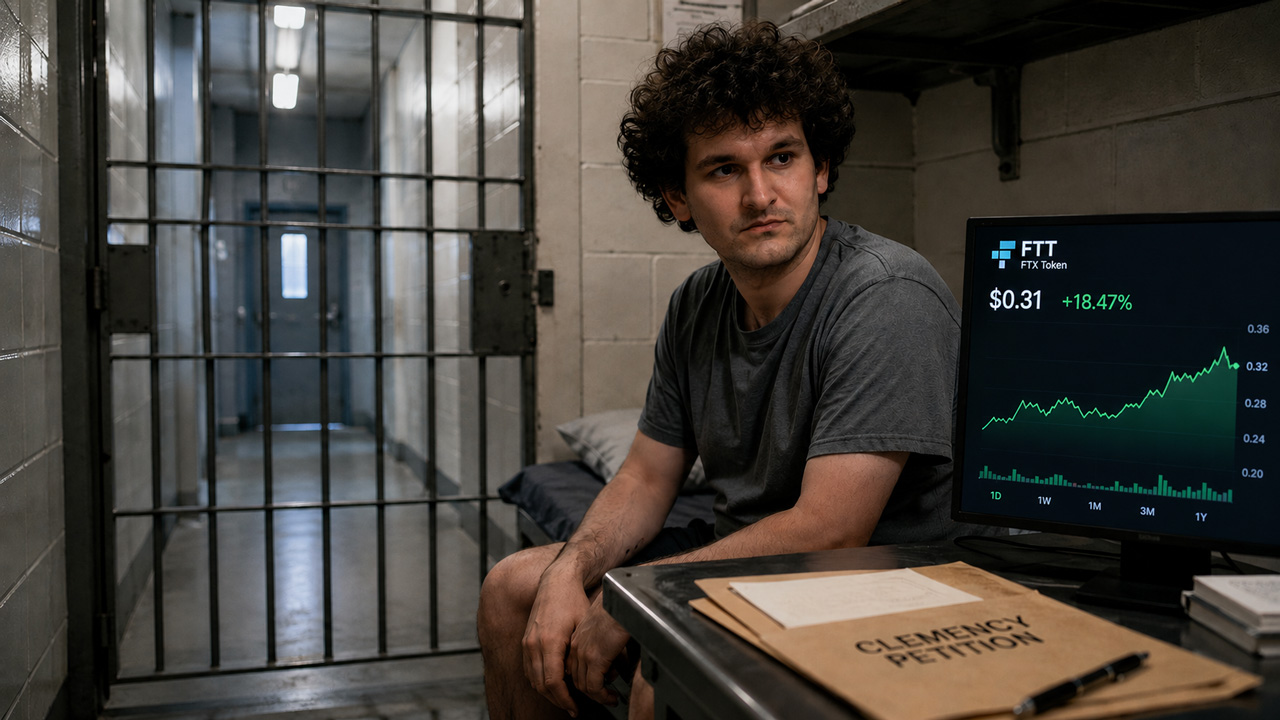
I've been in prison for about two years now. It feels somewhat dystopian. Fortunately, there isn’t physical danger where I am. To be honest, the staff are trying their best under difficult conditions, but nobody would want to stay here. About 40 people are confined in one room—all charged with various crimes and unable to leave for years. In such an environment, even the smallest things become major focal points.
Tucker: Have you run into any trouble?
SBF:
Nothing violent—I haven’t been attacked or anything—but I’ve faced significant logistical challenges. The biggest difficulty was during my trial period, when I had almost no opportunity to handle legal matters. A typical trial day started at 4 a.m., followed by five hours shuttling between buses, vans, and holding cells. Hearings usually lasted until 5 p.m., then another four hours returning through detention and transport. By the time I got back to prison at 9 p.m., I had no energy left for legal work. That was my biggest challenge.
Tucker: So when there’s no trial, what do you do all day?
SBF:
That’s a good question—because there really isn’t much to do. I read books, have restarted reading fiction, occasionally play chess, and try to manage legal affairs like appeals. I also attempt to get some meaningful work done. But the hardest part of prison life is the lack of purposeful activities to fill the time.
Did SBF Use Adderall Before Imprisonment?
Tucker: Regardless of what someone is accused of or has done, I feel sorry for every person behind bars. Personally, I don’t think incarceration is a good solution.
SBF:
I understand what you mean. Though sometimes it may be necessary, I sympathize with everyone in prison too—that’s my view. You could call me a liberal. But honestly, after two years here, I think you look healthier and less tense than before.
I’ve had a lot of time to reflect, especially on communication. Looking back, I realize I didn’t communicate well when the crisis first hit. In the month after, I fell back into an old habit—getting lost in details while losing sight of the big picture.
Tucker: Every time I saw you on TV, you always seemed hyper, like you were on Adderall. You don’t seem like that anymore. Were you actually taking it?
(TechFlow Note: Adderall is a prescription medication primarily used to treat Attention Deficit Hyperactivity Disorder (ADHD) and narcolepsy, helping users focus and improve efficiency.)
SBF:
No, I wasn’t. But I did feel mentally overwhelmed—there was just so much going on. At FTX, I’d often give interviews while simultaneously handling urgent company issues. Even during interviews, my mind was preoccupied with other problems. Often I hadn’t prepared properly and had to improvise on the spot.
Tucker: What do you think? Now that you don’t have a phone—does that matter to you?
SBF:
I still prefer life with digital tools. Ultimately, these aren’t for entertainment—they’re for efficiency and for making an impact on the world. Without them, doing anything becomes extremely difficult.
SBF’s Encounter With Diddy in Prison
Tucker: Have you made friends in prison? Are you still in the same unit as Diddy?
SBF:
Yes, he is. I’m not sure how to describe it—he’s actually quite friendly. I’ve made some friends too. The environment is unique, housing both high-profile defendants and former gang members or accused individuals.
Tucker: What kind of person is Diddy?
SBF:
To be honest, I’ve only seen him in prison. He’s been friendly to everyone in our unit, including me. But obviously, no one wants to be here. He clearly doesn’t either. I remember him saying this life feels like a spiritual suffocation. All we see every day are the people around us—not the outside world.
Tucker: You and Diddy might be the most famous people in your unit. How do others—like armed robbers—see you two?
SBF:
That’s an interesting question. Some probably think, wow, meeting people like us is a rare opportunity. I was surprised, but I can understand why they’d feel that way.
I found out they’re surprisingly good at chess. That’s one fascinating thing I’ve learned here. Former armed robbers—some didn’t finish middle school, some don’t even speak English—many of them are excellent chess players. I’m not saying they’re grandmasters, but playing against them turned out to be far more challenging than I expected.
How SBF’s Mindset Has Changed Since Incarceration
Tucker: How are things now? Has this experience changed your perspective?
SBF:
I see this as part of a broader life experience. This might be one of the deepest lessons I’ve learned—even if I still don’t fully grasp it. Obviously intelligence and hard work matter, but there are certain qualities we don’t even have proper words for. I haven’t found the right term yet, but these traits allow someone to perform exceptionally well, succeed, operate efficiently, and exceed expectations. Of course, everyone’s different. But in finance, I’ve met many people who lacked elite backgrounds or relevant experience, yet outperformed nearly everyone else in the company. Because they had resilience, intuition, dedication, knew how to work, collaborate, and solve problems. I worked on Wall Street before—it’s full of hidden talents, all kinds of people.
Despite Massive Donations, Democrats Refused to Save SBF
Tucker:
Overall, while I don’t want to dive too deep into case specifics, your company seemed to build political connections through donations—a common practice, and you weren’t the only businessman doing this. But you donated so much to Democrats—I assumed they’d step in to save you. Democrats usually protect their own from prison. Why didn’t you get that protection?
SBF:
That’s a great question, but I can only speculate since I don’t know their true intentions. One possibly relevant point: even in 2020, my stance was center-left, and I donated to Biden’s campaign. I hoped he’d be a relatively moderate center-left president. But over the next few years, traveling frequently to Washington, meeting people, attending meetings—I became deeply disappointed. By 2022, my private donations to Republicans equaled those to Democrats. Coincidentally, this fact emerged around the time FTX collapsed.
Tucker: What disappointed you? I know you spent a long time in D.C., met almost everyone, and there are many photos circulating. What shocked you?
SBF:
Some things were worse than I feared. Cryptocurrency regulation is a prime example. I never expected Democrats to champion sound financial regulation, but I didn’t expect them to be this bad. Of course, every party has good and bad actors, thoughtful individuals. But the Securities and Exchange Commission (SEC) under Gary Gensler has been an absolute nightmare. I’ve seen companies offering services in the U.S. get sued by Gensler for being “unregistered.” He says registration is welcome, yet provides no clear process. Nearly every crypto project faces this—none have successfully registered. That’s deeply troubling.
Tucker: Can you explain further? To outsiders like me, Gary Gensler clearly seems corrupt—no doubt about it. But what motivates him? What does he actually want?
SBF:
Good question. I can’t read his mind, but I have guesses. He clearly enjoys being in a position of power. Power attracts many people—and he’s no exception. It seems more about expanding his authority. He wants his agency to wield greater power, even if he won’t use it to advance the industry, only to block it. What baffles me is why he demands registration while refusing to provide clear guidance—even if he himself doesn’t know how to handle registrants.
Tucker: Sounds very consistent with Washington’s style. I’ve seen similar patterns before.
SBF:
This isn’t a moral issue. He’s not someone with strong communist beliefs.
Tucker:
When things began deteriorating, you were accused—or facing accusations. Normally, someone who donated heavily to Democrats would call their allies for help: “Hey, I’m in trouble—can you assist?” Did you call Schumer or others you supported, asking them to intervene—say, urging the Biden DOJ to go easy on you?
SBF:
No, I didn’t—and there were several reasons. First, I didn’t want to do anything inappropriate. Second, many people quickly distanced themselves from me. By then, my relationship with Republicans in Washington was likely stronger than with Democrats—even if not public, it should’ve been obvious from the outside.
Finally, there’s a complicated story involving a law firm that played a special role in the case. But in reality, even before I gave up control of FTX—before the company filed for bankruptcy—the DOJ seemed already committed to taking action.
The Future of Cryptocurrency Under Donald Trump
Tucker: What’s your view on cryptocurrency’s future? Is development progressing fast enough? Is it moving in the right direction?
SBF:
I hope so. Look at the early statements from the Trump administration—many positive signals, policies sharply different from Biden’s. Of course, the key lies in follow-through actions, and we’re now at this critical juncture, waiting to see what unfolds. Unsurprisingly, a change in administration helps shift dynamics. But financial regulators are massive federal bureaucracies, typically slow-moving. Over the past decade, these agencies have mostly acted as “blockers” in crypto. The U.S. crypto market accounts for only 5% of the global total, while the U.S. holds 30% of global financial markets. This mismatch stems entirely from regulation. The U.S. regulatory environment is uniquely restrictive globally. Therefore, the crucial question is whether the government will take necessary measures to remove these barriers when truly challenged.
Tucker:
I remember when crypto first entered public awareness—it was promoted as a currency restoring individual commercial freedom. It promised free buying and selling without government interference, with privacy protection. But clearly, that vision hasn’t materialized—and seems unlikely to. I hardly hear anyone talk about privacy anymore. Crypto now seems like just another asset speculation tool. So, what’s the current state of privacy?
SBF:
Actually, crypto isn’t just an investment tool—it has practical technical uses like cross-border remittances and payments. But adoption and application of these technologies usually take longer. Investment bubbles, by contrast, rise and fall frequently—almost daily or monthly.
Currently, crypto hasn’t evolved into an everyday tool for a quarter of the world’s population. The goal isn’t achieved yet, but it’s getting close. If the industry stays focused on technological advancement instead of obsessing over price movements, in five to ten years we might see a new world where anyone can easily own a crypto wallet, enabling billions to transact daily—privately, securely, quickly, cheaply, and seamlessly across borders. These were the original promises of cryptocurrency, but sadly, the industry’s attention has been distracted by other issues over the years.
Tucker: Do you think governments will allow this to happen? If global populations conduct financial transactions beyond government control, wouldn’t that undermine governmental foundations?
SBF:
Different countries have vastly different attitudes toward financial transaction oversight. Take Bitcoin—for instance, wallets are anonymous, but every transaction is recorded on a public ledger accessible to anyone. So even without direct control, governments can still obtain a certain level of information through the public ledger.
However, not all governments view this transparency the same way. Over the past 30 years, the U.S. government has maintained a very clear stance on controlling financial transactions. Other countries like France have adopted similar positions, especially regarding international money transfers. In contrast, more authoritarian regimes might pursue entirely different strategies. But in reality, half the world’s nations don’t intervene in daily financial transactions as deeply as the U.S. does.
Does SBF Still Have Any Money Left?
Tucker: After everything, do you still have any money?
SBF:
Almost none. My former company remains in bankruptcy proceedings. I’m not sure about the exact details. Without further intervention, the company’s liabilities are roughly $15 billion, while assets stand at about $93 billion.
Theoretically, the answer should be yes—there are enough assets to repay all debts, even leaving substantial interest and billions in surplus for investors. But in reality, things didn’t unfold as planned. The company’s assets rapidly eroded during bankruptcy, with tens of billions siphoned off by those who took control. It’s a massive disaster, and failing to prevent this is the greatest regret of my life.
Tucker: Before your charges, you were one of the most prominent figures in the industry. Do you consider yourself the biggest criminal in crypto?
SBF:
I don’t think I’m a criminal. I know the DOJ probably sees me that way, but honestly, I don’t care about their opinion.
Tucker:
You’re clearly imprisoned, which shows they do. But let me ask—do you think there’s a lot of shady behavior in the crypto industry?
SBF:
Definitely. Ten years ago, it was especially evident—or at least relative to the industry’s size at the time. Looking back at 2014 to 2017, the crypto space was much smaller than today. I saw many transactions—quite a few operating in what you might call “gray areas.” For example, “Silk Road” was a classic case. Ten years ago, using crypto to buy drugs online was a common use case.
Of course, criminals exist in every industry. But over time, such behavior has significantly declined in crypto. Partly because legitimate use cases have grown, partly because governments have strengthened anti-money laundering (AML) regulations. So while shady activities still exist, they’re no longer as widespread as in the early days.
Tucker Challenges SBF on "Effective Altruism"
Tucker: You were once considered the face of “effective altruism”—a worldview, ideology, even a belief system—centered on maximizing welfare for the greatest number. You claimed to earn money to help as many people as possible. Yet critics point out that when your company collapsed, about a million people lost their funds. There’s irony here—your entire philosophy was about doing maximum good.
I wonder—has this made you rethink effective altruism?
SBF:
I haven’t rethought the principles. Obviously, I feel terrible about what happened—it was never the outcome I wanted. I know if things had gone differently, the result could’ve been completely opposite. People could’ve recovered their money, but the wait was too painful, and ultimately they only got dollars back, not real value. Also, all the good I hoped my company would bring to the world was severely undermined—or even destroyed—by its collapse.
Tucker: Most people struggle to understand how helping strangers you’ve never met could be more valuable or morally significant than helping loved ones. Helping family or friends might intuitively feel more meaningful. Most people think this way—you seem to disagree.
SBF:
I do disagree—but with a caveat about a common mistake. Often, people assume they know how to help without understanding others’ actual needs—an attitude that can seem arrogant. In fact, many foreign aid projects waste resources entirely because no one truly understands what the recipients actually need. For example, teams might deliver pumps to villages with ample water but insufficient food—aid that’s clearly pointless.
Such examples abound. When helping familiar people, you better understand their needs—that’s an advantage. Even if I believe every life is equally important, it doesn’t mean helping a stranger will be as effective as helping someone close.
Tucker: But your answer seems to contradict effective altruism. I mean, its logic appears overly simplistic. For instance, curing polio might be relatively easy, but keeping someone happy for 30 years is extremely hard. Maybe the harder, more complex tasks are more worthwhile.
SBF:
I see your point, but let me use malaria as an example. In the U.S., almost no one dies from malaria anymore, but globally, it still kills about a million people annually—deaths that shouldn’t happen. We know theoretically how to solve this, so we should act without hesitation. Even if solving malaria seems simple, that shouldn’t excuse inaction.
Interventions in the poorest regions often aren’t costly. If we allocate resources efficiently, these efforts won’t significantly impact domestic aid budgets. But efficiency is key. If we waste resources—like sending useless pumps to food-scarce villages—we won’t save lives.
Tucker:
You make a valid point—this is clearly true. Over the past 60 years, aid to Africa has seen life expectancy decline in many areas. But morally speaking, when your loved ones face depression or other struggles, how can you justify prioritizing malaria patients? Shouldn’t you help those closest first?
SBF:
If I could, I certainly would. Ultimately, everyone has responsibilities. If I know my loved ones well and understand how to help them, I absolutely have a duty to address their issues. But if I’ve done my best and still can’t help, while I could save more lives elsewhere, I don’t believe that diminishes the good I can do globally.
Tucker: Final question—can you name a recent international aid project that undeniably succeeded?
SBF:
Certainly, though I won’t name specific ones. These aren’t government-led but privately funded initiatives. Malaria is a good example. Thanks largely to private donations, malaria cases have significantly dropped in many regions—especially in Africa and India—saving hundreds of thousands of lives annually. On average, saving one life costs a few thousand dollars—a highly successful outcome relative to scale.
We’re talking billions, not trillions—funds carefully planned and efficiently distributed. Of course, government-led projects often show minimal results. For government success stories, consider the Marshall Plan, which achieved tremendous success rebuilding Germany after WWII.
Will SBF Ever Truly Be Released?
Tucker: If you’re not pardoned, assuming nothing changes, how old will you be when released?
SBF:
It’s a complex calculation. I don’t fully grasp all the details, especially regarding the First Step Act. If you simply add my sentence to my age, I’d be in my forties upon release.
Tucker: Could you handle that life?
SBF:
Sorry, I misspoke earlier. Considering my sentence and age, I’d likely be in my fifties. With all possible reductions, maybe late forties. But I was convicted at 32, sentenced to 25 years—that’s age 57.
Tucker: Given you’ve already served two years, do you think you can endure the rest?
SBF:
Honestly, I’m not sure. The hardest part is having nothing meaningful to do. Some studies—though I’m unsure of their accuracy—suggest prison suicide rates are triple that of the general population. So imagine multiplying my 25-year sentence by three, adding my age at conviction—32. That math feels deeply depressing.
Tucker: The contrast—from adigital currencyworld to one with no money—is strange. What do people use as exchange in prison?
SBF:
People use small items they can find—like plastic-wrapped muffins. These muffins might have sat at room temperature for a week, the kind you’d see at gas station counters. Also instant noodles or oil-packed fish cans—gross-looking, but functional here.
Tucker: So you’ve moved from crypto to a muffin economy. How do you compare the two? International muffin transfers are clearly much harder.
SBF:
Exactly. Muffins clearly won’t become a global strategic reserve. Their value is purely demand-based, with no added value. Though not perfectly fungible, they’re close enough—two muffins are roughly equivalent, so they’re interchangeable. But this monetary system only supports small transactions—under $5. Trying to complete a $200 trade with muffins would be nearly impossible.
In prison, all transactions are tiny. You’ll see people fighting over a banana—not because they love bananas, but because they lack other outlets for emotional release.
Why Did SBF’s Friends, Family, and Colleagues Abandon Him?
Tucker: Since your imprisonment, facing up to 23 years, I’m curious—did those you helped, especially in Washington, ever call to check in or wish you well? SBF:
In the initial phase after the company collapsed, I did receive messages from several people, including friends in D.C. But about six months later, contact faded. By trial time, almost no one reached out. The situation became highly politicized—too risky for anyone to maintain contact.
Tucker: Truly no one? I noticed your ex-girlfriend testified against you in court. Did any friends remain loyal?
SBF:
A few—but very few. I was surprised. But thinking deeper, it’s understandable. Anyone close to me faces enormous pressure and must make tough choices—one of which could land them in prison for decades. Ryan Salem’s case is tragically illustrative. He was charged with completely fabricated crimes.
He initially refused to plead guilty, but prosecutors threatened his wife—saying she’d be jailed if he didn’t cooperate. Eventually, to protect her, he pleaded guilty. Such conduct shouldn’t be legally permissible.
This completely violates justice. It’s untrustworthy. He’s a good man who did nothing wrong.
Tucker: Have you realized how fast the outside world changes? When you’re released, you might find yourself in a completely different world.
SBF:
Yes, I definitely feel that. The world keeps evolving, while I’m stuck, unable to keep pace.
Tucker: Is having children part of your “effective altruism” philosophy?
SBF:
No. Within the community, views differ. Over the past five years, I’ve felt like I had 300 kids—my employees made me feel deeply responsible. I barely had time for personal life.
Tucker: Have any employees visited you?
SBF:
No—almost none. Only one or two.
Tucker: Maybe you should consider having your own children. When you’re in trouble, they’ll always be by your side.
SBF:
This has made me reflect deeply on trust and dependence. Certain systems in our country hold immense power and can subtly exert pressure and intimidation, influencing people’s decisions.
Join TechFlow official community to stay tuned
Telegram:https://t.me/TechFlowDaily
X (Twitter):https://x.com/TechFlowPost
X (Twitter) EN:https://x.com/BlockFlow_News
 深潮TechFlow