IOSG Founder's New Article: From Hong Kong to Denver, Ethereum Is Entering its "Dunkirk Moment"
TechFlow Selected TechFlow Selected
IOSG Founder's New Article: From Hong Kong to Denver, Ethereum Is Entering its "Dunkirk Moment"
Optimists are often right; the more difficult and turbulent the phase, the more one should maintain confidence and optimism.
 Navigating Web3 tides with focused insights
Author: Jocy@IOSGVC
You've probably already read many accounts of Consensus HK from the past two weeks, so I won't repeat them. In short, most felt disillusioned with the industry, seeing no breakthrough on the horizon and believing we’ve entered a bear market. That week, however, was a feast for P-normies and KOL gods. My trip to Hong Kong shocked me with its sense of fairness—those young traders and influencers who work harder than funds and founders truly deserve what they earn. They are hyperreal investors, always able to put a perfect period on every trade. Many P-normies follow a 90% or BTC, 10% active Solana allocation strategy, keeping their Sol positions ready for PvP and sprints at all times. No matter how much profit they make per trade, they stick rigidly to this portfolio structure. Fueled by meme waves and attention economics, this became the hottest topic in HK.
Kaito’s victory has ushered in a golden age for KOLs—attention is now priced and can be quickly monetized. In stark contrast, the entire Ethereum ecosystem feels lifeless, hollow, and idealistic, with no one answering its calls. This is reality striking back. Deeply underwater value investors and long-term holders are turning bearish on Ethereum, migrating en masse to Solana. Many fail to recognize the hunger of Ethereum's builders (compare this to Solana, where a dev contacting the foundation for integration typically gets connected within two days, versus an average two-week wait when reaching out to L2/Ethereum teams). It seems as if the industry's gatekeepers have deliberately engineered this environment—this mini-bull cycle rewards short-term speculators over long-term holders, which I see as a wake-up call for leaders like Ethereum, highlighting their complacency and lack of crisis awareness.
The Reign of Short-Termism: The Collapse of Industry Values
At the same time, as everyone sheds pretense and scrambles for last-minute gains before the bull run ends, ideals and beliefs vanish—people become emotionless arbitrage machines. No one cares about the industry’s future; everyone just wants to grab one final payout from this cycle. Exchanges, eager to boost their own project tokens and chains, abandon listing standards to onboard projects they’ve invested in. Blue-chip projects treat TGEs as ultimate ATMs, while market makers dominate this cycle—thanks to BD and branding, they get free allocations and, even amid declining VC token prices, median-sized market-making firms net close to $40M. Everything appears to be shifting from long-term vision to short-term bubbles and speculation, and these behaviors are profoundly affecting genuine builders committed to real construction.
This moment feels eerily similar to 2018 or 2022—desolate and bleak, with professionals leaving due to lack of hope and recognition. Everyone is doing whatever it takes just to survive the coming bear market. For those still building and working, this is painful—they must maintain unwavering conviction and values at all times. Just as Trump reshaped America’s core values, the emergence of Trump tokens in crypto has ignited massive nihilistic investing. When both builders and speculators view this as a fast, short-term game, the only goal becomes how much cash they can extract before the money faucet shuts off.
In summary, my Hong Kong experience marked a major breakdown of industry ethics—a formal written verdict on Ethereum. As the most successful entrepreneur in the space, did he steer the ship correctly? Did he lead the industry into nihilism?
Ethereum’s Challenges and Transformation
TL;DR: Founders from Denver-based infrastructure projects are deeply bearish, while application and AI founders remain bullish.
The Denver trip revealed some shocking scenes: founders and developers who had been steadily building for years suddenly heard that “the Qing Dynasty has fallen.” Some refused to believe it. Ethereum has long had a cradle-to-grave culture—these teams raised funds smoothly and watched less impressive projects thrive in speculative markets. They never imagined a day would come when fundraising dried up and their own tokens crashed to zero like any other vaporware. Only when runway dwindled to 6–9 months did they finally realize they needed to build real products with revenue and user bases, and began seriously questioning Ethereum’s structural issues. Of course, it’s never too late—but for them, this means drastic layoffs and a complete rejection of their past selves, a huge challenge for any founder, as they’re betting everything on an uncertain direction. According to incomplete estimates, projects rooted in Ethereum and the EVM ecosystem have collectively raised hundreds of billions in funding, with total valuations across primary and secondary markets exceeding a trillion dollars. The existential question now facing these projects is clear: stay on Ethereum or leave? Even Lido founder Konstantin, upon tweeting about forming a Second Ethereum Foundation, instantly received DMs from over a hundred DeFi founders (including Uniswap). Yet achieving consensus remains extremely difficult.
I also met a wave of Ethereum-native founders—once the backbone of technical innovation—whose products in TEE/zkTLS/rollups were widely adopted and dominant in their niches. But even they are now disillusioned. Delivering cutting-edge solutions for protocols without end users or real demand no longer brings them entrepreneurial joy. What excites them now are groundbreaking new papers emerging from the AI research world. Honestly, such founders aren’t rare—they’re among the few in this industry capable of deep, practical innovation. If large numbers of them begin to exit, I believe Ethereum’s infrastructure development will regress by three to five years.
The Magical Energy of AI and Web3 Convergence
Initially, everyone said Denver’s infrastructure scene was dead and quiet. But after averaging 3–4 conversations daily with new AI×Web3 projects, we witnessed Ethereum’s community actively embracing emerging technologies and innovating in areas like DeTraning, Inference, and DePIN. Ethereum is adapting to new tech trends and exploring novel use cases. Capital and founders have become canaries in the coal mine. Paradigm led a $1B valuation investment into Web3 LLM startup Nous Research. Groq generated over $100M in inference revenue last year. Openmind partnered with Unitree to launch RobotAI. DePAI unveiled its open-source product in Denver. Hyperbolic emerged as one of the most integrated inference networks among Web3 developers. Platforms like Open Gradient and Pluralis are pioneering open-source intelligence. At this Ethereum-centric event, brilliant developers and founders are driving Web3’s full embrace of AI. Everyone is brainstorming how to embed AI agents into more Web3 applications. The industry never stops—curiosity and research keep builders moving forward.
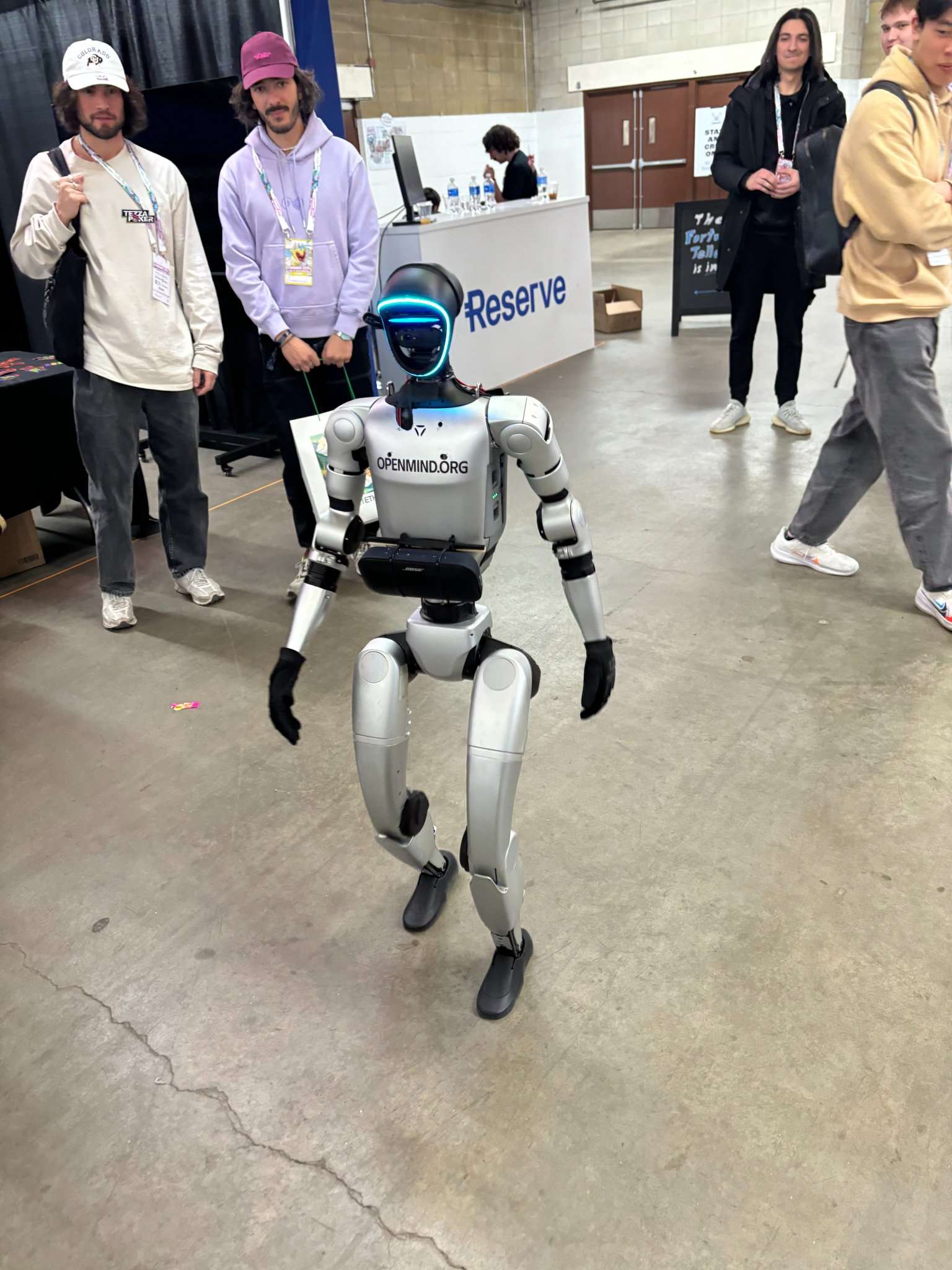
Openmind partnered with Unitree to launch RobotAI; DePAI unveiled its open-source product in Denver
Macro Tailwinds Emerging, Crypto Evolving with the Times
Interacting with U.S. institutions revealed a completely different picture from Asia—there’s strong optimism around crypto-friendly policies, a potential bull market, and looser regulatory environments. U.S. banks have passed legislation allowing crypto custody, and soon BTC/ETH will be accepted as collateral, potentially expanding to mining equipment. A clear trend is emerging: a "crypto rate cut" environment is forming, lowering borrowing costs from previous industry highs of 10% to around 3–4%, possibly even reaching negative rates like in Japan. This will reintroduce liquidity into the sector. We’re also seeing a stream of pro-crypto policy developments in the U.S., with Uniswap and Coinbase exploring tokenized securities models to help traditional investors better evaluate and purchase tokens. Regulatory tailwinds in this cycle may exceed our expectations, leading me to believe the next two years will bring a favorable macro environment. Many claim this bull market has already ended, but I disagree. Every true bull market requires not only macro support but also internal innovation and new killer apps. We haven’t yet seen meaningful innovation in this cycle—if none emerges, this will be a fake bull run. Over the next two years, we can expect more traditional companies—and even nation-states—to adopt L2 networks and launch their own decentralized systems, fueling L2 commercial growth that in turn drives Ethereum L1 expansion and value capture.
Rethinking Ethereum Governance: Toward Mainstream and Commercialization
On day three in Denver, during ETHGlobal’s Pragma event, I met several core EF developers who hinted at upcoming organizational changes within Ethereum. One notable figure is @dannyryan, whose reputation among core developers is well-earned. The newly formed @Etherealize is poised to carry forward Consensys’ mission in a new era, helping Ethereum reach mainstream adoption and commercial success. Additionally, the foundation’s two Co-EDs, Hsiao-Wei @hwwonx, have deep roots in Ethereum, having followed Vitalik since 2016 (see photo: at the 2019 Ethereum Beijing hackathon judging day, she’s the one sitting beside Vitalik). Tomasz @tkstanczak, founder of Nethermind, knows the Ethereum ecosystem inside out. As a third-party dev shop, they understand sustainable business models and can help Ethereum balance infrastructure development with commercial viability.
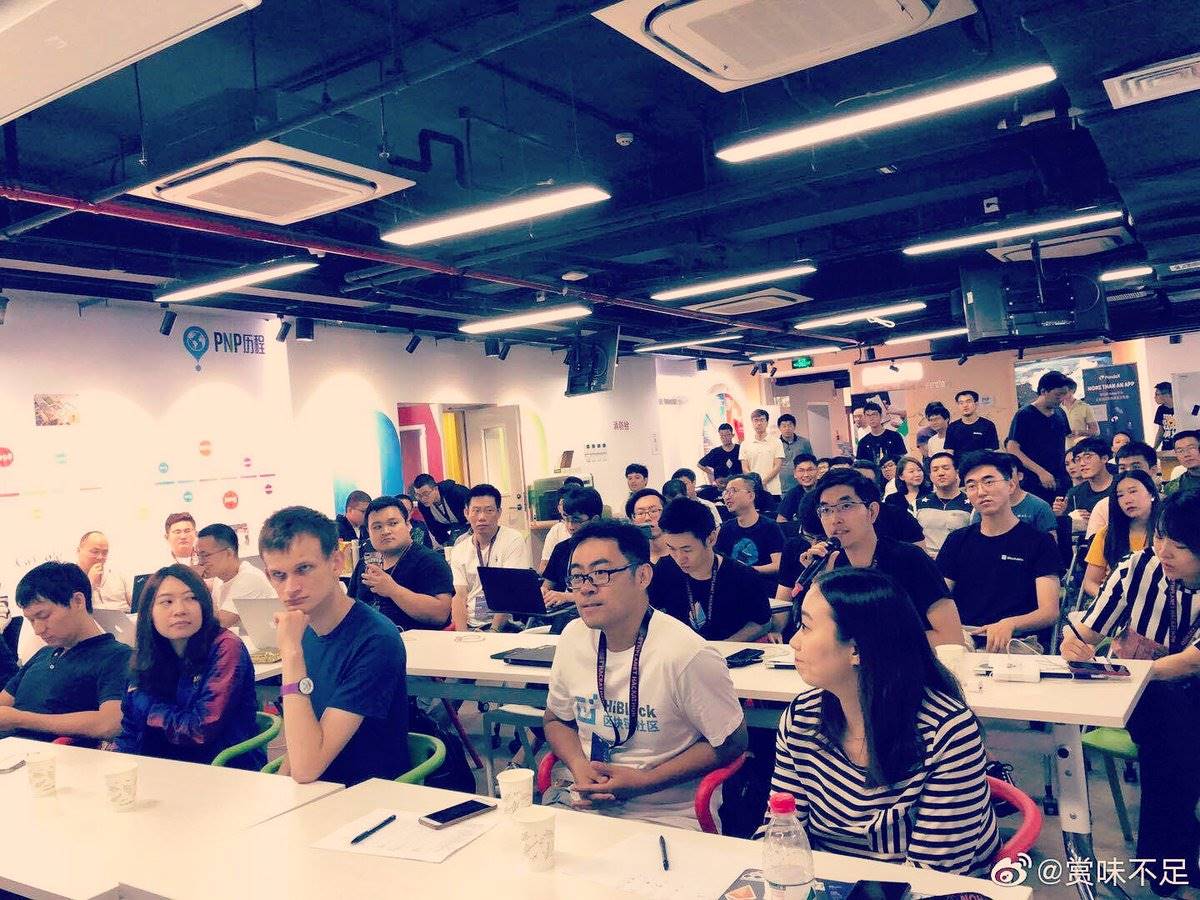
Photo: 2019 Ethereum Beijing hackathon judging day—Co-ED Hsiao-Wei @hwwonx sits beside Vitalik
Vitalik faces the same challenge as any founder: once the team grows, it becomes hard to lead. Those familiar with personality analysis might reflect on Vitalik’s journey—from using the Milady meme as his Twitter avatar to expressing disappointment in crypto OGs, then switching to a half-human, half-bird Druid from World of Warcraft, symbolizing his reconciliation with community feedback. The next day, he officially announced Ethereum’s new team structure. Ethereum may be the first truly decentralized organization and economy. We should extend more grace to this man who has just turned thirty. He hasn’t shined in organizational management or commercializing Ethereum applications—but who else could lead this organization to greater glory and results? Perhaps Ethereum could take a page from Elon Musk and create a DOGE纪委 to eliminate unproductive devs and ceremonial roles. Measuring contribution, value, and KPIs is a critical challenge ahead. Providing clearer value propositions and development priorities to core internal developers, along with concrete roadmaps and time-bound management goals, will help Ethereum return to community-driven, democratic governance. As the bedrock of Web3, Ethereum continues to explore Layer 2 solutions and technological upgrades to meet growing application demands.
No Savior Comes—Vitalik Must Empower More Application Builders
For Ethereum, is technical R&D really that important right now? Maybe in 2017, 2020, or 2022—but today, applications should outweigh technology. The next crucial milestone for Ethereum—and the greatest source of confidence for ecosystem builders—will be whether the "world computer" can produce a cross-generational super app.
Many see Vitalik as Ethereum’s savior, and Ethereum as the industry’s savior. But there has never been a savior. Everyone must become one. As I tweeted earlier, every organization that has accumulated substantial capital and stable business revenue in this industry should contribute to its future—donate to Ethereum’s open-source initiatives, create better opportunities for young talent. Beyond Grants, many founders still need funding. Amid this wave of altcoin bloodbaths, already fragile Asian funds have taken heavy hits, with many shutting down or pivoting to secondary markets. The Asian startup ecosystem is struggling. Losing Asian VC support would further thin the industry. I continue to advocate: early-stage risk capital must remain part of Ethereum’s ecosystem. I suggest all exchanges annually allocate 1–2% of their revenue to support Ethereum’s open-source innovation and development.
Will Ethereum die in the next bull-bear cycle? I don’t think so. It’s the most successful decentralized organization in Web3—we cannot afford to let it fail. Its collapse would mean thousands of projects and talents built on the Ethereum empire, worth hundreds of billions to trillions, would have to start over. The entire industry would face a 5–10 year regression, and many OGs would exit.
Please hold your Ethereum. If you look back from 2030 over the decade 2020–2030, the doubts and noise of 2025 may seem insignificant. Learning to assess value and innovation through a 10-year lens is a far more important priority.
Optimists are often right. In the most difficult and turbulent times, we should hold onto confidence and optimism even tighter.
Join TechFlow official community to stay tuned
Telegram:https://t.me/TechFlowDaily
X (Twitter):https://x.com/TechFlowPost
X (Twitter) EN:https://x.com/BlockFlow_News
 @JinzhouLin