








When Celebrity Coins Lose Their Charm: Ronaldinho's Crypto Venture Faces Trust Crisis
TechFlow Selected TechFlow Selected
When Celebrity Coins Lose Their Charm: Ronaldinho's Crypto Venture Faces Trust Crisis
Since Trump, it seems that celebrities launching their own cryptocurrencies has become a new business trend.
 Navigating Web3 tides with focused insights
Author: Frank, PANews
Since Trump, launching tokens has seemingly become a new business model for celebrities. On March 2, retired football legend Ronaldinho announced the launch of his personal token $STAR10 on the BSC chain. Despite reaching a peak circulating market cap of $32 million amid a sluggish market, it fell far short of the anticipated buying frenzy. Instead, social media was flooded with conspiracy theories surrounding the token—allegations emerged of a Shenzhen-based token team involved, unsecured liquidity pools, unrelinquished minting rights, and insider early dumping. Even CZ, Binance's founder who shared the listing announcement, briefly faced user backlash. Is this celebrity token trend truly a one-way致富 password for quick profits?
Football Genius Turned Harvesting Tool? Suspicions of Professional Team Manipulation
Ronaldinho, once hailed as the most naturally gifted Brazilian football star in history and affectionately known as "Little Rô" by fans, enjoyed immense popularity during his career and was even dubbed the "Football精灵." However, early fame, lack of discipline, indulgence in luxuries, and reckless spending led to the downfall of his career and eventual bankruptcy—forcing him to monetize his name. Like many talented athletes from impoverished backgrounds, Little Rô不幸 followed this familiar script.
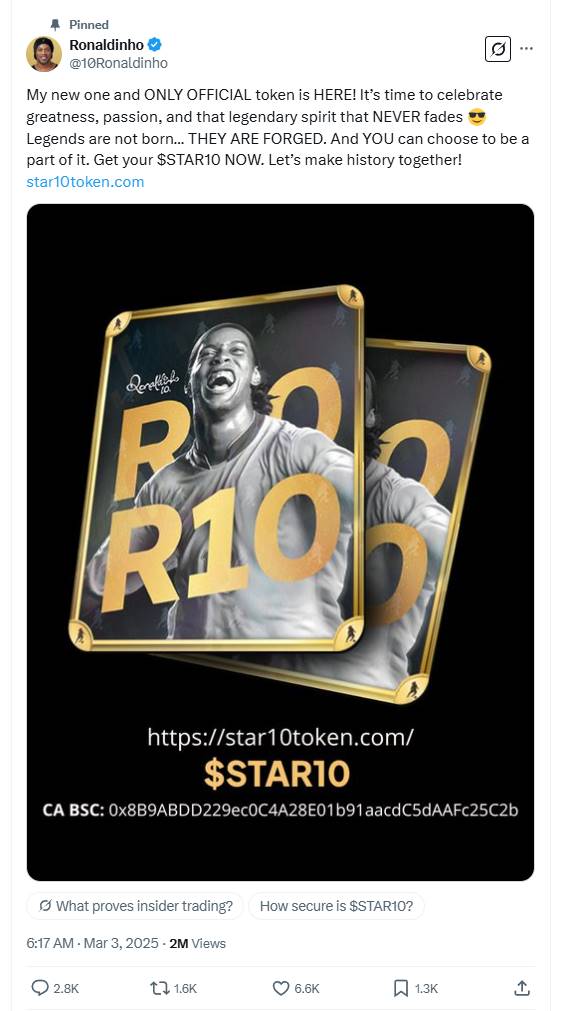
After trying various ways to earn income through appearances, the fast-profit potential of the crypto industry appears to be a more attractive option.
On February 22, Ronaldinho tweeted “Here, cryptocurrency looks good,” hinting at his upcoming token launch. However, due to continued downturns in the crypto market, the token wasn't officially launched until ten days later.
During those ten days, the crypto market saw a sharp decline. Previously hot Solana had already lost momentum, while BSC, boosted by frequent engagement from CZ, attempted to emerge as the new meme coin hotspot. Ronaldinho’s final choice suggests he may have been advised by a team well-versed in crypto market dynamics.
On February 28, Twitter user @R10coin_ claimed that Ronaldinho’s token was backed by a Shenzhen-based token team. The whistleblower identified themselves as representing another professional token issuance firm that had previously reached a $6 million agreement with Ronaldinho to jointly launch the token. They alleged they were outbid by another Shenzhen team offering $10 million, prompting them to expose the situation, sharing emails and signed documents from Ronaldinho. The community largely viewed this as a case of “criminals turning on each other,” but such behind-the-scenes manipulation is now commonplace. Previous incidents like President Milei’s token stunt had already revealed similar backroom operations. By March 4, the whistleblower’s Twitter account had been suspended.
Since no further concrete evidence was provided, the true identity of the team behind Ronaldinho’s token remains unknown. According to PANews' investigation, the official website domain for $STAR10 is hosted by GoDaddy, a well-known domain service provider. The site is deployed across two IP addresses, both traced back to Amazon cloud servers. One of these IPs has resolved over 80,000 domains, making it impossible to confirm centralized control.
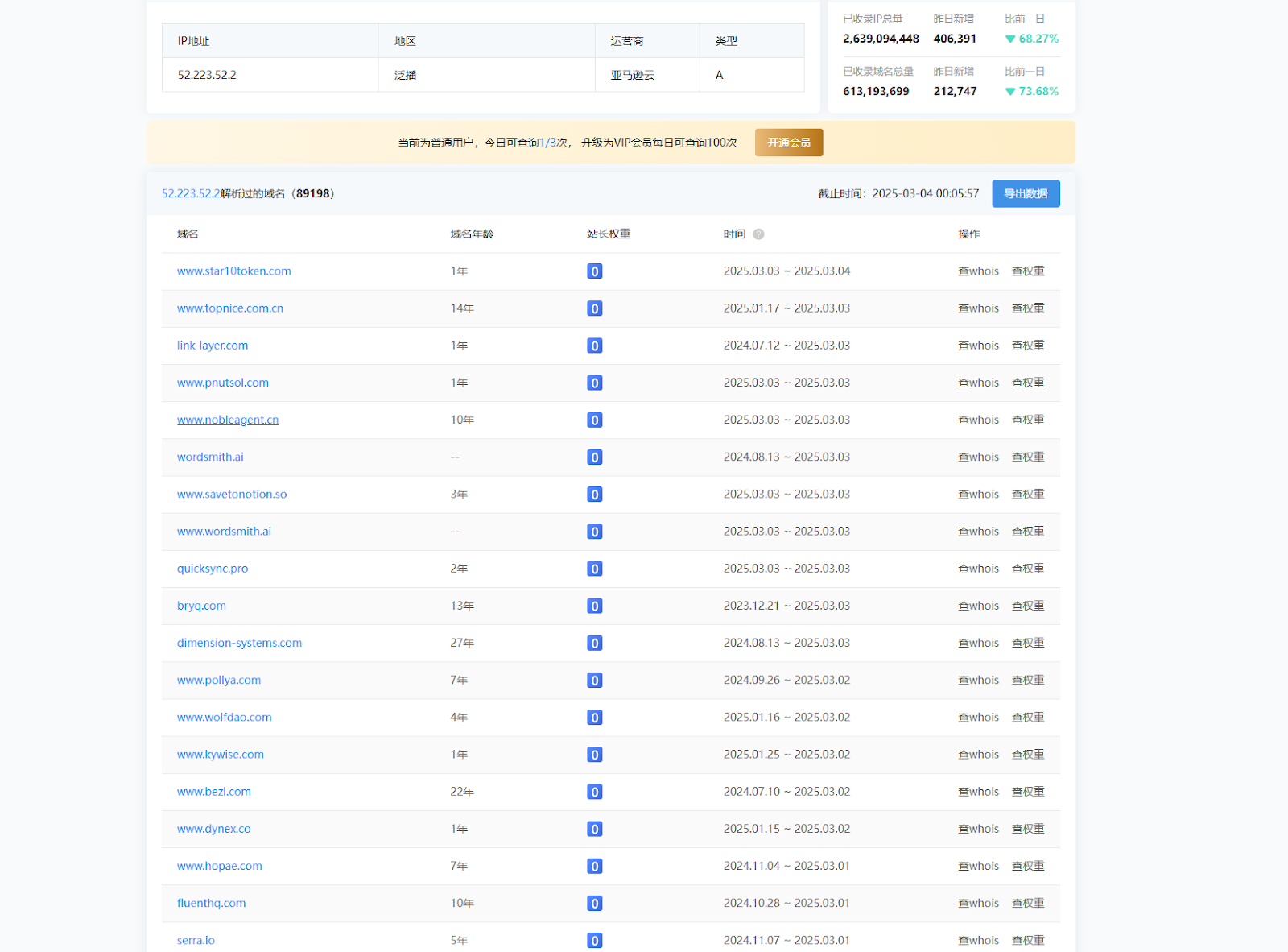
Interestingly, among the domains resolved by this IP address is the official website of another popular meme coin, PNUT—one of the meme coins listed on Binance last year. However, based on currently available evidence, there is no direct proof linking $STAR10’s launch to the alleged conspiracy groups circulating online.
Contract Hides Secrets: Backdoor Permissions Trigger Trust Crisis
Nevertheless, throughout the token launch process, users sensed insincerity in the rollout of $STAR10. According to monitoring by GoPlus Security, the contract owner of $STAR10 retains the right to burn tokens, and the liquidity pool is locked for only one month.
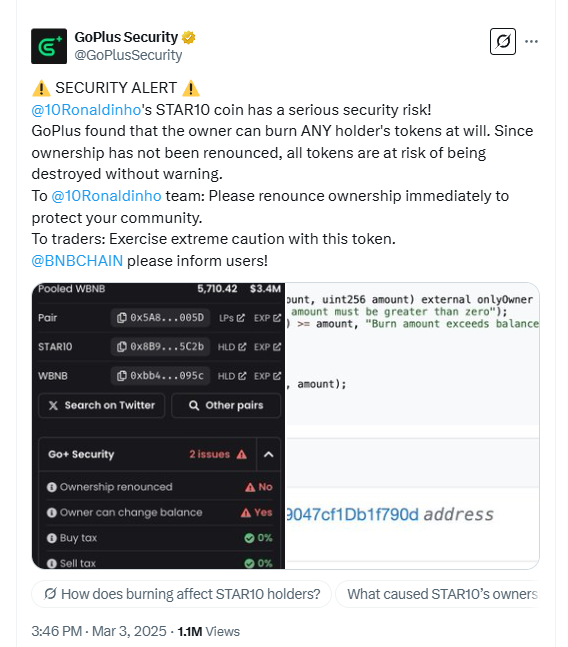
This backdoor-style setup led many users to believe the project team was preparing for a rug pull, sparking widespread criticism on social media. CZ, unaware of the vulnerability at first, initially shared Ronaldinho’s token announcement tweet, clarifying it wasn’t an endorsement but merely appreciation for choosing BNB Chain. He soon faced collective user backlash.
Perhaps under community pressure, Ronaldinho’s team later announced on Twitter that they had relinquished minting privileges and extended the lock-up period to 255 years—until 2281.
However, this damage-control effort failed to win back significant community trust. As of March 4, the number of on-chain holders of the token stood at approximately 9,500—far fewer than TRUMP’s 640,000 or LIBRA’s 27,000 addresses.
Insider Trading Profits Up 282x: Another Case of Early Insider Moves?
Additionally, insider pre-mining—a common issue in celebrity token launches—also surfaced with $STAR10. According to Onchain Lens, an insider purchased 20 million $STAR10 tokens before the public launch using 49 BNB (worth $29,000). By March 4, the address had sold $350,000 worth of tokens and still held over $2.6 million in unsold tokens.
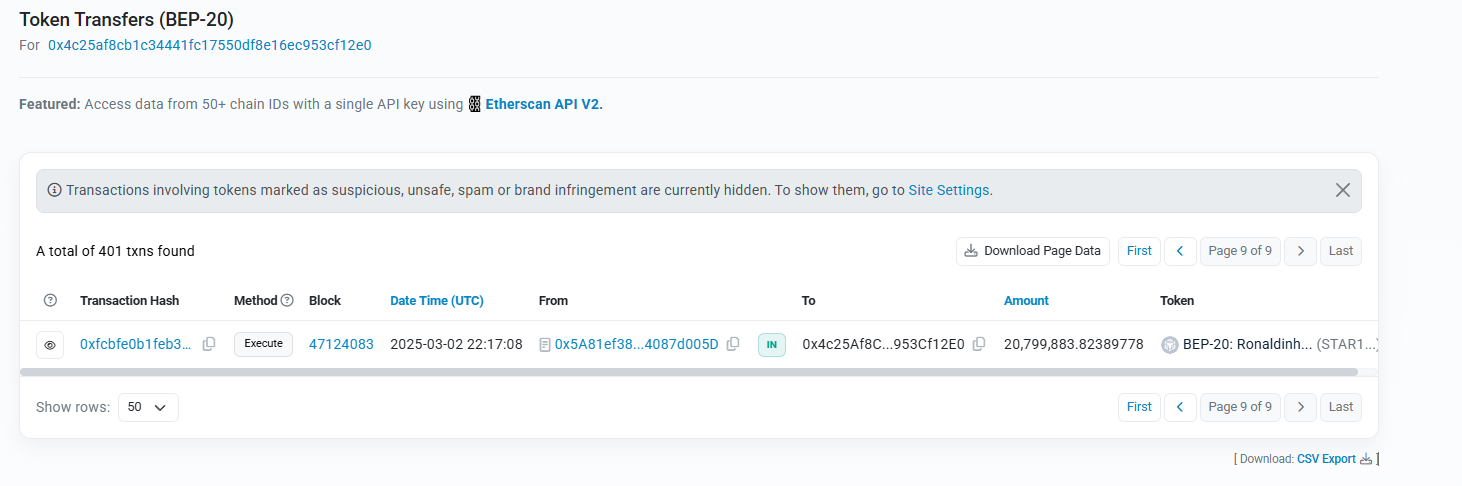
PANews calculated that the individual’s average cost was about $0.0014 per token. At its peak, the price surged nearly 282-fold. Their maximum holding value reached $8.26 million—nearly a quarter of the token’s total circulating supply. More suspiciously, Ronaldinho announced the token on Twitter at UTC 22:17 on March 2, while the purchase transaction occurred at 22:17:08—the same second, and even slightly earlier. How could this address commit $29,000 without confirming the token details? PANews’ investigation revealed the initial funds originated from Binance’s hot wallet.
Overall, Ronaldinho’s token launch appears to be another failure. Similarly, NBA legend Scottie Pippen, who launched his token $BALL in August last year, now sees a mere $4.5 million market cap, around 1,400 holders, $2,300 in 24-hour trading volume, and only five trades recorded—essentially a complete disaster.
Recent high-profile cases like LIBRA and MELANIA were also exposed as orchestrated schemes. The public seems increasingly aware of these harvesting tactics and less willing to blindly participate. As of March 4, $STAR10’s market cap had dropped to just $11.5 million—down 66% from its peak.
From an investment standpoint, celebrity tokens so far have been almost universally disastrous. For celebrities hoping to quickly cash in via crypto launches, this exploitative harvesting model appears to be reaching its limits.
Join TechFlow official community to stay tuned
Telegram:https://t.me/TechFlowDaily
X (Twitter):https://x.com/TechFlowPost
X (Twitter) EN:https://x.com/BlockFlow_News
 PANews


