
Bitcoin's "sharp drop" echoes "lack of economic demand"?
TechFlow Selected TechFlow Selected
Bitcoin's "sharp drop" echoes "lack of economic demand"?
Bitcoin was not created to fulfill the traditional notion of "use value," but rather to deconstruct and reconstruct the global economic consensus on value.
 Navigating Web3 tides with focused insights
By: Daii
The title of today's article mimics a piece from 30 years ago in the U.S. Newsweek magazine titled "The Internet? Bah!"

Bitcoin has just dropped below $80,000 today, and you'll quickly be surrounded by all kinds of criticism and skepticism toward it. This article aims to serve as a bit of intellectual vaccine, helping you remain unfazed by such reactions.
Although the title is somewhat tongue-in-cheek, the topic we're discussing today—economic demand—is highly academic.
The reason for tackling this academic subject is that a heavyweight expert has taken the opportunity of Bitcoin’s sharp decline to dismiss it, using thoroughly academic language, claiming that "Bitcoin has no real economic need."

The expert’s name is Jürgen Schaaf, an advisor to the European Central Bank. In an interview with Cointelegraph, he said, "National-level Bitcoin reserves are a highly risky idea." While it makes sense for governments to maintain reserves of energy resources like oil and natural gas, "Bitcoin has no real economic need," because the cryptocurrency lacks "practical economic necessity or relevant use cases."
1. Bitcoin's 'crash' echoes 'no economic demand'
Clearly, he made these remarks to oppose Bitcoin becoming a central bank reserve asset. Previously, the governor of the Czech National Bank had expressed a view contrary to his.
To support his argument, Schaaf also pointed out other shortcomings of Bitcoin, such as extreme volatility, potential for illegal use, and susceptibility to manipulation. He believes Bitcoin is unsuitable as a central bank reserve asset because it cannot ensure monetary stability and may instead fuel speculative behavior and wealth redistribution.
Jürgen Schaaf, as an advisor to the European Central Bank, possesses deep financial expertise and high authority. His views are widely followed in the industry, not merely because he is a theoretician, but because he is a key figure within Europe’s financial system. As one of Europe’s most important financial institutions, the European Central Bank’s decisions and positions directly influence economic policies across the eurozone. As an advisor to the bank, Schaaf undoubtedly holds significant weight in monetary policy and economic governance.
When he made these comments, Bitcoin had just dipped below $90,000 (on February 25). Two days later (February 27), its price fell below $85,000 again, and today (February 28) it dropped below $80,000—seemingly perfectly echoing Schaaf’s viewpoint.
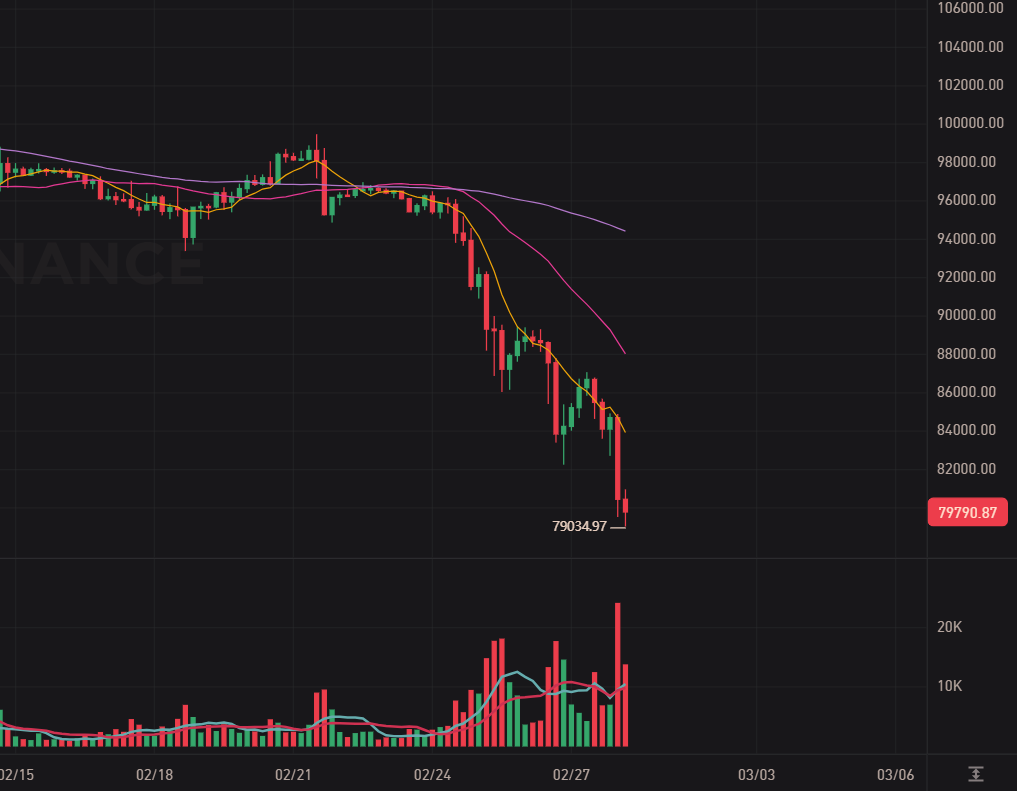
However, did you notice that Schaaf’s argument contains a fundamental cognitive bias—he equates "economic demand" entirely with industrial society’s dependence on physical energy. His thinking remains stuck in the 20th-century paradigm of "oil equals power," overlooking the leap in demand brought by the digital civilization era.
2. Bitcoin's value comes from a new system
Bitcoin was not created to fulfill traditional notions of "use value," but to deconstruct and reconstruct global economic consensus on value. Its contribution to human civilization will far exceed that of oil.
Bitcoin is redefining what we mean by "demand." It does not represent dependence on physical energy or traditional financial tools, but rather reflects the digital age’s profound need for trust, decentralization, and security. Just as the internet was once questioned for "not producing food," it was precisely the internet that drove global information flow, innovation, and economic development.
Bitcoin has created a borderless, decentralized, trustless value transfer system—an idea nearly unimaginable under traditional monetary systems.
In developing countries especially, Bitcoin has become a financial safe haven for many. During crises of hyperinflation and currency devaluation, numerous households have turned to Bitcoin to preserve wealth.
In Argentina, the peso has depreciated rapidly over recent years. Many citizens and businesses have chosen to convert funds into Bitcoin to cope with rising inflation. Statistics show that Bitcoin adoption in Argentina has reached nearly 10%, while in Venezuela, the rate is even higher—exceeding 20%. These figures reflect the substantial "economic demand" for Bitcoin among people in these nations.
In Venezuela, an ordinary family began investing in Bitcoin in 2016. Over several years, their capital appreciated by more than 4,000%. Bitcoin helped them not only preserve wealth that would otherwise have evaporated due to currency depreciation, but also create opportunities for wealth growth.
In Nigeria, despite repeated regulatory shifts by the government regarding cryptocurrencies since 2019—including a banking ban in 2021 and partial deregulation in 2023—Bitcoin trading volume continues to grow, reflecting strong public demand. Of course, the Nigerian government is furious about this and has sued Binance in local court for $79.5 billion.
Moreover, Bitcoin’s decentralized nature gives it powerful cross-border payment capabilities worldwide. Data shows that users of Bitcoin cross-border payments grew by over 200% between 2018 and 2023.
Certainly, not everyone sees Bitcoin’s potential, just as not everyone recognized the internet’s value back in 1995.

3. Lessons from "The Internet? Bah!"
The famous article in Newsweek became well-known for its pessimistic predictions about the internet. It questioned the internet’s commercial potential and social value, offering specific criticisms:
"No online database will replace your daily newspaper."—questioning the internet’s threat to traditional media. "No CD-ROM can replace a competent teacher."—doubting technology’s role in education. "No computer network will change how governments operate."—denying the internet’s impact on politics. "We were promised instant catalog shopping—with great deals just a click away. We’d book plane tickets, reserve restaurants, and negotiate sales contracts online. Stores would become obsolete. So why does my local mall do more business in one afternoon than the entire internet does in a month?"—challenging e-commerce feasibility.
You already know now that all of these criticisms have become reality.

Clifford Stoll, the article’s author and an astronomer, is now 74 years old. Stoll is no stubborn reactionary; as early as 2010, he reflected on his article and admitted his mistake.
We bring up Stoll’s article today because it perfectly mirrors current criticism of Bitcoin.
When ECB advisor Jürgen Schaaf declares that "Bitcoin has no real economic need," his underlying logic is identical to Stoll’s denial of the internet’s commercial value—using industrial-era definitions of "demand" to judge a paradigmatic revolution in the digital age.
Just as Stoll could not have imagined Amazon’s trillion-dollar market cap, traditional financial elites struggle to understand the new forms of economic demand created by Bitcoin—such as censorship-resistant transactions, algorithmic trust, and time sovereignty—and the immense productive forces they might unleash.
Conclusion
History doesn't repeat itself, but it often rhymes.
The value of every disruptive technology ultimately establishes its foundation in the cracks of outdated paradigms.
Bitcoin’s plunge and the surrounding skepticism resemble the darkest moments of the internet bubble burst. In 2000, the Nasdaq index plummeted 78%, Amazon’s stock lost 95% of its value, and The Wall Street Journal declared, "E-commerce is destined to be a flash in the pan." But 24 years later, global e-commerce transaction volume exceeds $6 trillion, and Amazon’s market cap is 30 times its peak value at that time.
Price volatility never negates value revolution, just as a tsunami cannot negate the existence of the ocean.
The steam engine didn’t bring faster carriages—it ushered in the entire railway era. Bitcoin isn’t changing existing money; it’s creating a new value network based on mathematical consensus.
Looking back from 2025, Stoll-style misjudgments constantly remind us:
The true power of technological revolutions lies not in what they replace, but in what new continents they create.
Join TechFlow official community to stay tuned
Telegram:https://t.me/TechFlowDaily
X (Twitter):https://x.com/TechFlowPost
X (Twitter) EN:https://x.com/BlockFlow_News
 @yzdxs8