Deepseek and Grok3 strike simultaneously, OpenAI tests open-source with a rush to launch GPT-4.5
TechFlow Selected TechFlow Selected
Deepseek and Grok3 strike simultaneously, OpenAI tests open-source with a rush to launch GPT-4.5
Under the dual pressure from Deepseek and Grok3, OpenAI is beginning to lose its composure.
 Navigating Web3 tides with focused insights
Author: Mu Feng, AI Pioneer Officer
Under dual pressure from Deepseek and Grok3, OpenAI has begun to lose its composure.
On February 18, OpenAI CEO Sam Altman posted a poll on X, asking users: "For our next open-source project, would it be more useful to build a fairly small o3-mini-level model that still requires running on a GPU, or a mobile-sized model—the best we can make for phones?"
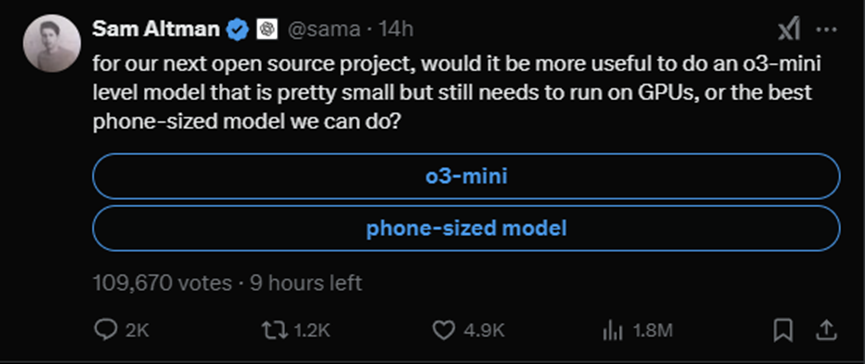
Over 30,000 users have participated so far, with nearly equal support—52% favoring the phone-sized model.
For the past six years, OpenAI has adhered strictly to a closed-source strategy.
But this poll signals that OpenAI is preparing to open-source another large model.
Earlier in February, Sam Altman rarely admitted that OpenAI's closed-source approach had "ended up on the wrong side."
Altman said DeepSeek means OpenAI's lead "won't be as large as in previous years," and that OpenAI needs a different open-source strategy regarding model weights and research outputs.
Just months ago, AI discussions centered on closed-source models like ChatGPT, Claude, and Gemini. Based on these closed-source models, OpenAI had built a formidable fortress via API access and subscription models.
But with DeepSeek's emergence, it has proven that open-source large models can match GPT-4o-level capabilities—at lower cost and with local deployment options.
DeepSeek has almost single-handedly shifted market direction, tipping the balance toward open-source large models.
Even Baidu, long an advocate of closed-source AI, announced it will open-source its next-generation Ernie 4.5 series by the end of June.
Now, the entire AI ecosystem is embracing open source.
For example, on February 18 alone, multiple models were announced as open-source:
Kunlun Tech announced the open-sourcing of SkyReels-V1, China's first video generation model dedicated to AI short drama creation, along with SkyReels-A1, a controllable facial expression and motion algorithm based on the video foundation model. SkyReels-V1 is claimed to be the most powerful image-to-video open-source model;
Meanwhile, StepFun and Geely Auto open-sourced the in-cabin scenario-oriented Step-Video-T2V text-to-video generation model and the Step-Audio large speech interaction model;
On the other side, LimX Dynamics also announced the open-sourcing of LimX VGM, an embodied manipulation algorithm based on video-generative large models.
Yesterday, Musk announced during the launch of xAI's third-generation AI model Grok3 that Grok-2's code and weights will be open-sourced.
Related reading: Musk Launches Grok3, Surpassing DeepSeek-V3 in Math, Science, and Coding; Grok-2 to Be Open-Sourced
Under such intense pressure and competition, OpenAI’s rhythm is clearly disrupted.
On the same day, Altman also posted about GPT-4.5, saying, "For demanding testers, trying GPT-4.5 feels much closer to AGI than I expected!"
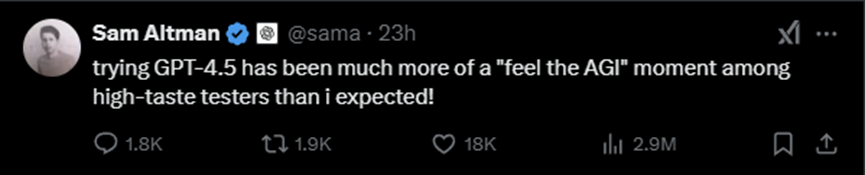
This may suggest that GPT-4.5 has already entered testing and is nearing official release.
Some speculate that Altman's promotion of GPT-4.5 is specifically aimed at countering xAI's Grok3.
Just days ago, Altman revealed the updated roadmap for the GPT series.
He stated that the o3 model will no longer be released as a standalone model, GPT-4.5 will launch within weeks, and GPT-5 within months.
Join TechFlow official community to stay tuned
Telegram:https://t.me/TechFlowDaily
X (Twitter):https://x.com/TechFlowPost
X (Twitter) EN:https://x.com/BlockFlow_News