Can Ethereum still be 'saved' in 2025?
TechFlow Selected TechFlow Selected
Can Ethereum still be 'saved' in 2025?
Reviewing Ethereum's fundamentals.
 Navigating Web3 tides with focused insights
Author: Mu Mu
Lu Xun never said, "No matter what sins you committed in your past life, holding Ethereum counts as paying them off." This cycle, Ethereum holders didn't expect Ethereum to underperform so badly—once trailing near the bottom among major projects. But it's too early to draw conclusions. The broader market cycle may not be over yet. If Bitcoin adoption is only just beginning, then crypto and Web3 as a whole are still in their infancy. Can Ethereum recover in 2025? What events and breakthroughs should we look forward to?

Spot ETF Inflows
Ethereum spot ETFs have been approved and listed on U.S. stock exchanges for some time now, but their pace and scale of capital inflows lag significantly behind those of Bitcoin spot ETFs. Aside from Ethereum lacking Bitcoin’s level of mainstream recognition and broad consensus, another key reason is that spot ETFs—which offer no additional yield while charging management fees—provide little advantage compared to directly holding ETH and earning staking rewards.
However, good news is coming in 2025: financial industry insiders are actively pushing for the approval of staking-enabled Ethereum spot ETFs that allow investors to earn yield. The motivation is strong—financial giants benefit greatly from the booming trading demand for crypto spot ETFs. Staking-enabled Ethereum ETFs have clear market potential, and with Trump’s return bringing a more favorable regulatory environment, such products are more likely to gain approval.
Ethereum Strategic Reserve
The U.S. government’s ongoing推进 of a Bitcoin strategic reserve has become one of the main catalysts for the Bitcoin and broader crypto markets. It's worth noting that alongside gold, oil is also a critical component of America’s strategic reserves. Therefore, it makes sense for Bitcoin—the “digital gold”—to be included as a strategic asset, and Ethereum, once dubbed “digital oil,” could similarly be considered for inclusion.
Notably, the Trump family’s WLFI project—a Web3 initiative built on the Ethereum mainnet—relies heavily on Ethereum’s DeFi ecosystem, supported by protocols like Aave and Chainlink. Moreover, the project’s treasury has begun accumulating significant amounts of ETH and tokens from Ethereum-based projects, recently converting large holdings of WBTC into ETH. Analysis of seven multi-sig wallets linked to the treasury reveals that some addresses belong to seasoned participants in Ethereum’s DeFi ecosystem, indicating a high level of expertise and professional execution by the team.
Given that Trump-affiliated groups have taken the lead in adopting Ethereum-based projects, we can infer a strong endorsement of Ethereum’s future development and support for high-tech sectors like Web3, aligning well with Trump’s “America First” agenda. Therefore, there is a non-trivial chance that Ethereum could be discussed as a strategic reserve asset in 2025.
Ethereum’s Next Major Upgrade
Ethereum’s lackluster performance has led to relatively low attention around its next major upgrade, codenamed “Pectra.” However, ten EIPs (Ethereum Improvement Proposals) have already been added to this upgrade plan, focusing primarily on improving user experience and Layer2 support. Key highlights include:
1) Account Abstraction Enhancements
This upgrade will improve wallet usability, enabling standard external-owned accounts (EOAs) to access advanced features previously limited to smart contract wallets—such as gas sponsorship, social recovery, and multi-signature controls. These improvements will significantly lower barriers to entry, allowing Web3 applications to deliver user experiences comparable to traditional Web2 apps, laying the groundwork for mass adoption.
2) Layer2 Support Optimization
The upgrade will expand data space (blobs) available for Layer2 solutions and re-evaluate calldata costs to optimize block throughput and storage efficiency. In simple terms, this means increased capacity and lower fees for Layer2 networks through expanded data availability and cost reductions.
3) Enhanced Validator Security and Flexibility
Improvements will be made to validator voting mechanisms and withdrawal processes to increase security and efficiency. Additionally, the 32 ETH staking cap will be raised, effectively merging multiple validator nodes. This reduces operational overhead and alleviates network-wide peer-to-peer messaging and data storage burdens across thousands of nodes.
In summary, the Pectra upgrade will strengthen Ethereum’s foundational infrastructure, delivering better user experience, greater scalability, and a more stable node network.
Burst of Ecosystem Applications and Technological Progress
Currently, an increasing number of institutions—including the Trump family’s DeFi project, Sony’s Layer2, and Deutsche Bank’s Layer2—are choosing Ethereum as their preferred platform for building Web3 applications and infrastructure solutions.
Ethereum leads in nearly every aspect: technical resources, development history, developer support, on-chain capital volume, client security, and wallet user experience—all mature, rich, diverse, and ahead of competitors. As such, during the next phase of the 2025 bull market—whether driven by a strong DeFi rebound or explosive growth in sectors like AI agents—Ethereum, as the foundational layer, stands to benefit immensely from rising application adoption and on-chain activity. Benefits include increased capital inflows, higher gas consumption, token supply deflation, and more.
With the launch of Unichain, the OP Superchain gains another heavyweight participant. Cross-Layer2 liquidity is expected to make significant progress in 2025. Combined with Ethereum’s own protocol upgrades, the collective momentum of major Layer2s could exert unprecedented competitive pressure on newer high-performance public chains.
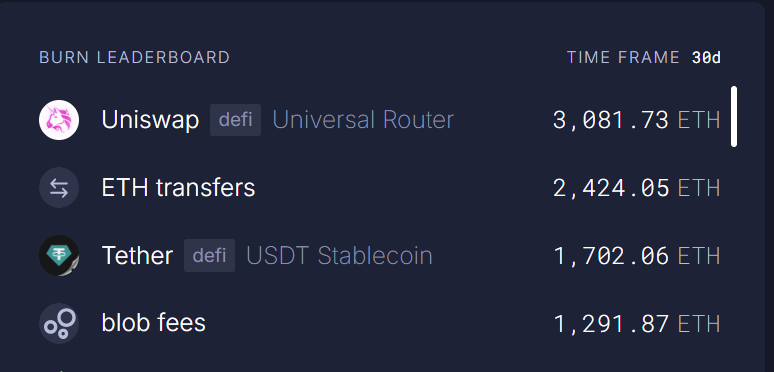
For years, critics claimed Ethereum’s Layer2 was a failure—draining value from the mainnet without giving back. But recently, we’ve clearly seen Layer2 thriving. Data from Ultra Sound Money shows that Layer2 blob fees have become one of the largest contributors to Ethereum’s gas burn, demonstrating the success of its rollup-centric scaling strategy.
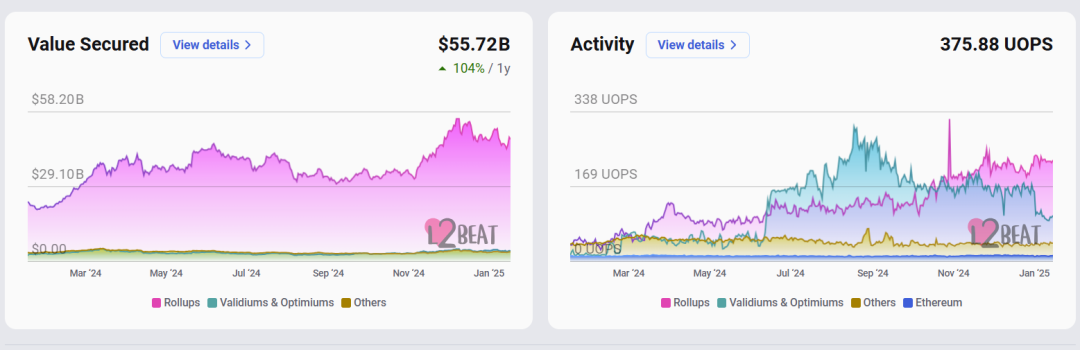
Real-time statistics from L2Beat show that funds locked in Layer2 exceed $55 billion. In terms of transaction volume, total scaling capacity exceeds 2,500% of the original Ethereum mainnet.
For major external organizations like Sony and Deutsche Bank, Layer2 offers an ideal entry point into Web3—requiring minimal technical investment while gaining immediate access to Ethereum’s vast ecosystem and community support. With these pioneers leading the way, institutional adoption of Layer2 is poised to accelerate rapidly.
Conclusion
Deep down, many people recognize that Ethereum and its ecosystem maintain clear advantages across multiple dimensions. The surprise lies in realizing that today’s Ethereum is no longer something that can be moved quickly by the same levels of capital that drove previous cycles. Clearly, this isn’t easy. Just as Bitcoin required massive institutional inflows via spot ETFs and strong expectations around U.S. strategic reserves to surge, Ethereum faces similar structural challenges. Yet unlike Bitcoin, Ethereum has the added tailwinds of continuous technical upgrades and the evolution of the Web3 ecosystem. There’s still plenty to watch in 2025—stay tuned.
Join TechFlow official community to stay tuned
Telegram:https://t.me/TechFlowDaily
X (Twitter):https://x.com/TechFlowPost
X (Twitter) EN:https://x.com/BlockFlow_News
 白话区块链
白话区块链