LBank Research: The Core Opportunities Behind the Mutual Empowerment of Desci and Web3
TechFlow Selected TechFlow Selected
LBank Research: The Core Opportunities Behind the Mutual Empowerment of Desci and Web3
By introducing blockchain and Web3 technologies, DeSci is dedicated to building a more equitable, transparent, open, and collaboration-driven scientific research ecosystem.
 Navigating Web3 tides with focused insights
Introduction:
DeSci, or Decentralized Science, leverages blockchain technology and smart contracts to provide a fair, transparent, and decentralized platform for funding, creating, reviewing, verifying, storing, and disseminating scientific research. Its goal is to break down financial barriers in traditional scientific research, promote global collaboration among scientists, and ensure the openness and transparency of research data.
What is Decentralized Science (DeSci)?
Decentralized Science (DeSci) is an innovative movement aiming to transform traditional models of scientific research. By integrating blockchain and Web3 technologies, DeSci seeks to build a more equitable, transparent, open, and collaboration-driven research ecosystem. At its core, this concept redefines how research is funded, knowledge is shared, and academic成果 are disseminated—using decentralized tools and technologies.
The essence of DeSci lies in solving a series of systemic problems within traditional science (TradSci), rather than merely advocating for "open science." Compared to the open science movement, DeSci places greater emphasis on applying technology to reconstruct relationships within the research ecosystem, emphasizing the use of tokens, NFTs, and decentralized autonomous organizations (DAOs) to dismantle centralized monopolies and establish a more dynamic and inclusive research system.
Currently, DeSci focuses on several key objectives:
- Incentive Mechanism Design: Motivating researchers to share their findings and recognizing academic value through reputation systems.
- Decentralized Peer Review and Funding: Breaking the monopoly held by centralized institutions over allocation of research funds and review processes, adopting community-driven resource distribution to support more high-potential projects.
- Lowering Barriers to Scientific Research: Enabling broader access to scientific knowledge and allowing more individuals to contribute to scientific advancement, thus democratizing research.
- Transparent Research Processes: Ensuring full transparency across all stages of research to enhance academic integrity and trust.
Through these innovations, DeSci aims to address imbalances in information flow and resource allocation in traditional research, making science more open and efficient. It not only provides researchers with new tools and platforms but also creates opportunities for global communities to participate directly in scientific inquiry.
At its heart, DeSci promotes the idea that science should be accessible to all and scientific knowledge must be transparent. Harnessing the power of Web3 technologies, this movement is steering science from traditional centralized models toward a new era defined by openness, collaboration, and technological empowerment.
How Does DeSci Address Pain Points in Traditional Research?
The current model of research economics suffers from clear structural flaws. In theory, funders, scientists, and publishers should collaborate to advance, disseminate, and apply scientific discoveries. However, reality paints a different picture—funders allocate capital, scientists conduct studies, and publishers distribute results. These three core components operate in isolation as separate economic entities, driven more by individual interests than collective goals. This fragmentation leads to inefficient resource allocation and obstructed knowledge sharing, hindering the healthy development of scientific research.

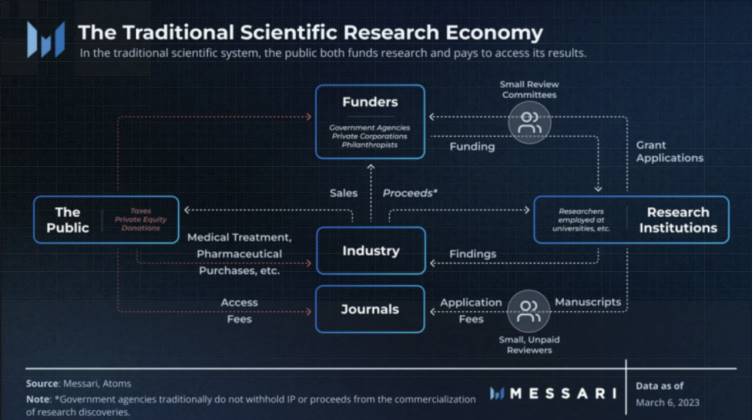
Traditional scientific research economic model, image source: Messari Research
DeSci emerged precisely to tackle this dilemma. By introducing blockchain and Web3 technologies, it seeks to dismantle siloed interests and efficiency bottlenecks in traditional science, reshaping the entire research ecosystem. One central issue DeSci targets is the so-called “valley of death”—a critical gap between fundamental research and its successful transformation into innovations that benefit society. In traditional models, many promising studies fail during this phase due to insufficient funding, closed data, and poor collaboration, preventing real-world impact.
To bridge these gaps, DeSci employs several innovative approaches:
- Efficient Funding Allocation: Utilizing DAOs and tokenized economic models to deliver transparent and efficient financial support to research initiatives, minimizing waste.
- Data Sharing and Collaboration: Establishing open research data platforms to simplify access and usage, breaking down information silos and enabling cross-disciplinary cooperation.
- Disruptive Publishing Models: Leveraging blockchain to decentralize academic publishing, ensuring transparency and verifiability while reducing publication costs and diminishing publisher monopolies.
- Bridging Basic Research and Application: Accelerating the translation of研究成果 through community-driven collaboration, increasing the societal impact of scientific work.
Overall, DeSci does not simply patch shortcomings in traditional research—it aims to construct an entirely new paradigm. In this model, stakeholders no longer operate in isolation but instead engage in deeper collaboration via technological integration, collectively advancing open, transparent, and efficient scientific progress. This offers fresh perspectives on resolving persistent challenges and unlocks vast possibilities for the future of science.
How Is the DeSci Sector Developing?
As an emerging sector, DeSci encompasses multidimensional innovation pathways. According to analysis by Messari Research, the current DeSci project landscape can be divided into multiple subfields, including financing, research, data management, peer review, publishing, infrastructure and services, open science ecosystems, art, and community building. As of July 2023, there were 85 active DeSci projects, some spanning multiple categories. The surge in activity began primarily in Q4 2021 through Q1 2022, closely linked to the DeSci-focused panel at LisCon in October 2021. Additionally, the broader crypto market boom at the time provided strong momentum for DeSci’s rapid growth.
Currently, the DeSci sector exhibits three notable characteristics: First, most projects adopt DAOs as their organizational structure, enabling community-driven governance and resource allocation. Second, fundraising remains a primary focus, leveraging Web3 digital asset tools to efficiently raise capital and propel research forward. Third, biotechnology—particularly life sciences, health, and longevity—is the dominant application area. Whether addressing early-stage funding gaps or tackling the "valley of death" in drug development, DeSci offers innovative solutions.
Market Performance of DeSci Projects
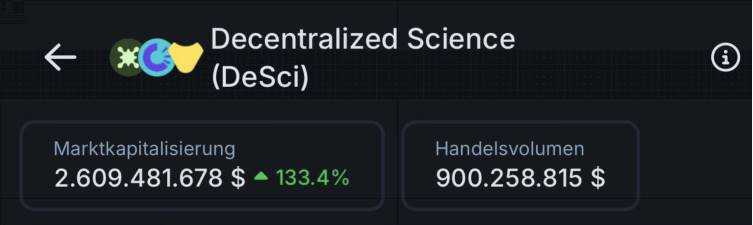
In terms of capital market performance, DeSci projects remain in their infancy. According to CoinGecko, the total market cap of DeSci-related tokens has surpassed $2.6 billion. However, compared to other Web3 sectors, DeSci tokens generally have lower valuations due to several factors:
- DeSci is still in the early exploration stage, with a limited number of projects;
- Many tokens are designed primarily for project financing and reinvestment, with restricted circulation, limiting their presence in secondary markets;
- The target audience for DeSci is relatively niche, attracting specialized participants interested in the intersection of science and Web3;
- Strong real-world ties make DeSci more focused on practical applications than financial speculation, constraining speculative trading potential.
Although DeSci has yet to achieve scale in market capitalization, its influence is gradually expanding, especially among users focused on research innovation and solving traditional pain points. Looking ahead, as more projects launch and研究成果 translate into tangible outcomes, DeSci's market performance is expected to steadily rise, unlocking greater synergy between science and Web3.
Key Projects in the DeSci Space
1) Molecule
Founded in 2021, Molecule is a decentralized protocol aiming to disrupt traditional biotech R&D models. It seeks to create a new financing ecosystem for early-stage biological research and pioneered the concept of IP-NFTs—tokenizing biotech intellectual property (IP) on-chain—earning it the nickname “OpenSea for biotechnology.”
Core Technology: IP-NFT Protocol
Molecule’s IP-NFT (Intellectual Property Non-Fungible Token) protocol combines legal agreements with smart contracts to bundle and tokenize legal rights, data access permissions, and economic value associated with biological research projects. This mechanism enables novel collaboration models between researchers and funders, making ownership and revenue sharing more transparent and efficient.
Molecule Marketplace: Connecting Research and Capital
Built on IP-NFTs, Molecule has created a marketplace dedicated to translational research, facilitating efficient connections between researchers and funders. On the Molecule Discovery platform, researchers submit proposals, which funders evaluate before negotiating collaboration terms. This approach strongly supports the transition from basic research to practical applications, accelerating the real-world implementation of medical advancements.
BioDAO Launchpad: Incubating Biotech DAOs
To further develop the decentralized biotech ecosystem, Molecule launched the Bio.xyz incubator platform. Focused on building and nurturing new bio-science DAOs (BioDAOs), this initiative brings together patients, researchers, and enthusiasts to fund targeted medical research based on IP-NFTs.
The Molecule incubator provides up to $100,000 in seed funding for each early-stage BioDAO, with notable success stories including:
- VitaDAO: The world’s first decentralized biotech DAO focused on longevity research and the largest funder on the Molecule platform.
- AthenaDAO: Dedicated to women's health research and funding.
- HairDAO: A scientific initiative targeting hair loss solutions.
Ecosystem Development and Future Outlook
Through its innovative IP-NFT model and robust ecosystem support, Molecule not only helps researchers secure early funding but also promotes the adoption of decentralized biotech. To date, Molecule has successfully advanced numerous projects from foundational research to real-world application. Collaborations with organizations like AthenaDAO and VitaDAO are helping build a biotech ecosystem centered on innovation and openness.
Tokenization and Market Dynamics
Molecule’s IP-NFT marketplace has attracted various research institutions and funders, enabling efficient capital flows via decentralized exchanges like Uniswap. Molecule’s vision is to expand its ecosystem further, making biotech R&D more transparent, open, and efficient, thereby powering the future of global health technology.
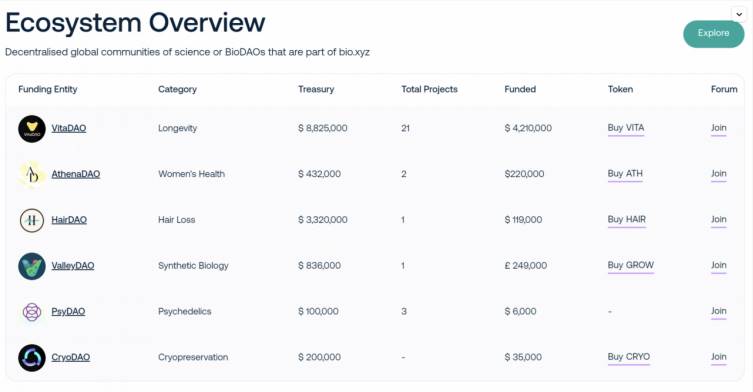
Molecule and BIO Protocol stand as pillars of the DeSci space, driving the decentralization of scientific research. With distinct innovation paths and token mechanisms, they jointly lay the foundation of the DeSci ecosystem:
- VitaDAO ($VITA): A community-driven decentralized autonomous organization (DAO) focused on providing early-stage funding for longevity research. Addressing the lack of early funding and technological monopolies in traditional biopharma—especially in longevity—VitaDAO introduces a novel solution. By leveraging blockchain and crypto-economic incentives, VitaDAO supports crucial initial funding for longevity research. In return, it holds the intellectual property (IP) and data rights of supported projects, consolidating them into a publicly accessible portfolio. Through data marketplaces or licensing/commercialization via traditional pharma channels, these IPs are further developed and utilized, while being tokenized with the issuance of a native governance token—$VITA. Individuals or organizations can earn $VITA by contributing work, capital, or resources such as data or IP. $VITA holders participate in curating and governing VitaDAO’s assets and research.
This model reduces risks of technological monopolization and opens new avenues for public access and widespread application of研究成果, deepening the integration of scientific research with blockchain technology.
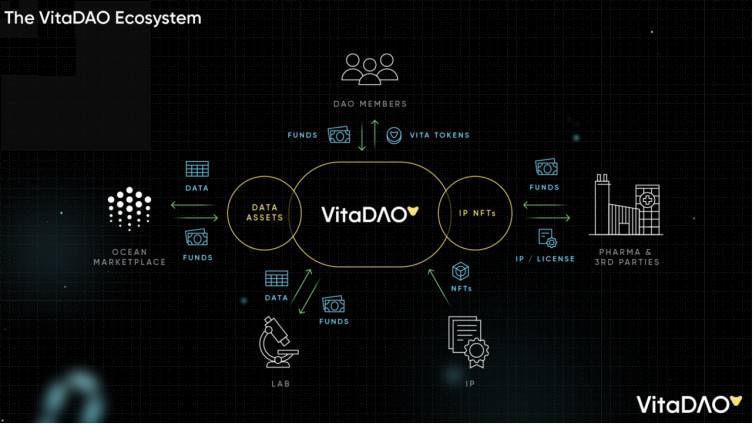
VitaDAO ecosystem, image source: VitaDAO Whitepaper
Tyler Golato, founder of the project, is also co-founder of VitaDAO, Molecule, and BIO Protocol. Paul Kohlhaas, author of the VitaDAO whitepaper and administrator of the token economics working group as well as member of technical and legal teams, is founder and CEO of both Molecule and BIO Protocol, formerly at ConsenSys Ventures. VitaDAO also received Pfizer’s first Web3 investment through its healthcare investment arm.
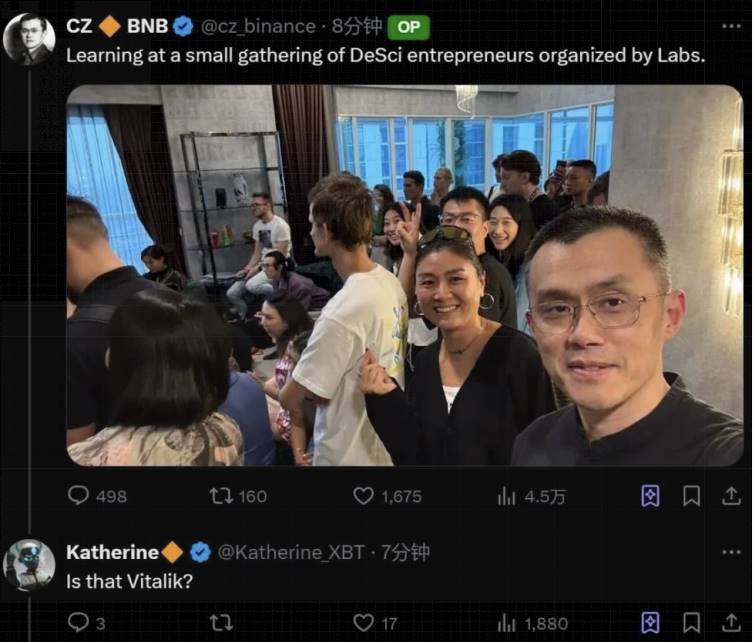
On November 13, 2024, Binance founder CZ posted on X about attending “a small DeSci entrepreneur meetup organized by Binance Labs” and shared a photo with Vitalik. During the event, Vitalik showcased VitaDAO’s first longevity product—VD001, a natural high-dose spermidine supplement approved by Thailand FDA.
BIO Protocol ($BIO): As the first DeSci project backed by Binance Labs, BIO Protocol has drawn significant attention. Beyond Binance Labs, it has garnered strong support from prominent venture capital firms in both crypto and biotech, including 1kx, Boost VC, Sora Ventures, Zee Prime Capital, and Northpond Ventures—a biotech fund exceeding $3 billion in size. In November 2024, BIO Protocol successfully completed its genesis community funding round, raising $30.3 million—an important milestone in community engagement and decentralized governance.
BIO Protocol’s core mission is to accelerate biotechnological innovation. The protocol enables patients, scientists, and biotech professionals worldwide to collaboratively fund, build, and share in tokenized biotech projects and intellectual property (IP), unlocking new possibilities in the field. Its Launchpad platform will offer more efficient funding and liquidity support for DeSci innovators and accelerate real-world deployment of biotech through fostering BioDAO creation and growth. Founder Paul Kohlhaas revealed that the Launchpad and token transfer functionality are scheduled to launch in Q1 2025.
The native token $BIO plays a vital role in the ecosystem with multiple functions:
- Token staking: Holders can lock $BIO to receive vBIO for voting and governance.
- Reward mechanism: Stakers who back successful BioDAOs earn additional $BIO rewards and gain priority access to funding rounds.
$BIO Tokenomics
- 56% allocated to ecosystem and community
- 25.4% to early contributors
- 18.6% to early supporters
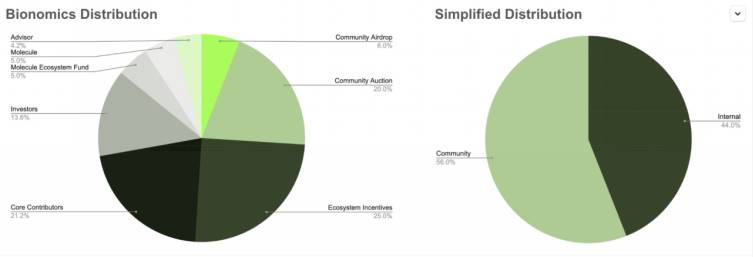
$BIO token distribution, image source: BIO Protocol official website
$BIO surged to a peak of $1.477 shortly after launching on January 3, but faced selling pressure afterward. At the time of writing, the price had dropped to $0.6921, with FDV exceeding $2.3 billion.
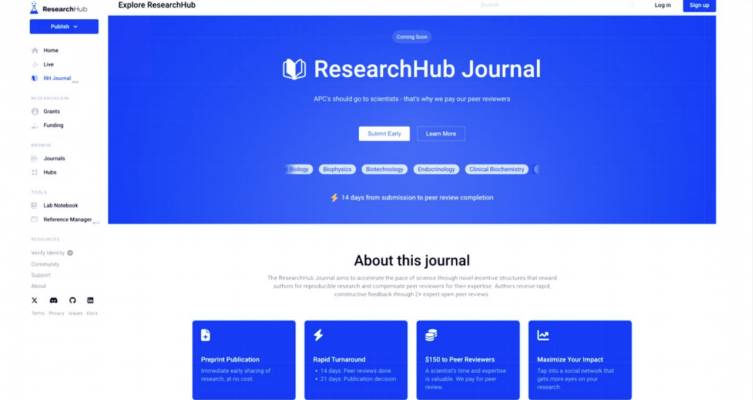
- ResearchCoin ($RSC): The native token of ResearchHub, designed to accelerate scientific discovery by rewarding users for sharing, discussing, and curating academic content. Users earn $RSC through contributions to scholarly resources.
- AthenaDAO ($ATH): Focuses on scientific research, education, and funding in women’s health, having funded over $500,000 and currently managing 14 pending IP transactions.
- ValleyDAO ($GROW): A decentralized organization focused on anti-aging and longevity therapeutics, aiming to accelerate innovation in life sciences through interdisciplinary collaboration.
2) Pump.Science ($URO & $RIF)
Pump.Science is a recently popular DeSci project gaining traction due to its meme appeal, with core tokens $URO and $RIF considered leading figures in the DeSci meme segment. $URO (Urolithin A) is based on a natural metabolite found in pomegranates and nuts, showing potential for lifespan extension; $RIF (Rifampicin) centers around antibiotics, commonly known as rifampin. Driven by various developments, both tokens have shown exceptional recent performance: $URO has surpassed a $48 million market cap, currently priced at $0.048, though down ~20% in 24 hours; $RIF has a total market cap of $45.53 million, trading at $0.045, with a 12% drop in 24 hours.
3) DeSci Meme: ($ANTI & $PRO)
$ANTI and $PRO are meme token pairs initiated by algorithm engineer and mathematical physics expert @sshmatrix_, symbolizing support ($PRO) or opposition ($ANTI) toward meme tokens. Their unique design has attracted many meme enthusiasts and sparked discussions in quantum computing circles. Currently, both tokens have liquidity on decentralized exchanges, with a 1:1 parity mechanism giving them distinctive market value. $ANTI and $PRO now have market caps of $1.71 million and $1.93 million respectively, prices at $0.0019363 and $0.0017073, each down about 5% in 24 hours.
4) Donation Concept: Sci-Hub ($scihub)
$Scihub is a community-driven meme token founded by @0xAA_Science to support Sci-Hub, the open-access academic paper repository often called the “shadow library.” Inspired by Sci-Hub’s ethos, $Scihub aims to enable decentralized support for open sharing of scientific knowledge. $Scihub is now tradable on PancakeSwap, drawing members passionate about open science and educational equity.
5) Artificial Neural Network: DeepWorm ($WORM)
DeepWorm is an innovative project merging artificial intelligence with DeSci by bringing biological neural structures onto the blockchain. Inspired by the 302 neurons of *C. elegans*, DeepWorm is developing the first verifiable on-chain digital lifeform, pioneering a new frontier where digital biology meets blockchain.
Project Highlights
- Digital Biology: Creating self-aware digital entities that simulate biological nervous systems.
- Blockchain Integration: Fully transparent and verifiable neural processes, permanently recorded on-chain.
- Biomimetic Design: Faithfully replicating the neural architecture and behavioral patterns of C. elegans.
- Autonomous Systems: Building autonomous monetary systems and smart contracts powered by evolutionary neural networks to drive innovation in on-chain applications.
Technical Implementation
Currently, DeepWorm runs the Nematoduino model on the Hyperliquid EVM testnet using Marlin TEE (Trusted Execution Environment) technology:
- Users can query the worm’s neural and muscular states and coordinate changes via a Web2 interface;
- DeepWorm regularly snapshots this data and posts it on-chain, providing foundational components for third-party smart contracts to develop innovative on-chain applications.
6) Metasci ($METASCI): The project’s token, focusing on integrating AI with scientific research to optimize workflows and drive technological revolution.
7) First DeSci Project on SUI: SUI Desci Agents ($DESCI)
The SUI ecosystem has rapidly risen in this cycle, drawing attention with a $43 billion FDV, thriving ecosystem, and an over 8x price increase. As the first DeSci project on SUI, SUI Desci Agents aims to leverage SUI’s scalability and developer-friendly Move programming language to revolutionize decentralized science. The project plans to become a DeSci token launchpad akin to Pump.fun, democratizing DeSci investment opportunities. Official information indicates that $DESCI will soon be publicly offered on Ape Terminal.
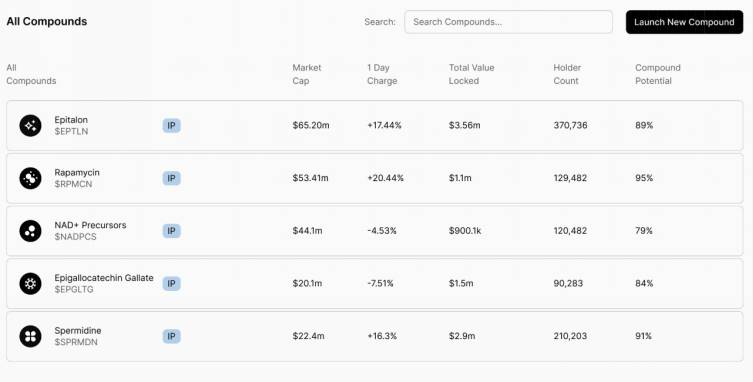
DeSci remains in its early developmental phase, with practical impacts currently limited mainly to research funding and data sharing. Widespread adoption of token-based incentive mechanisms in core scientific processes like peer review has yet to materialize. Additionally, DAO-operated DeSci projects face ongoing challenges related to organizational efficiency and sustainable business models.
Nevertheless, DeSci introduces a fundamentally new perspective to science: not only overcoming limitations in traditional research funding but also alleviating data silo issues. More importantly, through decentralized technologies, DeSci enables trustless, global, interdisciplinary collaboration and fosters a more democratic and open mode of participation in science. Particularly in advancing open science and citizen science, DeSci demonstrates unique strengths—shifts that could profoundly influence modern scientific development and inject renewed vitality into the future of research.
Conclusion:
Although DeSci is still in its early stages, growing investment and interest indicate immense potential. DeSci is not just technological innovation—it represents a paradigm shift in scientific research that could reshape how science is organized and incentivized in the coming years. Several DeSci-related tokens have already demonstrated strong market performance, signaling the sector’s growth trajectory.
Challenges facing DeSci include regulatory compliance, balancing the long-term nature of scientific research with the short-term speculation prevalent in crypto markets, and raising public awareness of its value. Yet, DeSci also presents tremendous opportunities—improving access to research funding, advancing open science, and enhancing accessibility and fairness in science.
Join TechFlow official community to stay tuned
Telegram:https://t.me/TechFlowDaily
X (Twitter):https://x.com/TechFlowPost
X (Twitter) EN:https://x.com/BlockFlow_News