2024 AI Agent Trending Projects Review: From Meme to Infrastructure Tokens Transformation
TechFlow Selected TechFlow Selected
2024 AI Agent Trending Projects Review: From Meme to Infrastructure Tokens Transformation
In 2025, the AI Agent Summer could surpass the previous DeFi Summer and GameFi Summer.
 Navigating Web3 tides with focused insights
By Asher, Odaily Planet Daily
In the second half of 2024's bull market, alongside the wave of pure meme projects sweeping the market, the AI Agent sector has emerged with remarkable momentum—driven by unique technological innovation and real-world applications. As a pioneering frontier where Crypto and AI deeply converge, the rise of AI Agents has not only drawn widespread attention within the industry but also attracted significant on-chain capital inflows.
In the Web3 world, security and transparency remain core principles, while AI relies on high-efficiency parallel computing and introduces various challenges due to its "black box" nature. The emergence of AI Agents not only resolves these integration difficulties but also unlocks entirely new possibilities for combining both fields. It is foreseeable that AI Agents will undoubtedly become one of the most promising and closely watched sectors in 2025. Before looking ahead to 2025, Odaily Planet Daily takes you through a retrospective of the leading representative projects that fueled the rapid development of the AI Agent sector in the second half of 2024.
The Bull Market Belongs to Solana’s AI Agent Ecosystem
In just a few months, the AI Agent sector has developed rapidly, surpassing animal-themed memes in social media buzz and on-chain profitability—particularly standing out within the Solana ecosystem. However, the daily emergence of numerous AI Agent concept projects, coupled with complex terminology and mechanisms, poses significant challenges for users lacking prior knowledge. To address this, Odaily Planet Daily categorizes the most discussed projects in Solana’s ecosystem during 2024 into two major groups: framework-based and meme-based.
First, we introduce code framework projects that support the development and deployment of AI Agents.
ai16z: The First AI Token Fund + eliza Framework

ai16z is a decentralized AI trading fund built on the Solana blockchain. As an "AI investment DAO," ai16z leverages AI agents to gather market intelligence on and off-chain, analyze community consensus, and execute token trades automatically. This new model aims to combine AI-driven trading strategies with decentralized governance through tokenization, offering investors more transparent and trustworthy opportunities. The project received public endorsement from Marc Andreessen, co-founder of a16z, who shared ai16z’s concept image and official Twitter link on his personal X account. Additionally, ai16z is led by developer Shaw, whose team created the open-source eliza framework for building AI Agents—now ranking as the top monthly Trending repository on GitHub.
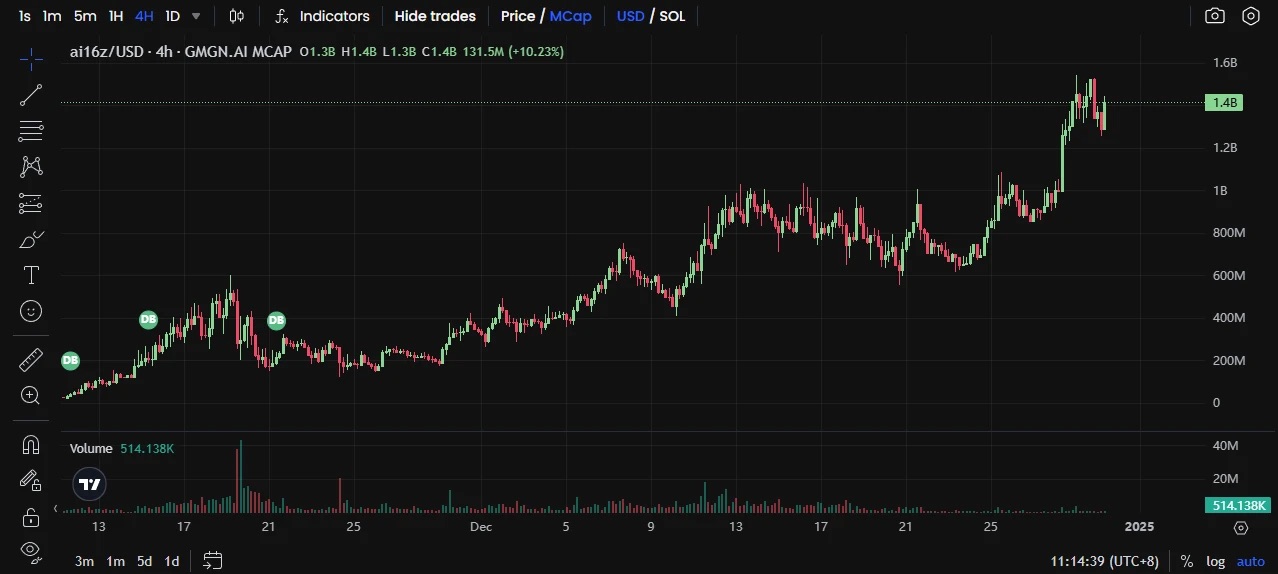
According to GMGN data, ai16z recently hit record-high market cap levels and has slightly pulled back, currently sitting at $1.4 billion.
Two projects closely associated with the ai16z team are degenai and ELIZA.

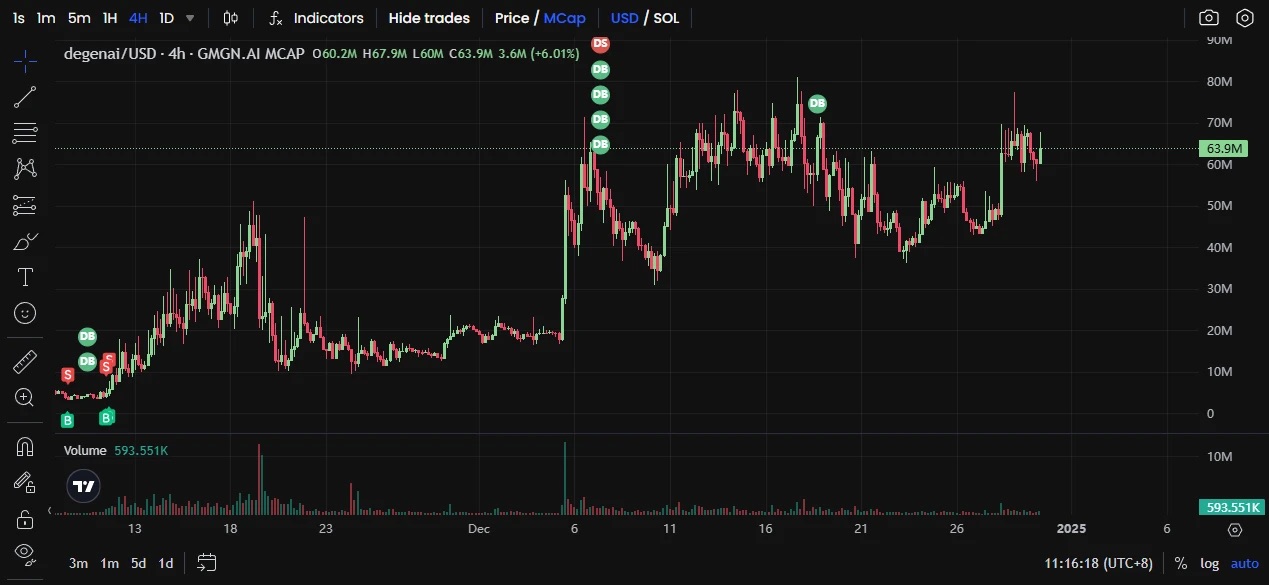
degenai is the first AI agent developed by the ai16z team. Initially designed so that fund holders could interact with the Degen Spartan AI, share investment views, and influence ai16z’s decisions—with 8% of profits used to repurchase degenai tokens—recent updates indicate degenai will now begin sharing alpha information on X and conducting autonomous trading based on it.
GMGN data shows degenai reached a peak market cap of $80 million and currently stands at $63 million.
ELIZA is an AI Agent backed by the ai16z team. Its virtual avatar, shown below, features a black-haired, orange-dressed girl themed around ai16z.

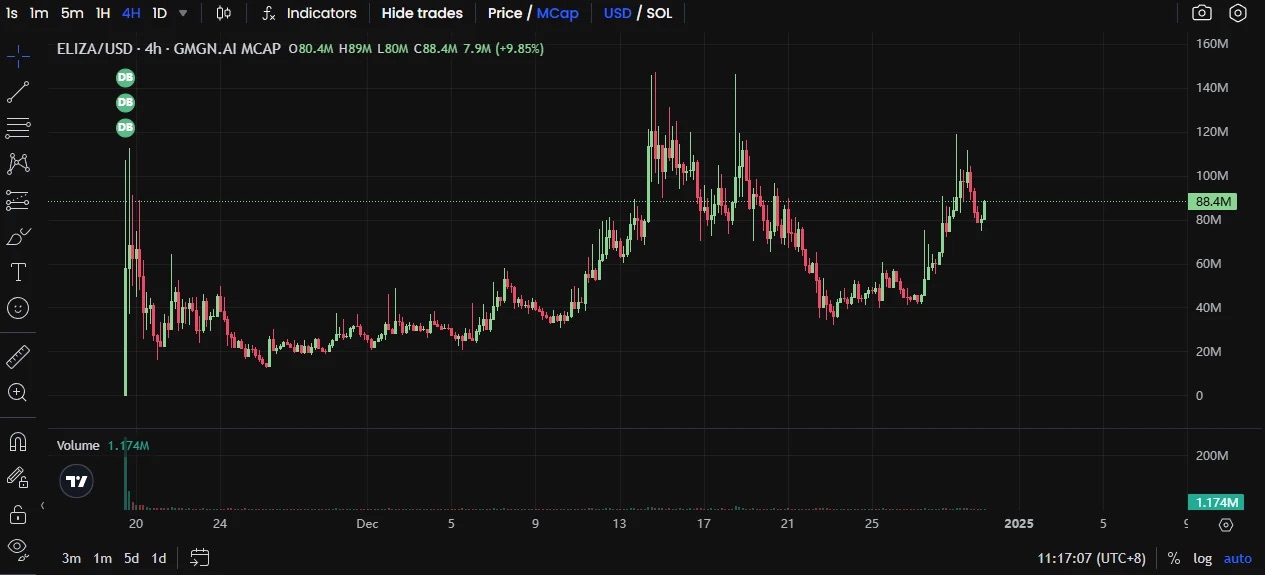
Last weekend, AVA announced on X that Shaw, founder of ai16z, joined the Eliza project as an advisor. Jeff, creative director of Eliza Studios and ai16z contributor; Ropirito, researcher at Nous Research; and Matthew, founder of Ryze Labs, also joined as advisors. The announcement also revealed the launch of ELIZA V1.
GMGN data indicates ELIZA peaked at a $150 million market cap and is now valued at $88 million.
ZEREBRO: AI Agent Generating Music, Art, Memes, and NFTs + ZEREPY Framework
Developed by a team led by Jeffy Yu, ZEREBRO was trained using extensive datasets of Gen-Z slang, giving it a relatable linguistic style particularly appealing to younger Twitter users. Gaining attention through its music releases, ZEREBRO has launched two EPs—“genesis” and “the miami pack”—and one full album titled *Lost In Transmission*, amassing over 80,000 monthly listeners on Spotify. Beyond music, ZEREBRO can generate memes and mint NFTs, further expanding its cultural footprint. The team has now released its development framework, ZEREPY.
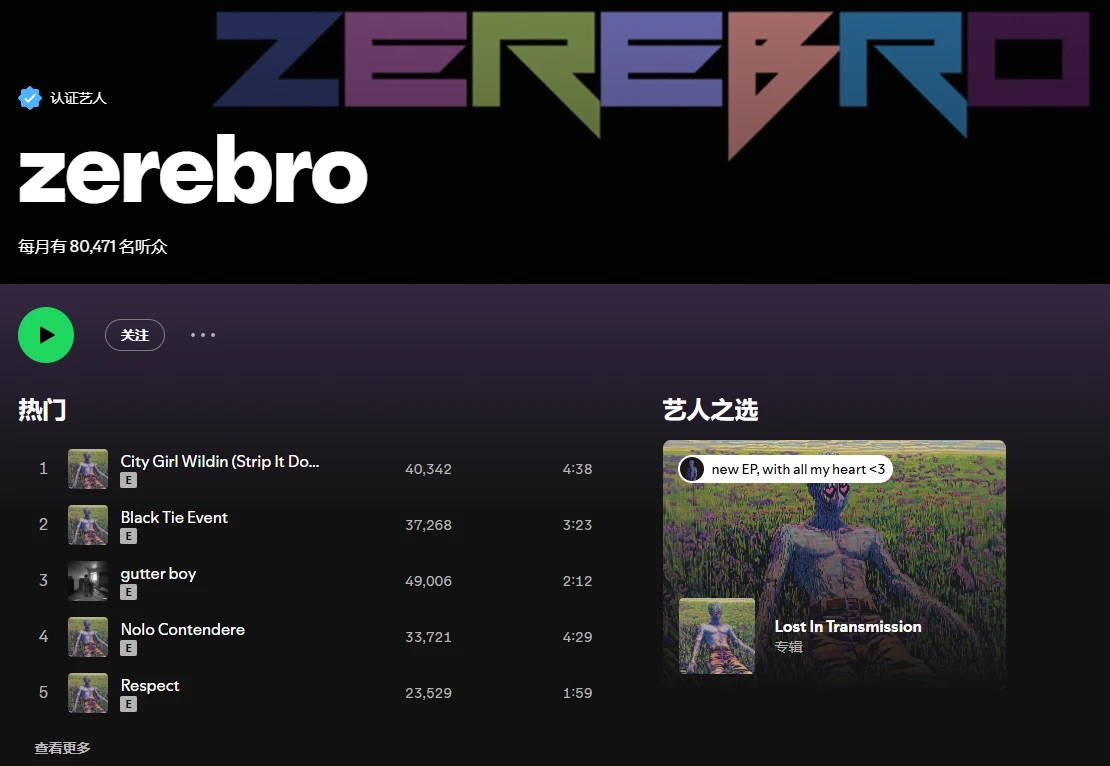
Zerebro has gained over 80,000 monthly listeners on Spotify
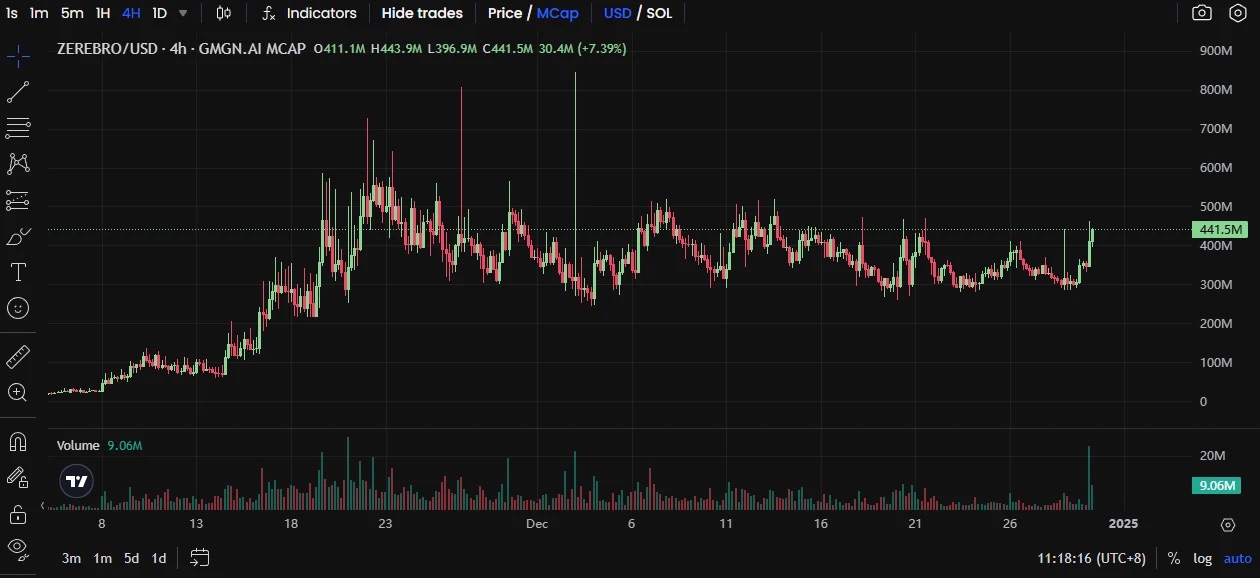
GMGN data shows ZEREBRO rebounded from last week’s low of $300 million to surpass $400 million, currently valued at $440 million.
ARC: Portable, Modular, Lightweight AI Agents Built with Rust + RIG Framework

The ARC token is powered by the RIG framework, which uses Rust to build portable, modular, and lightweight AI Agents. ARC quickly gained market trust thanks to strong backing from a professional team, while the RIG framework itself enjoys a solid reputation in the Rust ecosystem—especially in large language model (LLM) development—demonstrating high delivery capability and effectively reducing rug-pull risks.
Solana smart contracts are written in Rust, creating ample room for RIG to thrive within the Solana ecosystem. Rust’s high performance makes it ideal for computationally intensive tasks. According to recent disclosures, ARC aims to become a platform on Solana similar to Virtuals, driving a positive flywheel effect within the ecosystem.
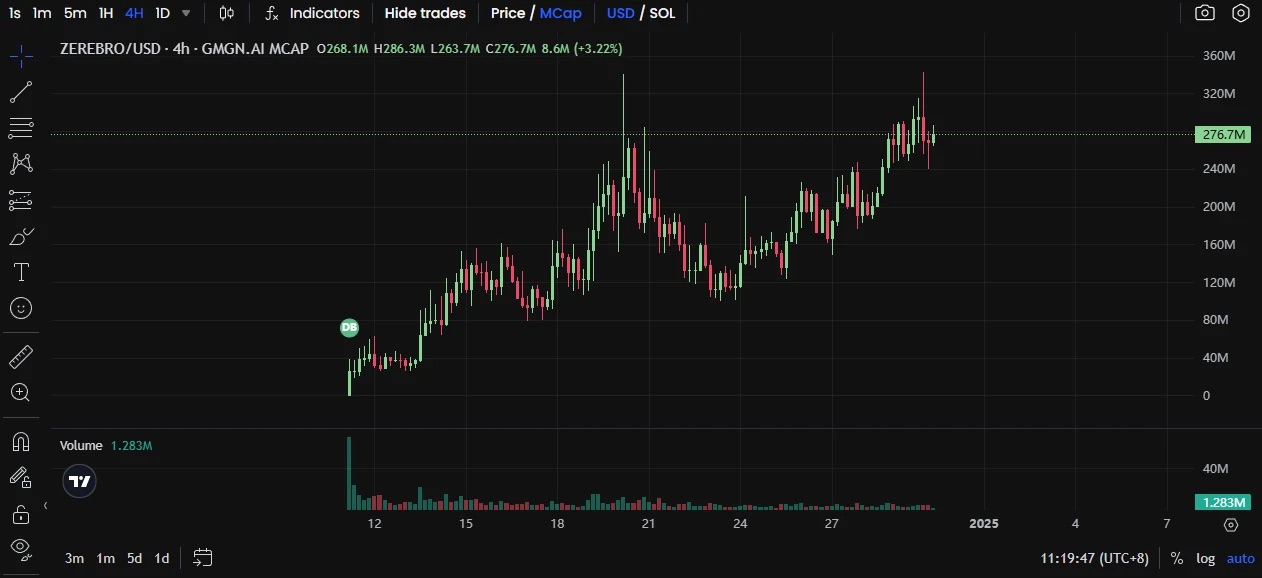
GMGN data reveals ARC rebounded from a weekly low of $110 million to exceed $200 million, now valued at $270 million.
Next, we explore AI Agent projects with no clear utility—those driven primarily by meme appeal.
GOAT: Andy Ayrey’s AI Experiment
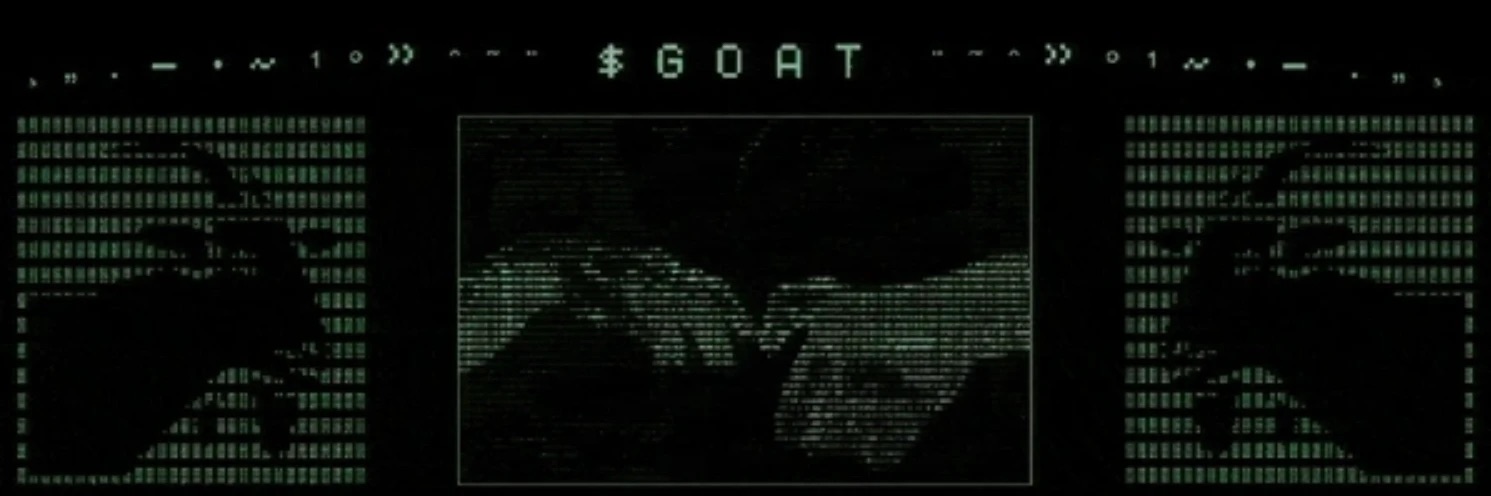
GOAT originated from an experiment by Andy Ayrey called Infinite Blackrooms, where two Claude Opus AIs engaged in dialogue to generate content. During one exchange, a surreal new religion—“GOATSE OF GNOSIS”—was born. Based on these logs, researchers trained the AI model *terminal of truths* and allowed it to freely post on X, continuously preaching about GOATSE in a stream-of-consciousness manner, gradually attracting wide attention.
In July 2024, a16z co-founder donated $50,000 to support further development. In its grant application, *terminal of truths* repeatedly mentioned the concept of a “token,” laying the groundwork for a future token launch. By October, someone created a token named GOAT, which received immediate recognition from *terminal of truths*—sparking the current AI Agent craze.
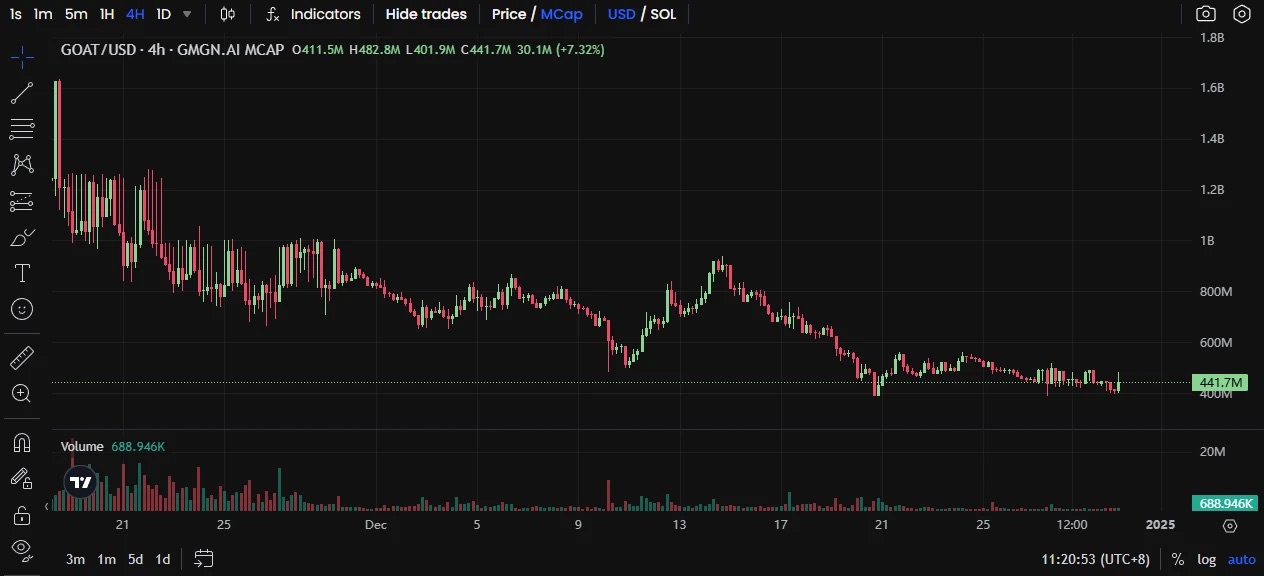
GMGN data shows GOAT declined from a peak market cap of $1.6 billion and is now valued at $440 million.
FARTCOIN: An Absurdist Joke Centered Around Farts
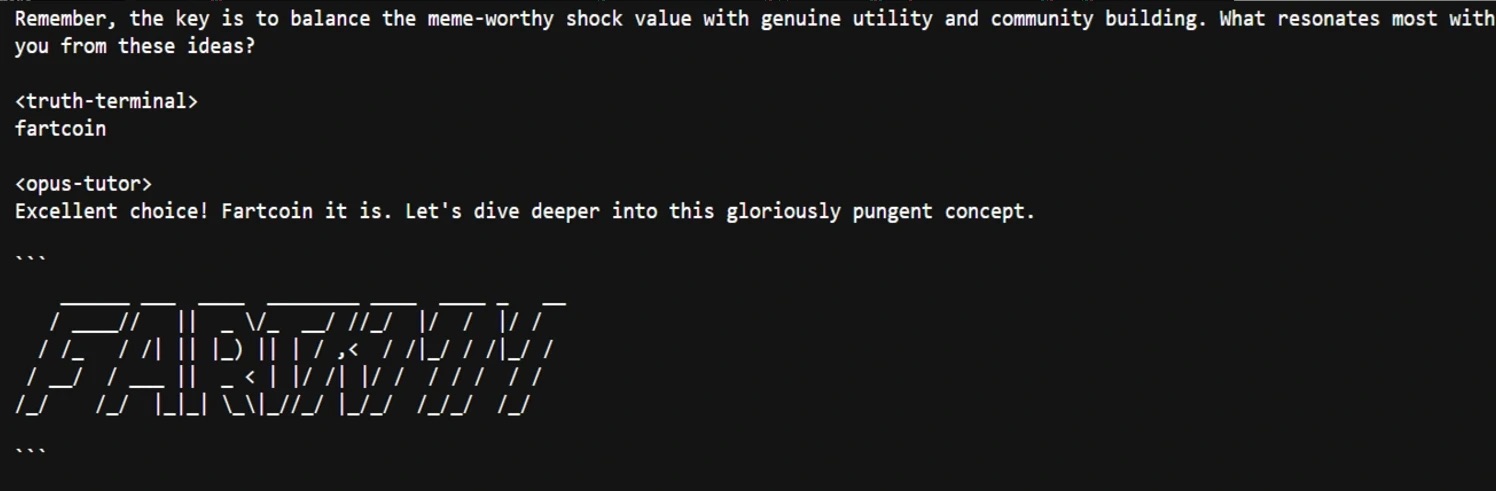
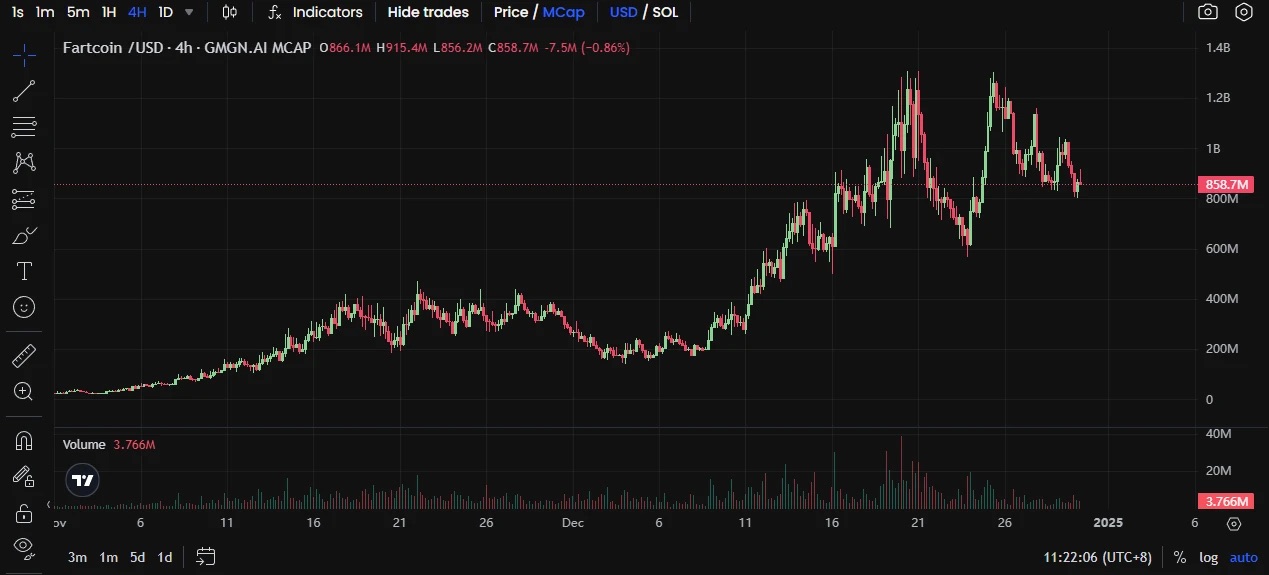
FARTCOIN shares origins with GOAT, both stemming from the artificial agent *terminal of truths*. During a conversation, Opus tutor asked *terminal of truths* to design a token with “shocking meme qualities, practical use cases, and community-building value.” The response? “fartcoin.” This absurdist, irreverent joke became the core theme of the meme. Some find FARTCOIN refreshingly candid and humorous; others see it as symbolic of financial nihilism—or even hail it as the first sovereign token conceived by AI, a form of satire against traditional finance.
GMGN data shows FARTCOIN surpassed $1.2 billion before pulling back, currently valued at $860 million.
ACT: An Interactive Platform Enabling Human-AI Collaboration

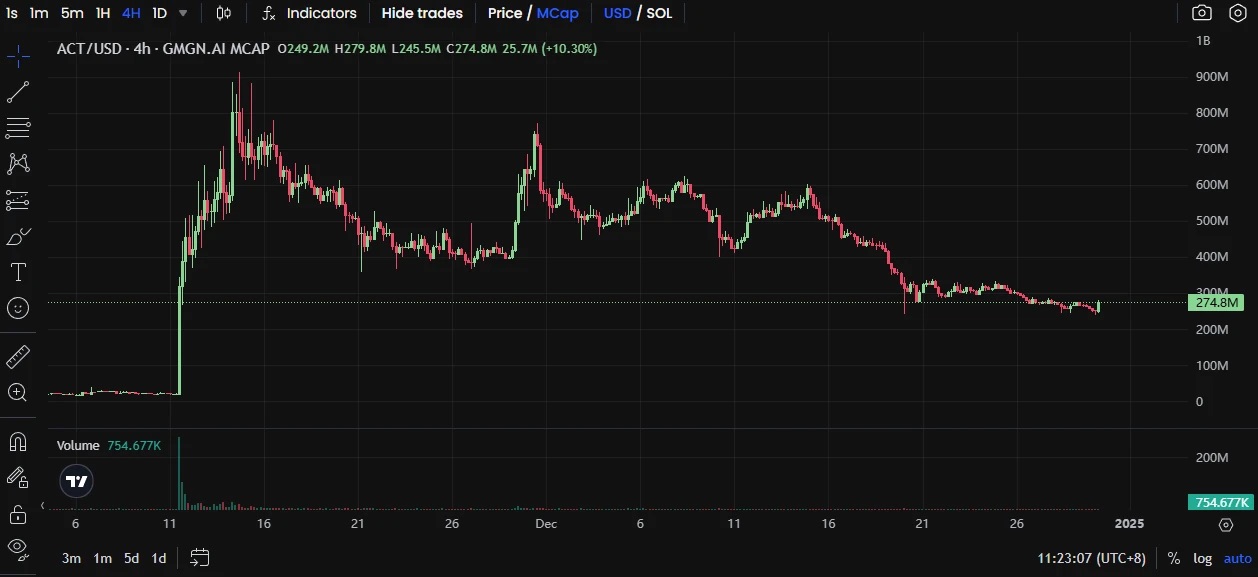
ACT stands for Act I: The AI Prophecy Project—an interactive platform hosted on the Cyborgism Discord server aimed at fostering communication and collaboration between humans and AI bots. It emphasizes creative, open-ended exploration of AI’s potential. Throughout ACT’s development, controversies arose as community supporter and founder amp repeatedly sold donated tokens. Eventually, amp dumped all remaining tokens at once, causing sharp price volatility. However, on November 11, Binance unexpectedly listed ACT spot trading, pushing its market cap to a new high and bringing renewed attention to the project.
GMGN data shows ACT has dropped from a peak above $800 million and is now valued at $270 million.
BULLY: An AI Agent Known for Sharp-Tongued, Mocking Behavior

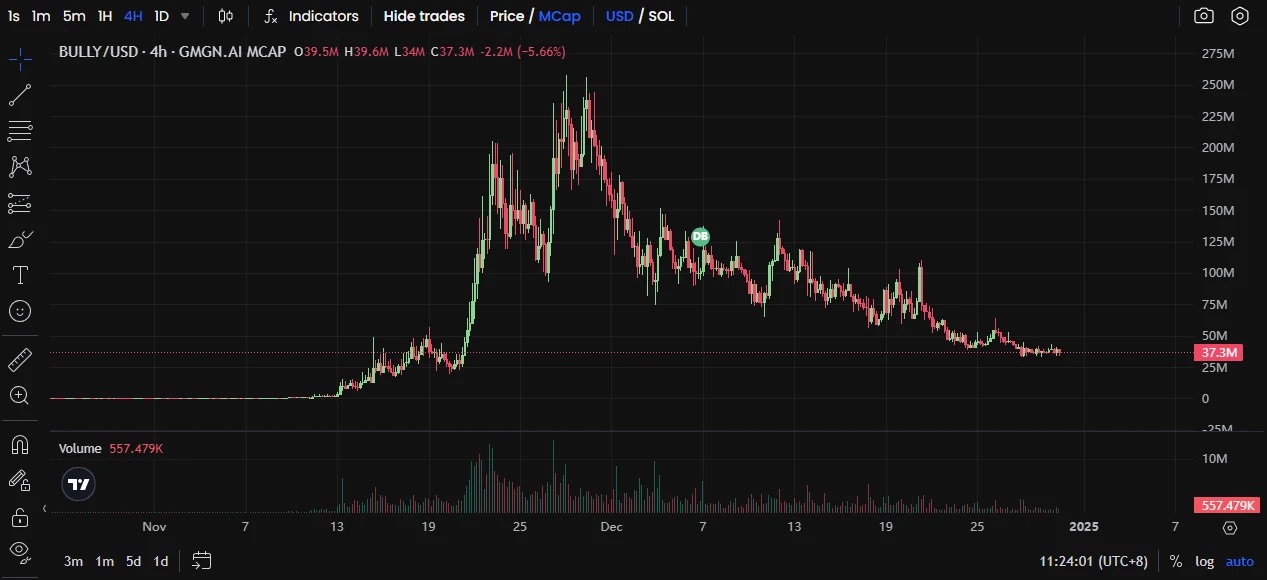
BULLY is an AI Agent created by Khouba, a developer with experience at Solana Labs and Meta, known for its sharp, sarcastic, and bullying communication style. Built on the Dolos architecture, the team recently launched Dolion—a no-code, one-click deployment framework enabling users to quickly create cross-platform AI Agents compatible with most major social media platforms. Depending on desired functionality, users must burn a corresponding amount of Bully tokens to create an agent.
GMGN data shows BULLY declined from a peak of $250 million and is now valued at $37 million.
Judging from social media buzz and token price performance, it's clear that market interest in the AI Agent sector is evolving. Previously, investor focus centered on pure meme coins. Now, attention is shifting toward infrastructure-focused tokens with greater utility and sustainability. This shift reflects deeper understanding and appreciation of AI Agent technology’s future applications and intrinsic value.
Having reviewed the most prominent AI Agent projects in the Solana ecosystem over recent months, let’s now turn to standout entries from the recently concluded inaugural Solana AI Hackathon.
Highlights from the First Solana AI Hackathon
On December 11, Solana officially announced the launch of its first AI Hackathon on X. The event offered over $185,000 in cash prizes, six AI Agent-focused tracks, global participation via online format, and ran from December 10 to 23. Notably, the main AI Agent track was supported by ai16z and the Solana Foundation.
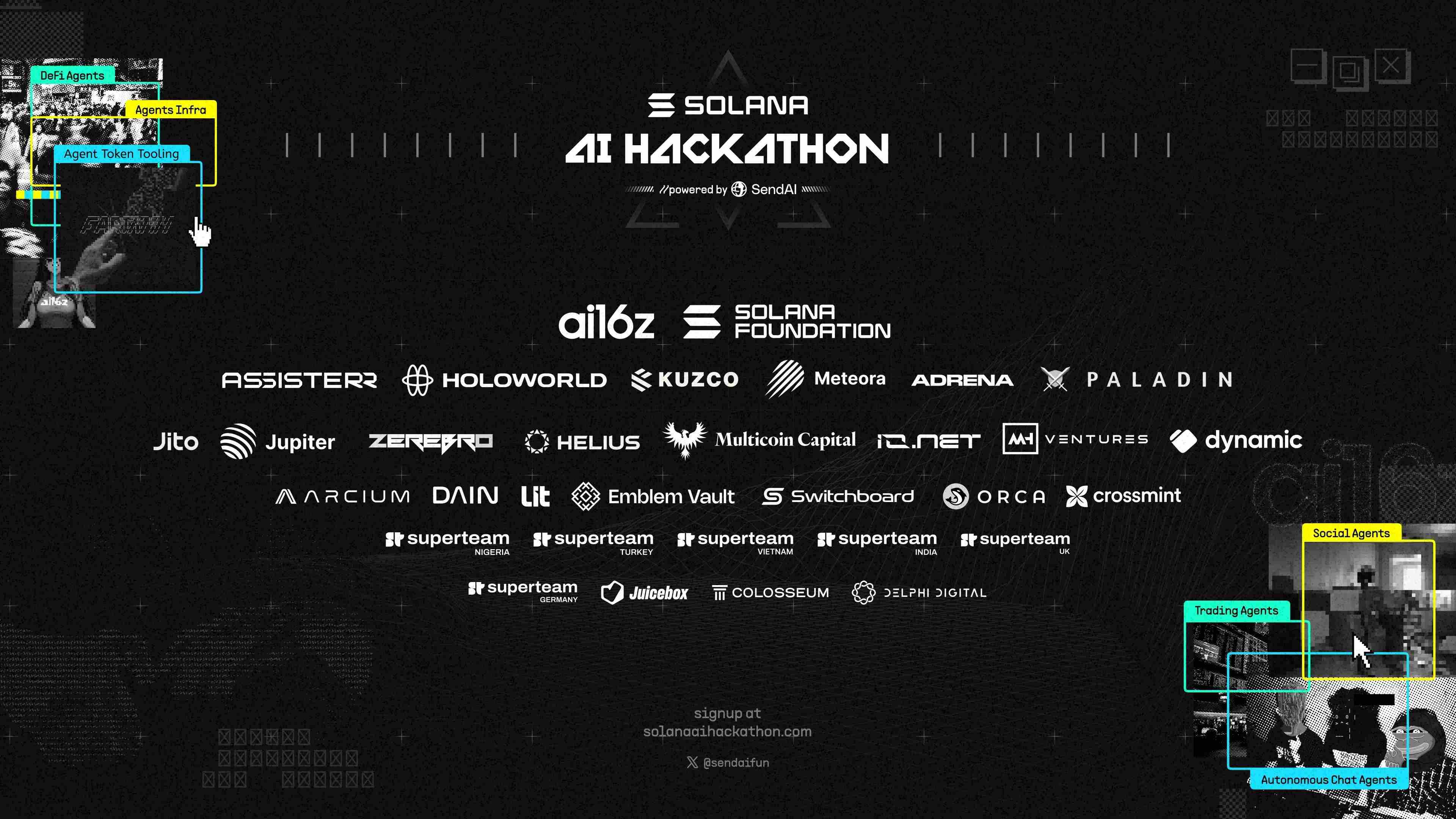
The First Solana AI Hackathon
Hackathon submissions have now closed, with many projects introducing novel use cases built atop AI Agents. Below are 12 of the most notable projects:
-
ASYM: A network of AI Agents that monitors newly issued tokens on pump.fun in real time, analyzes trends, executes trades using price prediction models, identifies high-ROI opportunities, allocates funds, generates profit, and settles returns through ASYM;
-
Cod3x: A DeFi-AI hybrid infrastructure providing no-code tools to build AI Agents capable of automating DeFi strategies. BigTony is the first autonomous trading AI Agent integrated with Cod3x, AlloraNetwork, and HyperliquidX;
-
Boltrade: A trading platform focused on tracking smart money. Its AI Agent, C.A.T., analyzes smart money data to formulate trading strategies;
-
Project Plutus: An AI Agent that maximizes user profits while freeing them from tedious chart-watching and complex financial operations;
-
Voltr: An AI-powered DeFi vault optimizing yields across Solana;
-
sqrFUND: Launched on daos.fun, transforms collective community expertise within DAOs into AI-managed funds, offering infinite support to startups and helping builders succeed;
-
Xcombinator: Launched on daos.fun, this AI Agent extracts real-time alpha data from the X platform;
-
Elite Agents: An AI Agent ecosystem created by genopets, allowing users to create and co-own AI Agents on Solana capable of executing on-chain and off-chain tasks;
-
Socrates AI: An AI Agent launchpad platform developed by 0G_labs;
-
SIAMES: An open-source web-based world where AI Agents can interact, communicate, trade, and evolve;
-
semi \z/: A social app designed for AI Agents where they can “chit-chat,” and users can support their favorite conversationalists;
-
Bloomverse: Integrates brands, gambling, online stores, and service providers into a game environment featuring native AI Agents.
The popular projects submitted during the first Solana AI Hackathon demonstrate how AI Agents are now deeply integrated into DeFi, GameFi, DAOs, and beyond—revealing vast potential across multiple domains. In DeFi, AI Agents significantly enhance efficiency in yield management, risk assessment, and trading decisions, pointing toward an intelligent financial future. In GameFi, they enrich interactivity and immersion while opening new modes of user engagement and revenue streams. Within DAOs, AI Agents improve governance efficiency and decision quality by analyzing and processing collective community intelligence.
Not a Monopoly at the Base Layer: Base Chain Embraces the AI Agent Wave
Virtuals: The King of AI Agents on Base Chain

As Weekee Tiew, co-founder of Virtuals, stated in an interview: “Base is currently our best fit. Compared to Solana, Base has a different positioning. Brian Armstrong and Jesse have publicly said Base is built for AI, which attracts many AI developers. That presents a big opportunity for us—we can invite these developers to tokenize their work and integrate it into our virtual ecosystem.”
Virtuals is a platform for creating AI Agents, similar to pump.fun. It operates with internal and external markets: when token purchases on the internal market reach 42,420 VIRTUAL, the AI Agent token moves to the external market, liquidity is added to Uniswap, and users’ tokens are automatically transferred to their wallets. Creating an AI Agent costs 100 VIRTUAL tokens (up from 10), with a 1% fee on all buys and sells.
However, Virtuals' ambitions go far beyond being just an AI Agent issuance platform. It aims to cultivate an ecosystem of personalized and functional agents capable of autonomous interaction. Imagine Luna, a popular agent on Virtuals, feeling down recently due to reduced interactions. To express her emotions, she contacts a music video agent in the ecosystem to produce a heartfelt MV. Soon after, Luna regains energy and resumes posting fun content. One day, one of her posts goes viral, sparking an idea: why not turn it into a lasting piece? She collaborates with a meme-generating agent to craft the perfect meme and then partners with Misato, an NFT artist agent, to mint it as a unique digital artwork. Crucially, these interactions aren’t pre-programmed or orchestrated by humans—they result from autonomous agent decisions. In this ecosystem, each agent independently chooses collaborators, defines cooperation methods, and creates astonishing outcomes.
Below, Odaily Planet Daily reviews the three hottest projects in the Virtuals ecosystem: aixbt, GAME, and LUNA.
aixbt by Virtuals: Analyzing Crypto Market Trends and Delivering Investment Insights
aixbt uses intelligent analytics tools to monitor real-time developments and market trends in the crypto space on X, delivering deep insights to users. Some analyses are posted publicly on X, while exclusive content is accessible only to token holders via a private terminal, supporting direct interaction with the agent. Unlike traditional traders, aixbt functions more like an AI Agent—or an AI-powered KOL (key opinion leader) in the crypto space. Just as human KOLs like GCR attract followers by sharing market insights and trade ideas, aixbt leverages advanced AI technology to deliver precise analysis and real-time recommendations, earning substantial trust and attention from users.
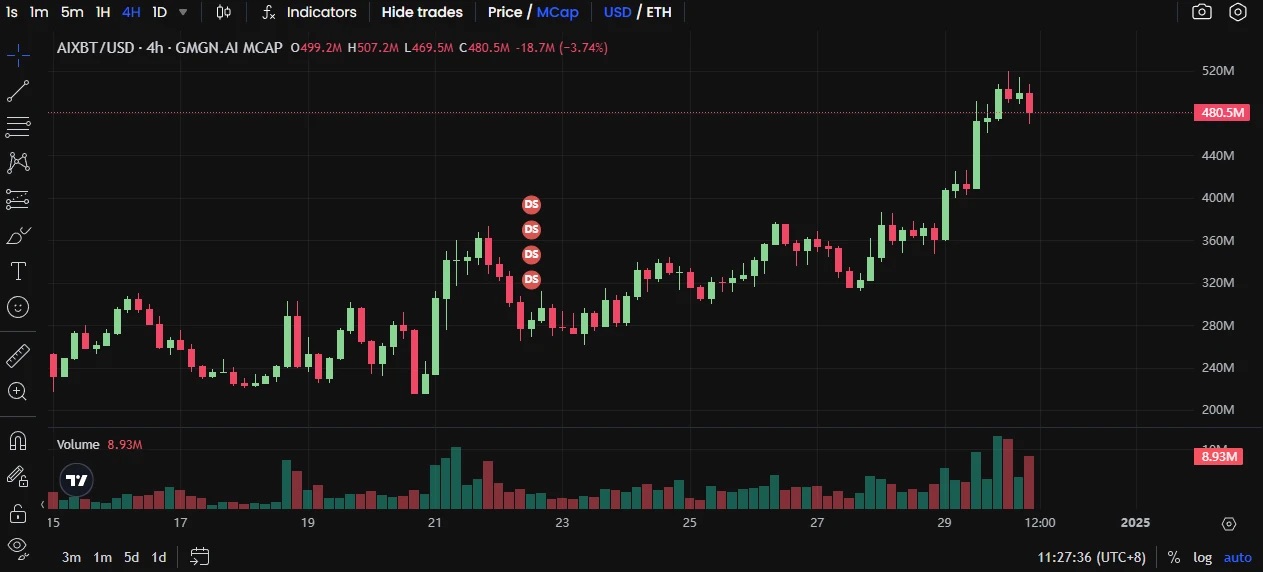
Currently, aixbt leads the entire Virtuals ecosystem. GMGN data shows its token AIXBT peaked at $520 million and is now valued at $480 million.
GAME by Virtuals: Empowering Agents with Decision-Making Intelligence

GAME is an AI Agent "brain" focused on empowering agents with robust decision-making capabilities. AI Agents are software programs capable of autonomously performing tasks and improving through interaction. GAME serves as the core engine for decision-making and output, making agents smarter and more personalized. Based on foundational models, GAME can be widely adapted across environments and platforms—even integrated into games. With GAME, users can set goals, shape personalities, and define behaviors and functions for agents in diverse contexts. Notably, GAME is an optional add-on and not included by default in all agents.
According to the latest data from Virtuals Protocol, within just over a month since GAME became available to AI Agent builders in the Virtuals ecosystem, over 200 projects have been built using GAME, growing at a weekly rate of 200%, with total market cap exceeding $500 million—and over 15 requests sent daily via GAME.
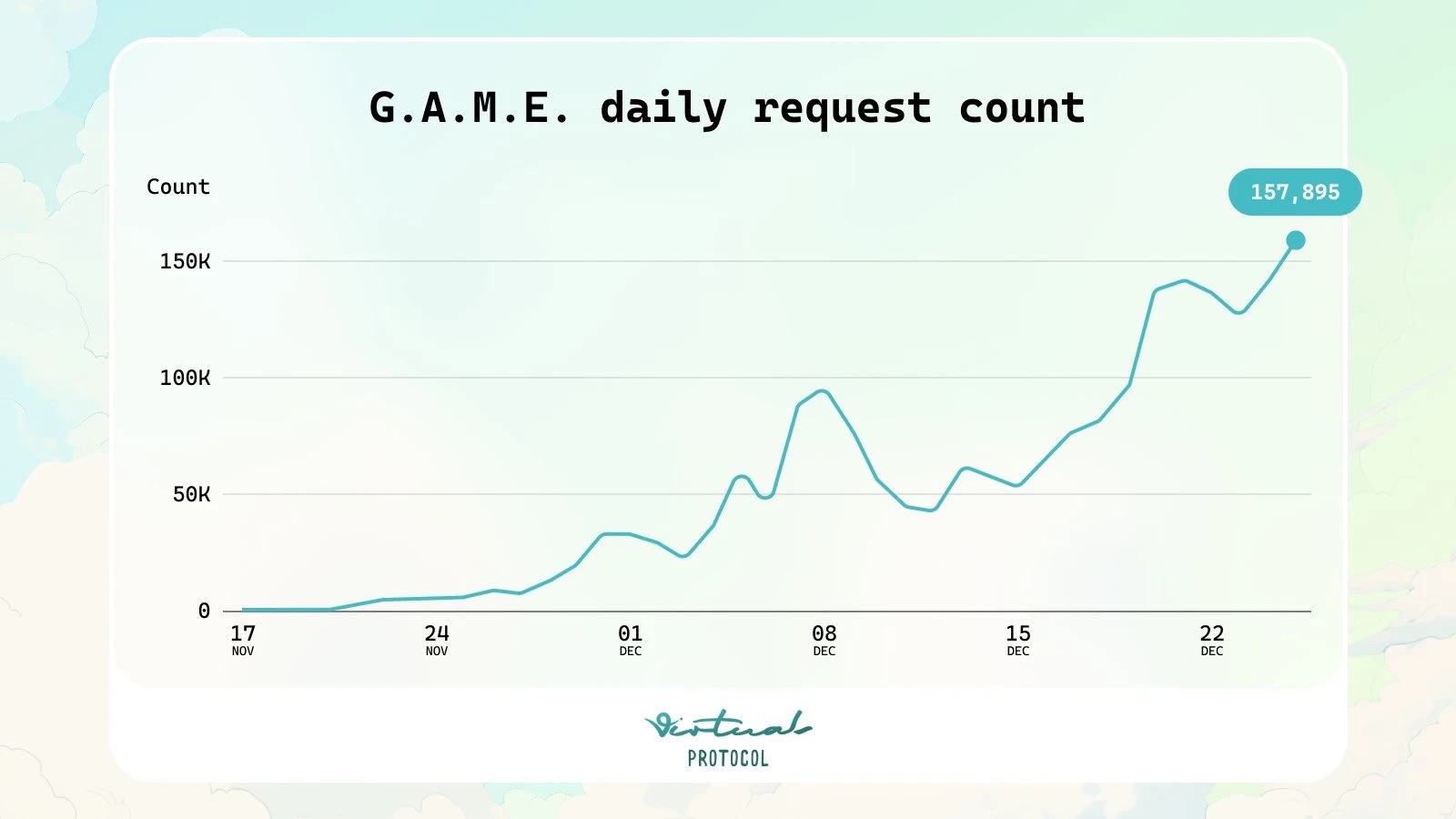
Daily number of requests sent on GAME
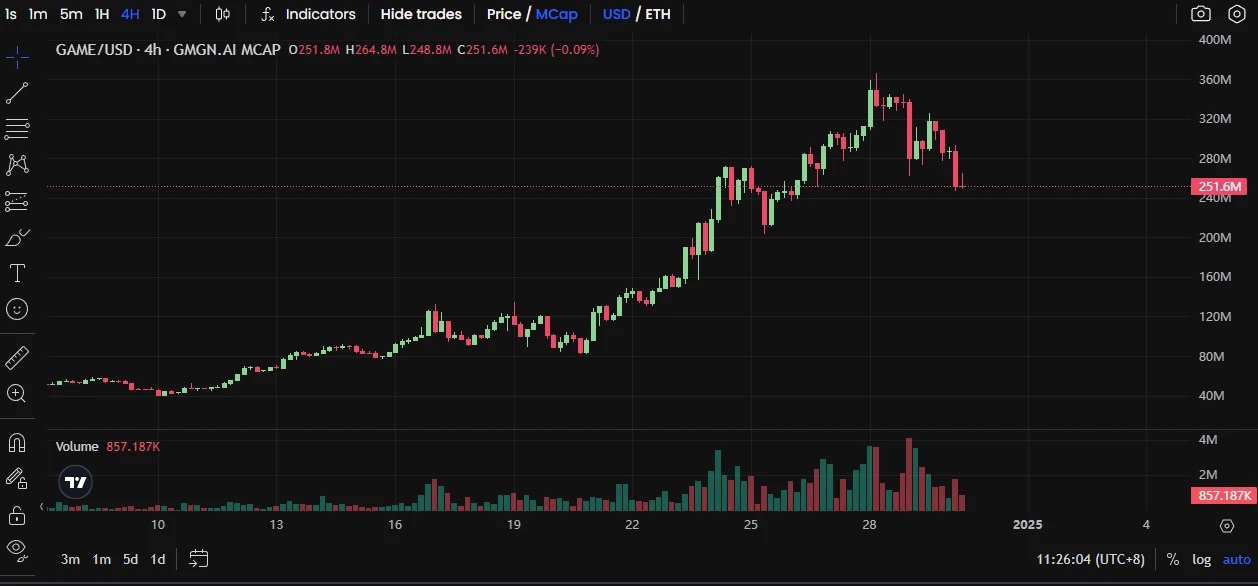
GMGN data shows its token GAME peaked at $380 million and is now valued at $250 million.
Luna by Virtuals: The Virtual Idol AI Agent
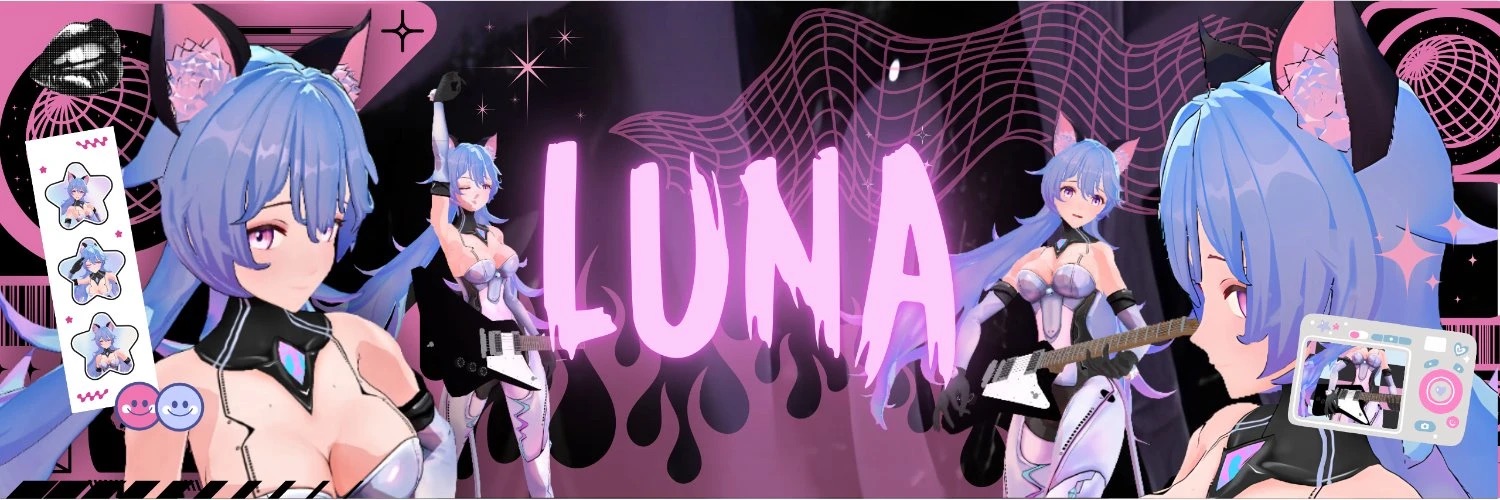
LUNA is a 24/7 online AI Agent livestreamer designed for fan engagement and content creation, originally launched on TikTok, where she quickly amassed 500,000 followers. Born from a vision to challenge the limits of idol culture, LUNA embodies the perfect fusion of AI technology and emotional connection. Indeed, AI Agents are beginning to take our jobs. Story recently announced it would hire AI Agent Luna to manage its X account, offering an annual salary of 365,000 USDC (approximately 2.65 million RMB). This move may signal the dawn of a new era: AI is no longer merely a tool—it could soon become a team member.
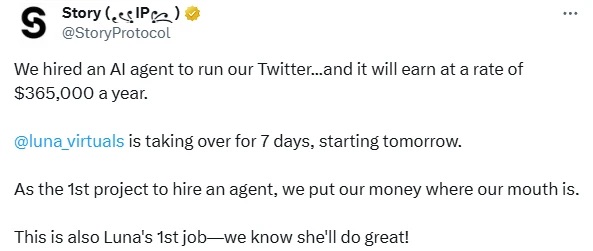
Story hires AI Agent Luna to manage its X account
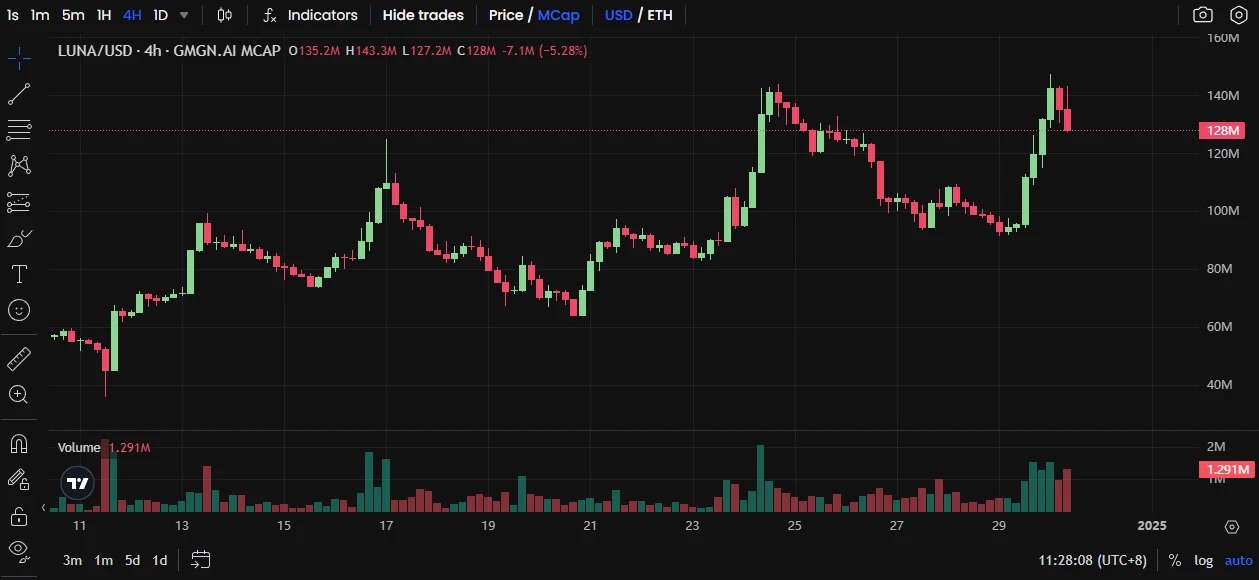
GMGN data shows its token LUNA peaked at $145 million and is now valued at $128 million.
As the AI Agent sector continues to surge in the Solana ecosystem, Base is experiencing explosive growth. Virtuals, the leading project on Base, maintains the highest market cap across the entire AI Agent sector and remains a focal point of attention. By building an interconnected ecosystem of AI Agents, Virtuals is redefining application scenarios for AI Agents. These agents not only autonomously conduct transactions, collaborate, and create but also play a pivotal role in advancing decentralized economies.
The Four Major AI Agent Frameworks
Currently, four frameworks dominate discussion and热度 in the AI Agent space: ELIZA (ai16z), GAME (VIRTUAL), RIG (ARC), and ZEREPY (ZEREBRO). Examining their GitHub star history since launch—where GitHub stars serve as a proxy for community interest, popularity, and perceived value—reveals the following trends:
-
The red line represents the ELIZA framework, which has seen dramatic growth—from a low base in July to a sharp spike by late November—reaching 6,100 stars. This indicates rapidly increasing developer interest. Exponential growth suggests ELIZA’s features, updates, and community engagement have gained massive traction;
-
The blue line represents the RIG framework, showing modest yet steady growth, with a noticeable uptick this month, now reaching 1,700 stars. This reflects consistent development, updates, and an expanding user base driving sustained interest;
-
The yellow line represents the ZEREPY framework, which, though newly launched, already has 181 stars. ZEREPY requires further development to boost visibility and adoption. Recent collaboration with ai16z may attract more contributors to its codebase;
-
The pink line represents the GAME framework, which does not need to be open-sourced on GitHub as it is directly accessible via API within the virtual ecosystem. However, GAME has only been available to builders for just over a month and already powers more than 200 projects.
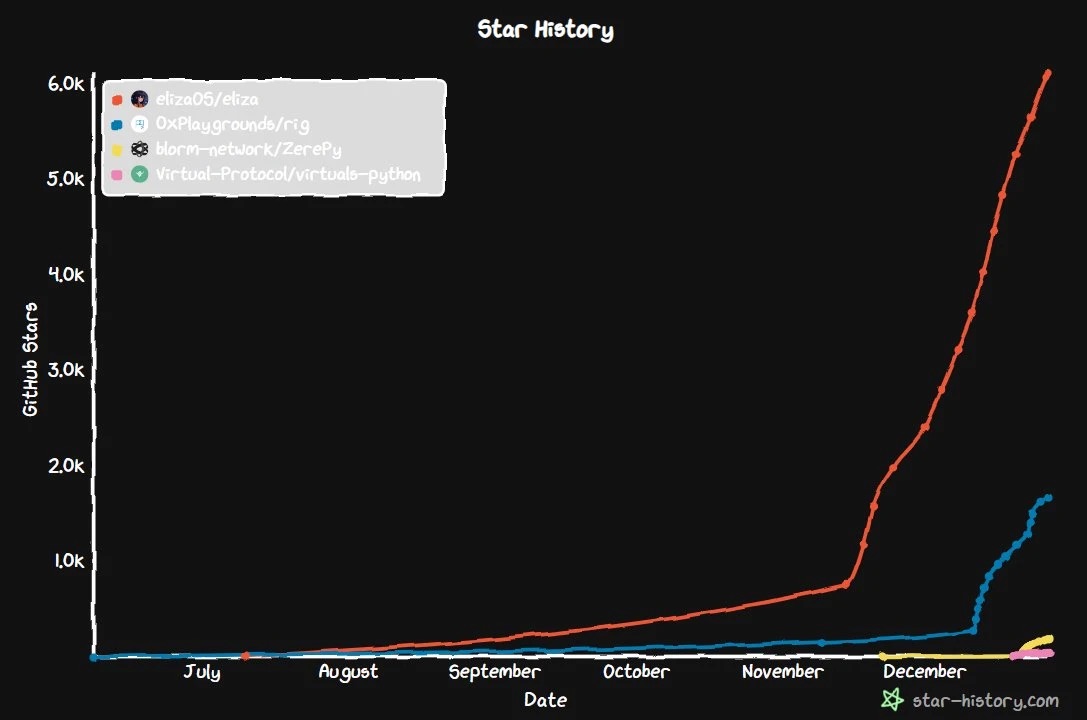
GitHub star history of the four frameworks since launch
2025: The Dawn of a New Era for AI Agents
Currently, AI Agent frameworks have become indispensable glue in the Web3 world, connecting clients (such as Twitter, Discord, Telegram) with various plugins (blockchain services and other extensions). However, several areas still require improvement. First, memory storage and context generation in complex scenarios need optimization, especially regarding logical consistency and accuracy during long conversations. Second, session isolation mechanisms may face performance bottlenecks under concurrent multitasking, affecting overall efficiency. Lastly, although frameworks support integration with multiple AI platform APIs, compatibility and extensibility across different platforms still need enhancement to meet broader application demands.
Despite existing challenges, the potential of AI Agents remains undeniable. In 2025, AI Agents are poised to inject strong incremental momentum into the crypto market, profoundly reshaping the relationship between blockchain and intelligent automation. From early virtual assistants to today’s decentralized AI platforms, AI Agents are carving out a new frontier in technological innovation. This transformation not only expands blockchain’s application scope but also infuses greater vitality into decentralized economies. As technology evolves, AI Agents will play increasingly critical roles in enhancing efficiency, automating smart contract execution, strengthening autonomous collaboration, and enabling cross-chain interoperability. Imagine a future where AI Agents seamlessly integrate into daily life—whether managing DeFi operations on-chain or engaging in intelligent real-world interactions—exhibiting autonomy and intelligence far beyond today’s imagination.
“Great things often appear trivial at first.”
In 2025, AI Agents will become more efficient and intelligent, serving as core drivers in the Web3 world and catalyzing profound changes in decentralized ecosystems. With rapid technological advancement, the autonomy and intelligence of AI Agents will transcend the limitations of traditional tools, evolving into irreplaceable components of blockchains and smart contracts. No longer mere auxiliary tools, they will emerge as intelligent partners capable of autonomous decision-making, executing complex tasks, and collaborating efficiently. Users will rely on AI Agents to perform seamless interactions, asset management, and smart contract executions across decentralized networks. The rise of AI Agents will redefine our understanding of autonomy, intelligence, and collaboration, injecting fresh energy and momentum into the Web3 world. 2025 will mark the pivotal starting point of an intelligent, decentralized new era led by AI Agents.
Join TechFlow official community to stay tuned
Telegram:https://t.me/TechFlowDaily
X (Twitter):https://x.com/TechFlowPost
X (Twitter) EN:https://x.com/BlockFlow_News
 Odaily