Nic Carter: Why I Oppose a Bitcoin Strategic Reserve
TechFlow Selected TechFlow Selected
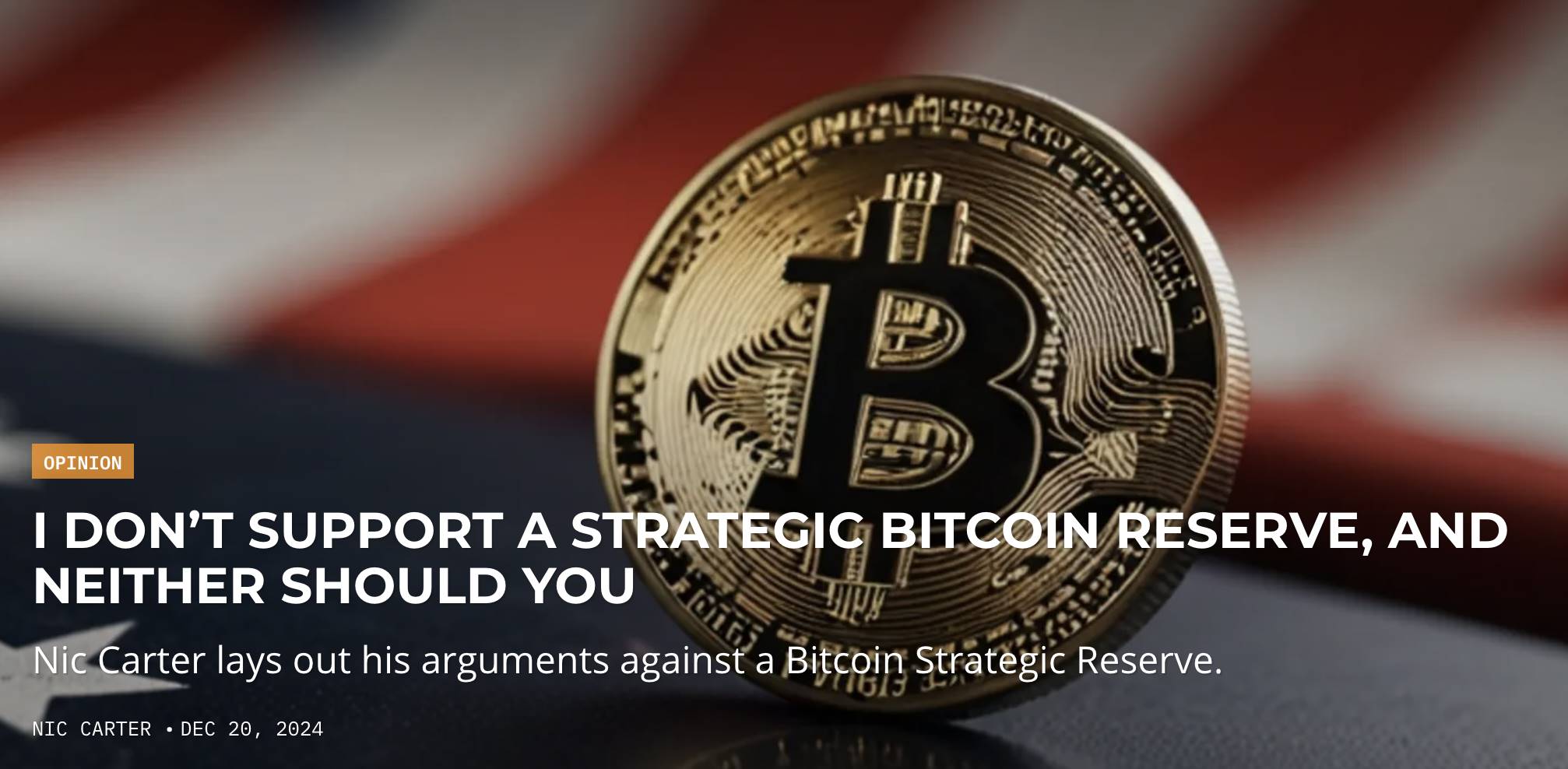
Nic Carter: Why I Oppose a Bitcoin Strategic Reserve
Nic Carter believes that, at least in the short term, the United States does not need Bitcoin.
 Navigating Web3 tides with focused insights
By Nic Carter, Partner at Castle Island Ventures
Translated by Luffy, Foresight News
Recently, the idea of a Strategic Bitcoin Reserve (SBR) has started gaining significant attention. Trump has advocated for continuing to hold bitcoins seized by the U.S. government, but some proposals go further—Senator Lummis recently introduced draft legislation suggesting that the U.S. government purchase 1 million BTC over five years.
Bitcoin enthusiasts believe the case for a strategic reserve is nearly settled. But I disagree. I think it's unlikely and that a Strategic Bitcoin Reserve is a bad idea. Let me explain why.
Are We Talking About Inventory, Sovereign Wealth Fund, or Reserve?
First, let’s clarify what we mean by a “bitcoin reserve.” In his speech at the Bitcoin conference in Nashville, Trump promised: "I declare that if elected, my administration—the United States of America—will adopt a policy whereby all bitcoin currently held or acquired in the future by the U.S. government will be retained... This would effectively become the core of a national Strategic Bitcoin Reserve."
I strongly support the idea of the U.S. government maintaining an inventory of seized bitcoins, but I do not support buying additional bitcoins. Some proposals suggest large-scale government purchases: ranging from about 800,000 BTC (BPI), to 1 million BTC (Lummis), up to 4 million BTC (RFK Jr).
Senators like Lummis, Michael Saylor, and institutions such as the Bitcoin Policy Institute have been promoting the concept of a “Strategic Bitcoin Reserve (SBR).”
Under Senator Lummis’s framework, the U.S. government would buy 1 million BTC over five years and hold them for at least 20 years. Her rationale is to “strengthen America’s financial standing and hedge against economic uncertainty and monetary instability.” Lummis explicitly states that the SBR would “reinforce the status of the dollar,” drawing parallels between bitcoin and gold’s role in previous monetary eras.
It’s important to distinguish these proposals from George Selgin’s suggestion of buying bitcoin within a sovereign wealth fund. To my knowledge, none of the main SBR advocates view this as simply adding an asset to a national portfolio. Instead, they explicitly tie bitcoin to the dollar and imply that bitcoin could actually strengthen the dollar. This suggests they envision a monetary system where bitcoin plays an active role—currently functioning similarly to foreign exchange reserves, but perhaps eventually becoming the actual base of a new commodity standard, akin to Bretton Woods. (For those who think I’m exaggerating, just read the writings of SBR proponents.)
To be clear, I don’t oppose retaining existing seized bitcoins (which I believe will ultimately be Trump’s policy), nor do I oppose placing bitcoin into a sovereign wealth fund (even though the U.S. doesn’t have one). Rather, I oppose creating a Strategic Bitcoin Reserve and assigning it any form of monetary function.
A Bitcoin Reserve Would Weaken, Not Strengthen, the Dollar
My central argument is that a bitcoin reserve would not strengthen the dollar. Unlike other nations, the United States issues the global reserve currency—the U.S. dollar. Other countries may consider buying bitcoin; indeed, some already are.
If you're Russia or Iran, adding a non-confiscatable asset to your foreign reserves might make sense—especially after the U.S. seized Russian Treasuries in 2022. But the U.S. does not need to hedge its exposure to the dollar because it issues the dollar itself.
Purchasing bitcoin and assigning it a monetary role—whether as part of foreign reserves or something more significant—would signal that the U.S. lacks confidence in the current dollar-based system.
This would mean the U.S. government is abandoning the irredeemable fiat standard, which would throw the entire system into disarray. Currently, the dollar is underpinned by multiple factors: America’s role as the global trade manager, the strength of the U.S. economy, the solvency of the U.S. government, its ability to project hard and soft power, the depth of U.S. securities markets, and the ubiquity of the dollar in global trade and finance.
If the U.S. suddenly shifts course and says, “We’re reconsidering the entire Washington Consensus,” markets will begin questioning what’s going on. Is the government planning to default? Will it dismantle Bretton Woods institutions? Are massive deficits and high interest rates being signaled?
To be clear, I don’t think the government is seriously considering these things—but bond traders will react instantly with alarm.
You might object: “We’re not talking about shifting to a new gold standard with dollars pegged to bitcoin. We’re just discussing buying some bitcoin and putting it on the U.S. balance sheet.”
Markets won’t see it that way. If bitcoin on the balance sheet were merely symbolic, it would still be an extremely expensive symbol. At current prices, 1 million BTC would cost $100 billion. And given that the U.S. government is widely seen as a price-insensitive buyer, it might end up paying $1 million per BTC—totaling $1 trillion. That’s a massive expenditure that should be spent on more meaningful priorities.
I suspect markets wouldn’t view the purchase as symbolic at all, but rather as the first step toward a new commodity standard backed by bitcoin.
Austin Campbell noted that this would “accelerate the demise of the dollar, signaling to the world that the U.S. doesn’t intend to responsibly manage its finances and might reprice everything in bitcoin someday.”
Imagine the probability of the Lummis SBR proposal converging toward certainty. You’d see financial markets collapse. Interest rates would spike dramatically, as investors in U.S. debt start doubting whether America is contemplating a full exit from Bretton Woods II.
The cost of capital for everyone on Earth would rise sharply, and inflation could worsen. As financial markets plunge and bitcoin soars, there would be a massive redistribution of wealth.
In other words, the U.S. contemplating abandoning its relatively stable monetary system in the short term—replacing it with a standard based not on gold, but on a highly volatile emerging asset—would cause outright panic among its creditors.
In my view, if a Lummis-style reserve approached reality, markets would go haywire, forcing Trump to retract the policy.
While SBR supporters may claim they aren’t advocating a new bitcoin-backed gold standard, their stated intentions are radical enough that Treasury markets would panic if such a reserve became likely.
Politically, SBR Is Unwise
I believe any legislative attempt to establish a Strategic Bitcoin Reserve would be completely unworkable in Congress. Just weeks ago, I visited several pro-crypto members of Congress in Washington—I’ve seen the terrain firsthand. The political landscape is tough, with Republicans holding only a slim majority. They can’t push through legislation along party lines, and I’m not even sure Republicans would vote uniformly on this issue.
SBR advocates insist the executive branch could fund the reserve without passing laws. Technically, the executive can spend money without prior congressional authorization. Bitcoin supporters have proposed various mechanisms. But this misses the point entirely. A bitcoin reserve imposed by executive order would be undemocratic and likely reversed by a subsequent administration if Congress never formally approved it.
The executive can unilaterally decide to launch a costly foreign war and divert funds through secret programs. But such actions are deeply unpopular because they’re seen as undemocratic. Our republic’s system of checks and balances requires the President to act, but Congress to grant authority—and funding. We don’t operate under autocracy.
Because Congress controls the purse strings, American citizens must be consulted on major spending decisions.
In other words, in a household, a husband might not mind his wife occasionally using his credit card. But if she decides to buy a new car or a house, he’d certainly want to be consulted. Yes, technically, if the limit is high enough, she might be able to charge the car. But that’s not the point. She should consult him before making such a major decision. The President should consult Congress—and by extension, the American people—on any major expenditure, and a bitcoin reserve undoubtedly qualifies.
You might say, “But Trump has the power.” He doesn’t. He has no authority to spend hundreds of billions establishing a Strategic Bitcoin Reserve. The topic didn’t come up meaningfully in campaign debates or media coverage.
He spoke about a bitcoin reserve in Nashville—but only in the sense of holding existing seized bitcoins, not purchasing additional ones. Attempting to bypass Congress to spend government funds on bitcoin would be politically disastrous. It would burn through his limited political capital. Trump has a far broader agenda than bitcoin. Even if momentarily excited by the reserve concept, political reality will likely bring clarity.
Another problem with imposing bitcoin purchases via executive order is reversibility. If such a policy proves unpopular, a future Democratic administration would undoubtedly liquidate the reserve immediately, destabilizing the bitcoin market.
Bitcoin users should want democratic consensus—a broad agreement that a bitcoin reserve or inventory is sound policy—implemented through bipartisan legislation or even a constitutional amendment. Historically, meaningful monetary reforms happen legislatively: the Gold Reserve Act of 1934, or the Gold Clause Resolution of 1977 after Nixon ended Bretton Woods I.
Bitcoin users should want durability, not a fleeting experiment. An executive-order-driven policy under a new Trump administration would not last.
An SBR Would Severely Alienate the Public
There’s no doubt an SBR policy would be perceived as a massive wealth transfer from U.S. taxpayers to wealthy bitcoin holders. It would be regressive and deeply unpopular. Bitcoin holders are a relatively small group. The Federal Reserve found in 2022 that only 8% of American adults own cryptocurrency, with disproportionate ownership among the affluent.
Even if SBR funding came from some fiscally “neutral” source—like selling part of the gold reserves—it would still be seen as undeserved enrichment for bitcoin holders. That money could be used for anything else instead of benefiting this narrow group.
A major monetary policy shift benefiting only a small segment of Americans would turn everyone else against bitcoin holders. And I doubt most Americans would understand the logic behind SBR, especially since there’s no visible crisis facing the dollar today.
If de-dollarization accelerates, the U.S. faces a debt crisis, interest rates soar, and many other nations begin adopting bitcoin as a reserve asset, attitudes might differ ten or twenty years from now. But that’s not the case today.
Recall that student loan forgiveness was quite unpopular because it was seen as bailing out upper-middle-class Americans who could afford college and obtained arguably worthless liberal arts degrees. (Interestingly, Elizabeth Warren proposed a unilateral $640 billion student loan cancellation plan in 2019/2020, which was ultimately rejected by Congress.)
Biden’s student loan relief program would benefit about 43 million Americans—more than the entire population of bitcoin holders. So imagine how much louder the backlash would be over a bitcoin reserve.
Currently, interest in bitcoin among financial circles is growing organically. An SBR would pit ordinary Americans against bitcoin holders, severely damaging adoption.
A Bitcoin Reserve Has No “Strategic” Purpose
The term “Strategic Bitcoin Reserve” is confusing, especially the word “strategic.” The U.S. government holds many commodities for genuine strategic purposes. Most notably, the Strategic Petroleum Reserve stabilizes oil markets.
Creditably, Biden actually sold large amounts of oil at high prices and later bought it back at lower prices, turning a profit. We also hold or have stockpiled heating oil, natural gas, grains, dairy, cobalt, titanium, tungsten, helium, rare minerals, and medical supplies.
The common thread is that these commodities have industrial uses, and the government has a vested interest in preserving them for emergencies or market stability.
In contrast, bitcoin has no industrial use. The U.S. government doesn’t “need” bitcoin to trade at any specific price level. Whether bitcoin trades at $1 or $1 million makes no difference to the government. Bitcoin produces no cash flow, so holding it won’t help pay future debt interest.
The only “strategic” role bitcoin could play is analogous to existing U.S. reserve assets like gold and foreign exchange—that is, none at all. As George Selgin painstakingly explains, compared to other developed nations, the U.S. actually holds relatively little foreign exchange reserves. This is because the dollar is a truly free-floating currency that the U.S. doesn’t manage. Since 1971, the ~8130 tons of gold held by the U.S. government have had no functional purpose. They’re purely historical relics, kept due to tradition. The last major intervention to manage the dollar’s exchange rate occurred in the 1980s.
SBR proponents vastly overestimate gold’s role in the dollar system. Ultimately, when it comes to the dollar’s global dominance, the U.S. government’s balance sheet is almost irrelevant.
What truly backs the dollar is:
-
U.S. GDP growth, generating tax liabilities payable only in dollars
-
The credibility and stability of U.S. government and monetary policy
-
The attractiveness and liquidity of U.S. capital markets, making them the world’s primary investment destination
-
Network effects from the dollar’s dominance in trade settlement, commodities, forex, and debt markets
-
U.S. continued role as global hegemon and guarantor of global trade and security
Gold and bitcoin are simply irrelevant to today’s U.S. monetary system. Perhaps one day they’ll matter, but the current irredeemable fiat standard isn’t built on commodity reserves in any way.
Why Bitcoin Specifically?
Why bitcoin? Why not something else? Bitcoin holders haven’t provided a convincing answer. You might say bitcoin is valuable (~$2T market cap), globally liquid, and widely held. But it’s not unique in this regard. Can you make a case for a bitcoin reserve that doesn’t equally apply to Apple or NVIDIA stock?
“Well,” you might reply, “those are claims on corporate cash flows, not bearer assets. Bitcoin is special because it can’t be confiscated.” But presumably, Apple or NVIDIA aren’t at risk of having their assets and IP seized either. That might be a reason for foreign governments to avoid holding U.S. equities, but we’re talking about the U.S. government here.
Choosing bitcoin over gold also makes no sense. If you want to remonetize hard assets for the monetary system, gold is the obvious choice. If the goal is to “get ahead” of other nations in reserve assets—a common SBR argument—gold is perfect because we already hold more than anyone else. Simply remonetizing gold puts us ahead immediately.
Gold is also a “bearer” asset—ownership isn’t a claim on anything, just physical possession of bars and bullion. If bitcoin advocates succeed in convincing the U.S. to abandon Bretton Woods II and return to a pre-1971 commodity standard, gold would still be a better option. It has a longer history, wider ownership, is worth about nine times more than bitcoin, is far less volatile, and we already possess it—making monetization far cheaper.
If you dislike gold because it’s not a “high-growth” asset like bitcoin, consider fast-growing equities like NVIDIA, Apple, or Microsoft. If we consider strategic investments the U.S. might make, I’d prefer AI data centers or semiconductor manufacturing. These serve clear strategic purposes and are economically productive. Then we’re discussing using Treasury or Fed resources for “industrial policy.”
Most conservatives and libertarians are skeptical of top-down government resource allocation, preferring the private sector to lead. I disliked Biden’s massive infrastructure spending, seeing it as wasteful—so I oppose deeper government intrusion into the private sector, especially through overt dollar creation.
Typically, the U.S. government doesn’t use monetary tools to intervene in markets beyond setting interest rates. Its role is rule-making and system stability—not actively deploying public funds to speculate on commodities. (This is why many criticized Biden’s sale of the Strategic Petroleum Reserve.) We’re a market-based capitalist economy, not a centrally planned one. Managing a commodities hedge fund isn’t the government’s job.
That’s left to the private sector. Government only steps in when there’s an urgent strategic need to stockpile a critical commodity. Ultimately, if the U.S. private sector invests in appreciating commodities and assets, the government still benefits via capital gains taxes.
There’s No Reason to Create an SBR Now
Why create a bitcoin reserve now? What’s different today that makes this urgent? Nothing. The dollar isn’t collapsing—in fact, it’s thriving. The dollar index has been rising over the past 15 years, hurting U.S. manufacturing and countries with dollar-denominated debt.
Relative to the rest of the world, U.S. GDP is growing. Europe is slowly declining, while China faces its worst economic crisis since reform and opening-up began. U.S. equities are outperforming globally, representing about 50% of global stock markets—a trend likely to continue.
You might argue, “But the dollar is falling against hard assets like gold. Its purchasing power is eroding; we’re in an era of volatile, high inflation.” Yet the dollar doesn’t appear to be in crisis.
Interest rates are slightly higher than the past decade, but no one is panicking about U.S. solvency. The dollar’s share of global foreign reserves has declined over decades—but not precipitously. The dollar remains overwhelmingly dominant globally, with no viable challenger. Neither the struggling euro nor the (managed) yuan has the capacity or ambition to displace the dollar as the world’s preferred reserve asset.
The only serious reason SBR is being discussed today is Trump’s electoral victory. Bitcoin enthusiasts, seizing political opportunity, hope he’ll not only introduce favorable regulation but become a national-level bitcoin buyer.
But bitcoin’s size and liquidity are still far too small to impact the U.S. reserve portfolio meaningfully. Under a gold standard, it’s certainly not ready to serve as a monetary commodity like gold. It’s worth only ~$2 trillion today, versus ~$17 trillion for gold. Bitcoin remains extremely volatile and clearly unsuitable as a unit of account.
Bitcoin holders should be more patient. Bitcoin has performed exceptionally well in its 15-year lifespan and is becoming a significant global monetary asset.
Over time, its volatility will moderate—as its market cap and liquidity grow—it will become a more suitable asset for governments to consider in their portfolios. But for now, it plays no meaningful role in the U.S. monetary system.
A Bitcoin Reserve Might Not Be What You Want
The truth is, there’s no need for any form of bitcoin reserve. The U.S. can simply wait—and lose nothing. If bitcoin continues its monetization journey and eventually challenges gold, if other nations add bitcoin to sovereign wealth funds or even begin “backing” their currencies with bitcoin, then America will still have ample time to respond.
U.S. institutions, investors, and individuals already hold more bitcoin than anyone else. If the U.S. government truly wants bitcoin, it has plenty of ways to obtain it at any time.
It could buy bitcoin on open markets. But more realistically, it might choose a cheaper route: set a price ceiling, ban private ownership, and force conversions of American-held bitcoin—just as it did with gold in 1933.
It could simply confiscate bitcoin held on domestic platforms—U.S. custodians are by far the largest. It could nationalize bitcoin mining operations. It could raise capital gains taxes and demand payment in kind. It could arrest known large holders and seize their holdings. It could invest in quantum computing powerful enough to crack roughly 4 million BTC vulnerable to quantum attacks.
“Wait… not like that.” But that’s precisely the problem. You can’t control how the U.S. government acquires bitcoin. If you successfully convince them of bitcoin’s merits and they genuinely decide to build a reserve, they’ll do so in the most politically expedient way possible.
That may not align with the best interests of American bitcoin holders. Between buying 1 million BTC at $1 million each and seizing 1 million BTC through other means, they’ll choose the more efficient method.
How Should We Support the Dollar—Without Bitcoin?
The long-term solvency of the U.S. government is undoubtedly concerning. Debt-to-GDP is near a historic high of 120%. Interest costs as a share of GDP are at a 60-year peak and rising. Federal net outlays as a share of GDP are the highest in a century outside WWII and its aftermath.
Deficits have fallen from pandemic highs but remain elevated, leaving little room to maneuver if a recession hits. Four years of reckless spending triggered an inflation surge we’re still managing.
Over the past quarter-century, the dollar’s share of global FX reserves has dropped from 70% to 60%. After the U.S. seized Russian reserves in 2022, some buyers have grown cautious about purchasing U.S. Treasuries.
All this suggests potential long-term dollar challenges, though no immediate crisis looms. If a recession hits and the government finds it can’t engage in large-scale stimulus due to already high rates and massive deficits, the situation could change.
If it were up to me, I’d do the following:
-
Do everything possible to boost GDP growth—cheaper energy, fostering high-growth sectors like AI, unleashing the private sector
-
Reduce the scale of government spending to shrink deficits, as government spending is far more wasteful than equivalent capital in private markets
-
Limit political interference in dollar markets—for example, recognizing that the dollar’s sanctioning power conflicts with its international utility
-
Allow inflation to persist for a time to reduce real debt burdens
The good news is that incoming Treasury Secretary Scott Bessent’s 3-3-3 plan essentially achieves this. We don’t need bitcoin.
Join TechFlow official community to stay tuned
Telegram:https://t.me/TechFlowDaily
X (Twitter):https://x.com/TechFlowPost
X (Twitter) EN:https://x.com/BlockFlow_News
 @BitcoinMagazine