The Puzzle of Consensus: Understanding the Progress of the Bitcoin Upgrade Community
TechFlow Selected TechFlow Selected
The Puzzle of Consensus: Understanding the Progress of the Bitcoin Upgrade Community
We must discuss upgrades only on the premise of adhering to Bitcoin's core value proposition.
 Navigating Web3 tides with focused insights
Author: Kevin He, Co-founder of Bitlayer
Preface
Discussions about Bitcoin's next upgrade have been ongoing, yet as of December 2024, the community has not reached consensus on whether to upgrade, what problems an upgrade should solve, or what functionalities it should introduce. The situation resembles a political deadlock, with各方 holding firm to their own positions.
This impasse has led to several interesting phenomena:
-
Some community members actively push for upgrades. Due to information asymmetry or commercial interests, certain individuals emphasize specific opcodes, and some projects build upon the assumption that certain opcodes "might appear."
-
A significant number of pragmatic ecosystem developers, assuming no protocol upgrades will occur, have invested heavily in cryptography and engineering efforts to expand Bitcoin’s potential.
-
There is also substantial advocacy for slow upgrades—or opposition to upgrades altogether.
These phenomena indicate that the topic of upgrades remains highly contentious within the Bitcoin community. However, they also reflect a widespread lack of understanding regarding the full process of a Bitcoin upgrade, as well as underappreciation of how innovative cryptographic tools can unlock Bitcoin’s capabilities. This article aims to break down this information asymmetry, bringing everyone onto the same informational footing to enable deeper discussion.
The article will define what constitutes a Bitcoin upgrade, examine historical patterns, analyze current upgrade proposals and potential alternatives, and conclude with key takeaways. By presenting this information, readers will gain clarity on the concepts, history, and progress of Bitcoin upgrades—laying the groundwork for informed participation in future discussions and ultimately helping pave the way toward community consensus.
This article strives to present factual content. As a Bitcoin ecosystem developer, the author believes Bitcoin should embrace more possibilities and therefore expresses clear opinions on certain topics—readers are advised to discern accordingly.
Upgrade Overview: What and Why
What Is a Bitcoin Upgrade?
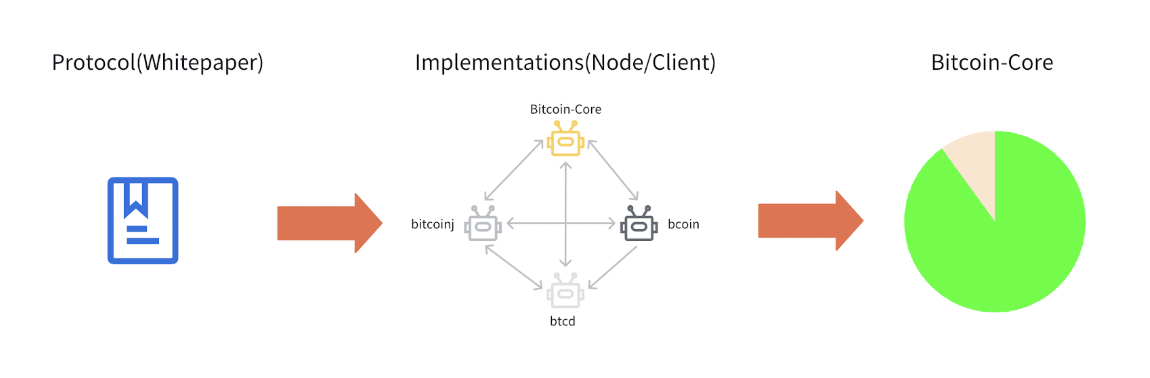
The Bitcoin whitepaper defines a protocol, forming the Bitcoin blockchain network through tens of thousands of nodes adhering to it.
There are multiple implementations of the protocol (commonly referred to as clients). According to data from bitnodes, Bitcoin Core holds the largest market share among clients. Thus, the maintainers of Bitcoin Core (hereafter referred to as Bitcoin-Core-Devs) wield considerable influence in the Bitcoin ecosystem.
what-why-1
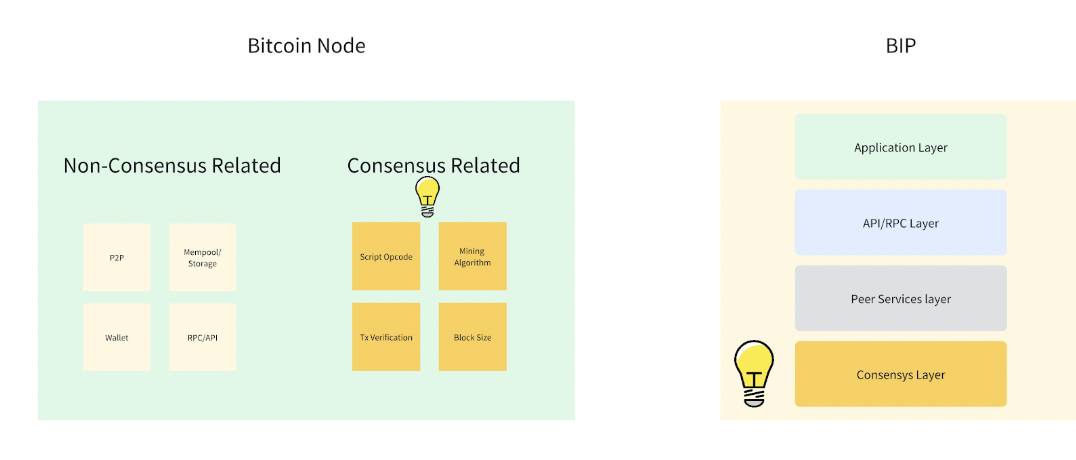
Bitcoin node software consists of multiple modules. Bitcoin-related upgrade proposals are defined via BIPs (Bitcoin Improvement Proposals), which have been categorized in various ways.
Typically, when people discuss Bitcoin upgrades, they refer specifically to "consensus protocol upgrades." Unless otherwise noted, this article follows that convention. Since consensus upgrades require agreement from the majority of the network’s nodes (otherwise risking forks), they must be approached with particular caution. As shown below, components related to the consensus protocol in the Bitcoin system—and BIPs targeting the consensus layer—deserve special attention.
what-why-2
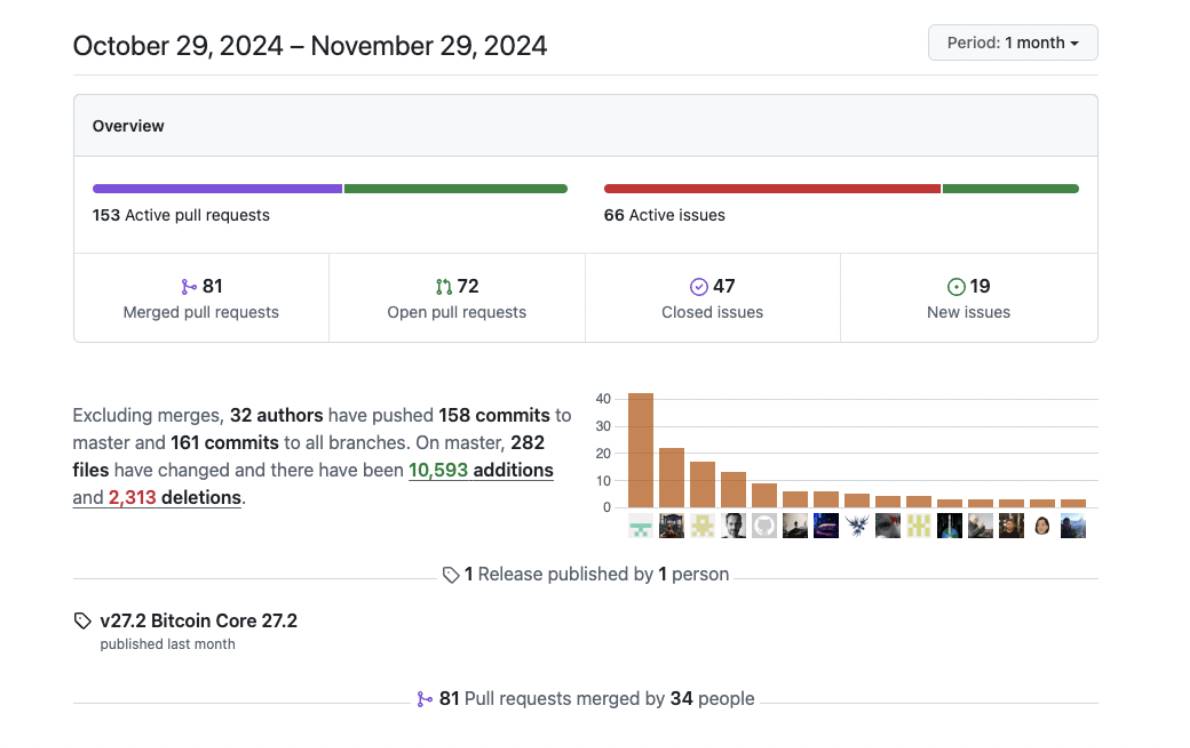
In practice, according to statistics from Bitcoin’s GitHub repository, code changes frequently. However, most modifications are unrelated to the consensus protocol and thus receive little public attention.
Bitcoin-core-github-stats
Types of Consensus Protocol Upgrades
According to BIP-123, consensus protocol upgrades are primarily divided into soft forks and hard forks.

Alternatively, here’s a less intuitive but equally insightful way to understand and contrast them:
-
Soft fork: Adds or tightens rules (e.g., introducing a new feature like Taproot address support)
-
Hard fork: Removes or relaxes rules (e.g., eliminating a restriction such as the block reward cap)
BIP and Soft Fork Process
The two previous successful consensus upgrades (Taproot and SegWit) both used soft forks, enabling upgrades without causing major community splits. This article focuses on soft forks—upgrades compatible with older software versions.
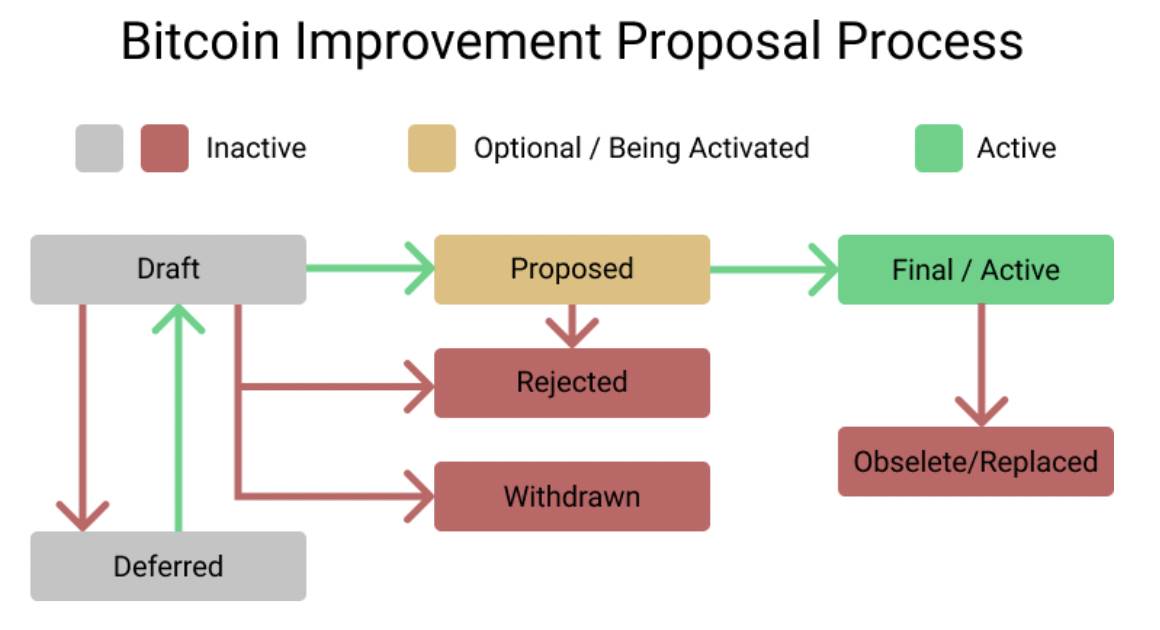
After a BIP proposal is submitted, the process generally follows the diagram below:
bip-state, source: https://river.com/learn/what-is-a-bitcoin-improvement-proposal-bip/
A typical soft fork proposal aggregates multiple BIPs. For example, Taproot included three BIPs:
-
Schnorr Signature: BIP-340
-
Taproot: BIP-341
-
Tapscript: BIP-342
Reviewing Taproot’s upgrade timeline:
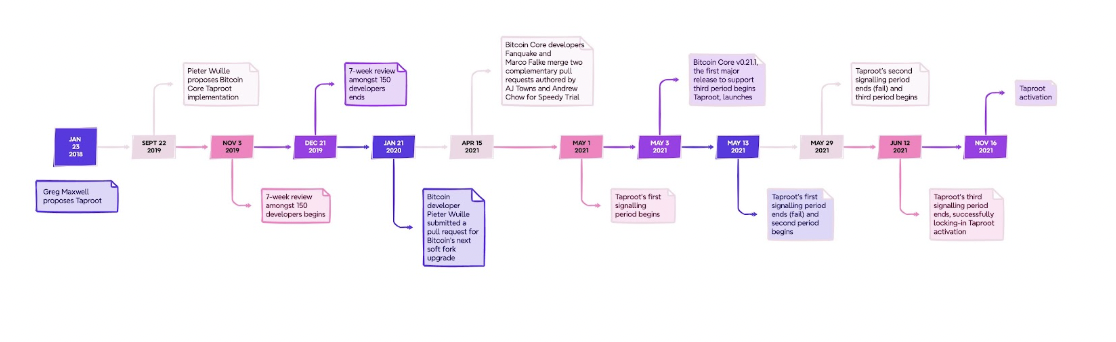
Taproot-timeline, Source: Kraken Intelligence, GitHub, CoinDesk, https://www.argoblockchain.com/articles/bitcoin-taproot-upgrade-explained
Milestones in the Taproot soft fork included:
-
Relevant BIPs proposed; implementation reviewed and accepted
-
Bitcoin-Core maintainers initiate GitHub pull request for upgrade
-
Bitcoin-Core maintainers review, merge pull request, and determine activation method
-
New version of Bitcoin-Core released
-
Miners vote on-chain to approve activation block height
-
Upon reaching the agreed block height, the upgrade completes
Note: These stages are derived from retrospective analysis; there is no formalized consensus outlining these milestones.
Throughout this process, the Bitcoin Development Mailing List played a crucial role in凝聚 consensus.
Why Upgrade?
As mentioned at the beginning, the community currently expresses three main views on upgrades:
-
Pro-upgrade advocates: Propose numerous ideas, analyzed further below.
-
Pragmatic builders: Relying on the existing protocol, they implement Fraud Proofs (via BitVM and its extensions), functional encryption (through Bitcoin PIPEs-based contracts and zk proofs), and hash collision contracts (via ColliderScript).
-
Status quo supporters: Include TeamSlowAndSteady, who believe upgrades should proceed cautiously every ten years, and Ossifiers, who oppose upgrades unless quantum threats emerge (reference).
The author provides a cost-benefit analysis of upgrading versus maintaining the status quo:
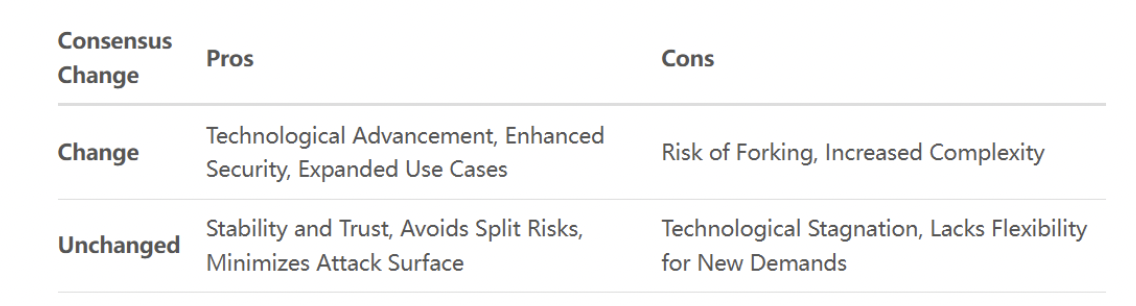
As a pragmatic Bitcoin ecosystem developer, the author believes that fully exploring Bitcoin’s potential through cryptographic and engineering innovation within the current protocol framework is essential. Furthermore, from perspectives of sustainability and adaptability, continuous upgrades—when necessary and after thorough assessment of impact and security risks—are advisable.
Diving Deeper into Upgrades
Stakeholders in Upgrades
The Hong Kong Agreement (signed during a Bitcoin Roundtable event in February 2016, see reference) primarily involved:
-
Bitcoin-Core-Devs
-
Mining pools
-
Users and ecosystem developers (mainly exchanges, chip manufacturers, etc.)
With Bitcoin’s rapidly growing adoption, stakeholders in upgrades have evolved beyond this simple tripartite structure into a complex landscape akin to a "game of thrones," as detailed in the report Analyzing Bitcoin Consensus: Risks in Protocol Upgrades.
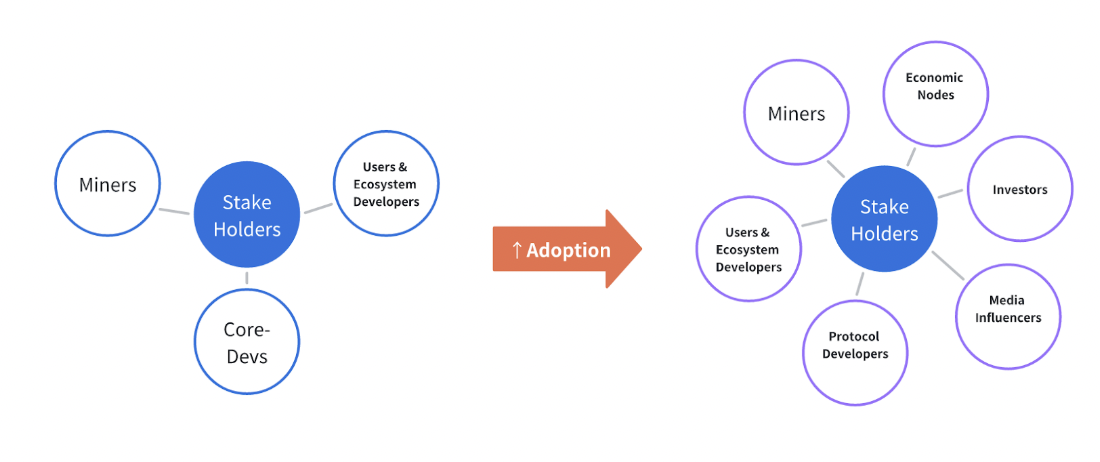
stakeholders
Several roles deserve closer examination:
-
Economic Nodes: Primarily major CEXs, payment processors, and custodial service providers. Their stance during a soft fork determines which chain is recognized as legitimate Bitcoin, significantly influencing adoption.
-
Investors: With rising global interest in Bitcoin strategies (ETFs, institutional reserves, national reserves), the investor role has become increasingly complex.
-
Users & Ecosystem Developers: After the Taproot upgrade, the Bitcoin ecosystem flourished, giving rise to asset protocols like Ordinals and a wave of native applications and scaling solutions.
Some interesting observations about these roles:
-
Different stakeholders play distinct roles at different stages: Ecosystem developers often drive proposals, protocol developers typically control BIP reviews, while mining pools and economic nodes exert significant influence over activation.
-
Different ecosystem developers tend to propose and support proposals aligned with their commercial interests.
Historical Review and Summary
Based on public records, Bitcoin has undergone multiple soft fork upgrades since its inception.
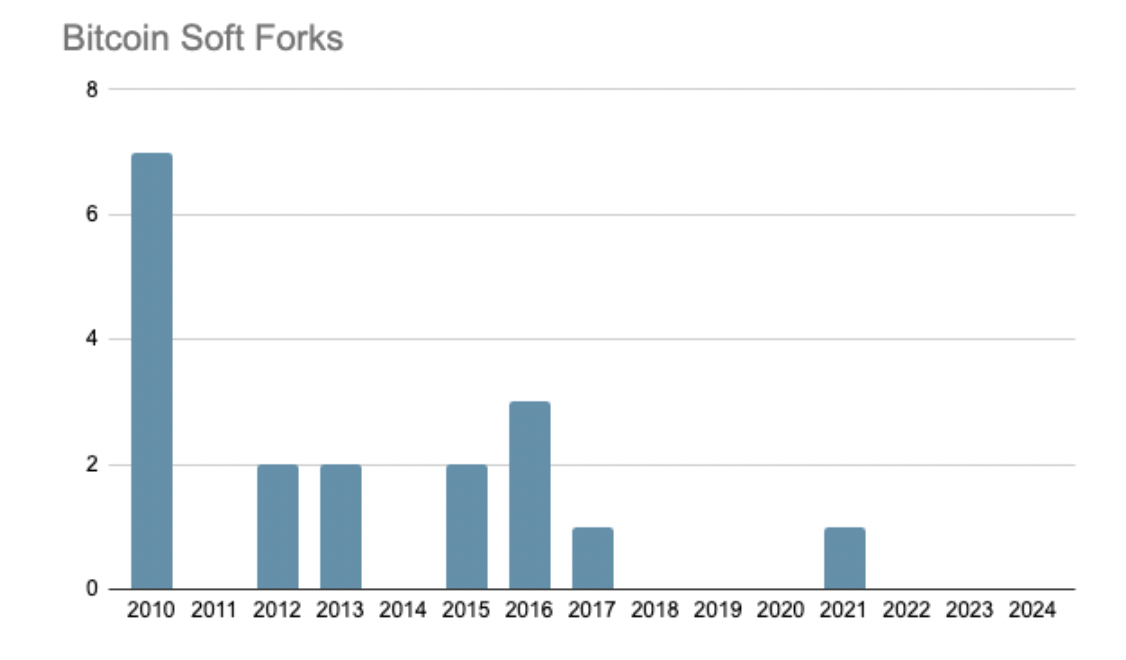
soft forks, data sources: https://blog.bitmex.com/a-complete-history-of-bitcoins-consensus-forks-2022-update/, https://www.drivechain.info/media/slides/mit-2023.pdf
From the chart above, we can draw several insights:
-
A form of protocol ossification has emerged: Over time, the frequency of soft forks has decreased.
-
The time required to reach consensus on upgrades has increased.
Focus Areas of Soft Forks
Analyzing past soft forks and their associated BIPs reveals common focus areas:
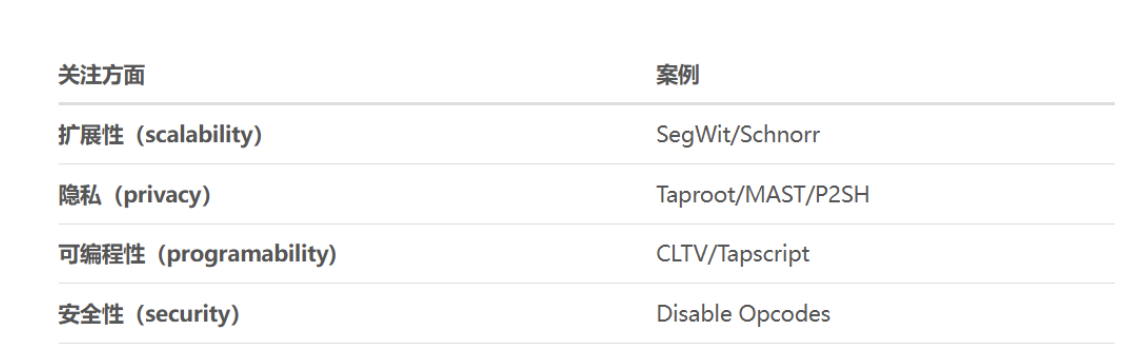
What Makes a Good Upgrade Proposal?
Based on the facts and analyses presented earlier, we attempt to define characteristics of a good upgrade proposal:
-
Uphold Bitcoin’s core identity as a payment system: Bitcoin has a unique positioning.
-
Elegant balance between application potential and risk: Broadly appealing, with minimal strong opposition.
-
Appropriate scale: Not too trivial (not worth the effort), nor overly complex (too difficult to push forward).
-
Right timing: Must address a pressing need or solve a specific problem. For example, scalability was a critical demand during the SegWit upgrade.
Outlook on Future Upgrades
Categorization of Proposals
The author compiled most active proposals, tagged them by focus area, and mapped them into quadrants for visual clarity.
Important notes on categorization:
-
The four focus areas are not entirely isolated; for instance, a BIP enhancing programmability may indirectly benefit scalability.
-
A single proposal may span multiple areas. For example, OP_CAT enhances programmability but is primarily advocated for enabling validity rollups.
-
Determining which aspects a proposal addresses requires a form of “consensus” (inherently political). There is no single authoritative definition, as different participants hold varying perspectives.
-
The second diagram is not a coordinate system. Groupings are based solely on tags; circle attributes (size, position, color) carry no inherent meaning.
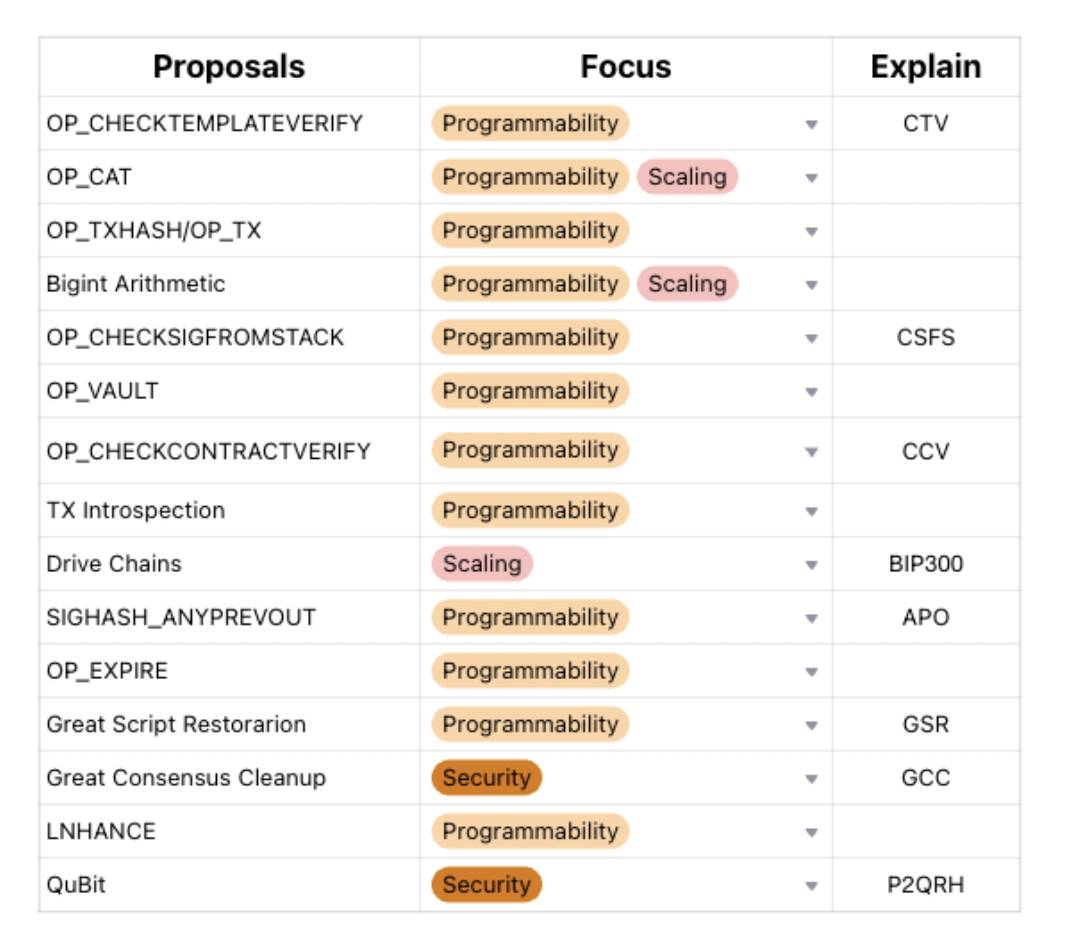
proposal category-2
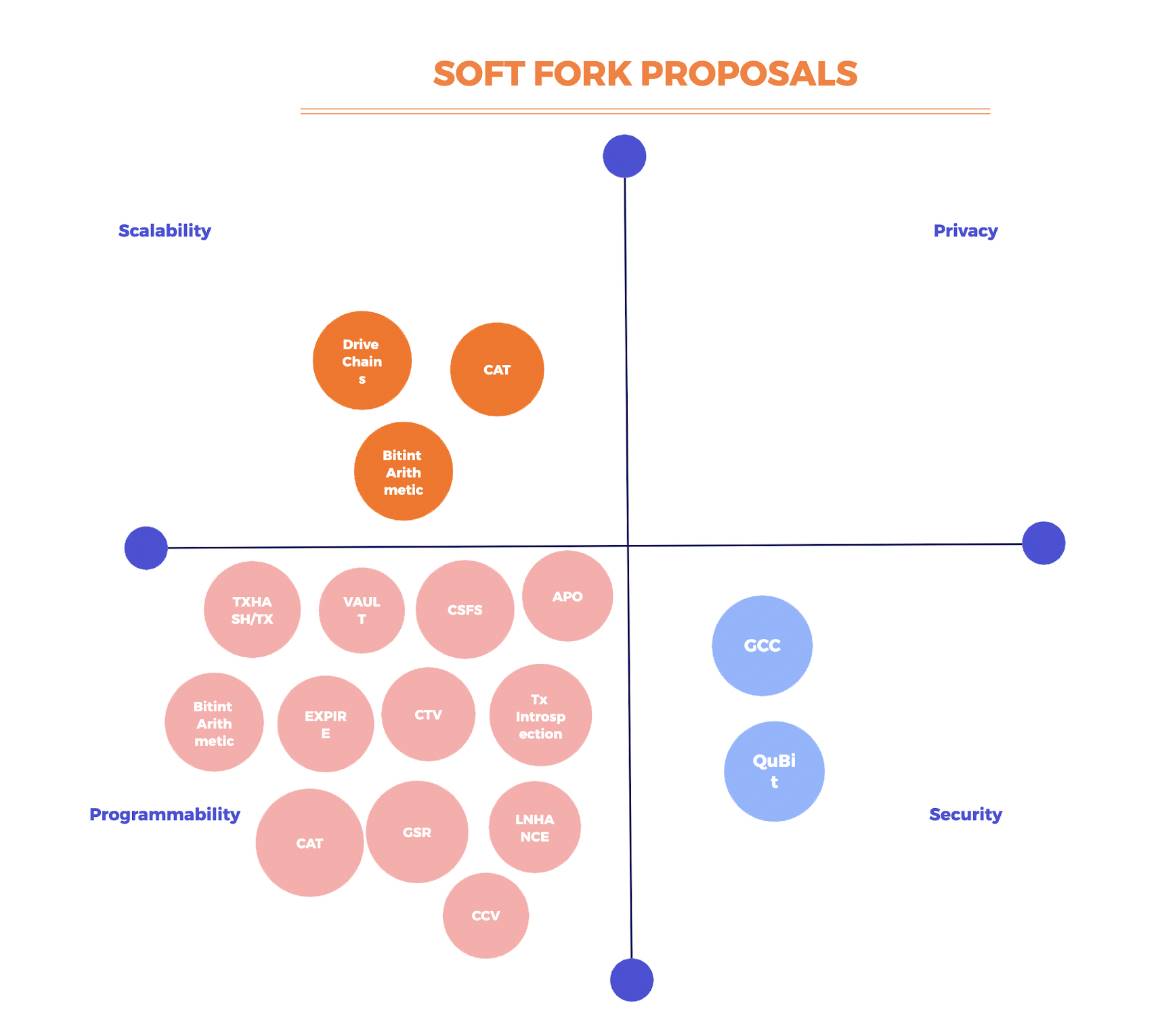
proposal category-1
Community Priorities
From the diagrams above, we observe a degree of consensus within the community on the types of functionality needed—centered around expanding Bitcoin’s payment system capabilities. These can be grouped into two main categories:
-
Programmability: Enhancing UTXO programmability, including features like covenants, vaults, transaction introspection, conditional payments, and script enhancements.
-
Scalability: Expanding Layer 2 solutions, broadly divided into on-chain verification and off-chain verification approaches, each supported by active proposals.
The Consensus Puzzle
The author believes the Bitcoin community is trapped in a maze of consensus regarding the next upgrade, due to the following reasons:
-
Ossification: A nearly $2T FDV software system makes many stakeholders prefer stability, with no party willing to assume responsibility for potential failures.
-
Highly fragmented stakeholders: Divergent interests and varying influence across stages; governments have also become stakeholders.
-
Underdeveloped governance mechanisms: As the first blockchain, Bitcoin lacks robust governance structures; even the method for activating soft forks remains unresolved.
-
Evolving role of Protocol Developers: While they do reject proposals, they cannot be simply labeled as conservative or progressive—their role is dynamic.
-
Lack of urgency: Blockchain infrastructure continues maturing, reducing immediate pressure for Bitcoin upgrades.
Summary & Takeaways
This article introduced fundamental concepts of Bitcoin upgrades, conducted an in-depth analysis of past upgrades, surveyed active proposals for future upgrades, and identified root causes behind the current consensus deadlock.
Through this review and outlook, readers should now have a clearer understanding of the current state of upgrade discussions. Below are key takeaways:
-
Pragmatic development combined with cautious upgrades makes soft forks preferable.
-
Highly fragmented stakeholders make the community inherently conservative.
-
Upgrades must align with Bitcoin’s core value proposition.
-
Scalability is just one of several important upgrade dimensions.
-
A favorable window of opportunity could enable rapid consensus around a strong proposal.
-
The community needs to explore better governance mechanisms.
Join TechFlow official community to stay tuned
Telegram:https://t.me/TechFlowDaily
X (Twitter):https://x.com/TechFlowPost
X (Twitter) EN:https://x.com/BlockFlow_News
 @BitlayerLabs