








Sushi Officially Plans to Liquidate Treasury SUSHI Tokens, Where Is DeFi 2.0 Heading?
TechFlow Selected TechFlow Selected
Sushi Officially Plans to Liquidate Treasury SUSHI Tokens, Where Is DeFi 2.0 Heading?
Sushi community proposal underway, DeFi 2.0 future looks promising.
 Navigating Web3 tides with focused insights
By Wenser, Odaily Planet Daily
As ETH prices gradually recover, DeFi sector tokens are also enjoying their "moment of surge." According to OKX market data, at the time of writing, SUSHI is trading at $2.54, up 32.68% in the past 24 hours—leading the pack among DeFi-related tokens. In addition, tokens such as UNI, HYPE, and CRV have all posted weekly gains exceeding 30%, prompting many to wonder: Is DeFi 2.0 really here?
Odaily Planet Daily will analyze the future direction of DeFi 2.0 through a review of Sushi’s recent moves, offering readers insights for reference.
Frequent Moves: Has Sushi Fired the First Shot in the 'DeFi Revival'?
In October, Sushi hinted via official posts that “something big is coming.” On October 21, Sushi tweeted “Tomorrow” in the early morning, suggesting major news was imminent. At that time, the SUSHI token price had only slightly risen to $0.8318.
Later that day, Sushi CEO Jared Grey announced: “Testing shows Sushi outperforms leading aggregators on competing networks across key metrics like price, gas, and latency, with monthly volume steadily growing. Additionally, Sushi is about to announce a strategic acquisition that will allow us to introduce innovative, built-in DeFi primitives into our AMM and perps verticals.”
Since then, as a veteran DeFi platform, Sushi has taken the lead in launching what could be called the “first shot” of the DeFi revival.
Shortly after, Sushi released its Super Swap roadmap, which includes:
-
Multichain Expansion: Sushi is already live on over 35 chains, with more to come. This broad network ensures seamless trading across new and established ecosystems, accessible through an intuitive Sushi user interface.
-
Route Processor (RP): The Route Processor delivers the industry’s most decentralized cross-chain aggregation stack. By aggregating liquidity from hundreds of sources, RP5 ensures competitive pricing and optimal trade routes for diverse assets—even across fragmented networks.
-
Swap API: Powered by the Route Processor, Sushi’s Swap API allows partners to directly integrate Sushi’s seamless swap experience into their applications. Future updates will include fee-capture mechanisms, opening new revenue streams for partners.
-
SushiXSwap: Now on version two, SushiXSwap supports cross-chain swaps across 15 networks, with plans for further expansion.
-
Trader-Centric Features: Sushi’s UX is designed for traders, offering essential tools such as tax token support, dollar-cost averaging (DCA), limit orders, mini portfolios, and a simplified token selector.
-
Blade: Blade is Sushi’s upcoming AMM designed to solve impermanent loss (IL) for liquidity providers. With Blade, LPs can expect stable returns on premium assets without exposure to IL risk.
-
Kubo: A DeFi perpetuals primitive enabling liquidity providers (LPs) to generate yield via delta-neutral strategies across multiple networks.
-
ALM Smart Pools: Steer’s smart pools simplify V3 concentrated liquidity management with user-friendly strategies that typically outperform standard LP approaches.
From ecosystem expansion and product aggregation to seamless integration, cross-chain swapping, LP risk mitigation, and process simplification, Sushi has initiated a new round of product iteration—aiming to attract broader liquidity and more users.
Following this, Sushi integrated with ecosystems such as zkLink Nova and ApeChain, advancing its previously announced multi-ecosystem integration strategy.
On the theme dominating this cycle—Meme coins—Sushi has offered its own “solution.” On November 28, Sushi announced that its Dojo proxy and Tweet Tokens feature are now live. This allows users to tokenize their favorite tweets or directly launch Meme coins from Twitter (i.e., X). Minting tokens from Twitter is completely free, though each user must wait five minutes between creations to prevent spam.
Thanks to a series of positive project developments, the SUSHI token has continued to climb, surpassing $1.36 in early December—a more than 200% increase compared to four months earlier. One trader who had accumulated 1.5 million SUSHI (worth ~$2.01 million) on August 9 cashed out with a 134% profit, earning $1.17 million.
If that trader had held until now, profits would have doubled to approximately $2.4 million. Of course, there’s no hindsight in markets, and the recent rise in SUSHI is closely tied to these favorable developments and ETH’s price recovery.
On December 6, a “Treasury Diversification Proposal” was launched on Snapshot, with voting ending on December 14 at 5:00 AM. Sushi CEO Jared Grey explained that currently, 100% of Sushi’s treasury consists of SUSHI tokens. Under the proposed diversification strategy, 70% of treasury holdings would be converted into stablecoins, 20% into blue-chip assets (BTC, ETH), and the remaining 10% into DeFi tokens (e.g., AAVE). If executed, Sushi would systematically sell off SUSHI holdings within a specified timeframe to minimize market impact, using dollar-cost averaging and executing sales under favorable market conditions.
The goals of this proposal include:
-
Reducing Volatility: Minimize the impact of SUSHI price fluctuations on treasury value;
-
Enhancing Liquidity: Increase liquidity for operational and strategic assets;
-
Generating Yield: Explore staking, lending, or liquidity provision opportunities.
So far, the proposal has received 774,000 SUSHI votes in favor, still about 84.5% short of the 5 million SUSHI threshold required for approval.
On December 8, Sushi CEO Jared Grey summarized the comprehensive governance reforms passed by the Sushi DAO in April and unveiled Sushi’s 2025 product roadmap, including:
-
Wara (wara.exchange): A new integrated trading experience built on Solana;
-
Susa (susa.exchange): A new order-book-based perpetual DEX launched by Sushi;
-
Kubo (kubo.bid): A native perpetuals product from Sushi Labs, launching new markets via delta-neutral strategies;
-
Blade (part of SushiSwap): A new LVR AMM solution eliminating MEV on blue-chip assets;
-
SushiSwap Aggregator: Already in development, this product will expand distribution through new partner integrations.
He also noted in a community reply that multi-token airdrops had already been announced back in April.
Sushi's official homepage banner
With this, Sushi’s ambition to expand into the Solana ecosystem becomes unmistakable.
Additionally, its “referral commission program” launched at the end of November is showing early success—referrers receive 75% of the 40% trading fee rebate, while referees get the remaining 25%, marking a clear “platform-passing-benefits-to-users” initiative.
With Sushi’s momentum, crypto users are increasingly hopeful about the evolution of DeFi 2.0—the result of concerted efforts by both legacy and emerging DeFi platforms.
How Will DeFi 2.0 Begin? Old and New Platforms Play Their Cards
According to SoSoValue data, after a wave of sector rotation-driven rallies, the crypto market saw a pullback today, with most sectors declining 1.5% to 3% over 24 hours. Notably, previously strong sectors such as CeFi, Layer 1, AI, and PayFi pulled back around 3%. In contrast, the DeFi sector remained relatively strong, posting a 0.63% gain. Within the sector, Chainlink (LINK) and Uniswap (UNI) stood out, rising 6.66% and 2% respectively over 24 hours.
Moreover, according to IntoTheBlock, Ethereum’s protocol revenue surged nearly 40% this week to around $57 million, driven by continued growth in DeFi and Memecoin trading. A closer look at current conditions of DeFi protocols and platforms reveals the following:
Hyperliquid: An L1 Chain Powering DeFi 2.0
In our previous article, “Single Accounts Averaging Up to $30K: Is HyperLiquid the ‘Most Generous Airdrop of the Year’?”, we provided an in-depth look at Hyperliquid, which has recently drawn significant market attention. After the article’s publication, the platform’s token HYPE rose from $8 to nearly $14, reaching new highs.
Clearly, HYPE’s decision not to debut on CEX initially served as effective “reverse marketing,” while its positioning as an L1 blockchain significantly raised the project’s ceiling. Combined with measures such as allowing community-requested 3x leverage on HYPE long/short positions and auctioning spot listing slots, it’s evident Hyperliquid has big ambitions—and the token may have further upside potential.
According to the latest Hyperliquid Hub statistics, Hyperliquid achieved $10 billion in daily trading volume over the past seven days, with daily open interest reaching $3.5 billion and over 220,000 users—remarkable market performance.
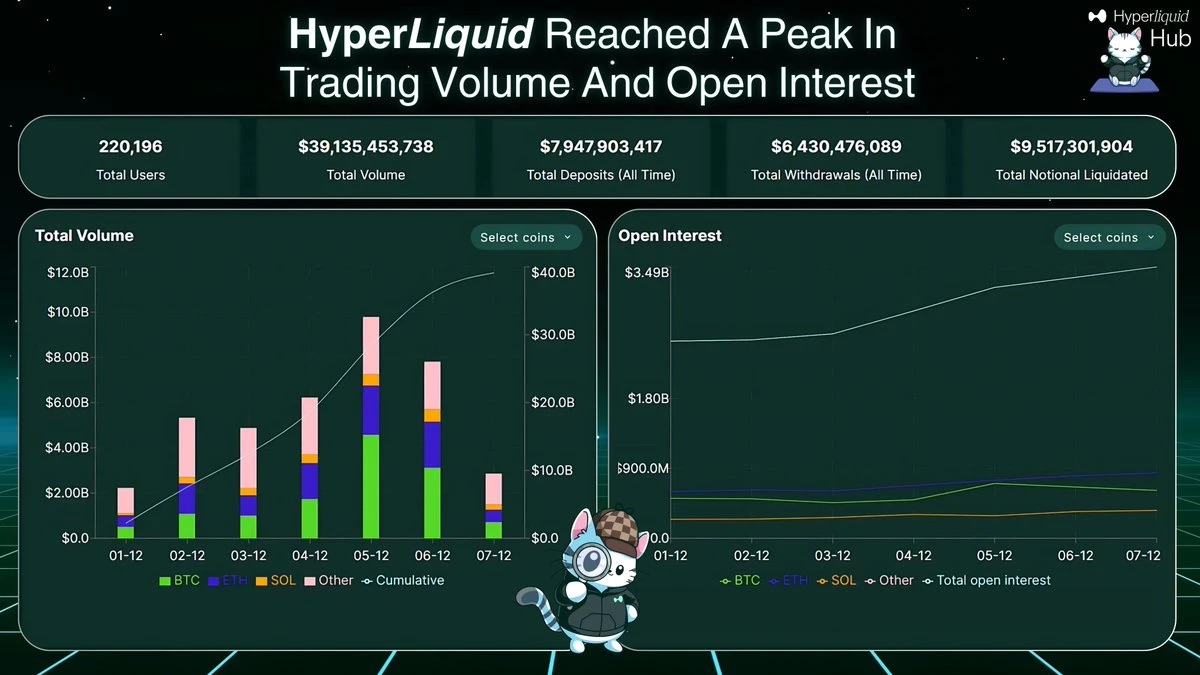
Hyperliquid delivers impressive results
Uniswap: Unichain Poised for Launch
Veteran DEX platform Uniswap isn’t staying behind either. It previously announced the launch of Unichain. Analysts suggest that Uniswap has long been a key driver of activity on the Ethereum mainnet. As Uniswap transitions onto its own chain, Ethereum validators could lose $400–500 million annually in revenue. But beyond the financial impact, this move threatens Ethereum’s core narrative as a deflationary asset. Uniswap’s Universal Router is the largest gas consumer on Ethereum, accounting for 14.5% of total gas fees—equivalent to burning $1.6 billion worth of ETH. Weakening this burn mechanism undermines Ethereum’s economic foundation.
In November alone, Uniswap recorded $38 billion in monthly trading volume—nearly 50% higher than October’s $34 billion record. Monthly fees reached $5.44 million, ranking sixth among DeFi protocols. Arbitrum became the first L2 to surpass $20 billion in monthly trading volume on Uniswap. Recently, Uniswap Labs also announced a partnership with Fireblocks, a digital asset operations and payments platform. Through Fireblocks, asset managers, hedge funds, and other financial institutions can directly access Uniswap’s deep liquidity and competitive pricing.
Thus, Uniswap has effectively established an “institutional-grade user service system.”
Others: ORCA, RSR, DYDX, CRV
Other DeFi-related tokens such as ORCA, RSR, DYDX, and CRV have also seen strong price performance due to various catalysts:
-
ORCA: Price rose following its Binance listing;
-
RSR: Gained attention after Paul Atkins, the newly appointed SEC chair, was revealed to have served as an early advisor;
-
DYDX: Trading volume remains among the industry leaders, and the platform has responded quickly to market trends such as Meme coins;
-
CRV: Achieved a sixfold surge in one month after recovering from its earlier “liquidation crisis.”
Given the strong protocol revenue performance of current market leaders, the future of DeFi 2.0 looks promising. (For details, see “Curve Up Sixfold in a Month: Who Are the Real ‘Value Tokens’ from a Protocol Revenue Perspective?”)
Conclusion: When DeFi Meets Meme Coins, MemeFi May Drive the Next Industry Surge
As one of the first sectors to lead the market following BTC’s breakout above $100,000, the DeFi space continues evolving to find new paths forward. Some market analysts believe MemeFi could become the “engine” driving the next wave of industry growth—combining DeFi mining yields with the low barriers and high-frequency trading of Meme coins to attract new investors and fresh liquidity. The emergence of various Meme coin projects on Hyperliquid exemplifies this new direction.
Besides, LP farming by Meme coin teams has become a popular tactic recently. For more details, see “Meme Waves Aren’t Just About PVP—‘Farming’ Is Also a Great Option”.
In the near future, we may witness another “wealth-creating star” in the Meme coin space beyond pump.fun.
Join TechFlow official community to stay tuned
Telegram:https://t.me/TechFlowDaily
X (Twitter):https://x.com/TechFlowPost
X (Twitter) EN:https://x.com/BlockFlow_News
 Odaily






