








A flurry of aggressive moves, yet still unable to escape the curse of "holding too long, cutting losses, or selling too early"?
TechFlow Selected TechFlow Selected
A flurry of aggressive moves, yet still unable to escape the curse of "holding too long, cutting losses, or selling too early"?
Success cannot be copied, but failure keeps getting replicated. This article will omit specific figures on unrealized gains and losses, focusing instead on lessons from failures to help newcomers avoid pitfalls.
 Navigating Web3 tides with focused insights
By: 1912212.eth, Foresight News
The bull market has finally arrived as we hoped. After enduring a downturn since March this year and waiting half a year, the market has finally exploded. With the Federal Reserve cutting rates, Trump's election victory, and the impending departure of the SEC chair, overall market sentiment is extremely high. On December 5, Bitcoin even broke through $100,000 for the first time. Many now believe the bull market peak could occur in the first half of next year.
However, an improving market doesn't mean every trade will be profitable. As the saying goes: buying well makes you an apprentice; knowing when to sell makes you a master.
Based on my past failures with two tokens, I'll analyze common trading mistakes to help newcomers avoid pitfalls.
Be cautious with new tokens late in the bull market; don't expect excessive returns
In the second half of 2021, the market was already nearing the end of the bull run. DYDX attracted significant attention due to its large airdrop and leadership position in the derivatives sector. I entered around $10, doubled my money within a week amid soaring market excitement, and assumed prices would continue climbing. However, the rally peaked in early November—new token returns were disappointing. The market then began a violent decline. Holding stubbornly, I missed the optimal exit window and eventually cut losses near $2.
Unwilling to accept defeat, I reasoned that DYDX falling below $1 was unlikely. During the mid-2023 market recovery, I steadily accumulated spot holdings, especially given the anticipated dYdX V4 upgrade. The market did rebound, and DYDX eventually surpassed $4 by November 2023—coinciding with broad market gains. I assumed it was entering a new upward phase. Ironically, by early 2024, the price had dropped nearly 50% from its peak, and I exited with only one-third of my maximum unrealized profit.
Looking back, my selection process was deeply flawed. First, the CEO showed blatant disregard for the token price—even stepping down to pursue "ideals." Despite improved tokenomics, relentless selling pressure from VCs and miners continued. The team also moved slowly on new launches, failing to generate momentum, causing the token to remain stagnant since June 2022.
Second, expectations for new tokens late in a bull cycle should be tempered. In the previous cycle, my only losing trade was buying a new token—DYDX—late in the bull market. Conversely, early-positioned assets like DOT and NEAR proved much easier to hold and delivered solid returns.
Sometimes waiting for the wind is harder than chasing it
In early 2024, after evaluating CoinList projects and VC lineups, I heavily invested in the RWA token ONDO at an average cost of about $0.30. ONDO remained a core HOLD position. I attempted several swing trades afterward, reducing my holdings by tens of thousands of tokens—prompting me to vow never to swing trade again. Yet my subsequent actions became my worst heavily-weighted decision in recent years.
During the recent meme coin surge, countless meme coins skyrocketed while my ONDO position barely moved. Additionally, despite being listed on Binance futures since early 2024, ONDO wasn’t added to Binance spot—limiting its upside during each RWA sector rally. This bred growing disappointment.
Constant frustration turned into doubt. Realizing my returns might not match those of meme coins, I rotated my position into three parts: BONK, FLOKI, and ZK.
I chose ZK because Ethereum’s momentum was clear, OP and ARB had already surged, and ZK appeared promising. That thesis wasn’t wrong—but my timing for entering meme coins was disastrous.
Who would have thought the music would stop immediately after I rotated? Except for ZK, the rest of the new positions began a steady decline. Most painfully, just after I sold ONDO near $0.99, it surged strongly within a week—reaching as high as $1.95.
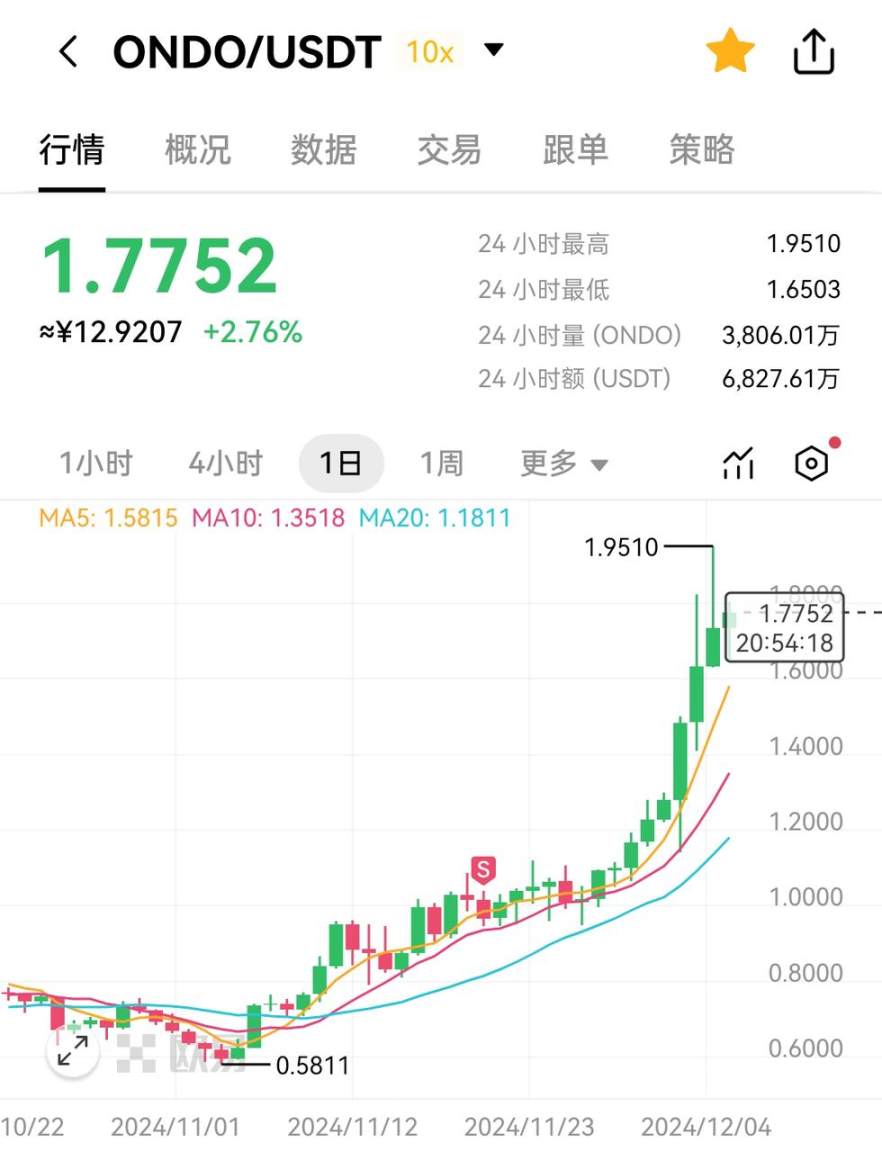
Missing a 100% gain on a core holding during the early stage of a new bull market severely impacted my mindset.
Reflecting later, I realized my mentality had been overly restless. Watching other tokens soar while my heavy position stagnated caused emotional动摇 (wavering). Market rotation was extremely fast—capital shifted rapidly from memes to L1s, DeFi, and RWA.
Many decisions are made in an instant—but these choices are often subconsciously shaped by accumulated experiences.
Prolonged meme coin rotations made me doubt the return potential of VC-backed tokens, leading to mental imbalance and missed profits—a self-inflicted penalty for impatience.
Summary
During cyclical market movements, several key points deserve attention:
First, avoid buying new tokens late in a bull market—or at minimum, keep return expectations realistic. Macro cycles matter greatly. Once bearish signals emerge, slow exits can lead to severe profit drawdowns.
Second, during sector rotations, resist the urge to rotate into hot themes. In bull markets, certain narratives suddenly ignite, promoted widely on Twitter amid intense sentiment. If your holdings remain flat for extended periods, it's easy to feel impatient. But by the time you decide to switch, the trend may already be reversing—leaving you trapped. At such moments, discipline and the courage to ignore noise are essential.
Third, before making any trade, ask yourself: what truly convinces me? Can I clearly and simply explain this rationale to others? If many conditions aren't met, the asset likely wasn't suitable from the start.
Planning is critical. Where exactly is the market in the current bull cycle? If we're only at the beginning, do better alternatives exist that can outperform current holdings if sold today? Why is now the ideal time to sell? If reasoning is arbitrary or based solely on influencer hype without independent analysis, traders easily become slaves to price charts—chasing trends only to get stuck at peaks and damage their psychology.
Everyone has different preferences, capital sizes, and risk tolerances. What works for others may not suit you.
The refinement of trading skills and mental discipline is an endless journey. Finally, don't obsess over missing the absolute top—no one consistently sells at the perfect peak.
Join TechFlow official community to stay tuned
Telegram:https://t.me/TechFlowDaily
X (Twitter):https://x.com/TechFlowPost
X (Twitter) EN:https://x.com/BlockFlow_News
 Foresight News











