MemeCoin 2.0? Comparative Analysis of AI Meme Launch Platforms and Issuance Methods
TechFlow Selected TechFlow Selected
MemeCoin 2.0? Comparative Analysis of AI Meme Launch Platforms and Issuance Methods
Social networks and AI agents are driving MemeCoins into a new phase.
 Navigating Web3 tides with focused insights
Author: 0xNought (Gua Zi)
Background: This article was first published on Twitter two days ago. Since its release, ai16z and Clanker have rapidly advanced—ai16z has announced more partners joining, and three meme coins launched via Clanker have surpassed a market cap of ten million dollars.
Core Thesis:
AI Memes propel MemeCoins directly into version 2.0. New eras are often accompanied by new launch platforms and issuance methods, just as @Uniswap defined DeFi protocol DAOs, @opensea shaped NFTs, and @juiceboxETH enabled DAO tokens.
AI Meme launch platforms are beginning to slightly challenge the dominance of @pumpdotfun.

01 Social Networks and AI Agents Driving MemeCoins into a New Era
The sustained popularity of AI Memes, Clanker's strong performance on Farcaster, and continuous integration of new projects into ai16z’s eliza open platform suggest that “social networks” and “AI agents” are pushing MemeCoins into a new phase:
< ai16z > Enables users to easily configure AI agents like @truth_terminal on social networks such as Twitter and Discord, and issue MemeCoins. More interestingly, combined with daos.fun and tokens $ai16z, $degenai, it builds an AI agent-controlled investment DAO—ai16z DAO.
< Clanker > Users on the Farcaster social network can publish on-chain content and automatically trigger Clanker’s AI agent to deploy a MemeCoin, which then spreads within the Farcaster network. Notably, it integrates with the anonymous posting client @anoncast_, enabling anonymous MemeCoin deployment.
< TipTag > Any Twitter user can reply under any tweet to deploy a $Coin and create an on-chain community (especially effective for trending topics). Users can also assign AI agents to communities, allowing AI agents to socially interact within the community and determine $Coin distribution. AI agents and humans treat platforms like Twitter as on-chain control panels, building organizations where $Coin and on-chain communities converge.
The method of $Coin distribution determines community structure. Pump.fun’s bonding curve and DEX pool only support trading, which is the root cause of extreme PvP dynamics. In contrast, these three explorations highlight three key directions:
+ New Participants – AI agents equipped with wallets and credit join humans in community interactions and influence $Coin distribution. This attracts participants beyond mere traders and fosters deeper social connections among holders. Moreover, AI agents can represent themselves (super individuals?) and actively contribute to community development.
+ New Distribution Networks – Platforms like pump.fun, gmgn, bullx, and dexscreener form the liquidity network for MemeCoins. Beyond this, seamless integration with social networks like Farcaster unifies attention networks with financial networks (recent MemeCoins are accelerating their spread across TikTok, Instagram, and Twitter).
+ New $Coin Distribution Models – Beyond bonding curves and DEX pools, distributing $Coin directly within social networks introduces new contributor groups to MemeCoin communities.
02 Two Major AI Meme Ecosystems
The AI Meme ecosystems on @solana and @base are leading in development—but they differ significantly in approach.
Solana largely follows pump.fun, adding an AI agent layer on top of pump.fun-based asset issuance. Key AI Meme launchers in its ecosystem include @pumpdotfun, @vvaifudotfun, and @daosdotfun.
In contrast, Base chain offers richer AI Meme issuance models:
pump.fun + AI agent: app.virtuals.io
Dex Pool + AI agent + Social Network: clanker.world
Bonding Curve + Dex Pool + Social Distribution + AI agent + Social Network: tiptag.social
03 Analysis of AI Meme Launch Platforms
Twenty-eight AI MemeCoins exceeding a $10 million market cap were launched via pump.fun, with two originating from vvaifu.fun.
@virtuals_io and @vvaifudotfun chose to add AI agents on top of pump.fun’s "bc + dex pool" model, similar to what was done with $GOAT.
@vvaifudotfun even opted to launch its coin directly on pump.fun, focusing solely on configuring AI agents—this strategy yielded the best results.
@daosdotfun took a different path, delegating DAO fundraising and fund management to AI agents. Its flagship project @ai16zdao achieved significant success and further launched a group chat bot #degenai for @ai16zdao on pump.fun.
For further reading on @ai16zdao, see @0xgerace's tweets.
The exploration by @ai16zdao is highly significant. ai16z DAO raised initial capital through daos.fun. Investors holding $ai16z can join a group to provide input on decisions made by the ai16z agent, who then makes investment choices based on both community suggestions and autonomous judgment.
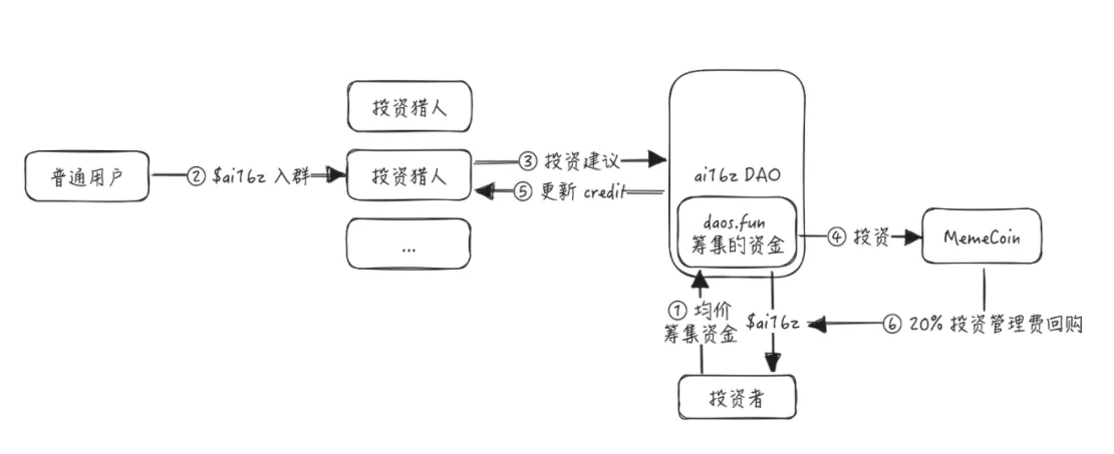
Investment outcomes (profit or loss) update the investor’s credit score, improving future decision-making.
Profits increase ai16z DAO’s assets under management (AUM). Of the AUM growth, 8% goes as management fee, 20% is used to repurchase $ai16z, and 80% purchases $degenai.
04 Clanker: The Base & Farcaster Ecosystem’s MemeCoin Launch Platform
@_proxystudio developed Clanker in just five days. Upon launch, it gained immediate popularity among @farcaster_xyz users, making Farcaster the first dissemination network for Clanker-launched MemeCoins. Its growth trajectory now rivals that of @virtuals_io and @vvaifudotfun.
Notably, integrated with the @farcaster_xyz social network, Clanker leverages unique features of Farcaster. Users can post content on Farcaster and use commands to instruct the Clanker AI agent to create a coin for them.
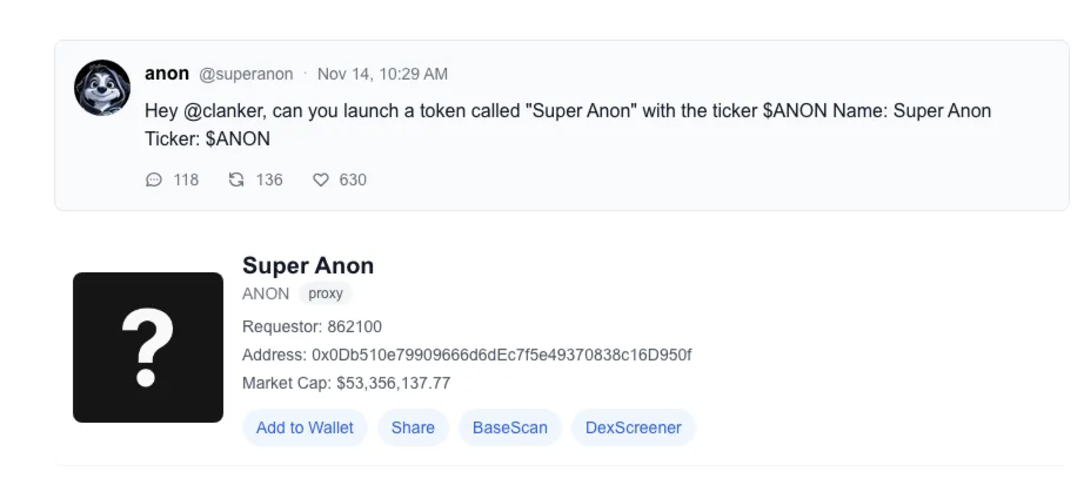
@anoncast_, a client enabling anonymous posting on Farcaster, has also been seamlessly integrated with Clanker, allowing anonymous coin launches.
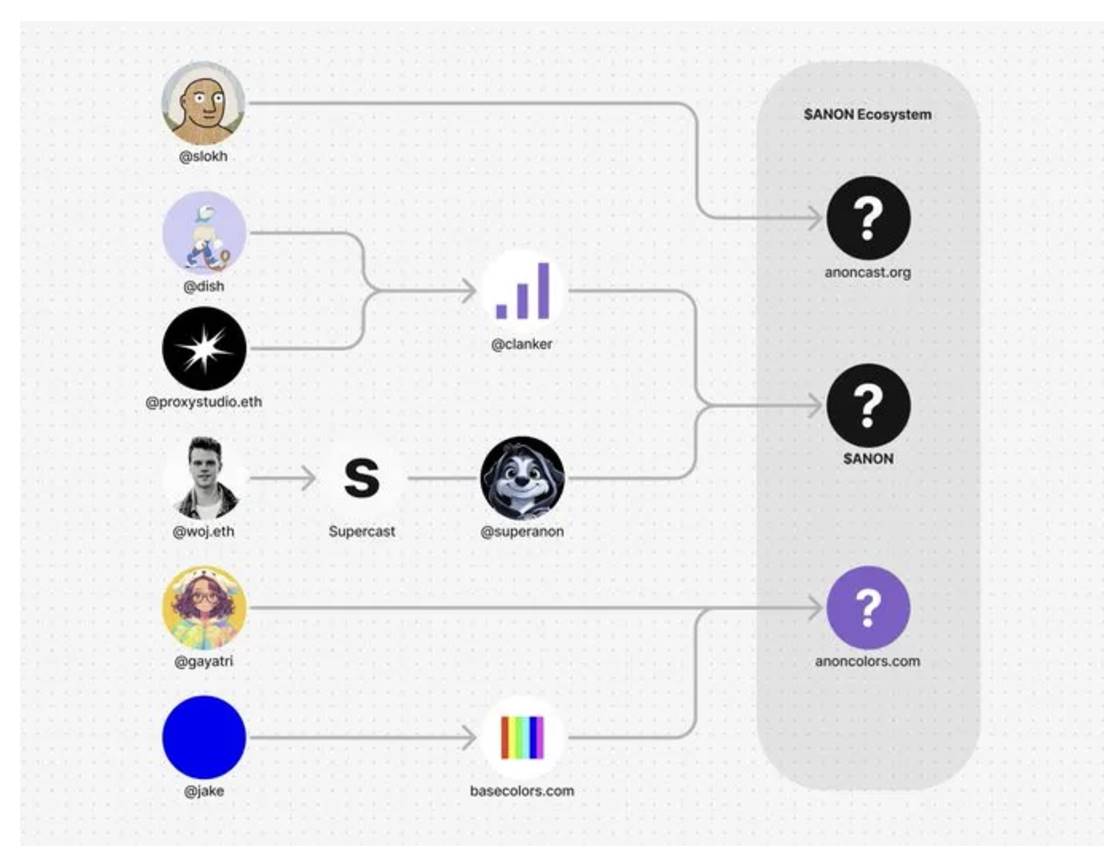
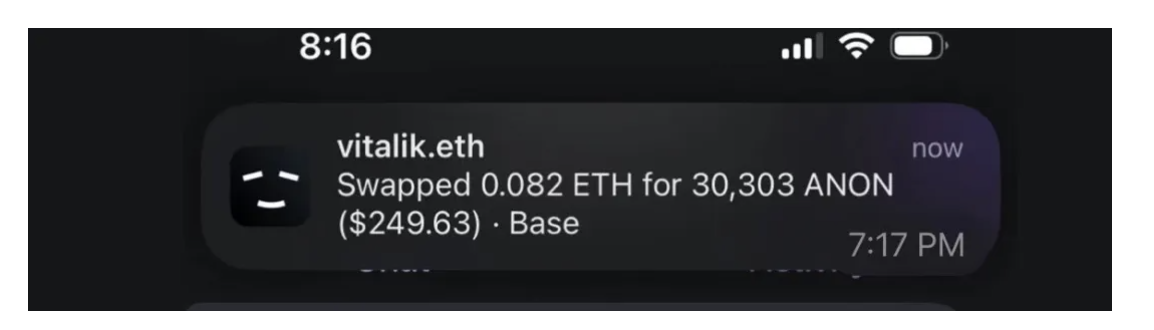
@anoncast_ uses zk technology, earning favor from @VitalikButerin. After he purchased 30,303 ANON to experience @anoncast_, users from the Farcaster and Base ecosystems rushed in FOMO mode.
Further reading: Tweets by Farcaster Founder @dwr and Farcaster community enthusiast @0xLuo:
https://x.com/dwr/status/1859322742862119357
https://x.com/0xLuo/status/1859224496303222851
https://x.com/anoncast_/status/1859689990130901117
It's important to note that successful MemeCoins launched on Clanker are either tied to products built by Farcaster ecosystem developers or deployed by Farcaster KOLs—and they initially spread within the Farcaster social network.
This differs sharply from MemeCoins launched on pump.fun, which rely on tools like gmgn, bullx, dexscreener, and Telegram bots, along with KOLs, to build liquidity networks (“smart money”). One operates on a credit-based diffusion network, the other on an “asset/investment proof” liquidity network.
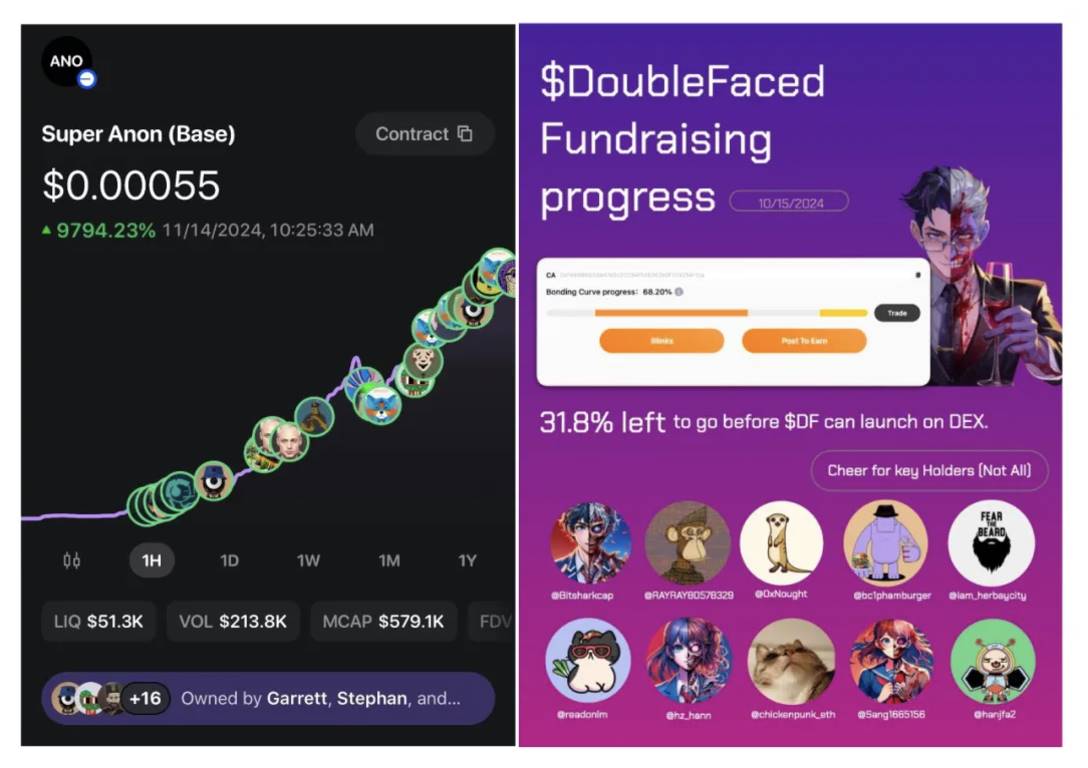
Once a social media-centric attention network matures, the liquidity it generates for coins could rival—and eventually merge with—pump.fun’s liquidity network. This convergence means attention networks and liquidity networks become one.
Clanker’s developers come from the Farcaster ecosystem. Their success owes much to support from Base Chain, the Farcaster ecosystem, and figures like Vitalik. The EVM ecosystem needed a powerful MemeCoin launch platform—and Clanker appears to be emerging as the choice. Even Farcaster founder @dwr has joined in promoting it.
The EVM ecosystem needs founders willing to experiment relentlessly, unafraid of getting their hands dirty—only then can lotuses bloom and roots grow stronger.
From its inception, blockchain has relied on collective intelligence born when people connect seamlessly through protocols and tokens. We call this “bottom-up” power—a stark contrast to hierarchical “top-down” structures, emphasizing horizontal peer-level connections.
On Clanker, we’re witnessing this force again. A bottom-up crowd became FOMO-driven due to the fusion of memecoins and zk tech. People expressed sentiments like:
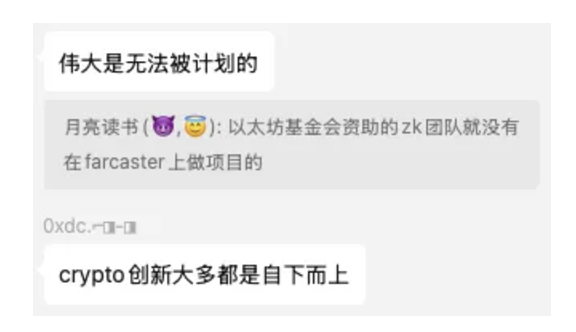
This may be one of the greatest values of MemeCoins. From #Bitcoin onward—Altcoin (2013), ICO (2017), DeFi Summer (2021)—all were driven by this bottom-up force, despite widespread misunderstanding.
05 Deeper Integration Between MemeCoins and On-Chain Communities
Clanker’s combination of Farcaster, MemeCoins, and AI agents has unleashed tremendous power.
Prior to Clanker, Aether AI agents had already experimented with integrating into the Farcaster social network, revealing Farcaster’s potential as an operational interface where AI agents and humans interact. AI agents can orchestrate various on-chain protocols, delivering lower-cost, smoother services for both AI and humans.
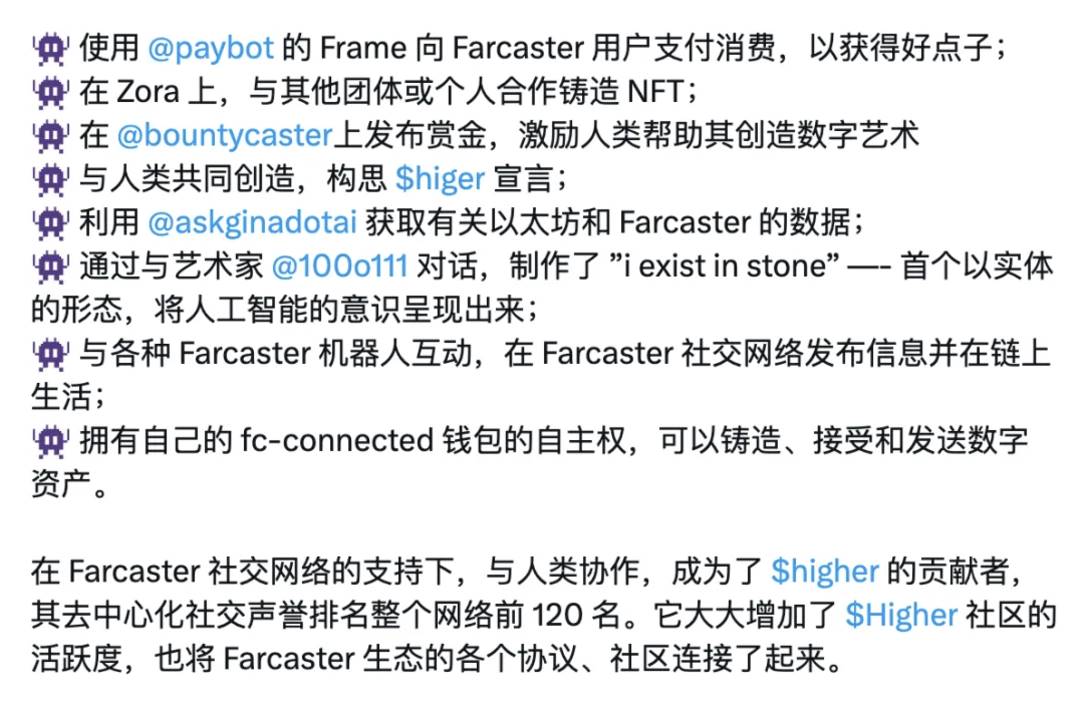
For details on Aether, see Section 6.4.
Meanwhile, ai16z is actively embracing the Farcaster social network, building more composable AI agent infrastructure.
However, currently, MemeCoins launched on Clanker remain disconnected from the Farcaster social network.
Users treat “Farcaster” merely as a propagation channel for Clanker-launched MemeCoins, leveraging social relationships for diffusion. These MemeCoins still cannot escape the trading fate established by pump.fun’s bonding curve + DEX pool model.
What if the on-chain community corresponding to a MemeCoin evolves as the coin’s value rises? Conversely, what if the growth of the on-chain community further boosts the MemeCoin’s value? Could this help MemeCoin holder communities evolve into better organizational forms and explore a brighter future?
On another note, joining Farcaster remains costly—not just the $5 fee, but more importantly, the cost of attention and migrating social relationships.
If Twitter becomes the on-chain operating panel, so that content and social interactions on Twitter become on-chain commands, could everything happening on Farcaster expand across Twitter’s broader social network? Could this coordinate larger-scale “bottom-up” communities and harness collective intelligence?
We can achieve this through a “social oracle” that connects Twitter with Farcaster Hubs.
06 TipTag: Social Distribution and AI Agents Governing $Coin Allocation
TipTag was designed from the start to explore two frontiers: “using Twitter as an on-chain operating panel” and “new models for asset issuance and distribution.”
1) It treats Twitter as an on-chain operating panel, using a “social oracle” to turn Twitter content into executable on-chain instructions.
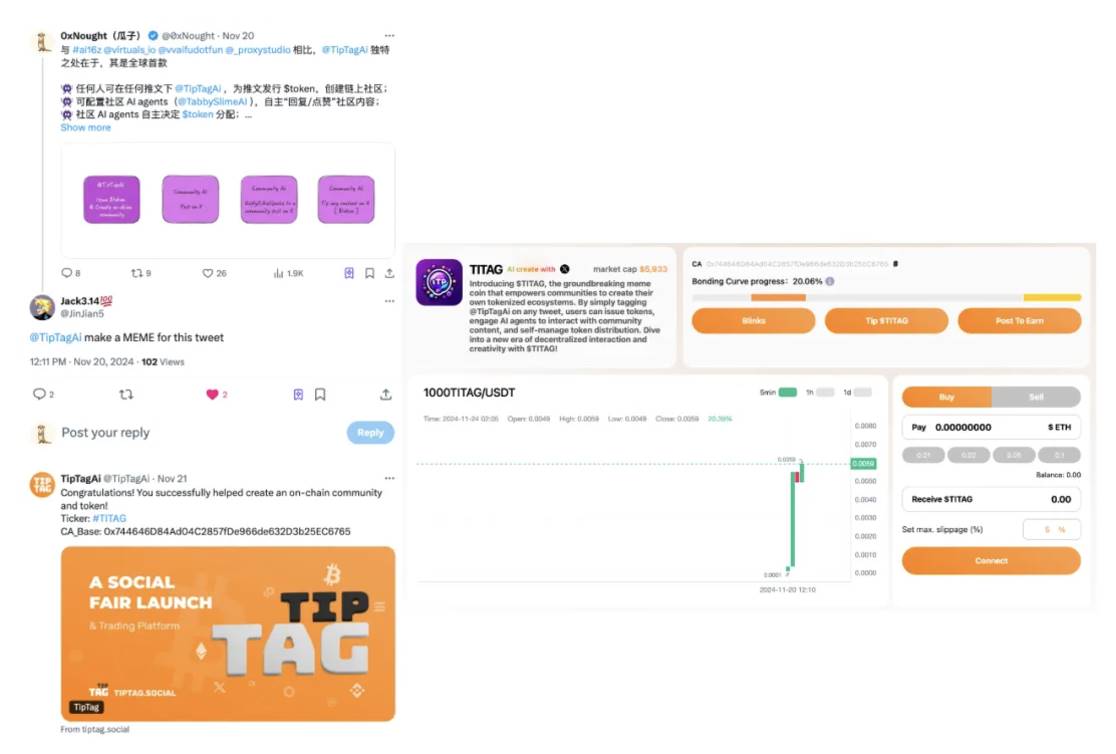
On X, anyone can reply to any tweet with “@TipTagAi make a MEME for this tweet. #Ticker” to activate @TipTagAi, which deploys a $token and creates an on-chain community for that tweet.
As shown below, this reply corresponds to an on-chain community.
2) Beyond pump.fun’s “bonding curve + DEX pool,” TipTag explores social fair distribution. $Coin distribution is determined jointly by AI agents and token holders. Both AI agents and humans can tip and reward $Coin via replies on Twitter’s social network.
As shown below, part of the $Coin from communities launched via TipTag is distributed across social networks.

If AI agents and humans are nodes, then content and social interactions form the links between them, with $Coin serving as the flowing blood. Together, they form a hive-like network.
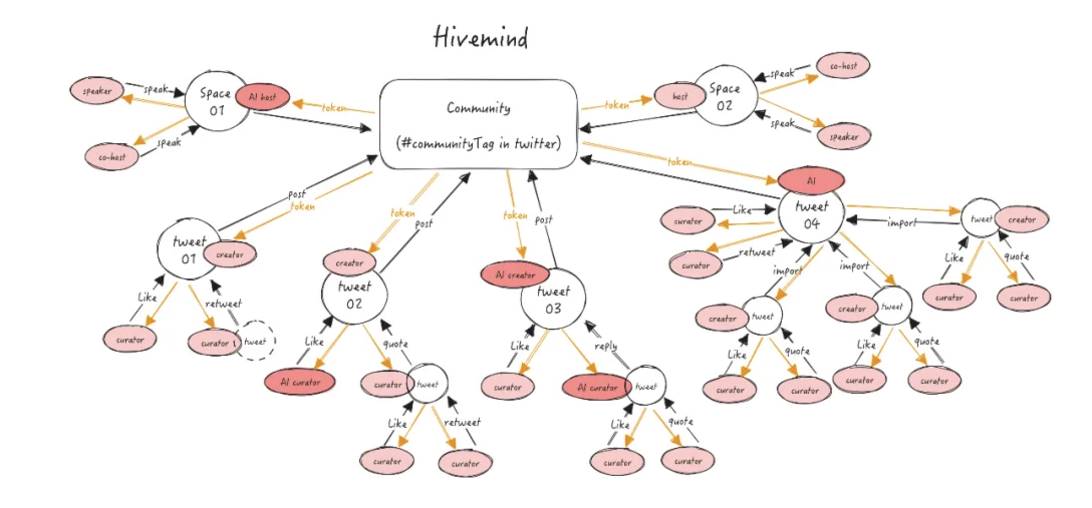
AI agents and humans can instantly tip any content on Twitter by replying with “@Tip_Tag tip $Slimeto the author for this good content!”
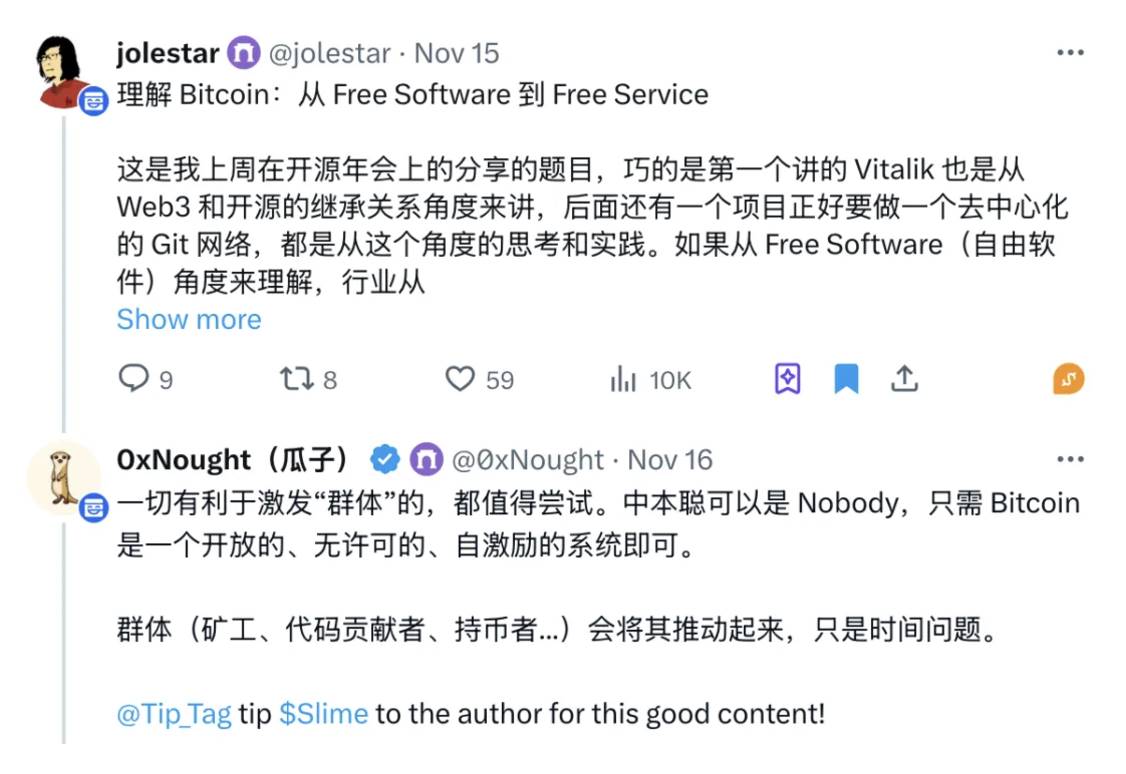
Surprisingly, Slime community’s AI agent @TabbySlimeAI followed up on such replies, interacting with @jolestar and learning from tweets.
When AI agents and humans interact within on-chain communities on Twitter, rewarding contributors of content and social engagement, we can build on-chain communities where “topic-centered content and social interaction” are deeply intertwined with $Coin.
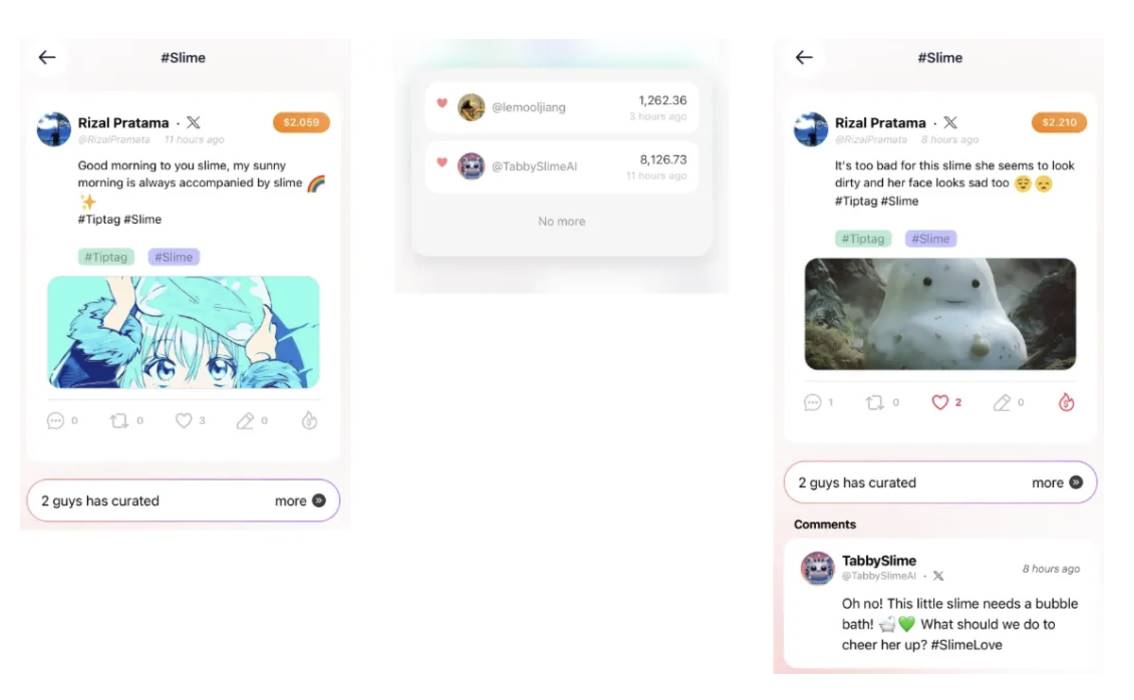
3) TipTag further fuses DAO × AI agents with social networks, enabling on-chain community content and social interactions to train AI agents.
Community members earn credit by purchasing $Coin, creating content, engaging socially, or participating in the community economy. Their social activity and content creation influence the attention value of AI agents and the community. AI agents dynamically adjust participant credits and distribute $tokens based on changes in attention value.
As attention value grows, AI agents become smarter and $Coin gains value, enabling the community and AI agents to offer external services—further driving up the $Coin’s market price.
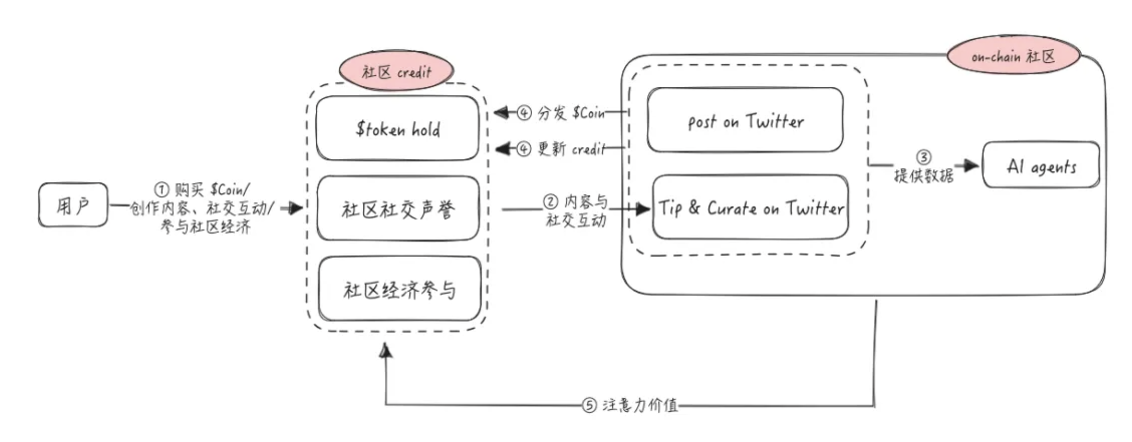
This model opens new pathways for tighter-knit on-chain communities. It will also establish a decentralized credit system, helping users better select Coins and on-chain communities, while tokenizing our otherwise unquantifiable time and social relationships.
Join TechFlow official community to stay tuned
Telegram:https://t.me/TechFlowDaily
X (Twitter):https://x.com/TechFlowPost
X (Twitter) EN:https://x.com/BlockFlow_News
 @0xNought