Beam Chain: The Ultimate Path or a Technical Maze for Ethereum's Consensus Layer Restructuring?
TechFlow Selected TechFlow Selected
Beam Chain: The Ultimate Path or a Technical Maze for Ethereum's Consensus Layer Restructuring?
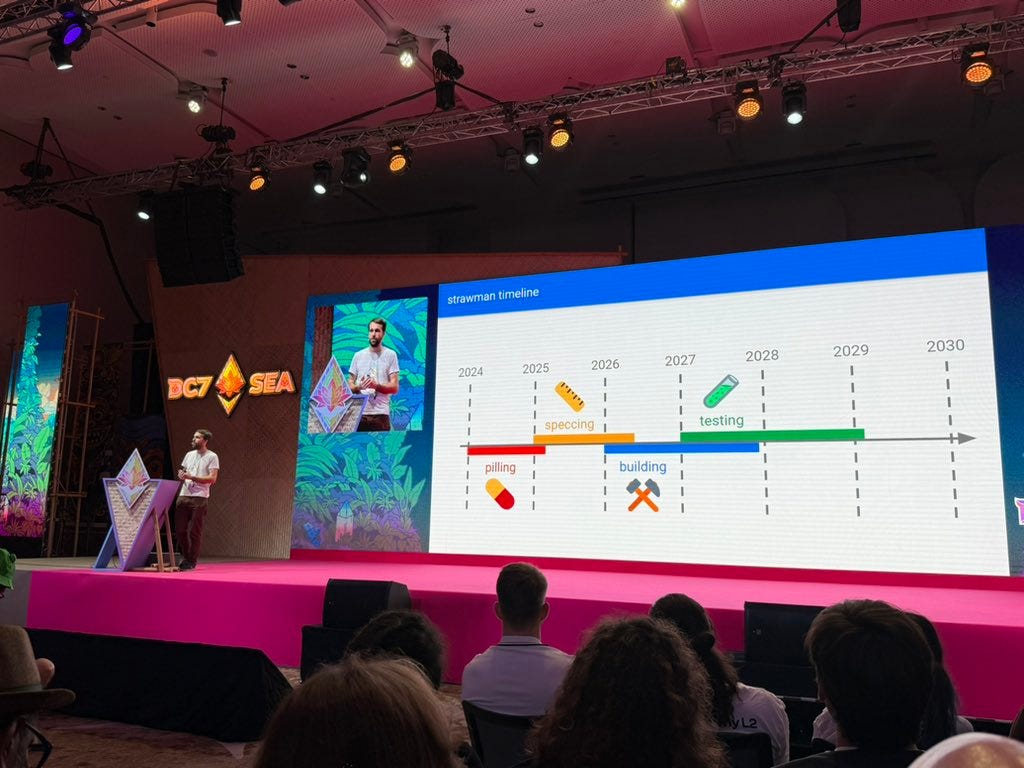
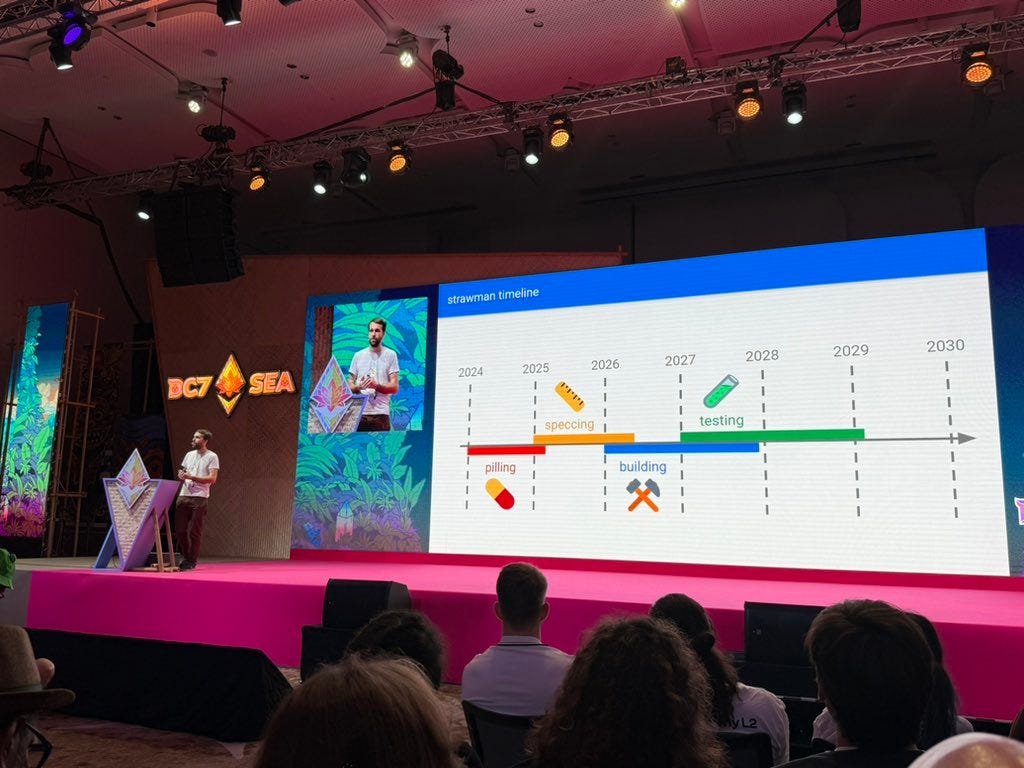
Is Beam Chain's 5-year implementation timeline reasonable? What does the community think?
 Navigating Web3 tides with focused insights
Author: 0XNATALIE
At Devcon, Ethereum Foundation core member Justin Drake proposed a comprehensive overhaul of Ethereum's consensus layer called Beam Chain. By redesigning the consensus layer, the proposal aims to mitigate MEV issues, improve scalability and security, and leverage ZK technology for performance gains. Beam Chain focuses solely on changes to the consensus layer and does not involve creating a new token or altering the existing blockchain architecture.
Ethereum’s current consensus layer (Beacon Chain) has been in place for five years. While it has performed well in terms of security, technical debt has accumulated over time. As the Ethereum community deepens its research into MEV and ZK technologies advance rapidly, the existing consensus layer is increasingly inadequate in adapting to emerging innovations. The Beam Chain initiative aims to eliminate this technical burden, enabling Ethereum to be more flexible and adaptable in the future.
Technical Highlights
Beam Chain features two key technical innovations: Snarkification via ZKVM and hash-based aggregate signatures.
The consensus layer is primarily responsible for how all nodes in the network reach agreement on the state of the chain—such as transaction ordering and account balances. In Ethereum, tasks include validating blocks, verifying signatures, handling forks, and maintaining/updating account states. A critical operation is state transition—the process of moving from the state of one block (e.g., account balances after transactions) to the next. These operations often require significant computation, and Snarkification refers to converting these computations into zero-knowledge proofs.
Beam Chain leverages ZKVM to achieve Snarkification of the consensus layer, transforming the state transition function into zero-knowledge proofs. The ZKVM moves computation off-chain, reducing on-chain computational load. Each node can verify the correctness of the state by checking the zero-knowledge proof, without needing to recompute everything. Additionally, Beam Chain allows validators to choose their preferred ZKVM, rather than mandating a specific ZKVM within the on-chain protocol.
Meanwhile, with advances in quantum computing, traditional cryptographic methods like elliptic curve cryptography may become vulnerable to attacks. This means the private keys and signature verification mechanisms underpinning current blockchain systems could be compromised once powerful quantum computers emerge. To address this threat, Beam Chain introduces a hash-based aggregate signature scheme. Hash functions are considered post-quantum secure, offering resistance against quantum attacks. This approach not only improves the efficiency of signature aggregation but also provides stronger long-term security.
In addition, Beam Chain adopts PBS (Proposer-Builder Separation), incorporating inclusion lists and execution auctions to reduce the negative impacts of MEV. It also plans to lower the minimum staking requirement for validators from 32 ETH to 1 ETH, further enhancing decentralization. The transition to Beam Chain will occur in phases, gradually replacing the functionality of the Beacon Chain, with an estimated timeline of five years.
Community Perspectives
Concerns about development timeline: The community generally expresses concern over Beam Chain’s projected five-year development cycle. Some members also question whether Beam Chain aims to gradually align Ethereum with characteristics seen in Solana.
-
José Maria Macedo, founding partner at Delphi Ventures, expressed disappointment with Beam Chain. He believes the core improvements—such as codebase refactoring, 4-second block times, and "quantum-resistant" capabilities—are expected to take until 2029–2030 to materialize. Such incremental upgrades, he argues, are insufficient for Ethereum L1 to maintain a competitive edge in the broader blockchain landscape, let alone establish a compelling long-term narrative.
-
Mert, CEO of Solana development platform Helius, shares concerns about the development timeline. If Beam Chain won’t launch until 2029, Ethereum may struggle to remain competitive amid the fast-moving pace of blockchain innovation.
-
Qi Zhou, co-founder of EthStorage, finds the projected completion date of 2030 excessively long. He suggests focusing development efforts on a single programming language—such as Rust or Go—to accelerate progress. For tackling technical debt, he recommends Ethereum consider Cosmos’ “re-genesis” model: resetting the blockchain’s genesis block while preserving essential user and contract state data, removing redundant historical records and outdated code through a clean slate approach.
-
Meir, co-founder of Hydrogen Labs, worries that Beam Chain’s extended timeline may fail to meet the scalability demands of a full-featured blockchain. If Ethereum aims to be an efficient blockchain platform rather than just a data availability layer, it needs faster and more aggressive scalability improvements—not gradual optimizations over the next five years.
-
Cygaar, developer at Abstract, explains why the five-year timeline for Beam Chain is necessary. He emphasizes that Ethereum is not a small blockchain; it is the second-largest blockchain globally, with $60 billion in TVL, $400 billion in underlying asset value, and thousands of applications depending on it. Implementing such large-scale changes across a distributed, live network is extremely challenging and high-risk. Therefore, extensive preparation and rigorous testing are essential. Any failure could result in severe losses for users.
-
Terence, maintainer of the Ethereum client Prysm, addressed concerns about the long implementation timeline by stating that Beam Chain represents Ethereum’s “endgame.” During this period, Ethereum will continue improving through hard forks. Many Beam Chain proposals aim to strengthen decentralization and censorship resistance. Meanwhile, prior to Beam Chain’s full rollout, ongoing enhancements in data availability, anti-censorship measures, and EVM performance will help meet evolving demands.
-
Hasu, Strategy Lead at Flashbots, cautions against overhyping the Beam Chain proposal, noting it is a long-term project requiring at least five years to realize, with most improvements already part of the existing technical roadmap. The real novelty lies in bundling these upgrades together for integrated testing and eventual full replacement of the current system—an approach meant to streamline deployment. However, many community members mistakenly perceive this as an exciting “Ethereum 3.0” release or expect Ethereum to emulate certain Solana-like features, leading to unmet expectations.
-
GabrielShapir0, founder of MetaLeX, believes Ethereum’s core value lies in its decentralization and autonomy, both of which Beam Chain would significantly enhance. Many people want Ethereum to offer different products, services, or follow popular trends and narratives, but that is not Ethereum’s purpose—it aligns more with Solana’s direction.
Technical Challenges
-
Péter, a core member of the Ethereum Foundation, believes the Beam Chain proposal bundles too many changes together, posing potential risks from both technical and governance perspectives. Technically, combining numerous changes increases the likelihood of errors. From a governance standpoint, packaging multiple changes may lead to overlooked details and heightened controversy. He recommends first implementing low-difficulty improvements on the Beacon Chain, then rolling out more complex changes incrementally, allowing the system to adapt gradually instead of undergoing a complete overhaul at once.
-
Mteam, an Ethereum researcher, notes that while Beam Chain is presented as a new vision, it essentially consolidates many previously discussed ideas. He supports the general direction but warns that such an upgrade might distract from ongoing research on the execution layer. Since the execution and consensus layers are independent research tracks, they should be improved in parallel without interfering with each other.
-
Max Resnick, Research Director at SMG, argues that Ethereum needs a bolder, more ambitious vision rather than being constrained by five-year cycles of incremental upgrades. He calls for a return to Ethereum’s original mission: becoming a global computing platform that empowers developers to solve the most complex coordination challenges. He outlines goals Ethereum should achieve within the next five years: achieving 1-second block times; single-slot finality to facilitate cross-chain interoperability; significantly increasing throughput (>1000 TPS); and introducing multiple parallel proposers to enable real-time censorship resistance.
Join TechFlow official community to stay tuned
Telegram:https://t.me/TechFlowDaily
X (Twitter):https://x.com/TechFlowPost
X (Twitter) EN:https://x.com/BlockFlow_News
 @ChainFeedsxyz