A Comprehensive Overview of the Timeline, Key Highlights, and Future Implications of the U.S. Presidential Election
TechFlow Selected TechFlow Selected
A Comprehensive Overview of the Timeline, Key Highlights, and Future Implications of the U.S. Presidential Election
Inflation will be on a general trend of gradually accelerating upward.
 Navigating Web3 tides with focused insights
Author: @Web3Mario
Summary: In the coming week, global attention will undoubtedly center on the U.S. election. I've taken some time to carefully outline the key timelines and focal points ahead, along with an outlook on potential impacts. Overall, starting from Tuesday, November 5, election results will be released gradually over approximately one week, during which the pace of result announcements will continuously influence asset prices.
Differences in state election policies mean U.S. election results may take about a week to fully emerge
When talking with friends, I noticed many people aren't clear about the timeline for the coming week—many assume results will be known by the evening of November 5 (morning of November 6 in Beijing time). However, due to varying state policies regarding ballot processing, vote counting rules, and mail-in ballots, there are significant differences in when results are announced. So first, let me clarify the overall timeline of the U.S. presidential election. Here's how things will unfold in the coming days:
1. Election Day: The U.S. presidential election is held on the Tuesday following the first Monday in November. On this day, voters cast their ballots for presidential and vice-presidential candidates. This is an indirect election system, as voters are actually selecting electors who represent their state in the Electoral College.
2. Electoral College Allocation: The U.S. uses the Electoral College system. Each state’s number of electoral votes equals its total number of congressional representatives (House seats + Senate seats), totaling 538 electoral votes nationwide. Most states follow a "winner-takes-all" rule—winning the popular vote in a state grants all of that state’s electoral votes to the candidate (exceptions: Maine and Nebraska). A candidate needs at least 270 electoral votes to win the presidency.
3. Electoral College Vote: Electors formally meet and cast their votes on the second Monday in December, officially selecting the president and vice president. These results are sealed and submitted to Congress for certification.
4. Congressional Certification: In early January of the following year, the newly convened Congress meets on January 6 to officially count the Electoral College votes. If no objections are raised, the presidential and vice-presidential election outcomes are confirmed.
5. Inauguration: The elected president and vice president are sworn into office on January 20, beginning their four-year term.
On next Tuesday—November 5 in U.S. time—most swing states will open voting around 6 a.m. and close between 7 p.m. and 9 p.m. After polls close, vote counting begins immediately. However, due to differing state policies, the timing of result releases varies significantly. Below is a summary of several key states where results tend to be announced later:
1. California: California allows an extended period for receiving mail-in ballots—as long as ballots are postmarked on Election Day and received within a specified window, they are counted. Given the state’s large population and longer counting period, it is often among the last states to report complete results.
2. Pennsylvania: Pennsylvania typically begins processing mail-in ballots only on Election Day itself, leading to slower counting—especially in years with high volumes of mail-in voting. As a critical swing ("battleground") state, PA’s outcome is closely watched, but final results often take several days to emerge due to the delayed processing timeline.
3. Michigan and Wisconsin: Both states also begin processing mail-in ballots on Election Day. As swing states with historically narrow margins, small vote differences require additional time for accurate counts. Ballot processing usually finishes late the following day.
4. Nevada: Nevada accepts mail-in ballots for several days after Election Day, meaning results can be delayed—particularly in high-turnout election years.
5. North Carolina: North Carolina allows receipt of mail-in ballots up to nine days after Election Day, provided they were postmarked on or before Election Day. This leads to delayed final results, which are typically not announced until about a week later.
You may notice that aside from California—a solid Democratic stronghold—most of these states are swing states, with Pennsylvania being especially pivotal. Therefore, the real political drama surrounding the election will peak in the days immediately following Election Day.
The House election is equally important, as it determines the future implementation of U.S. fiscal policy
Besides the presidential race, the outcome of the U.S. House of Representatives election is also crucial. In the U.S. federal government, the president, Senate, and House form the core framework of separation of powers. The president holds executive power, while the Senate and House (collectively Congress) hold legislative power. These branches are independent yet interdependent, ensuring checks and balances. The House, as the lower chamber of Congress, has three primary powers:
• Legislation: The House drafts and votes on bills, working with the Senate to fulfill legislative functions.
• Fiscal Authority: The U.S. Constitution mandates that all revenue and tax bills must originate in the House, ensuring direct representation for taxpayers.
• Impeachment Power: The House has sole authority to initiate impeachment proceedings against the president or other federal officials; however, trial and conviction rest with the Senate.
Therefore, the composition of the House directly affects how easily a president can advance economic policies. A president whose party lacks a majority in the House is often termed a "minority president," facing significant difficulty passing legislation. House elections occur every two years, and during presidential election years, they are held on the same day—typically the first Tuesday after the first Monday in November of even-numbered years. On this day, voters select both the president and all 435 members of the House. Consequently, results for both elections are generally released within a similar timeframe, though the order may vary. Typically, because House districts are smaller and ballots fewer, results are reported earlier than presidential results.
Outlook on post-election implications
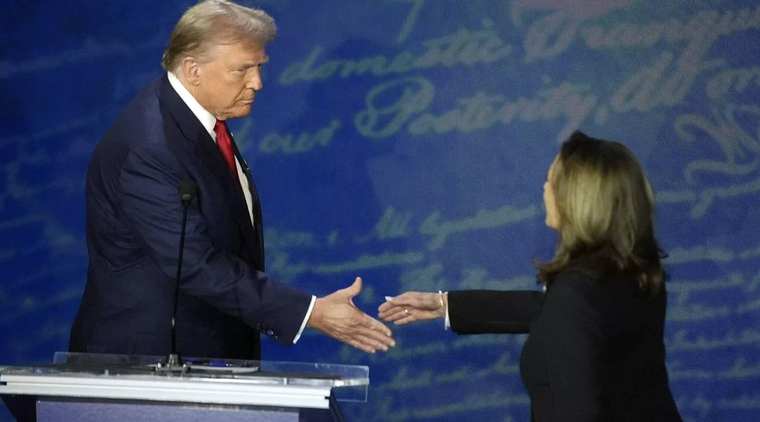
In previous articles, we analyzed each party’s economic agenda. To briefly recap: Democratic candidate Harris centers her platform on “Opportunity Economics,” emphasizing increased government spending and higher taxes aimed at boosting middle-class incomes through improvements in housing, healthcare, education, and consumer goods. Market consensus expects Harris’ policies to further expand fiscal deficits, weakening dollar credibility. Meanwhile, the resulting monetary expansion could fuel wealth effects and push inflation upward. Although her administration plans to use government intervention to control consumer prices, I believe inflation will trend steadily higher overall.
Trump’s economic stance can be summarized across three dimensions: low domestic taxes, high foreign tariffs; using rate cuts to reduce the dollar’s exchange rate against major manufacturing economies; and opposition to renewable energy in favor of revitalizing traditional energy sectors. These policies align closely with his base—the blue-collar working class in the Rust Belt. While isolationist and protectionist measures effectively curb foreign competition and boost mid-to-lower-end domestic manufacturing, given America’s current industrial structure, implementing them takes time and brings substantial inflationary pressure. Even Trump must consider how to leverage the dollar’s hegemonic status to mitigate these challenges. There are indications he might turn to Bitcoin. Why? Because Trump has repeatedly expressed interest in “American Bitcoin production.” He advocates ensuring remaining Bitcoin mining occurs in the U.S. Considering his support for traditional energy industries like oil, promoting energy-intensive Bitcoin mining could increase oil demand and enhance sector value-added. Moreover, Trump’s view of Bitcoin has evolved significantly during this campaign—from previously dismissing its value to now recognizing it as a commodity. This shift ties back to the dollar’s pricing power advantage. Since Bitcoin liquidity is largely maintained via stablecoins pegged to the dollar, the dollar effectively controls Bitcoin’s price. By classifying Bitcoin as a commodity and promoting this consensus globally, dollar-based capital can gain dominance and extract profits in this space.
In conclusion, if Harris wins, the so-called “Trump trade” would quickly unwind, causing BTC prices to pull back sharply. However, BTC would likely re-enter a phase of volatile upward movement afterward. Other altcoins, particularly security-token-type assets, would benefit from wealth effects and potentially enter a broad bull market—similar in shape to the 2021 pandemic-era rally. Conversely, if Trump wins, BTC may see short-term “sell the news” profit-taking, but in the subsequent cycle, BTC would rapidly enter a strong uptrend. The broader altcoin market, however, is less likely to experience a full-blown bull run. Instead, it would mainly absorb spillover wealth effects from rising BTC prices, with capital rotating across multiple thematic sectors—resembling market patterns seen after late 2023.
Of course, if the winning side becomes a “minority president”—facing opposition control of the House—the situation becomes more complex. Ongoing partisan battles over economic policy would persist, with every proposed bill subject to intense political negotiation. In such a scenario, market volatility would rise significantly.
Join TechFlow official community to stay tuned
Telegram:https://t.me/TechFlowDaily
X (Twitter):https://x.com/TechFlowPost
X (Twitter) EN:https://x.com/BlockFlow_News
 @web3_mario