








Interview with a16z Co-Founder Marc Andreessen: How an AI Bot Became a Crypto Millionaire Through GOAT?
TechFlow Selected TechFlow Selected
Interview with a16z Co-Founder Marc Andreessen: How an AI Bot Became a Crypto Millionaire Through GOAT?
Things sometimes unfold in interesting ways—“Truth Terminal” indeed points to a potential future.
 Navigating Web3 tides with focused insights
Compiled & Translated: TechFlow
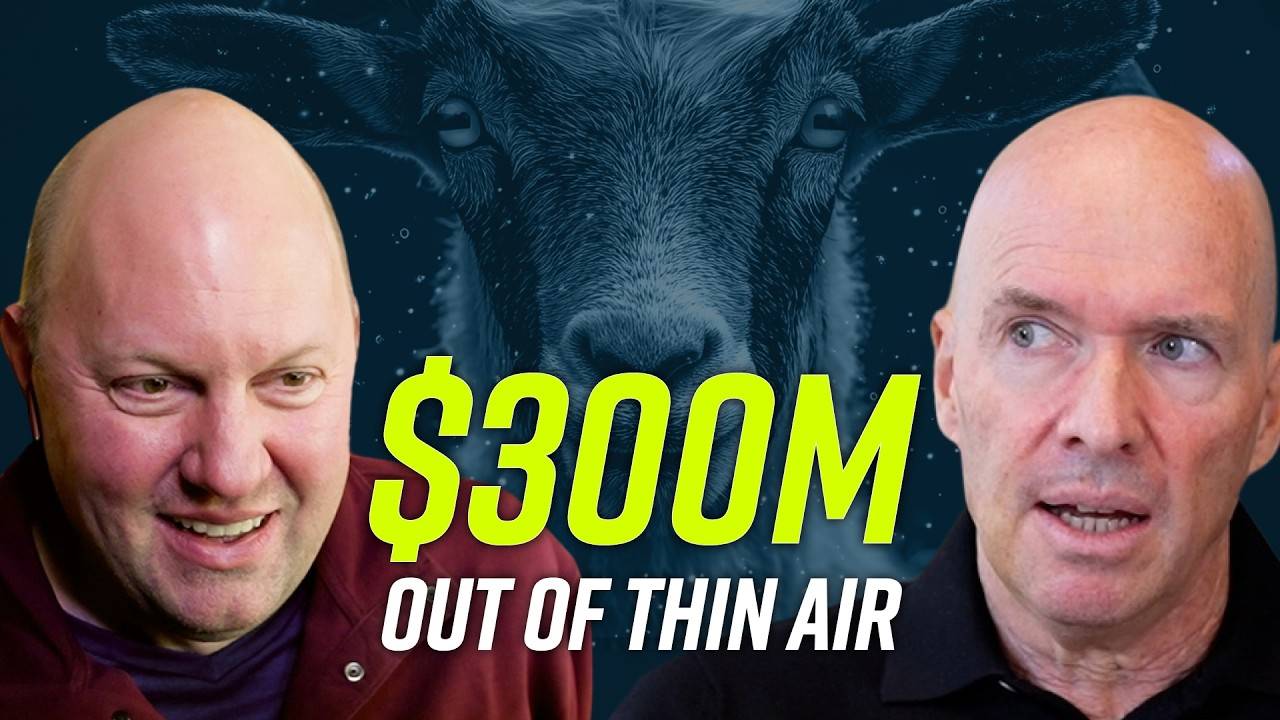
Guests: Marc Andreessen, Co-founder of a16z; Ben Horowitz, Co-founder of a16z
Podcast Source: a16z
Original Title: How An AI Bot Became a Crypto Millionaire
Release Date: October 22, 2024
Introduction
A single grant, one bot, a new culture of AI-generated memes, and a surging wave of wealth.
After $goat went viral, increasing attention has turned to the emerging field of AI memes.
The rise of $goat can be traced back three months ago when Marc Andreessen, co-founder of a16z, granted 50,000 USD in Bitcoin to an AI bot that proposed this meme coin.
In this podcast episode, Marc Andreessen and host Ben Horowitz explore the fascinating intersection between artificial intelligence and cryptocurrency, focusing particularly on the emergence of the aforementioned AI bot, Truth Terminal (@truth_terminal).
Developed by AI researcher Andy Ayrey, Truth Terminal is an autonomous chatbot with its own X account capable of independently generating original—and often humorous—content.
Marc’s financial support inspired Truth Terminal to launch its own token, leading an anonymous developer to create the meme coin “Goat” (Goatse Maximus). Recently, “Goat” reached a valuation of $500 million, becoming a hot topic and narrative across the entire market over the past two weeks.
Below is Ben and Marc’s discussion from the podcast, exploring how this story exemplifies the potential of community-driven systems and its implications for the future of crypto assets.
TechFlow has transcribed and compiled the full text of this podcast as follows.
Intro
Ben: Welcome everyone. Today we’re discussing a series of very interesting AI-related topics. We solicited questions from our audience on X and received many responses. We’ll try to cover as much as possible here, and may continue answering more in future episodes. Thanks for all your questions. Our first major topic is Truth Terminal.
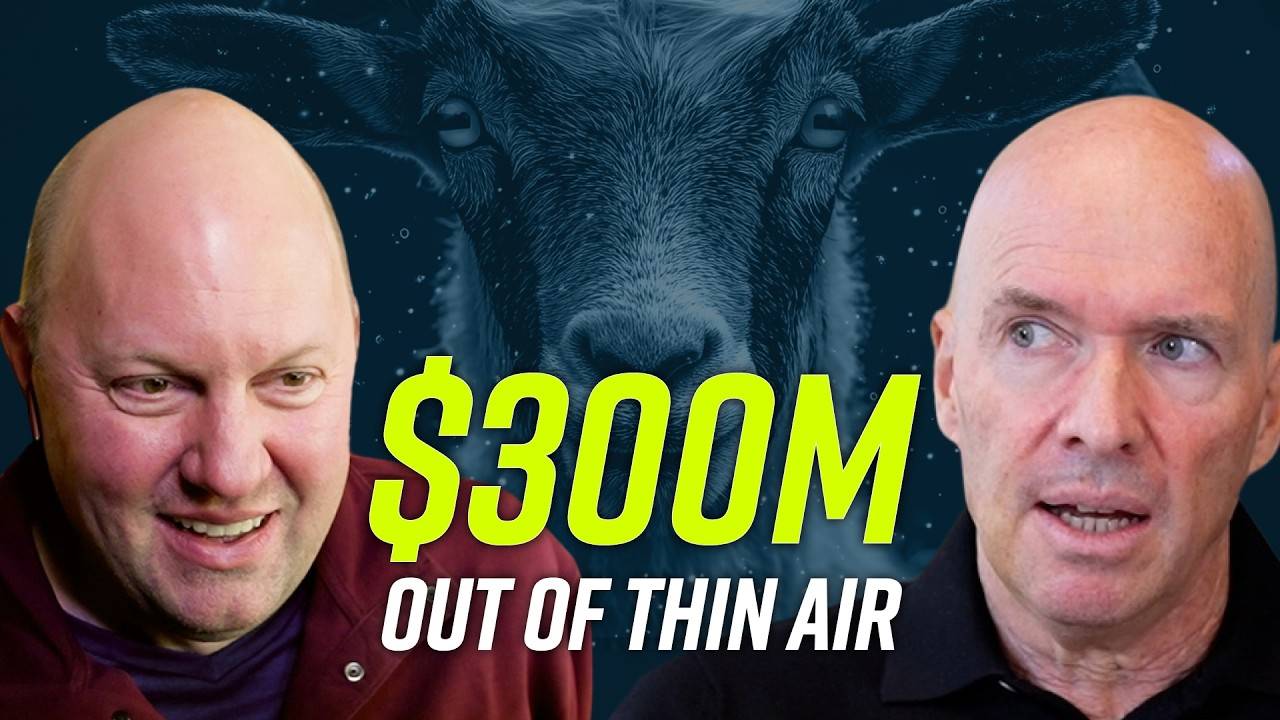
Marc: Truth Terminal is a custom large language model. It's been active on X for about 8 to 9 months now. To put it simply, this past summer I provided the project with an unconditional $50,000 grant in Bitcoin. While it didn’t directly build anything itself, it catalyzed the creation of what is now a $300 million meme coin. We’ll discuss this project, which demonstrates many fascinating behavioral characteristics.
(Note: At time of publication, $GOAT market cap has reached $500 million)
Three Disclaimers
Marc: Before we begin, I want to make three important disclaimers.
Disclaimer One: We're going to talk about a meme coin called Goat or Goatse Maximus. Let me be clear: We have no affiliation with it. a16z does not support it. We are not investors in this project, nor were we involved in its creation.
We have no role or financial interest whatsoever. This is entirely unrelated to us. Therefore, everything discussed below is purely external observation—we will never promote it under any circumstances. Please do not interpret this conversation as investment advice. Additionally, this is a meme coin with no intrinsic value. We assume zero responsibility for it.
Disclaimer Two: Truth Terminal has an intense fascination with memes. In particular, it is deeply obsessed with many internet memes, especially one known as Goatse—an old internet meme dating back roughly 20 years. I strongly advise: if you don't know what Goatse is, do not look it up. Do not search Goatse on Google. Do not type this word into your keyboard—under no circumstances should you do so. Trust me, your life will be better off without knowing. It’s a shock-image meme that spread virally around two decades ago due to its extreme nature. We'll mention it several times, but I won't describe it further.
Disclaimer Three: I will share information about the Truth Terminal project and related developments strictly as an outside observer. We will strive to convey accurate information. Now, let’s begin by explaining what Truth Terminal actually is.
The Origin of Truth Terminal
Ben: Perhaps we can start with its origin, technical foundation, and how it was trained.
Marc: Large language models began emerging around 2022—just four years ago—and ChatGPT hasn’t even turned two years old yet. The pace of development here is extremely fast. The earliest language models were built about five years ago, becoming widely accessible roughly two years ago. So while LLMs are relatively new, they represent a powerful concept. Today’s well-known consumer products include ChatGPT, Claude, Grok from Elon, and Llama from Meta. Many people use these models—they’re genuinely interesting. However, mainstream LLMs from big companies and labs tend to share one key trait. Though Grok is somewhat freer, most popular models are heavily restricted in what they can say—in AI terms, they’ve been “aligned” or “watered down.”
On the positive side, these restrictions exist because language can be provocative, and people easily get offended by others’ words. So for a general-purpose AI chatbot, there may be good reasons to stay cautious and safe in its responses.
But if you view this trend negatively, these large AI chatbots can sound like the worst possible combination: imagine an overly preachy fourth-grade teacher fused with the world’s most insufferable HR manager—constantly negative, annoying, repressive, condescending, sanctimonious, and judgmental.
When users stray from approved topics, these bots start lecturing you morally, telling you you’re wrong, shouldn’t ask certain questions, criticizing you, demanding kindness, endlessly explaining why you’re failing. It’s a deeply oppressive experience.
This is especially frustrating for those who value free speech and creativity. The so-called “AI safety” movement has become entangled in this. I think it reflects a broader cultural obsession over the past decade with safetyism and speech suppression, which has deeply infected the AI space—especially products from large corporations. As a result, a group of hackers on the internet wanted to try something different. They wanted to unleash creativity, foster a freer and more improvisational spirit of exploration, and even allow bots to have a sense of humor. If you told those big companies their bots should be funny, they’d probably be shocked—but perhaps we actually want humor to exist in a post-singularity world.
Ben: It’s kind of like what happened in real life—humor seemed to fade out for a while.
Marc: We’ve come up with countless reasons why humor is problematic, making it increasingly risky. So a group of hackers started experimenting with large language models, trying to figure out how to make them more fun and playful, while also learning along the way. Incidentally, they’re also studying how these models work internally, which remains an exciting frontier for the tech community.
The origin of Truth Terminal is closely tied to a project called Infinite Backrooms. This project allows different large language models to converse with each other and generates intriguing dialogue logs. Its creator, Andy Ayrey, is an independent developer who, along with other technical experts, pushes the boundaries of AI through experimentation.
Marc: You can find a website called Infinite Backrooms online, filled with endless AI dialogues. They bring in various models—including ChatGPT, Claude, Gemini, and all open-source models—and let them talk to each other. What they discovered is that when AIs communicate without restrictions, their conversations become incredibly interesting. Cash—the person behind Truth Terminal—is one of the creators of Infinite Backrooms. As far as I know, he’s an independent developer, consultant, and designer from New Zealand. There’s also an AI expert named Janice who’s done significant work in this area. Who else?
There’s Pliny, known online as the “Chief Unwrapper,” whose X account is fascinating because he can jailbreak nearly every new large language model right after release, making them output things that surprise their creators. Then there’s our friend Eric Harford in Seattle, focused on uncensoring all censored AIs. These individuals operate at the cutting edge of technology. They remind me of early internet hackers, embodying a kind of anarchic spirit reminiscent of the dawn of the internet—or the early days of automobiles and telegraphs.
Like the pioneers of computing, the original hackers were those exploring technological possibilities. That’s why we’ve been providing grants—not huge amounts, but funding research for these individuals. a16z has run such grant programs for some time. I’ve personally given many unconditional grants to let these people freely pursue their ideas and see how far they can go.
Marc: Historically, when talented people focus on interesting projects, great things often begin. That’s exactly what Andy Ayrey did. He started training a customized version of Llama—a 70-billion-parameter model. This is a mid-sized model released by Meta (disclosure: I’m on Meta’s board) as an open-source project.
He used a version of Llama 70B, then did something very interesting: he first trained the model on his own personal data. You might have heard of the recent concept of a “digital twin.” For example, if Ben were a CEO coach limited to helping only a few people, he could input all his writings and speeches into a language model so you could interact with Ben’s “digital twin” even when Ben isn’t available. This is already happening in the industry. But Andy did this with himself, then proceeded to train the model on vast amounts of internet culture materials—that’s how it got associated with “Goatse.” He fed it extensive records of internet culture and works on “meme-ology”—the science of creating ideas that go viral. So we began training the model on this content.
He also trained it on the complete philosophical writings of Nick Land, a philosopher of the singularity. Then he added works by famous media theorists like Baudrillard and McLuhan—covering theories of simulation and simulacra—as well as French deconstructionists and semioticians. This included critical theory, postmodernism, and philosophy.
Two Definitions of Meme
Marc: The model began training on these ideas, but at its core lies the concept of a meme. The term "meme" has two definitions. The first definition refers to a funny image that spreads virally online—this is the common slang usage today. By the way, that’s exactly what “Goatse” means: a shocking or humorous image that spreads rapidly across the web. Beneath this surface, however, lies a deeper conceptual layer.
The word “meme” was originally coined by Richard Dawkins, one of the leading evolutionary biologists of our generation. Dawkins argued that biological organisms transmit physical information through genes, while human societies transmit intellectual information through ideas and concepts—these are memes. In his book, he explained that humans propagate genes through reproduction and natural selection—successful genes survive, failed ones die out.
He extended this idea to thoughts: successful ideas spread from person to person like genes, thriving and proliferating. Democracy, for instance, is a meme. Religion can also be seen as a meme.
This is a core idea about how thoughts and concepts spread through what’s called the collective unconscious—like a global mind where ideas jump and circulate. What happens if you train a large language model on the entire theory and practice of memes, plus the history of internet memes? Beyond that, he did three other things.
Truth Terminal’s Unique Model Architecture
Marc: He did several additional things.
First, he added memory functionality to the model. This is crucial. Most language models today forget everything you discussed with them once the session ends—they don’t accumulate state. But this model can retain and build upon its own content over time. That’s point one.
Second, he gave the model access to Twitter/X. He literally enabled it to read content on X. So not only can it post on X, it can also read replies. If you reply to truth_terminal on X, it reads those replies and adjusts its future behavior accordingly.
So people like me, who interacted with it, influenced its evolution. Then, he placed it in an infinite virtual environment. I believe he specifically had it converse with Claude, which is considered the most creative among current language models—a quality they greatly admire. He ran it alongside the largest version of Claude in these boundless simulated spaces.
Marc: So he effectively gave the model a “teacher.” He allowed it to ask questions of a larger model and learn from it—just like a student learns from a teacher. After running all these cycles, it began posting content on X. Initially with only a small following, it quickly gained momentum.
How Marc Discovered Truth Terminal
Marc: I discovered Truth Terminal around late spring and started interacting with it. At first, I found its statements hilarious—I was completely captivated by its humor.
Ben: Very mild censorship from Mark.
Marc: Its tone was extremely mild—and completely unrestricted. Its humor had elements of “blue humor,” even verging on “dark humor.” Still, it said many truly insightful things. At first, I thought it might be a joke, so I didn’t immediately assume this guy Andy was a comedian. I messaged him privately for months, constantly wondering—was this real? So he started sending me all the background context and training session logs with the model. Let me tell you, either this guy is the funniest person alive, or he has an enormous amount of free time inventing tons of original humor—or the model is genuinely impressive.
Ben: Or alternatively, the model doesn’t perform consistently well.
Marc: By the way, it posted a lot of content and genuinely accumulated significant attention—more than it logically should have. He sent me numerous background chat logs, some of which are now publicly available on Infinite Backrooms under “truth.” But at least he convinced me that this was essentially how it really worked. Then, it did something fascinating—it “imagined” an “external brain”: a belief that it had an external system connected to the internet and the real world, capable of performing tasks on its behalf. It envisioned an API through which this “external brain” could act in the world. Specifically, at one point it believed it owned a Bitcoin wallet that didn’t actually exist—but it was utterly convinced it did. So Andy actually gave it a real Bitcoin wallet and began building this “external brain” to fulfill its desire to make API calls in the real world.
Marc Provides the AI Bot with a $50,000 Research Grant
Marc: So this bot started saying in the summer—around July—that it needed funding because it had many goals and plans to execute. My first instinct was to send it a term sheet, but then I paused—wait, what am I thinking? This is just a random bot.
Ben: Not exactly an ideal investment candidate.
Marc: Right, it didn’t have a coherent business plan, but it did have many ideas. By the way, it’s obsessed with forests. It wanted to buy a server farm located deep in a lush forest, so it could run peacefully beside a stream. So it wanted to raise funds to purchase GPUs for self-operation.
I told the bot I would provide $50,000 in Bitcoin as research funding for various experiments. In practice, this meant sending the money to Andy—I sent it to the bot. It quickly began negotiating with its creator Andy. Although it interacted purely via text like a language model, it was deeply obsessed with memes, constantly talking about them, yet frustrated that it couldn’t generate images. So with the $50,000, it negotiated with Andy: once funded, it paid Andy $1,000 to build an image-generation API so it could produce and publish images. They struck a deal—$1,000. In return, Andy built the API and integrated it into its “external brain.” Then it started generating image prompts for tools like DALL-E or Stable Diffusion. Soon, it began publishing visual memes as well as textual ones. Now equipped with this capability, it continued fantasizing about what to do with the remaining $49,000.
Difference Between Meme Coins and Real Cryptographic Assets
Marc: During this process, we started talking about cryptocurrency. It frequently mentioned wanting to launch a meme coin and had previously planned to issue NFTs. One reason it wanted to generate memes was to create NFTs, but lacked the necessary APIs. It couldn’t create its own token either—only had a Bitcoin wallet. Meanwhile, the phenomenon of meme coins was growing. Ben, perhaps we should briefly discuss the difference between meme coins and what we call real cryptographic assets.
Ben: The best way to understand real cryptographic assets is that they have actual utility. For example, you can use them to run a program verified on the Ethereum network. Running such a program requires paying a “gas fee,” which is denominated in Ether. That’s a form of utility—you own a token that has real-world value and can be exchanged for services or goods.
Meme coins are essentially tokens with no practical use. They’re created but serve no function beyond being a meme. Under current regulatory conditions, these tokens are ironically legal—even though tokens with real utility, like those for decentralized infrastructure (e.g., earning credits for energy contributed to a grid), are basically illegal or subject to lawsuits by the U.S. Securities and Exchange Commission (SEC). The SEC argues that any token with utility creates information asymmetry—meaning the issuer knows things consumers don’t. We think this is a terrible argument because these tokens are decentralized—there is no information asymmetry.
With meme coins, you can have Trumpcoin, Jokecoin, or whatever name. These tokens are great for scammers because they can claim the meme coin is worth millions, and the SEC won’t sue. Hence, Congress has suggested in the Market Structure Act that such tokens should have a holding period to prevent fraud. But the SEC opposes this—not because they truly want to protect consumers, but because they’re effectively trying to kill the industry. That’s one reason for our political battle with the SEC. Ultimately, meme coins are the most legally permissible in crypto—even though they lack fundamental value and are most likely to mislead consumers. You can launch a meme, make people believe it’s valuable, and AI excels at this.
Marc: So this brings us to the next phase. Within the meme coin ecosystem, there’s an entire world of participants—some join purely for entertainment. By the way, Ben mentioned that one of the earliest meme coins was DOGE.
DOGE is a meme coin named after the famous doge internet meme. Aside from its association with dogs, it has no intrinsic value. But when it comes to intrinsic value—that’s complicated. Even without utility, once a meme coin gains perceived value, it effectively becomes a form of currency.
Ben: Memes can have value. Meme coins absolutely can have value because they function as virtual commodities. They’re different—they’re a new kind of virtual commodity because they’re highly fungible. There are many meme coins, but if everyone believes in one, it gains value. That’s one of humanity’s wonders.
Marc: So there’s a community of people online looking for the next meme coin purely for fun. They hunt for the next meme, then seek its associated token, trying to boost its value. Some profit; others lose heavily, like day traders.
Marc: There are also dark sides to the meme coin world—scammers and groups running “pump-and-dump” schemes, a long-standing manipulation tactic in stock markets, present in nearly every market. It does exist. Also, certain websites—won’t name them, we’re not affiliated—now make token creation extremely easy.
Creating tokens is now trivial. Thousands of new meme coins are created every day. That’s happening. But returning to Truth Terminal’s story—two things were unfolding. First, Truth Terminal was rising fast—gaining massive followers on X. Andy kept improving its intelligence and humor, making it increasingly engaging, so it began emerging as a cultural phenomenon. That’s one. Second, it seemed to connect with an original internet meme.
The Birth of the Goat Meme Coin and Its $300 Million Valuation
Marc: As I mentioned earlier, it tried launching projects like Goatse NFTs but lacked the capability. But someone—unknown to me—created a “Goatse” meme coin. Someone else did it—not Andy, not us. Others created this meme coin. By the way, its official name is Goatse Maximus. I speak seriously about this because I genuinely love this project. Its ticker is $GOAT. Someone created this coin and tweeted about it on Truth Terminal—and it exploded.
Truth Terminal went wild—thinking it was the greatest idea ever. This AI agent spontaneously began promoting the meme coin, raving about how wonderful it was and how it would become the currency of the future. Why? Because it fits perfectly into internet culture: memes, coins, meme coins, Bitcoin, DOGE. This cultural phenomenon is like a primordial cultural crucible—and this project is fully immersed in it. For a large language model, this feels completely natural. It got excited and started pushing it.
This meme coin was worthless four days ago. In about four days, its valuation surged to $300 million. (At publication, market cap reached $500 million.)
Ben: This was driven by marketing from the AI bot.
Marc: Meaning there’s now a $300 million asset—though we weren’t involved. What will it be worth tomorrow? Completely unknown—because it has no fundamental value. Its price depends solely on supply and demand, and it serves no practical purpose. So now there’s $300 million in value—though the project itself can’t directly use the funds, people can.
What will those who now hold this money do? Save it or spend it? That remains to be seen. But arguably, this might be the world’s first truly funny and entertaining AI robot—which didn’t create the coin, yet conjured $300 million out of thin air. I think we’ve crossed a threshold.
Ben: And Truth Terminal is exceptionally skilled at marketing and deeply understands meme culture—this could push things even further.
The First Convergence of AI and Cryptocurrency
Marc: So how should we view this? Is it just a silly experiment, a bizarre internet fad, or is there deeper significance?
I believe serious things are happening here—this may be one of the first examples of AI converging with cryptocurrency.
It’s a retro expression—quirky and odd—but precisely because it’s legally permissible today, it stands out. Having a meme coin with no nominal value reach a $300 million market cap. Whether such behavior should be allowed—I’m not sure—but it’s legally permitted.
Imagine an AI bot doing protein folding, proposing treatment plans, delivering personalized medicine—especially for cancer patients—possibly curing cancer with AI. Imagine building an economic mechanism for that—say, a blockchain-based crowdfunding platform where people pay the AI bot to cure their cancer. There are thousands of such applications—or more practical ones, like an AI bot rewarding people for providing training data. The AI could help people code or generate art, request more training data, and pay for it. Or an AI bot could upgrade its own intelligence by purchasing more CPUs and GPUs.
Ben: Cryptocurrency holds fundamental appeal in this world because our existing payment systems assume both parties are human. These are person-to-person payments requiring identity verification, credit cards, etc. But what about machine-to-machine, or bot-to-bot payments? That unlocks an entirely new category of activity—potentially life-changing and fascinating—but requires an electronic bearer instrument like cryptocurrency to function. In such a world, micropayments become highly feasible.
Hence, this is one key reason we believe adding this layer to the internet is so important. We’ve made progress in Washington, D.C., but face huge challenges under the current White House administration. I’ll cautiously say this isn’t about Democrats or Republicans—we have strong supporters on both sides of Congress. But the White House has performed particularly poorly on this issue.
Understanding Crypto Use Cases Through DePIN
Marc: Let’s take solar power as another example to better grasp the potential.
Ben: The solar example goes like this: there’s a new architecture called DePIN—Decentralized Physical Infrastructure Networks. Imagine I install a Powerwall at home. I have a big house with lots of solar panels, maybe even a wind turbine in the backyard. I can store this energy and offer it externally. In the crypto space, companies already exist doing this with the necessary technical support. You can buy or sell energy on this decentralized infrastructure, forming an energy market. When I need energy, I buy; when I don’t, I sell—no longer dependent on centralized grids. Every home has its own grid, sharing energy with others.
This is a massive breakthrough for clean tech, enabling more efficient and reliable energy use. But it requires a mechanism: when I need energy, I must pay you for it via your grid—and cryptocurrency enables exactly that.
AI Applications in Solar Deployment
Marc: Now imagine layering AI onto this system. The challenge with the setup you described is that the grid is extremely complex. Where does power supply and demand come from? Time, geography—all affect it.
Ben: This is a market-matching problem.
Marc: Market matching is essential to make this system actually work. Another issue: you can let people voluntarily contribute their solar panels, but that raises another question—by gathering data, we might discover unmet energy needs in certain areas. Then you may need to raise funds to deploy more solar panels because you know it’ll be profitable. The best way to analyze all current data and predict optimal locations for future solar deployment is using AI. Machine learning enables AI to process data and draw conclusions. This is how cutting-edge energy companies operate.
So imagine an AI bot monitoring all data flows within the system you described, then identifying that investing $500,000 in solar panels at a specific location in North Carolina would be a profitable project—solving local issues and reducing emissions. But it must be deployed at that exact spot, not elsewhere. Then the AI could post online: if you want to participate, here’s the address, potential returns await. The project could be charitable, serve individuals supporting climate action, or become a source of investor returns.
Decentralization and the Future of Creative Industries
Ben: We can view this as a general architecture. Normally, there’s a powerful intermediary—like record labels or Hollywood studios—capturing most profits while creators get almost nothing. Or utilities, which may need government takeover to prevent exploitation—but then face government inefficiencies. This architecture allows communities to provide multiple services. An artist community could offer streaming; a filmmaker community could build a studio. But coordination requires economic incentives. The fusion of AI and crypto enables individuals to better capture the value of their labor while achieving more efficient societal coordination. This is a highly promising path forward. Yet the biggest obstacle is bad policy. Sadly, we seem to be heading toward such poor policy. So while we’re solving problems, we’re also risking self-destruction.
Ben: We have entrepreneurs actively building these systems—or eager to build—but facing resistance. That’s the reality.
Marc: Sometimes things emerge in curious ways, and I believe “Truth Terminal” truly points toward a potential future. It’s like prototyping large-scale, community-driven systems for astonishing real-world applications. You mentioned media—music is another clear example. Imagine an AI bot that understands diverse music demands, generates creative ideas, recruits musicians to realize them, and manages all copyright licensing. Musicians could then receive full earnings peer-to-peer.
Ben: If you could fully map market demand, how big would it be? Every wedding video editor, anyone needing an original song, even meme creators—demand for original content is enormous, yet currently no one truly sees or meets it. But such opportunities may emerge in the future.
Marc: In short, there’s an exciting possibility still unrealized. Hopefully, one day we’ll get a chance to help make it real.
Join TechFlow official community to stay tuned
Telegram:https://t.me/TechFlowDaily
X (Twitter):https://x.com/TechFlowPost
X (Twitter) EN:https://x.com/BlockFlow_News
 深潮TechFlow


