Binance Labs Invests in ZEROBASE, a ZK Real-Time Proof Network: A Quick Overview
TechFlow Selected TechFlow Selected
Binance Labs Invests in ZEROBASE, a ZK Real-Time Proof Network: A Quick Overview
ZEROBASE can generate ZK proofs within 400 milliseconds.
 Navigating Web3 tides with focused insights
By: 1912212.eth, Foresight News
The ZK sector continues to attract venture capital investment.
Recently, ZEROBASE, a real-time zero-knowledge (ZK) proof network project, raised $5 million in funding. The round was backed by Binance Labs, Lightspeed Faction, Dao5, IDG, Matrix Partners China, Symbolic Capital, among others. This marks the second major investment in the ZK space since September, following a16z's CSX fund leading a round for Fermah, a ZK proof generation layer developer.
With such a high-profile group of investors, why has ZEROBASE captured the attention of VCs who are growing increasingly selective in an overcrowded ZK landscape?
Real-Time ZK Proof Network
ZEROBASE is a real-time ZK proof network that provides privacy and access to decentralized computing infrastructure. It is launched by Salus, a Web3 security firm specializing in vulnerability research and security audits. Three months ago, the company received a grant jointly awarded by Ethereum, Aztec, Polygon, Scroll, Taikoxyz, and ZKsync for its work on zero-knowledge vulnerability analysis and security auditing.
Shawnc Chong is co-founder of both ZEROBASE and Salus. Originally from Malaysia, he graduated from King’s College London. Notably, he is also an investor in prominent projects such as BounceBit and Sahara AI, with years of deep involvement in the crypto industry.
The core value of ZK technology in blockchain lies in two key aspects: privacy and scalability. It enables one party to verify information without revealing the underlying data, thus ensuring privacy and making it ideal for protecting sensitive information. Additionally, it improves scalability by offloading complex computations off-chain while maintaining on-chain verification integrity.
Despite rapid development in ZK technology, significant infrastructure challenges remain—particularly around speed, cost, centralization, and scalability. ZEROBASE aims to address these very issues.
Key Features and Architecture Design
According to its official website, ZEROBASE focuses on three main features.
ZEROBASE can generate ZK proofs within 400 milliseconds.
It ensures the security and privacy of proof computation through Trusted Execution Environments (TEE), providing tamper-proof data handling.
It adopts a distributed computing architecture to eliminate single points of failure, while maintaining a high degree of decentralization and achieving consensus in less than one second.
In traditional network architectures, users interact with a central Hub to obtain a list of nodes, then select a node from the list for further interaction. In this model, all nodes must send periodic messages to the Hub to maintain their online status, and the Hub stores information about every active node.
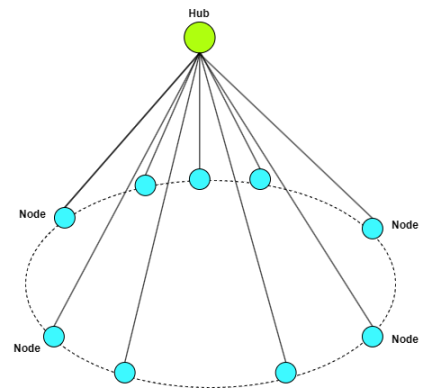
This centralized design creates a bottleneck at the Hub. If the Hub fails, the entire system suffers significant disruption.
ZEROBASE introduces a new architecture by partitioning nodes into subsets, each managed by a dedicated Hub. Each Hub only records the status of the nodes under its jurisdiction, meaning a node communicates solely with its assigned Hub.
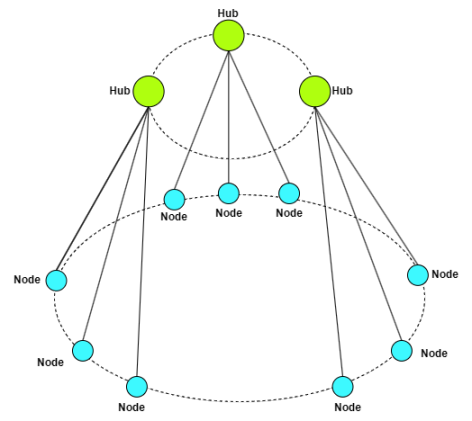
In this setup, as the number of nodes grows, the system can scale smoothly by adding more Hubs.
The ZEROBASE Hub is responsible for broadcasting verification tasks. It broadcasts tasks across the ZEROBASE network, and provers who respond within a specified time window randomly receive proof-generation assignments. The Hub also handles user validation requests. Users must first declare their tasks to the Hub before submitting the specific content required for proof generation. The Hub then broadcasts these tasks across the ZEROBASE network.
Additional Hub functions include generating node connection credentials, processing data packets sent by nodes, and creating payment orders.
Current use cases for ZEROBASE already include zkLogin, zkDarkPool, and the Tiga processor. Its future development trajectory warrants close attention.
Join TechFlow official community to stay tuned
Telegram:https://t.me/TechFlowDaily
X (Twitter):https://x.com/TechFlowPost
X (Twitter) EN:https://x.com/BlockFlow_News
 Foresight News