After the bull returns, which players in the Bitcoin ecosystem will emerge?
TechFlow Selected TechFlow Selected
After the bull returns, which players in the Bitcoin ecosystem will emerge?
Whether OP_CAT can be revived in this bull market will determine the direction of Bitcoin's ecosystem.
 Navigating Web3 tides with focused insights
By Cookie
The market is eagerly awaiting Bitcoin's breakout past the $70,000 mark. For many participants, once Bitcoin breaks and holds above $70,000, the long-awaited bull market will officially begin.
Amid this optimism, key assets within the Bitcoin ecosystem have surged. Over the past week, BRC-20’s $ORDI rose as much as 25%, while $SATS climbed up to 15%.
The runes market has been even more vibrant. GIZMO•IMAGINARY•KITTEN, a new cat named "Gizmo" released by Bitcoin Puppets artist @lepuppeteerfou on Twitter, skyrocketed to nearly $20 million in market cap shortly after its full minting—despite @lepuppeteerfou denying any direct connection to the rune. Yet market enthusiasm remains undiminished.
The success of GIZMO•IMAGINARY•KITTEN sparked interest in two other “golden dogs”: KODA•FLUFFINGTON, based on Koda, the dog of NodeMonkes founder, and POOKA•CANNOT•BE•STOPPED, believed to represent POOKA, the dog of OMB founder zkshark. Both quickly surpassed the $1 million market cap threshold—a significant hurdle in the runes market. At their peaks, KODA•FLUFFINGTON reached nearly $4 million and POOKA•CANNOT•BE•STOPPED approached $3 million.
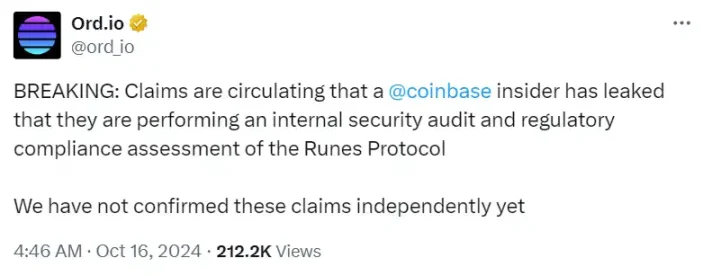
Leading rune assets also saw substantial gains. Since late September, PUPS•WORLD•PEACE and BILLION&DOLLAR&CAT have risen nearly ninefold at their highs, while DOG&GO&TO&THE&MOON doubled. Yesterday, @ord_io tweeted that insiders at Coinbase revealed the exchange is conducting internal security audits and regulatory compliance assessments for runes—though these claims haven’t been independently verified. This news inevitably fueled speculation around recent price surges in the runes space.
If a bull market is indeed approaching, what does the future hold for the Bitcoin ecosystem today?
On the Eve of Major Change: Continue Conservatism or Embrace Openness?
The potential revival of OP_CAT on Bitcoin’s mainnet carries profound significance. When it comes to realizing the vision of “smart contracts on Bitcoin,” the question is no longer “can we?” but rather “do we want to?”
Last year’s surge in popularity of the Ordinals protocol undoubtedly pushed the Bitcoin ecosystem toward openness—but only cracked the door open slightly. The Ordinals consensus is merely a subset of Bitcoin’s broader consensus. As a result, protocols like BRC-20 and runes, which enable fungible tokens (FTs) on Bitcoin, suffer from poor user experience. They resemble fragmented NFTs more than proper FTs and are thus considered “inferior products” compared to FT standards on other blockchains.
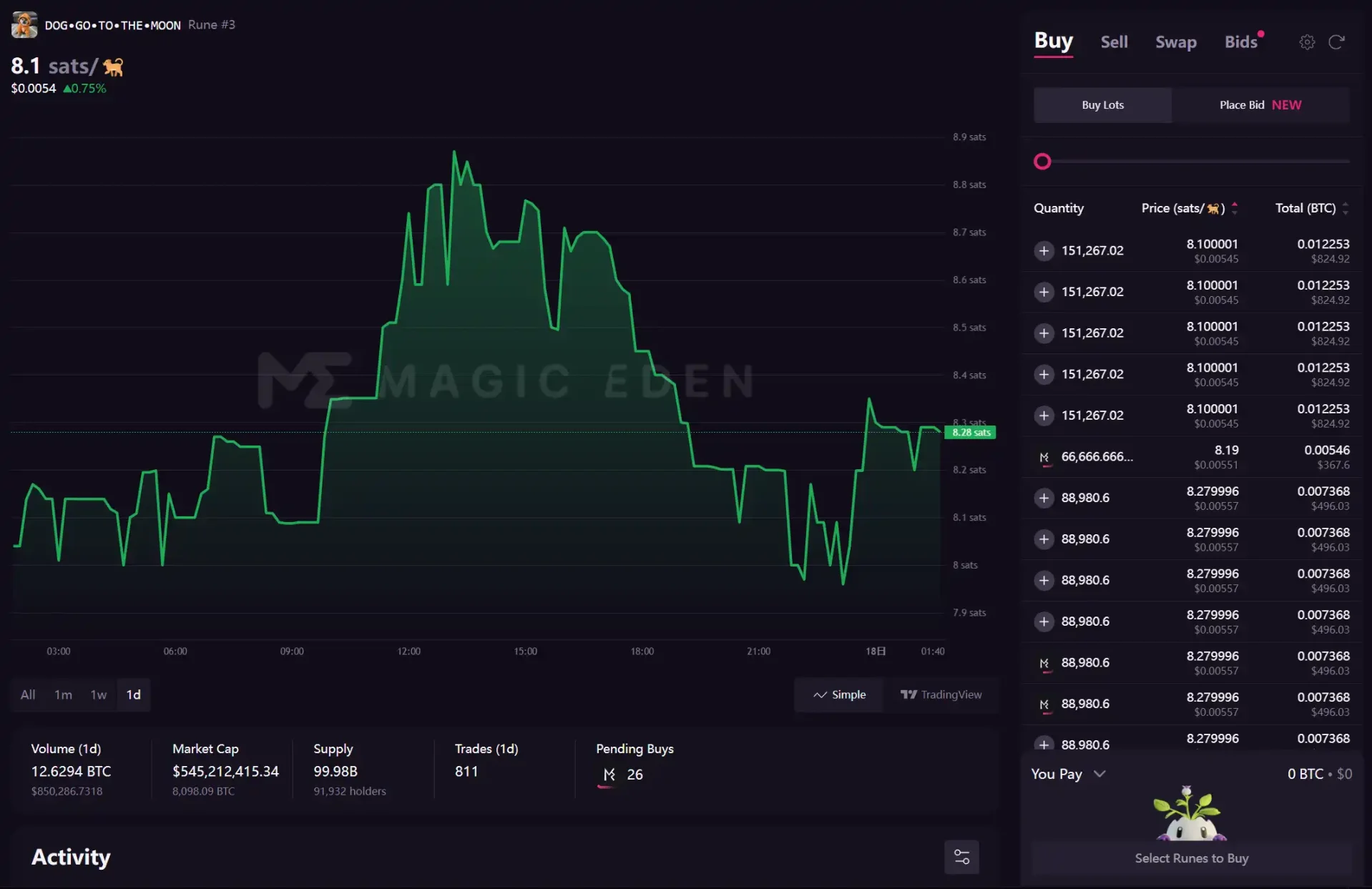
The rune purchase interface on Magic Eden looks just like an imageless NFT
Why are functional and UX limitations rooted in Bitcoin’s consensus? Because Bitcoin’s conservative stance maintains strict constraints on its mainnet. Protocols like Ordinals, BRC-20, and runes must operate within these tight boundaries to achieve goals like issuing tokens or images on Bitcoin. Even so, there remains strong opposition—such as Bitcoin Core developer Luke Dashjr—who views such innovations as damaging to Bitcoin’s integrity and actively resists them.
If BIP-347, “OP_CAT in Tapscript,” passes and Bitcoin eventually undergoes a soft fork, it would signify a major shift in consensus—from conservatism to openness—and dramatically expand Bitcoin’s narrative potential. I say “expand again” because I believe runes have already maximized the narrative of “issuing tokens on Bitcoin.” It’s hard to imagine anything surpassing it unless disrupted by something transformative like smart contracts.
However, whether OP_CAT will be revived during this bull cycle remains highly uncertain. Being assigned a BIP number doesn’t mean community consensus exists—it simply means “the debate can now begin.” We may not yet be at the stage of asking “do we have enough support?” but rather still in the phase where “this topic needs more discussion.” One of Bitcoin’s blue-chip NFT projects, Quantum Cats, is essentially a political campaign advocating for OP_CAT’s revival. Udi Wertheimer acts like an activist “politician” within the Bitcoin space, leading a prominent NFT community to rally behind OP_CAT. He has repeatedly attempted to debate Luke Dashjr directly on Twitter Spaces, but Luke often responds with indifference—effectively suppressing momentum through silence.
If OP_CAT successfully returns during this cycle, the technical narrative of the Bitcoin ecosystem will almost certainly revolve entirely around it. Currently, the primary bets on OP_CAT’s revival are Quantum Cats and the CAT20 protocol on Fractal.
If not, runes will likely remain the most influential FT protocol on Bitcoin.
The Runes Market Faces Further Tests
A rune only becomes a true fungible token (FT) once listed on centralized exchanges (CEXs). Prior to listing, runes behave similarly to NFTs. This is reflected in their market cap volatility—"recoil effect": when liquidity is good, market cap spikes rapidly; otherwise, floor prices collapse amid numerous small orders piling up at the bottom, triggering lower sell orders and陷入无人问津的死循环.
The real market cap of a rune must withstand the liquidity test of CEX listings—which might explain why CEXs are moving so slowly to list runes.
Beyond CEXs, there are on-chain solutions like Dotswap’s rune swap product, and Magic Eden is soon launching its own rune swap functionality. An interesting phenomenon: Dotswap’s product works well but hasn’t captured sufficient traffic. Instead, CAT20 on Fractal brought notable attention to Dotswap. Whether Magic Eden can leverage its user base and superior UX to improve on-chain rune liquidity remains to be seen.
In terms of asset diversity, the runes market already has cult favorites like PUPS•WORLD•PEACE. However, thematic variety remains limited—most trends still center around established NFT projects or simply the size of holder communities. More participants are needed to enrich content creation and foster new cult coins. This is evident in how both PUPS•WORLD•PEACE and BILLION•DOLLAR•CAT bridged to Solana in pursuit of broader reach and growth.
Looking ahead, BRC-20 appears relatively dim. Currently, $ORDI, $SATS, and $PIZZA constitute nearly the entire relevance of BRC-20.
NFT Blue-Chip Tier Is Relatively Stable, But Unique Narratives Still Have Room to Grow
Five projects—NodeMonkes, Bitcoin Puppets, OMB (Ordinal Maxi Biz), Quantum Cats, and Pizza Ninjas—have solidified their positions as blue-chips. Bitcoin Shrooms stands out as a unique case: extremely early inscription number, very low supply, yet consistently maintaining a floor price above 1 BTC.
In purely artistic NFTs, generative art has become passé on Ethereum. Therefore, Bitcoin-based art must innovate in theme—such as conceptual art tied to Bitcoin’s cultural identity or AI-generated art. From this perspective, CENTS may be the most distinctive art series on Bitcoin—one whose essence couldn’t be replicated elsewhere.
CENTS is created by artist Rutherford Chang, who selected pre-1982 U.S. penny coins made of copper (the composition changed to zinc in 1982 due to cost). Beyond inscribing them onto Bitcoin, he physically melted all the actual pennies into a single solid copper block.
CENTS creates a form of “value entanglement” on Bitcoin:
-
It blurs the line between a cent inscribed on Bitcoin and a satoshi engraved on a penny.
-
It artificially creates deflation in both pennies and Bitcoin. All pennies in the CENTS collection are pre-1982 copper coins—no longer being minted, hence deflationary. Meanwhile, 10,000 sats used for inscription are permanently removed from circulation—making Bitcoin itself slightly more deflationary.
-
A penny has a face value of one cent, but costs more than one cent to produce. A satoshi is worth far less than one cent. Yet transferring 10,000 physical pennies (total face value $100) onto a cheaper digital medium results in a vastly higher market valuation: today, one CENTS trades around $330, the physical copper block sold at auction for $50,400 in June, while the legal tender value of 10,000 pennies is just $100.
-
Over time, the legal tender value of the penny may vanish, production costs may fluctuate further, and one satoshi could one day be worth far more than one cent.
This kind of narrative cannot be replicated on other chains, because no other chain’s native asset feels as fundamentally coin-like or money-like as Bitcoin.
The DMT concept is another uniquely Bitcoin-native artistic narrative worth watching. In short, DMT aims to create digital assets based on various data types embedded in the Bitcoin blockchain—such as block hash, block size, height, and difficulty target. So far, aside from leader Natcats, no other DMT projects have gained significant market traction.
Conclusion
Whether OP_CAT revives during this bull run will determine the direction of the Bitcoin ecosystem. Other under-the-radar areas not discussed here—like the Lightning Network (Taro, RGB, CKB) and BitVM—may gain more attention if OP_CAT fails to return.
The Bitcoin ecosystem is currently the only corner of the crypto market where “technical narratives” still resonate. Why? Because Bitcoin is like an old computer still running a Pentium 4 processor—its hardware is outdated enough that upgrades are clearly possible, but whether those upgrades happen depends entirely on whether the system administrators can reach consensus. And achieving consensus is incredibly difficult—not just ideologically, but due to real-world利益 conflicts.
Regardless, the Bitcoin ecosystem will undoubtedly be one of the key narratives of this bull market—and a uniquely distinct one compared to other ecosystems.
Join TechFlow official community to stay tuned
Telegram:https://t.me/TechFlowDaily
X (Twitter):https://x.com/TechFlowPost
X (Twitter) EN:https://x.com/BlockFlow_News
 BlockBeats