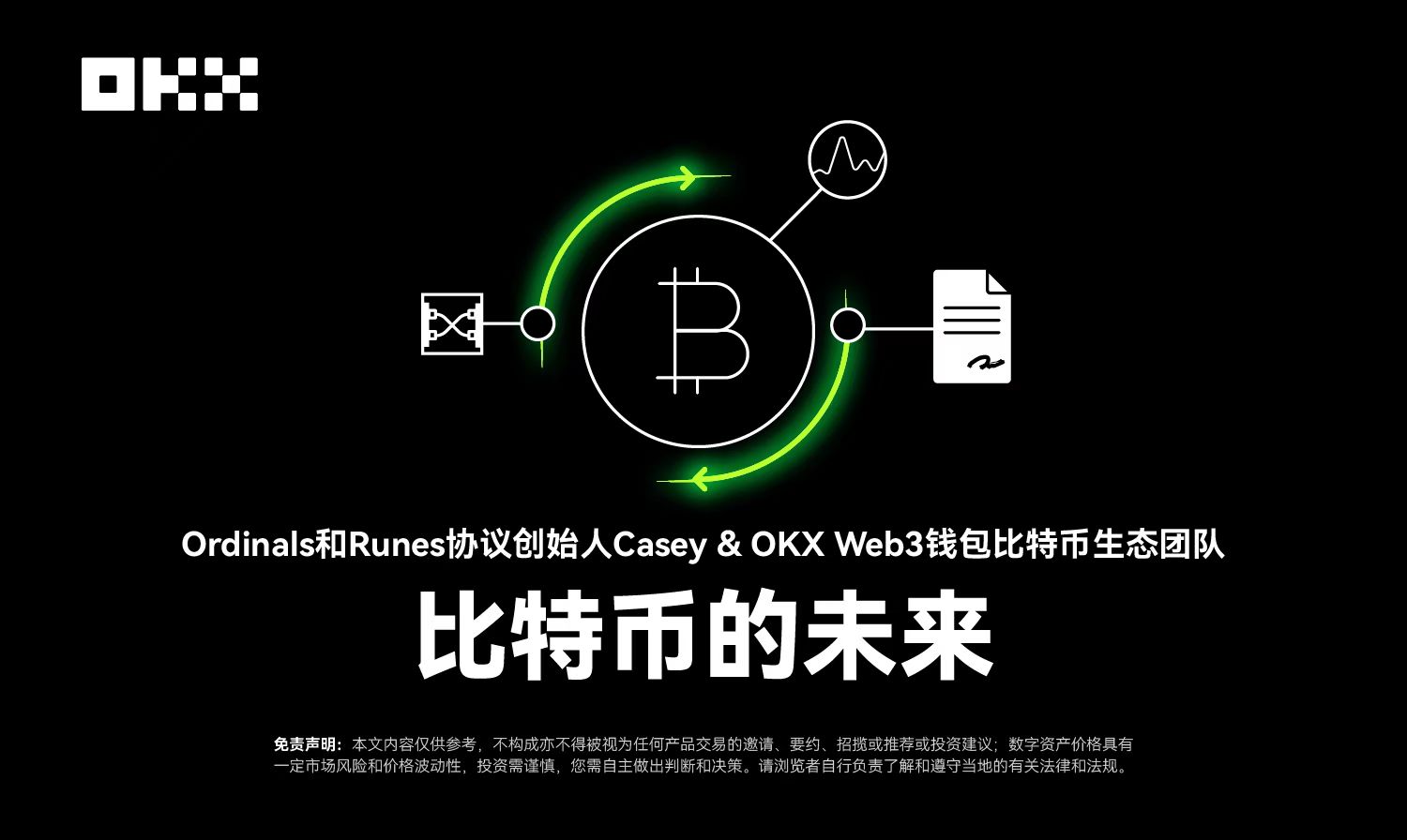
Developer's Tale 03 | Casey, Founder of Ordinals and Runes Protocols, OKX Web3: The Future of Bitcoin
TechFlow Selected TechFlow Selected
Developer's Tale 03 | Casey, Founder of Ordinals and Runes Protocols, OKX Web3: The Future of Bitcoin
Conversing with core developers to help users better understand every public blockchain world—Developer Tales
 Navigating Web3 tides with focused insights
The emergence of Ordinals has broken Bitcoin's singular narrative as a peer-to-peer electronic cash system. Subsequently, various asset protocol standards based on Ordinals, such as XRC-20, were created, triggering an explosion of inscriptions and Runes, and sparking a grassroots transformation in token issuance and distribution models. Both the Ordinals and Runes protocols were developed by Casey Rodarmor, introducing innovative functionalities to the Bitcoin network. Casey Rodarmor’s contributions to the Bitcoin community extend beyond technological innovation—he has also actively participated in community governance and developer support. His work has encouraged more developers to join the Bitcoin ecosystem, advancing both the development and adoption of Bitcoin technology.
This is the third episode of the "Developer Dialogues" series, offering perspectives from Casey, the creator of Ordinals and Runes, and OKX Web3 Wallet’s Bitcoin ecosystem team to better understand the world of Bitcoin. This episode covers topics including the latest developments in the Ordinals and Runes protocols, Bitcoin’s evolution, developer building, community governance, and more—aiming to provide deeper insights into the visions and plans of core Bitcoin developers.
Key Takeaways at a Glance
1. Inscriptions on other blockchains are merely copies of BRC-20; given that these chains already have native fungible token protocols, such replicas seem redundant.
2. Aside from the Lightning Network, all other Bitcoin Layer 2 solutions are "castles in the air," lacking users, solid implementations, or clear paths to success. It is wise to ignore them until they are truly realized.
3. The only ultimately important narrative for Bitcoin is its high-powered role as "digital gold" and hard currency—everything else is peripheral.
4. In the future, Bitcoin’s development will primarily focus on upgrading functionality and scaling.
Have Runes and Ordinals exceeded expectations or fallen short so far?
Casey:
To be honest, I haven’t paid much attention to adoption rates, growth metrics, or market value, because I’m neither a promoter nor a speculator. When creating Ordinals, inscriptions, and Runes, my sole goal was to build the best possible protocol. As for adoption, apart from fixing bugs and adding new features, it’s entirely up to fate. Some people complain about long token ticker names, but I don’t see this as an issue—short tickers will unlock over the next four years. Patience is key!
The greatest achievement of Runes and Ordinals is usability. Many users have provided feedback that Runes is convenient to use compared to other standards, with software running smoothly—this is very encouraging. Runes is a complete protocol: it launched with a clear specification and open-source implementation, including wallets, indexers, and browsers. While I haven’t deeply studied other fungible token protocols, compared to BRC-20, Runes is simpler and more efficient—transfers require just one transaction instead of two.
What stage are the inscription and Rune narratives currently in? How can the Bitcoin ecosystem regain attention in the next phase?
Casey:
Ordinals, inscriptions, and Runes are now in the hands of users. Future technical progress will almost certainly come from improvements within Bitcoin itself. Bitcoin leads the market, and markets move in cycles. Accumulate Bitcoin and wait patiently.
Regardless, inscriptions and Runes have established a "fee market," which is crucial for the long-term health of the Bitcoin network. I believe that regardless of their popularity, they will always provide some level of support in reducing selling pressure on Bitcoin transactions.
OKX Web3 Wallet Bitcoin Ecosystem Team:
On one hand, the "inscription" sector has introduced a fair launch model for retail investors, bringing significant attention to the Bitcoin ecosystem. On the other hand, according to OKLink data, since last December, transaction fees have accounted for over 10% of miners' total income—providing tangible benefits to miners. We believe that driven by this shared interest among participants in the Bitcoin ecosystem, the inscription landscape and asset issuance protocols on Bitcoin will enter a new era of exploration and growth.
(For more data, see here)
Is there any need for other public blockchains to develop inscriptions or Runes?
Casey:
As far as I know, inscriptions on other blockchains are just copies of BRC-20. Given that those blockchains already have native fungible token protocols, these replicas seem unnecessary.
However, if developers choose to continue building on the Bitcoin ecosystem, they must accept that Bitcoin development is slow and conservative. My advice to new developers is: unless you particularly enjoy working on Bitcoin’s core, try to build your projects without altering the underlying network.
You’ve previously expressed skepticism toward Bitcoin Layer 2s—does Bitcoin even need Layer 2 solutions?
Casey:
Aside from the Lightning Network, every other Bitcoin Layer 2 solution is a "castle in the air." None have real users, strong implementations, or a clear path to success. Until they actually deliver, it's wise to ignore them.
Do new asset issuance protocols and scaling solutions pose risks to the Bitcoin network?
Casey:
The only potential risk is if a protocol extends Bitcoin to allow Ethereum-style automated market maker (AMM) systems to develop, which could lead to harmful maximum extractable value (MEV). I take this risk seriously, having seen its negative effects already play out on Ethereum.
OKX Web3 Wallet Bitcoin Ecosystem Team:
Various asset issuance protocols on the Bitcoin network have recently gained significant traction, with many users trading these assets on OKX Marketplace. However, this has also caused severe congestion on the Bitcoin network, affecting other types of transactions. From this perspective, excessive hype around new assets does carry some negative impacts on the Bitcoin network. As a result, various Bitcoin "Layer 2" solutions have emerged aiming to relieve pressure on the mainnet. At present, each project offers different technical approaches, and it's too early to determine which ones are superior—they’re still in the early stages.
What are the main directions for future technological innovation in Bitcoin? Any notable developments to watch?
Casey:
I don't know which proposals will ultimately be adopted, but I think the current batch of soft fork proposals are reasonable and interesting.
OKX Web3 Wallet Bitcoin Ecosystem Team:
In the future, Bitcoin development will mainly revolve around functional upgrades and scalability. If the Bitcoin network supports more opcodes, it could enable more complex protocols—for example, OP_CAT has recently sparked renewed discussion and may be reactivated on Bitcoin. Additionally, Bitcoin’s limited capacity and slow speed are increasingly unable to meet current user demands, leading to numerous scaling proposals and staking initiatives—all of which are worth watching. For instance, there are now many Bitcoin "Layer 2" networks using diverse technical approaches, still in exploratory phases, which we continue to monitor closely.
At the same time, we maintain communication with developers across various domains and keep track of emerging technologies, such as RGB-related protocols, the Lightning Network, and Bitcoin staking protocols.
How do you view the relationship between Bitcoin and traditional financial markets?
Casey:
Bitcoin may increasingly resemble reserve currencies and hard money, potentially playing a role in traditional finance similar to real estate.
OKX Web3 Wallet Bitcoin Ecosystem Team:
The approval of Bitcoin spot ETFs signifies broader recognition from traditional financial markets. Through ETFs, traders can gain indirect exposure to Bitcoin without needing to directly purchase or store cryptocurrency. This lowers the entry barrier, enabling greater participation from institutions and individuals alike. For those previously hesitant due to regulatory or custody concerns, ETFs offer a regulated and familiar investment vehicle—greatly enhancing Bitcoin’s legitimacy and credibility.
The relationship between Bitcoin and traditional financial markets will become increasingly intertwined. ETF products make it easier to include Bitcoin in investment portfolios, especially diversified institutional portfolios. For example, pension funds, retirement funds, and wealth management firms may begin allocating to Bitcoin ETFs. This integration will further solidify Bitcoin’s role as “digital gold” and a hedge against inflation.
In the long term, the approval of ETFs may trigger a wave of institutional capital entering the Bitcoin market. As more traditional financial institutions participate, Bitcoin’s price could rise further. Simultaneously, this would mean the Bitcoin market becomes more mature and stable, moving away from past extreme volatility.
Bitcoin won’t become the next Ethereum—what is your long-term vision for Bitcoin?
Casey:
The Ethereum ecosystem isn’t truly thriving—or rather, its prosperity is like that of Las Vegas: a meaningless casino that provides no real utility to anyone. The only ultimately important narrative for Bitcoin is its powerful identity as “digital gold” and hard currency. Everything else is secondary.
OKX Web3 Wallet Bitcoin Ecosystem Team:
The Bitcoin ecosystem is still in its early stages. The surge in popularity of BRC-20 ignited public enthusiasm for broader narratives around Bitcoin. Since then, many builders have been exploring BTC’s untapped potential, hoping Bitcoin can be more than just “digital gold.” In the long run, through continuous innovation by communities and developers, Bitcoin will discover its own unique, native use cases distinct from Ethereum—and experience a new spring of growth.
Last question for OKX Web3: what have you done to support Bitcoin ecosystem development?
OKX Web3 Wallet Bitcoin Ecosystem Team:
OKX Web3 Wallet actively supports the development of the Bitcoin ecosystem. Our wallet offers multi-platform support (App, Extension, Web) for Bitcoin and fractionalized Bitcoin, along with multiple Bitcoin Layer 2 networks (B² Network, Merlin Chain), and supports various protocols including Ordinals, Atomicals, and Runes. We are also actively collaborating with other builders in the Bitcoin ecosystem.
1) From a marketplace perspective, OKX Marketplace enables trading of Ordinals, Atomicals, and Runes assets, supporting multiple protocols—with plans to expand to more in the future.
2) From a tools perspective, OKX provides professional tools for minting, splitting, and merging Runes, as well as UTXO management tools. The OKX faucet center also provides test tokens for developers in the BTC ecosystem.
3) From a DeFi standpoint, OKX has partnered with Babylon, launching a dedicated gameplay zone for Babylon. Cryptopedia has also introduced multiple staking campaigns around the Babylon ecosystem, helping users better understand it.
We are also actively supporting Bitcoin developers. First, we support and collaborate with various projects in the Bitcoin ecosystem—through features like Drops and Cryptopedia, we partner with new Bitcoin-based projects to help more users learn about and engage with the ecosystem. Second, we maintain close collaboration and communication with developers, regularly engaging with creators of Ordinals, BRC-20, and Atomicals to stay updated on protocol developments and offer our support.
About the Developer Dialogues Series
Web3 developers have made significant contributions to the development of the crypto industry. Their innovative spirit and technical expertise inject lasting vitality and momentum into the entire field—not only improving the technology itself but also enabling future applications and business models. Yet despite their active roles, they often remain under the radar. Co-launched by OKX Web3 and ChainCatcher, the "Developer Dialogues" series aims to amplify developer voices by featuring conversations with core developers from different blockchain ecosystems and OKX Web3’s technical team. Through their perspectives, we explore the developmental trajectories, technical insights, latest updates, market dynamics, and hot takes across various chains—bringing closer attention to this vibrant and fascinating community while providing them with maximum support.
Disclaimer
This content is for informational purposes only and should not be considered or construed as (i) investment advice or recommendation, (ii) an offer or solicitation to buy, sell, or hold digital assets, or (iii) financial, accounting, legal, or tax advice. We do not guarantee the accuracy, completeness, or usefulness of the information provided. Digital assets (including stablecoins and NFTs) are subject to market fluctuations, involve high risks, and may depreciate or become worthless. You should carefully consider whether trading or holding digital assets is suitable for you based on your financial situation and risk tolerance. Please consult your legal/tax/investment professionals regarding your specific circumstances. Not all products are available in all regions. For more details, please refer to the OKX Terms of Service and Risk Disclosure & Disclaimer. The OKX Web3 mobile wallet and its derivative services are governed by separate terms of service. You are solely responsible for understanding and complying with applicable local laws and regulations.
Join TechFlow official community to stay tuned
Telegram:https://t.me/TechFlowDaily
X (Twitter):https://x.com/TechFlowPost
X (Twitter) EN:https://x.com/BlockFlow_News
 OKX
OKX