








Who Is Angela Meng, the Chinese-American Coinbase Co-Founder Who Moved to the U.S. at Age 11?
TechFlow Selected TechFlow Selected
Who Is Angela Meng, the Chinese-American Coinbase Co-Founder Who Moved to the U.S. at Age 11?
Raised by grandmother, moved to the U.S. with parents at age 11, original family positioned between working class and neo-peasant class, frequently bullied by local kids during American middle school years, raised a German Shepherd mix dog, attended UCLA, later became a journalist and model...
 Navigating Web3 tides with focused insights
By: Jaleel Jia Liu
Who is Angela Meng? This might be the biggest gossip in the Chinese crypto community these days.
In the world of cryptocurrency, even marriage news can spark widespread discussion—especially when the protagonist is Brian Armstrong, co-founder and CEO of Coinbase, one of the most prominent cryptocurrency exchanges globally. Recently, Brian announced on social media that he had married Angela Meng a week prior, triggering enthusiastic reactions across the crypto community. Prominent figures from the global crypto scene quickly sent their congratulations, with Cathie Wood of Ark Invest ("Miss Wood") and the founder of MicroStrategy both extending sincere well-wishes to the newlyweds.
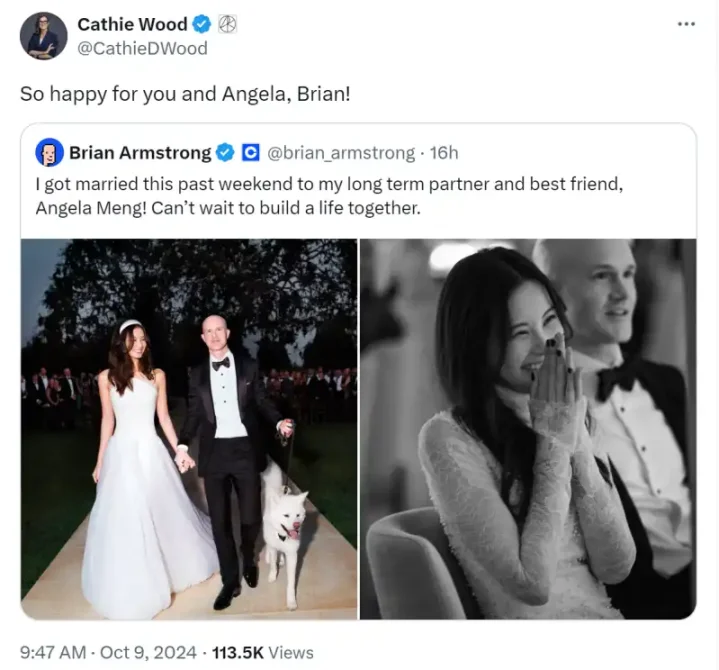
As one of the largest cryptocurrency platforms in the world, Coinbase has a market capitalization of $41.4 billion. It is not only the largest crypto exchange in the Western world but also one of the most influential fintech companies globally. Even before its IPO, Coinbase was already a company flush with capital; after going public, it gained even greater momentum. Data shows that approximately 13 out of every 100 people in the United States use Coinbase for trading.
Brian Armstrong's personal wealth has risen steadily alongside Coinbase’s growth. He is now worth around $7.4 billion, firmly placing him among the most important figures in the global cryptocurrency space.
The emergence of Angela Meng has naturally sparked immense curiosity, particularly due to her Asian heritage, which resonates closely with the Chinese community. Some members of the crypto community have even drawn comparisons between her and another prominent Chinese "exchange queen"—He Yi of Binance. Although Angela appears to have had no prior involvement in the crypto industry, many wonder whether she will become a key ally in Brian’s career, playing a significant role in the crypto world like He Yi, or continue pursuing her own path as a journalist within the industry.
From limited available information, BlockBeats pieced together Angela’s life story: immigrating to the U.S. at age 11, sharing an apartment with two other families; growing up in a household straddling the working class and emerging peasant class; enduring bullying during middle school as a new immigrant; fostering a German Shepherd mix for over half a year, though her parents couldn’t afford formal adoption; attending UCLA, then becoming a journalist and model...
Immigrating at 11, Living Three Families to a House
For the ten years before leaving China, Angela lived with her grandparents. Her grandmother initially worked in a paper mill with only a middle school education, but after universities reopened in China, she joined the University of Science and Technology of China as a lab assistant. Beloved by students, she eventually rose to become a professor.
Among Angela’s childhood memories are many moments spent with her grandmother in the kitchen. The dimly lit room had no hot water. Mung beans sizzled in a wok while the kettle began to shriek. Her grandmother would bring over a small stool so Angela could sit beside her and help chop vegetables, while she handled the cooking. After dinner, they did homework together, cleaned up, and occasionally watched the news. Every month, Angela helped dye her grandmother’s hair, and in return, her grandmother braided her hair.
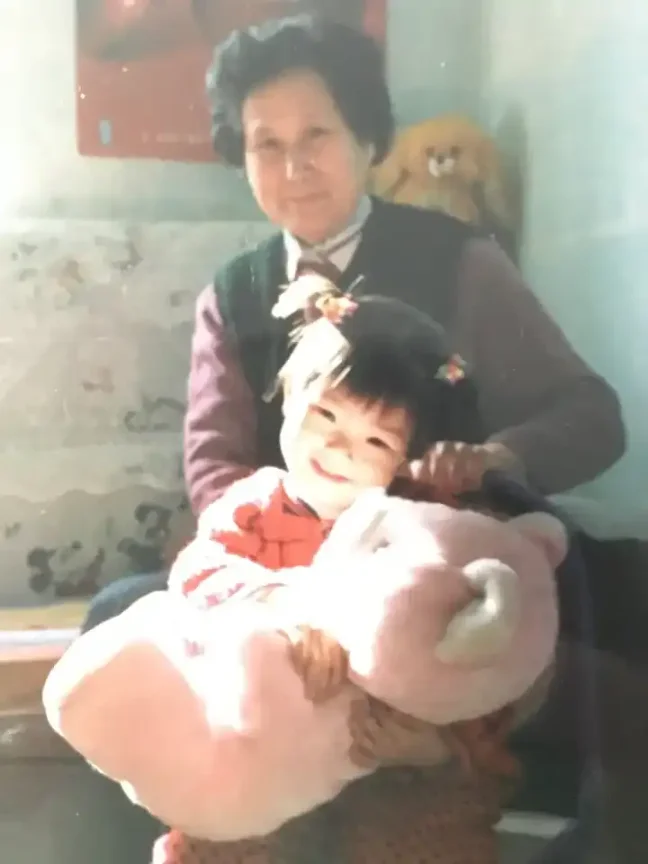
Young Angela Meng with her grandmother, photo courtesy of Angela
As part of China’s one-child generation, many children were spoiled, but Angela received strong early guidance from her grandmother, who acted as a surrogate mother. It was her grandmother who taught her diligence, humility, and integrity. Angela’s grandmother passed away on the morning of May 6, 2020. At the time, Angela was in California—15 hours behind—and struggled emotionally, feeling that in her time zone, her grandmother was still alive.
When Angela was 11, she moved to the U.S. with her mother to reunite with her father. The family of three squeezed into a single-room unit shared with two other immigrant households. They rented the cheapest bedroom in the center of the house for $400 per month, sharing the front door with one family and the back door with another, while rotating bathroom usage among all three.
One of the neighboring families consisted of three people who held green cards and spoke basic English, earning deep respect from Angela’s parents. They occupied the nicest part of the house, with roses and wild mint in the front yard. Annie, the mother of this family, worked as a warehouse receptionist, often practiced yoga, and frequently shared brief observations about “real American life” with Angela’s family: “Americans love pickup trucks, hamburgers, pizza. Sometimes they eat vegetables raw—that’s called salad.”
Angela was fascinated by Annie’s descriptions of American social classes. In her view, Chinese society was composed of three groups:
1) Those with political connections—wealthy and educated;
2) The working class—far less wealthy and much lower in educational attainment;
3) The peasant class, comprising about 65% of the population—uneducated, impoverished agricultural laborers, literally referred to as “peasants.”
Her own family, Angela believed, stood somewhere between the working class and the new peasant class. She recalled once going to the supermarket with her mother and wanting to buy a box of ripe strawberries. When her mother saw the price, she apologized and asked Angela to put down the $3.99-per-pound strawberries and instead pick up some Fuji apples priced at $0.69 per pound.
Besides the respected neighbors, the Annies, Angela also had another set of neighbors: four undocumented immigrants—a couple and their twins. Both Angela’s parents and neighbor Annie looked down on them because they worked below minimum wage in irregular, health-damaging jobs suitable only for undocumented workers. The father worked at a construction site three hours away, while the mother worked as an elderly care assistant—illiterate and formerly a farmer in China. Yet Angela felt drawn to this family, as they lacked the cultural self-consciousness displayed by Annie and her own parents. With them, there were no discussions of class or status, no jealousy or superiority. Though they often came home covered in dust or smelling of sewage, they remained warm and unself-pitying, curious without being preachy—seemingly born with an innate ability to accept life as it came.
The twin children were mischievous but became Angela’s close friends during childhood. The twin boys were named Kevin, while the twin girl, excited about having an English name, kept changing hers—from April, June, Olivia, to Samantha that week.
"The Outsider": A Bullied Middle School Experience
On her first day at an American middle school, Angela’s mother dressed her in what was considered “cool” in China: a bright blue sweater with “BABY SEXY DREAM” printed on it, a magenta cartoon bear underneath, a so-called “Louis Vuitton” headband (which LV doesn’t actually make), and mismatched blue pants that were too wide at the waist and too short in the leg.
Unlike the cheerful woman seen today—modeling for Elite Model Management and LA Models—back then Angela rarely smiled, always staring down at her shoes, afraid others wouldn’t smile back. She had no social skills and spoke very poor English. When someone asked why she didn’t climb the monkey bars, she awkwardly replied in broken English: “is very ouch,” intending to express fear of getting hurt.
She grew tall quickly, standing about 152 cm in middle school but weighing only 32 kg, towering over classmates who averaged around 135 cm and normal weight. Fearing mockery, she often hunched over, avoiding eye contact.
Angela hated the playground. She had never used her body for anything beyond carrying her mind. There, she appeared clumsy, unbalanced, and uncoordinated. She had never thrown a ball, let alone caught one. Dodgeball was her least favorite activity—she described it as the root cause of her elementary school PTSD. During games, she either shuffled embarrassingly or abruptly stepped backward, flailing her arms wildly. Most of her peers, raised in a diverse educational environment, possessed cheetah-like agility and monkey-like gymnastic abilities.
Like many young immigrants, Angela’s naturally lean frame and outsider appearance made her stand out, turning her into a target for ridicule and bullying. Classmates freely hurled vicious nicknames at her: “skinny bone jones,” “bulimic bitch,” “Jap,” “chink,” “gook,” and “dumpling dumpster.”
She was thrust into a world completely alien to the Chinese education system she knew. In Chinese schools, academic excellence was the sole standard—respect earned through perfect scores and mastery of instruments, with any misconduct strictly punished. But American schools felt anarchic. Students cursed each other, threw paper balls, and teachers merely muttered, “Stop it,” before letting things escalate. Here, everyone seemed locked into fixed social roles—hardworking kids labeled “nerds” and “losers,” while respect wasn’t won in classrooms but on playgrounds through physical dominance.
One afternoon, Angela was walking home when three science classmates caught up with her. “Hey, you!” shouted the ringleader. Angela said nothing, quickening her pace to get home faster. Just hours earlier, under teacher supervision, they’d cooperated civilly on a group project—but now reverted to savagery.
“Hey, SKINNY-ASS BITCH!” the leader yelled louder, grabbing Angela’s backpack strap. “Think you’re better than us?” Her hair was yanked sideways; another pulled open her backpack and started taking things out.
Angela tried to break free, but resistance only fueled their aggression. They dragged her along for a full block until nearing her home, when her mother heard the commotion and leaned out the window.
Years of coping with bullying taught Angela that the most humiliating thing was letting her mother see her victimized. So she did the only thing she could think of—laughed. She laughed loudly and casually, loud enough for the whole block to hear. Though confused by her reaction, the bullies didn’t let go.
Just as despair set in, a mixed-breed German Shepherd came sprinting out, fur bristling, growling deeply, charging straight at the attackers, barking wildly until the bullies fled in panic.
Mickey: Angela’s First Adopted Dog
This German Shepherd mix was a stray dog from the neighborhood, whom Angela secretly cared for. That day, Angela sat motionless on the front steps for a long time, processing her shame and fear, while the dog sat before her, one chubby paw resting on her knee as if holding up the entire world.
“In those days when I returned home bruised and humiliated, it saved me, using instinctive wisdom to keep me optimistic, as if telling me: This is life.” That was Angela’s exact words.
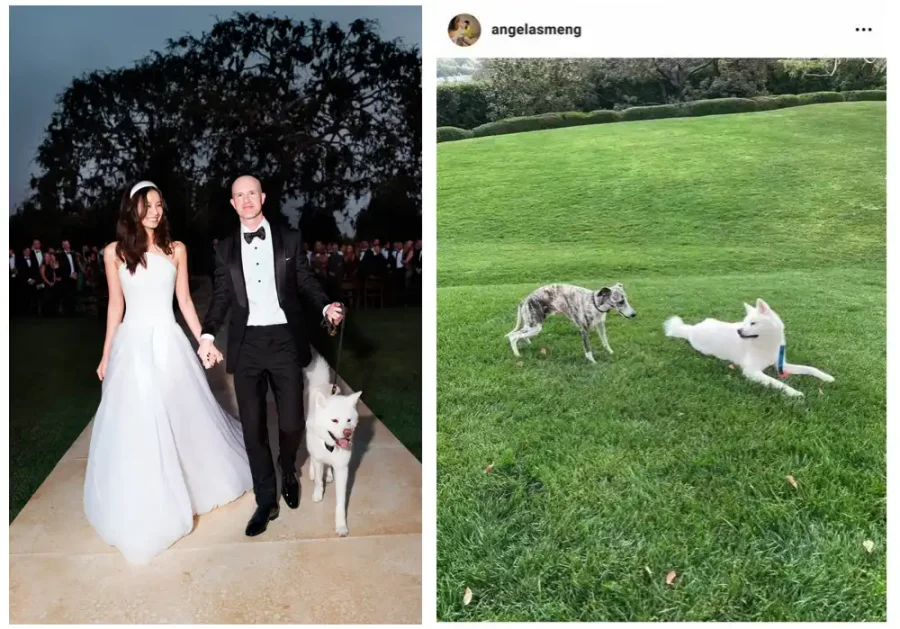
Left: Wedding photo; Right: Angela’s Instagram
Just as they walked down the aisle with a dog by their side, this German Shepherd played a crucial role throughout Angela’s upbringing.
Angela named the mixed-breed dog Mickey (Mickey), after Mickey Mouse—the only American cartoon character she knew at the time. Over time, Mickey became a vital companion in her life.

German Shepherd, Photo: Jena Ardell/Getty Images
There’s a scientific theory: pet owners project their ego onto their pets. Bodybuilders describe their pets as strongest; politicians say theirs are discerning and independent; celebrities claim their pets are princesses. Angela clearly understands this phenomenon—her descriptions of Mickey offer insight into the ego and personality of the Chinese wife of America’s crypto elite:
Mickey never complained, seemingly understanding the truth of the world like a philosopher: without hardship and pain, there can be no joy. Calm and steady, she wasn’t the kind to jump on furniture or roll over for belly rubs. Each movement was slow and deliberate, strong and confident—composed like the Sphinx, the Egyptian symbol of power and wisdom.
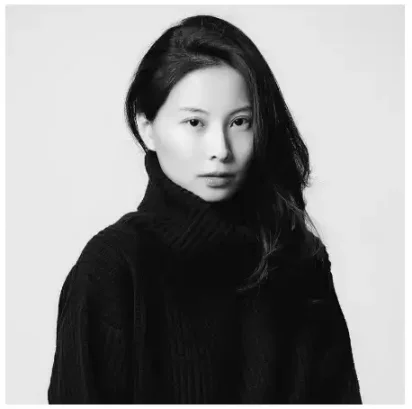
Angela, photo courtesy of thebigthing.org
But this delicate balance was suddenly shattered. One day, Angela realized Mickey was gone. Anxiously, she asked her mother, “Mom, where’s Mickey?” Her mother avoided answering directly, her face deliberately cold, telling Angela to go do her homework. Pressed further, her mother coldly replied, “What dog?” then fell silent.
This response plunged Angela into instant confusion and pain. She knew her mother must know what happened, yet the coldness made her feel rejected and distanced. Her mother wasn’t unaware of Angela’s feelings—but was dealing with a harsh reality in her own way: she could no longer allow her daughter to depend so heavily on this dog. The family had endured too much pressure and hardship. Keeping a dog was simply not affordable. Moreover, Angela’s mother harbored deep fear of dogs.
In China, dogs were animals almost never respected. Only in 2020 were they removed from the category of “livestock” and redefined as “companion animals.” For Angela’s mother, longstanding fears and stereotypes about rabies hadn’t disappeared overnight.
Eventually, Angela discovered the truth: Mickey had been kicked in the leg by a roommate neighbor for excessive barking, then abandoned at a construction site three hours away. When she confronted her parents, they responded with endless justifications and blame.
“What else could we do, Angela? Have you forgotten all the sacrifices we’ve made for your education here? All the sweat and tears? How many loved ones and friends we left behind? We don’t even have health insurance—how could we possibly afford vet bills?”
Each word carried the weight of real-life struggle. Her mother didn’t intend to hurt Angela, but left deep scars on the young girl. As an adult, whenever asked, “Have you ever owned a dog?” Angela always replies: “Yes, a German Shepherd mix named Mickey, after a Disney character. But I didn’t have her long—she passed away.” She chooses not to reveal the truth, because in that story, everyone had their own helplessness.
After that, Angela decided never to speak to her parents again, expressing defiance through silence, growing up quietly, finding a job to support herself, refusing to invite them to her graduation or wedding, and even excluding them from her funeral should she die before them.
Then one morning before school, Angela zipped up her backpack, checking in the mirror to ensure her face showed no emotion. Her mother called her over, holding a crumpled $100 bill—something that felt like an urban legend to young Angela.
But the same woman who chose $0.69-per-pound Fuji apples over $3.99 strawberries—her mother—opened the side pocket of Angela’s backpack, said nothing, slipped in the money, then gently stroked her head.
Angela suddenly understood: love doesn’t always appear in the form we expect. “Love languages” come in many forms. Unlike Mickey’s companionship, this $100 represented a quarter of their monthly rent. To her mother, it may have been the only support and expression of “love” she could give.
From UCLA to Journalism, Modeling, and Writing
In West Africa, there are griots—storytellers responsible for preserving the history of entire villages. People bring their memories to the griots, who remember them for future generations.
Angela Meng mentioned these “griots” in her own narrative, and she seems to place herself in that very role. Whenever she encounters unexpected stories, she instinctively pulls out pen and paper to record them—perhaps foreshadowing her eventual career as a journalist.
Angela attended the University of California, Los Angeles (UCLA), majoring in history. After graduation, she worked briefly in the investment banking division at Lazard in New York, then held positions at the South China Morning Post, Phoenix Weekly, and GEN Magazine. During this time, she wrote stories on Medium and compiled them into a book.
Thanks to her striking looks, she was scouted and began a four-year modeling career, signing with Elite Model Management and LA Models, regularly participating in photoshoots and art events.
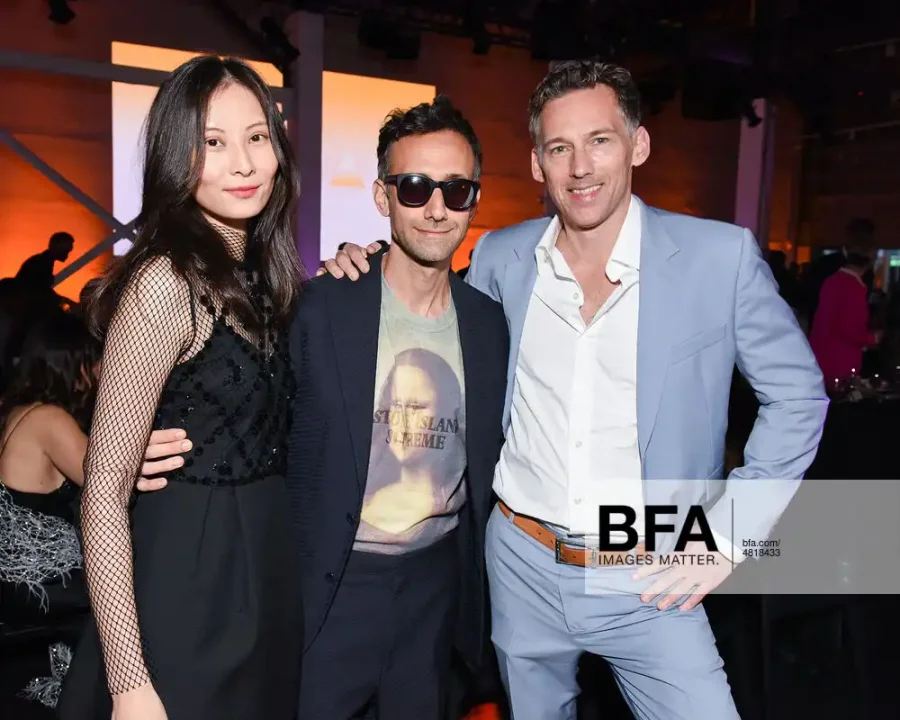
Angela at the 2022 MOCA Los Angeles Gala, photo courtesy of BFA
In her early twenties, Angela was both similar to and different from ordinary young women.
Like most young women, she enjoyed sweets—especially Jordanian knafeh, a traditional Arab dessert typically made with cheese, clotted cream, pistachios, or nuts.

Jordanian knafeh, image source: internet
But unlike most young women, Angela loved observing ants. On her desk sits a honeypot ant colony, simulating a real ant ecosystem. While ant farms aren’t expensive—costing a few hundred dollars—it’s the ants themselves that are valuable.
Among ant enthusiasts, Kenyan and Mexican ants are considered the most prestigious, with individual ants fetching prices as high as tens of thousands of dollars—entire colonies sometimes worth more than a house.
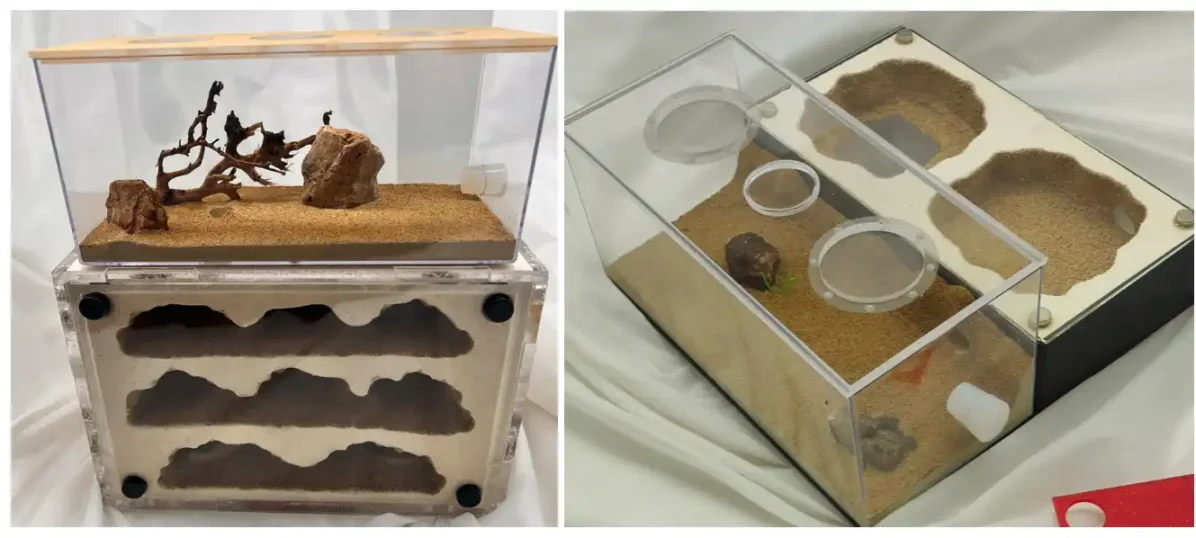
Ant farm, image source: internet
Later, Angela settled permanently in Los Angeles, beginning her life as a writer. Her children’s picture book, The Big Thing: Brave Bea Finds Silver Linings with the Help of Family and Friends During a Global Pandemic, has already been published.
This illustrated children’s book centers on themes of family, gratitude, and belonging, aiming to help children understand the coronavirus era through a positive lens. It tells the magical yet uplifting journey of a protagonist navigating the pandemic, discovering hope and positivity amid crisis with support from family, teachers, and friends. All proceeds from the book are donated to COVID-19 charities.
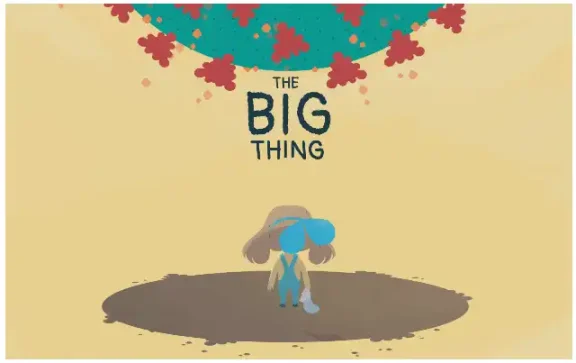
Image source: thebigthing.org
The 30-Year-Old Crossroads: Anxiety and Struggle
In 2021, Angela Meng approached her 30th birthday, entering what many call the “30-year-old anxiety” phase.
Some told her 30 was the best age—financially stable, settled, healthy, mentally balanced, akin to cities like Zurich, Calgary, or Copenhagen: clean air, low crime, excellent infrastructure, efficient governance. But three years ago, Angela found none of this appealing. She preferred chaotic, vibrant, unpredictable cities like Berlin, Tbilisi, or Tel Aviv.
In her essay Don't Make Me 30, she candidly expressed resistance toward crossing the 30-year threshold—facing the loss of many things she once loved. She asked in bewilderment: “What exactly is 30?”
She wasn’t ready to give up nightclubs, missing nights wearing polyester miniskirts and four-inch heels, shouting over DJs—even if she was inwardly tired. She didn’t want a mortgage or friends who had one. She preferred infinite social capital and the freedom to exploit it recklessly—the privilege of being in your twenties.
She didn’t want pension plans or saving for a secure future. She’d rather spend extravagantly on designer bags and champagne. She didn’t seek long-term relationships with mature men. Instead, she was drawn to emotional manipulators who seemed genuine on the surface—because that was the lifestyle she truly desired.
She didn’t want to write blog posts about “finally feeling whole,” “becoming stronger,” or “no longer burdened by societal expectations.” She wanted to remain “irresistible.” She didn’t want to learn to “love herself”—in her twenties, there had always been plenty of people lining up to love her. She didn’t want to confront the creeping resemblance to characters from *Sex and the City*—dining with any New York man willing to date her, laughing politely at their dull jokes, while her last five remaining eggs silently ticked away.
She refused to start meditating, traveling to India for yoga retreats, or adopting empty clichés only thirty-something women utter—like “age is just a number” or “30 is the new 20.” Deep down, she knew these were lies meant to comfort herself. You’re 30 now. That’s the reality.

The villa Brian Armstrong purchased in Los Angeles for $133 million
In 2024, the year Angela married Brian Armstrong, she had already crossed into her thirties. Though she ended up living the kind of life she once resisted in her twenties, she was fortunate—41-year-old Brian Armstrong possesses $7.4 billion in assets. Thus, she can still live extravagantly, spending freely on luxury bags and champagne. And she can continue living in familiar Los Angeles—only now moving from her own apartment into the $133-million mansion Brian bought in 2022.
Join TechFlow official community to stay tuned
Telegram:https://t.me/TechFlowDaily
X (Twitter):https://x.com/TechFlowPost
X (Twitter) EN:https://x.com/BlockFlow_News
 BlockBeats


