Interview with Gate.io CEO: Han Lin's "Crypto Worldview" Carrying 17 Million Users
TechFlow Selected TechFlow Selected
Interview with Gate.io CEO: Han Lin's "Crypto Worldview" Carrying 17 Million Users
"In this industry, to survive, we need to stay innovative, stay humble, and put users first, continuously providing users with quality services and content."
 Navigating Web3 tides with focused insights
Host: Joe Zhou, Deputy Chief Editor, Foresight News
Guest: Dr. Lin Han, Founder and CEO of Gate.io
Compiled by: aididiaojp.eth, Foresight News
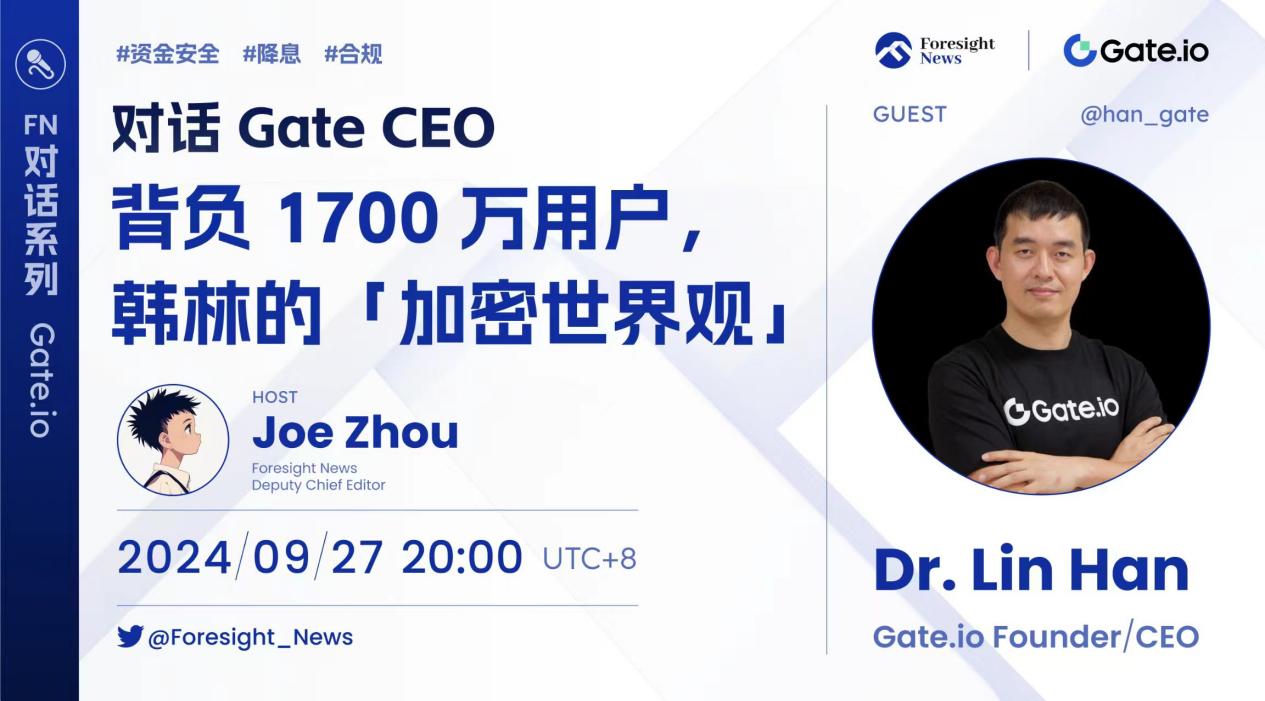
Regardless of bull or bear markets, exchanges remain the foundational force throughout the entire crypto cycle. We are honored to have Dr. Lin Han, CEO of Gate.io, join us in the studio today to share his insights on the crypto world with 17 million users relying on the platform.
Host: This year's TOKEN 2049 was exceptionally vibrant, with numerous side events held across Singapore during the event week. We noticed that Gate.io hosted several of them—Dr. Han, could you share some interesting experiences? What changes have you observed compared to previous years?
Dr. Lin Han: Hello everyone, I'm Lin Han, founder of Gate.io. This year’s TOKEN 2049 felt significantly more energetic than in past years. There were likely around 1,000 official and unofficial events, making it highly efficient for networking. Many attendees were enthusiastic, discussing projects, ecosystems, and industry development. Personally, I participated in many events—one particularly fun one being a football match co-hosted by Gate.io and LTP. We invited participants from top-tier industry institutions, and the level of play was surprisingly professional. I initially thought it would just be casual recreation, but we had actual pro-level players involved. Although we lost the game, the interactions were joyful and the atmosphere was great. Additionally, I attended Inter Milan’s football launch event—we’re sponsoring their sleeve badge. Of course, I also conducted several project partnerships and joined various ecosystem activities, all of which were very rewarding.
Host: Could you briefly introduce the origin of Gate.io and your personal background?
Dr. Lin Han: In April 2013, I launched our trading platform—already 11 years ago now. I originally pursued a Ph.D. in optoelectronics in Canada. After graduation, I worked as a postdoctoral researcher at a university before starting a venture focused on optoelectronic simulation software. During software development, I noticed people using high-performance GPUs to mine Bitcoin, which is how I first became aware of Bitcoin. I then read the Bitcoin whitepaper and code to understand its underlying principles. Coming from a technical background, I quickly realized this was a promising new technology. At the time, Bitcoin was cheap, so I bought some myself. However, the industry infrastructure was poor—there weren’t many trading platforms, and transaction fees were extremely high. I once traded privately through online forums and ended up being scammed out of 100 Bitcoins. That experience made me realize the market needed professional trading platforms and service providers to facilitate secure matching and prevent fraud.
So, I developed a Bitcoin trading system within about two weeks. Thanks to my technical background and prior web development experience, combined with a quick grasp of Bitcoin, I successfully launched the Bitcoin trading system on April 13, 2013. Soon after, we attracted our first batch of users. Back then, few platforms offered such services.
Around May-June 2013, CCTV reported on Bitcoin, calling it an interesting innovation capable of buying coffee. Many people searched for "Bitcoin" on Baidu and found our platform. Traffic surged overnight. Despite the heavy pressure, this moment marked the beginning of our user and traffic growth.
Host: Over these 11 years, what major challenges has Gate.io faced, and how did you overcome them?
Dr. Lin Han: In the early days, both we and the industry were immature. We didn’t fully understand what tokenization or digital asset management entailed—how to ensure security or comply with regulations. Initially, we even used personal wallets instead of enterprise-grade wallets for commercial operations, meaning security couldn't be guaranteed. We encountered frequent technical issues like system crashes, especially under high traffic.
About a year after launch, our exchange suffered a hacker attack resulting in the loss of nearly 10,000 Bitcoins. Initially, we simply wanted to build a website offering services and generating revenue, and users appreciated our work. But suddenly, we realized hackers were targeting our industry—and some possessed advanced, even nation-state-level skills (e.g., North Korean hackers). In the early phase, we lost assets worth approximately 3,000 BTC; six months later, another 7,000 BTC were stolen. Faced with this crisis, we had to rethink our path forward.
Many platforms chose to run away after similar incidents—keeping remaining assets while abandoning user liabilities—or declared bankruptcy like Mt. Gox, shedding responsibility entirely. We chose the hardest path: continuing operations and repaying every user. Based on our revenue at the time, repayment would take roughly 10 years. We decided to use monthly profits to gradually repay losses. Fortunately, favorable market conditions accelerated recovery, and within two to three years, we fully compensated all affected users.
Another significant challenge came during China’s “94” regulatory crackdown, when the entire industry faced immense pressure—we were no exception. We prioritized compliance, relocating users step-by-step and rebuilding trading volume organically. Not all platforms took this route; most leading exchanges kept their original systems and brands and simply moved overseas. We chose the harder path, which posed a major challenge at the time.
Host: What kind of crypto environment is Gate.io operating in today? What new problems are emerging?
Dr. Lin Han: The current landscape is vastly different from 11 years ago. Back then, there were only about 1 million global cryptocurrency holders. Today, that number has grown to 500–600 million—around 10% of the world’s population owns crypto assets. For example, Singapore ranks among the highest in crypto adoption, with roughly one in four citizens holding digital currencies. Unlike elsewhere, crypto usage in Singapore extends into daily life—people use it for food delivery and ride-hailing.
The competitive landscape has become more concentrated, products increasingly homogeneous, and services more mature. Competition among top-tier platforms has intensified.
From an overall industry and ecosystem perspective, we're still in a period of vigorous growth. New technologies continue to emerge, ecosystems expand, and participation grows steadily.
Host: Many exchanges are expanding into Telegram as a key channel for user acquisition. How does Gate.io view this trend? What efforts has Gate.io made this year to attract new users?
Dr. Lin Han: We believe that for homogenized products, superior user experience and performance are essential. For instance, we offer a broader selection of tradable tokens. To compete in such an environment, we must maintain strong competitiveness. As an innovation-driven company, we constantly analyze the industry’s stage and future direction, focusing closely on current and evolving user needs.
For example, meme coins are currently booming—with around 15,000 new tokens launched daily, mostly on Solana and a quarter on Base—both chains known for high performance and low cost. While derivatives offerings remain limited in novelty and mechanics, spot trading presents vast opportunities. The meme coin spot ecosystem is rapidly evolving, and underlying infrastructure continues to improve.
As base-layer performance improves, decentralized services may gradually replace certain centralized ones. We’re exploring how to layer centralized services atop decentralization, enabling DeFi users to access high-efficiency, low-cost services seamlessly.
Host: BTCFi, Solana, Base, and other ecosystems have seen rapid growth over the past year. Can you discuss Gate.io’s initiatives in these areas? Which other ecosystems are you personally watching?
Dr. Lin Han: Many ecosystems are progressively solving core industry challenges—trust, scalability, and cost. We were among the first centralized platforms to support BRC-20, bringing substantial traffic and new users. We’ve also been quick to support viral meme coins on Base and Solana. While in Singapore, I attended multiple Ton ecosystem events, including hackathons. The Ton Foundation aims to bring 30%–40% of Telegram’s users into the Ton ecosystem within five years. Recently launched Ton-based projects already show massive user numbers, which we’re actively supporting.
Beyond Ton, we’re also tracking ecosystems improving foundational infrastructure, such as Sui and Aptos—high-performance Layer 1s built on the Move language. We've also expressed cooperation intent with Movement, a Move-based Layer 2 protocol. On Layer 2s, we can offer higher throughput and lower fees. Parallelized architectures like Monad and Sei are also promising—Monad hasn't launched yet, but its upcoming release signals clear technological progress driving the industry forward.
We’ve long tracked Ton. Initially, the community proposed multiple chains, but last year, the current chain gained official backing, prompting us to focus heavily on it. From late last year to now, the Ton ecosystem has grown rapidly. Off-chain metrics for Ton already surpass on-chain data. Handling such scale poses major infrastructure challenges—the Ton core team is actively upgrading performance. Moreover, Ton’s off-chain ecosystem is enormous: Hamster alone has 50 million interacting users on Telegram. This massive user base and ecosystem inspire many to replicate WeChat Mini Programs’ functionality on Telegram.
Mini-apps on Telegram are growing rapidly, attracting developers aiming to build everything from trading bots and sniper tools to wealth management services and general-purpose applications like games. With around 900 million current users and projected growth to 1.5 billion in coming years, Telegram offers early-mover advantages despite relatively few apps serving users so far.
In BTCFi, Gate.io has built robust infrastructure. When BRC-20 gained traction in May last year, Gate.io was among the earliest centralized exchanges to support it. We've maintained leadership—for instance, we were again among the first to list BRC-20 tokens on Fractal Bitcoin, achieving strong trading volumes. These users represent a large demographic, though their profile differs from others. BTCFi attracts seasoned BTC holders—early industry participants with substantial accumulated wealth—whose transactions generate significant value. Serving them requires tailored solutions addressing their unique needs.
Besides Solana and Ton, Arbitrum leads among Ethereum Layer 2s in market share and ecosystem maturity. Users favor Layer 2s because they inherit Ethereum’s security without cross-chain centralization risks. However, costs remain relatively high—though much lower than Ethereum itself—leading many users to prefer Solana.
Beyond Layer 2s, some Layer 1s aim to solve performance and cost via improved infrastructure. Looking ahead, Sui, Aptos, and Movement show strong potential. We’re also bullish on parallel EVMs like Monad, where parallelization is key to reducing costs and boosting performance.
Sui and Aptos’ virtual machines and languages are inherently suited to parallel processing, giving them a natural edge. The main hurdle lies in developer inertia—Solidity and EVM have too strong a foundation. Asking developers and projects to switch languages and rebuild from scratch incurs prohibitively high transition costs.
Host: Recently, many centralized exchanges have introduced pre-listing trading markets for tokens. Dr. Han, what do you think of this new trend? Why is it happening? What are its pros and cons?
Dr. Lin Han: When top-tier projects distribute points or tokens early, users naturally seek ways to trade them in advance. We’ve considered how to serve this demand but struggled to find ideal solutions—until recently, when breakthrough approaches emerged. Some platforms allow users to deposit collateral and participate in auctions to trade expected points or future tokens. However, current pre-market models suffer from inefficiency—relying largely on OTC-style trading, where deals only happen if someone posts an order and another buys. This model lacks liquidity and efficiency.
To address this, we invented a new method: pre-mint. After pre-minting the tokens, users can trade them just like any other token—greatly improving efficiency. Using pre-mint, we successfully launched popular tokens like DOGS and HMSTR with solid trading volumes. Unique product innovation backed by solid technical implementation significantly enhances user convenience and trading activity.
We’re also focusing on solving pre-market pricing. Early-stage projects carry high uncertainty, hence significant risk. We provide strong risk warnings upon user entry. To reduce uncertainty, our mechanism includes clear terms and transparent valuation models. First, we communicate market expectations for the project, then set a fixed total supply ratio. With supply defined, users can reasonably estimate value, allowing prices to stabilize naturally.
If the final issued token supply differs from our predefined amount, we apply proportional mapping—ensuring users receive commensurate value as long as valuations are reasonable, minimizing deviation from expected returns.
Host: This year, I’ve noticed several major exchanges emphasizing wallet services. What is Gate.io’s strategy regarding wallets? Will you increase support for this business area?
Dr. Lin Han: Wallets are a critical segment for us, though investment levels vary across companies. As Web3 app performance improves and costs decline, user barriers drop and participation rises. On-chain trading volume has grown sharply in recent years. Naturally, during bullish periods, centralized exchange volumes rise too. Compared to two years ago, when DEXs held about 8% market share, they now command around 13%—a trend that’s expanding. Hence, we’ve decided to significantly boost investment in Web3 infrastructure.
Host: Which auditing firms does Gate.io work with, and what assets or business categories do they audit?
Dr. Lin Han: Gate.io collaborates with multiple auditing agencies covering code audits, on-chain contract audits, wallet audits, user asset audits, and penetration testing. Beyond third-party external audits, we conduct internal audits as well. Notably, Gate.io was among the first exchanges in the industry to implement Proof of Reserves (PoR), and we’ve even secured a patent related to PoR—specifically, using Merkle trees for reserve verification. In October 2020, we published our first PoR report, independently verified by Armanino, a leading U.S.-based audit firm. We placed user data into a Merkle tree and open-sourced the code, enabling users to verify data accuracy themselves.
However, in 2022, shortly after completing our PoR audit, FTX collapsed—shocking the entire blockchain industry. Traditional audit firms developed negative perceptions of crypto and began exiting the space, making it extremely difficult to engage reputable traditional auditors. In response, we developed a new asset auditing method based on zero-knowledge proofs (ZKPs). This innovative approach eliminates reliance on third-party auditors. Traditionally, platforms must partner with trusted audit firms because user asset data cannot be publicly disclosed. With ZKP technology, however, we can prove asset ownership without exposing user information—ensuring privacy and security.
In traditional finance, transaction clearing and asset custody are handled by separate entities, clearly delineating responsibilities—making misappropriation nearly impossible. In contrast, crypto exchanges often consolidate trading, clearing, and custody within a single entity. To users, such exchanges appear as "black boxes," obscuring internal operations. As early as 2020, we advocated for PoR to let users verify whether platforms misuse their funds. When platforms hold vast user assets without oversight, the temptation to reallocate them—into yield farming, investments, asset management, or quant strategies—becomes real. While such actions might seem low-risk initially, blowups can lead to massive user losses. Thus, we promote transparency so users can inspect platform holdings.
Yet merely allowing visibility isn't enough—users still can’t know if a platform might get hacked tomorrow. Therefore, we’ve implemented multi-layered security protocols with strict thresholds. For example, we cap the maximum transferable assets under specific conditions. Most funds are stored in cold wallets, only a small portion in hot wallets, ensuring user assets remain protected even in worst-case scenarios. Additionally, we’ve established our own reserve fund as an extra safety net.
Host: How can exchanges avoid malicious behavior, such as intentionally manipulating orders ("front-running") in contracts?
Dr. Lin Han: For an exchange to avoid malice—or deliberately liquidating user positions—a crucial requirement is maintaining an open system that provides a fair and equal environment.
Many platforms have internal teams capable of market manipulation, with APIs either closed or severely restricted. The extent to which institutional users adopt a platform largely depends on whether it offers fairness. Institutional traders using APIs can easily detect subtle signs of market manipulation. We provide excellent API access and serve over 1,000 of the world’s top-tier institutions. Their stringent requirements make market manipulation virtually impossible. If we attempted to manipulate futures contracts to profit from user liquidations, arbitrageurs would instantly exploit any price discrepancy. Hence, our role is to provide a transparent, open market solely for order matching—not to act against users. Since users trade peer-to-peer and aren’t our counterparty, we have no incentive to behave maliciously. Ensuring fairness is sufficient.
Host: Can you describe Gate.io’s corporate culture? Some say Bitget resembles Huawei’s culture, Coinbase mirrors NBA teams’ win-at-all-costs mentality, Binance values hardcore employees and direct communication, while Kraken rejects bureaucracy and office politics—even firing employees who engage in it. What defines Gate.io’s culture? If you had to pick keywords, which would best represent it?
Dr. Lin Han: Gate.io maintains a simple organizational structure, minimizing complex power dynamics. We share deep conviction in the industry—we believe we can achieve meaningful impact rather than merely encouraging leveraged trading to collect fees. We aim to allocate capital wisely and accelerate innovation. We see tremendous potential to contribute meaningfully and help refine the global financial system.
Hence, Gate.io strongly promotes an innovation-centric culture. We constantly ask: what products and services should we deliver? Delivering differentiated offerings that receive positive user feedback brings us great satisfaction.
The blockchain industry sits at the intersection of internet and finance—two fast-paced sectors. Finance moves quickly due to proximity to money; the internet breeds constant innovation. Combining these two powerful forces creates blockchain. To survive here, we must stay innovative, humble, and user-focused—continuously delivering quality services and content.
Host: Are you exploring regulated services? How do you view the rise of compliant exchanges squeezing non-compliant ones?
Dr. Lin Han: Compliance has always been a priority for Gate.io. My exposure to Western compliance culture during doctoral studies abroad shaped this mindset. Coinbase’s successful IPO further inspired us—it proved compliance is viable and strengthened our resolve. Thus, we began pursuing global compliance early on.
As early as 2018, when Malta introduced crypto-related regulations, we submitted our license application. After four years, we successfully obtained Malta’s Class IV Virtual Financial Assets Service Provider license, authorizing us to operate spot crypto trading and custodial services locally. While compliant platforms may face profitability constraints—especially given high initial investment—we believe compliance is the inevitable path forward. With sufficient strength and capital, we chose full commitment. Following Malta, we expanded compliance efforts to Dubai, the U.S., Canada, Singapore, Hong Kong, Italy, Australia, and the Bahamas.
The EU represents a massive market everyone wants to enter—but it’s also heavily regulated, requiring extensive preparation. As mentioned, we’ve had a presence in the EU for years—not just Malta, but also Italy and Lithuania. With the EU’s MiCA regulation now in place, we’re upgrading our regional compliance framework and actively communicating with regulators to expand licensing coverage across the entire EU. Beyond the EU, we also hold a DLT license in Gibraltar.
Host: Where are Gate.io’s primary markets today? Which regions will be strategic priorities going forward?
Dr. Lin Han: We’re targeting major global markets. Beyond developed economies, we prioritize regions with strong user bases and high blockchain penetration. As noted earlier, Singapore’s adoption rate reaches 24%, while parts of the UAE exceed 25%. Other high-adoption countries include Vietnam, Turkey, Brazil, and Argentina—each representing massive opportunities. We’re progressively entering these markets through compliant channels.
Host: What stage is the current crypto market in? And what trends do you foresee for the future?
Dr. Lin Han: Short-term market predictions are extremely difficult—too many variables affect daily movements; prices could rise or fall tomorrow. However, I’m highly optimistic about long-term trends. There’s growing consensus on blockchain’s societal contributions—efficient asset allocation and directing capital to its most productive uses.
Blockchain is no longer niche. Approximately 10% of the global population now holds crypto assets, establishing it as a major asset class. Though crypto’s total market cap remains about 10 times smaller than gold’s, it’s already substantial and increasingly influenced by global macroeconomic factors. Crypto market fluctuations are highly correlated with stock markets—especially U.S. equities. Global macro shifts like Fed rate cuts or European monetary policies directly impact crypto asset flows.
I remain bullish on blockchain’s future for three reasons: First, market expectations for rate cuts persist. Second, blockchain is moving toward mainstream adoption. During the U.S. presidential election, both candidates voiced strong support for blockchain technology, with proposals to include Bitcoin as a national strategic reserve asset. Third, blockchain user growth far exceeds early internet adoption rates and still has vast room to expand—from roughly 1 million users 11 years ago to about 600 million today. With only 10% global ownership now, we expect adoption to reach 30%, 40%, or even 60% of the world’s population within the next 5–10 years—indicating enormous growth potential ahead.
Join TechFlow official community to stay tuned
Telegram:https://t.me/TechFlowDaily
X (Twitter):https://x.com/TechFlowPost
X (Twitter) EN:https://x.com/BlockFlow_News
 Foresight News