Ethereum is sick
TechFlow Selected TechFlow Selected
Ethereum is sick
This is not the end of Ethereum, but before the phoenix rises from the ashes, we will first see the ashes.
 Navigating Web3 tides with focused insights
Author: Dr. Martin Hiesboeck
Translation: Block unicorn
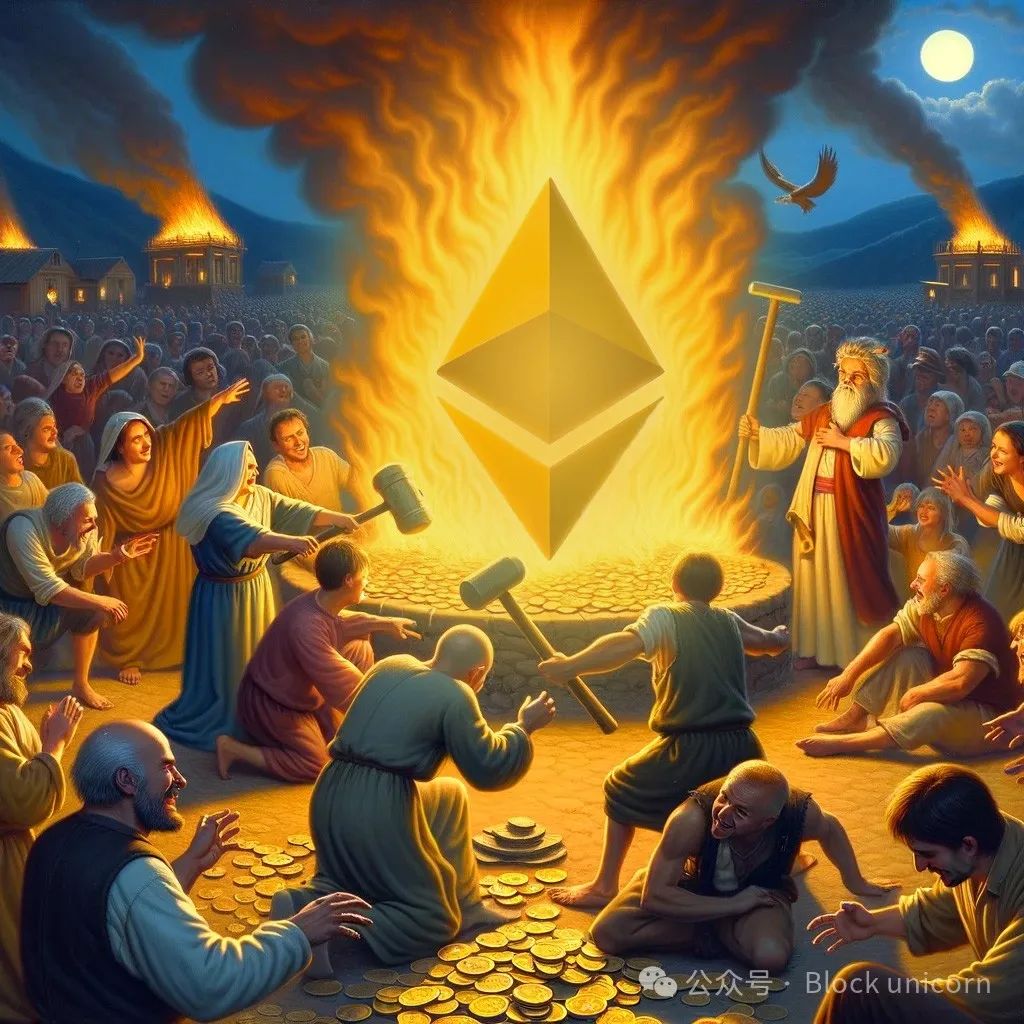
At Uphold Institutional, we have many clients with significant investments in Ethereum, so I’m currently flooded with questions about the future of this original smart contract network—especially in the face of strong competition from Solana and other L1s.
Today, Ethereum does seem to have lost its way. Its price is struggling, major players are exiting or shifting to Solana; weekly Ethereum meetings are filled with conflicting proposals, and “Hannibal” is truly at the gate: Never before have so many L1s directly challenged Ethereum—not just the network itself, but its vision and business model.
Don’t get me wrong: Ethereum has become a business. Revenue comes from transaction fees. Even though we’re repeatedly told that low transaction costs benefit everyone, that’s simply not true. ETH holders want high fees. They're frustrated by parasitic L2s—ostensibly created to solve scalability—that erode their profits. Fees go up, ETH price goes up. Fees go down, ETH price goes down. Over 90% of the Ethereum Foundation’s budget depends on Ethereum transaction fees. Everyone agrees blockchain networks need fees—but there are numerous examples of fairer incentive models. Ethereum is trapped in an outdated business model it can’t easily escape.
The problem isn't just fees—Ethereum has repeatedly betrayed its own founding principles and the original vision of crypto purists. The community was initially shocked by the emergence of Maximal Extractable Value (MEV)—achieved by reordering transactions within blocks—but later embraced it for greed. Pure, unadulterated greed, completely contrary to the original idea of decentralized networks. And this greed is driven by Ethereum stakeholders—large financial institutions that have bet billions on the “world computer,” caring only about their return on investment, indifferent to the ideals of decentralized finance and having no interest in supporting them.
Looking through Vitalik’s roadmap for the coming years, one can still sense urgency for reform, yet it's mixed with hesitation about resolving the network’s many flaws and contradictions. In private conversations, one increasingly hears him sigh. He’s caught between his noble ideals and the demands of the “board” and investors.
The most obvious technical issue is that Ethereum is no longer very decentralized. Of course, neither is Solana, so decentralization has little to do with investor priorities. For those who care only about dollar values and ignore ideals, this principle of blockchain has long been abandoned. Today, three block builders produce 90% of Ethereum’s blocks. In a paper written by Sen Yang and Fan Zhang from Yale University’s Computer Science department, and Kartik Nayak from Duke University, the authors pose a question: “If the builder market is permissionless and anyone can join, why has it become centralized?”
Certainly, there’s an old adage in computer science: Any decentralized system with incentives tends toward centralization over time (and without incentives, the system gradually decays into stagnation). But the real reason is that block building only makes economic sense at scale, favoring cheap data centers and offering little value to individuals. The larger the network and the more powerful the stakeholders, the stronger the push toward centralized control. Just as Bitcoin mining has become centralized, individual computers now stand almost no chance in competing. Ethereum has been hijacked by large corporate interests. Neither of these currencies is “the people’s coin” anymore, which is why we see so many compelling competitors emerging—Kaspa challenging Bitcoin, SpaceMesh as true people’s currency, Alephium as a safer, fairer smart contract platform, and others.
Allegedly to combat MEV, Ethereum introduced the MEV-Boost auction, originally intended to reduce and prevent malicious “front-running” on-chain. Yet, as often happens in Ethereum’s history, introducing competition only strengthened the dominance of the big three.
Ethereum has lost appeal among the broader decentralized community. The cost to participate in private order flow MEV is around 1.5 ETH—an entry barrier that deters newcomers while delighting existing giants. As a result, Vitalik introduced Proposer-Builder Separation (PBS), but this became yet another failed attempt.
The core debate centers on transaction ordering. Most L2s, for example, rely on a single sequencer. This contradicts the principle of decentralization. Ethereum insiders want to create “shared sequencers,” but that won’t work: it’s precisely the single sequencer that makes L2s profitable, while Ethereum pays the price. Ultimately, this requires real-time composability—or “synchronous composability”—which many researchers believe linear blockchains cannot achieve. To accomplish this, you need a Directed Acyclic Graph (DAG) or lattice structure.
Block unicorn note: The transaction ordering mentioned above means every transaction must be queued, like waiting in line to buy a milk tea—if someone is ahead of you, you wait. Current L2 sequencers and validators are designated nodes controlled by small groups, violating decentralization principles. When a few entities control the sequencer, the network becomes vulnerable to centralization attacks and loses security guarantees.
Some chains today don’t suffer from Ethereum’s problems—for example, MultiversX. Ethereum keeps putting Band-Aids on cancer patients, while other projects start from scratch and completely avoid the so-called “blockchain trilemma” (in reality, the “Ethereum trilemma”).
Yet today, newcomers to blockchain still first learn about the “two giants.” All wisdom of Bitcoin consensus is credited to Satoshi Nakamoto (actually a team of seven people), and all intelligence of smart contract platforms is attributed to Vitalik. This is unfair in both cases. Ethereum had many co-founders, all of whom left—and for good reasons! Yet in schools, new blockchain enthusiasts are shown an outdated picture of blockchain, misleading them into believing Ethereum’s Solidity smart contracts and EVM are the greatest invention since sliced bread. Innovation moves fast, but Ethereum benefits from educational inertia.
Another issue lies within Ethereum’s ecosystem itself—its sheer size makes it inflexible and often unwilling to support its own ecosystem. And because it’s so deeply entrenched, there are inherent alignment problems when trying to combine decentralization with cooperation (maintaining consistency). The challenge for the Ethereum team is ensuring diverse projects contribute toward a unified vision. This concept has historically been poorly defined, creating risks of “social layer” control. To “maintain control,” Vitalik has repeatedly argued that the concept of “alignment” should be clarified, broken down into specific attributes, and measured through concrete metrics.
Discussing “alignment” reveals how deeply rooted the “Ethereum-first” mindset is. Its own success has boxed it into an intellectual dead end. Embracing a “multi-chain future” would mean giving up its claim to dominance, clearly against investor interests. Rather than admit Ethereum will never be—and should never be—the universal settlement layer for all blockchains, let alone the so-called “world computer,” it continues to fight meaningless debates between Solana and Ethereum.
Vitalik is well aware he’s trying to turn this super-tanker of Ethereum around from a dead end. His problem is that staying in this “rent-seeking paradise” perfectly suits the interests of large Ethereum investors. And Ethereum still functions—it’s definitely not dead. Last week, three major traditional finance firms announced launching so-called “real-world assets” on Ethereum. It’s not dead, but it’s certainly entered the oncology ward.
Yet cancer can be cured, and more efficient EVMs are on the way. Thousands are working on Ethereum—that’s the beauty of decentralized, global labor: there’s still hope for a cure. Innovation is accelerating rapidly. Despite its many problems and fierce competition, dismissing Ethereum too easily would be a mistake.
So no, this is not the end of Ethereum. This is about seeking a cure, especially what we need:
1. Eliminate rent-seeking behavior in L2s and focus on making the mainnet scalable. This requires a major shift in thinking, but Ethereum has undergone many reforms and revolutions—another one won’t hurt.
2. Accept that Ethereum will not become the “world computer” or “global settlement layer,” but merely one of many chains, collectively building a resilient future for on-chain computing. Ethereum must become one of many blockchains in a “multi-chain world,” where digital networks seamlessly collaborate across boundaries, protocols, and blocks. Just as diversity empowers human labor, diversified networks bring security and redundancy to blockchain.
3. Open Ethereum development in a more democratic way, embrace DAOs, and move away from small developer cliques. Now, not only in block production, but also in development, too much influence rests in too few hands.
4. Reduce the influence of large investors—perhaps even limit individual ETH holdings.
5. Create incentives for block builders to expand from three to 300. This means making Ethereum cheaper and fairer, which also means reducing profitability. ETH’s price might take a hit, but so what? If saving the network means the rich earn less, then tax those holding over 10,000 ETH.
Pushing any reform is extremely difficult—on one hand, there are countless opinions within Ethereum, each person convinced of their own view; on the other, key decisions remain in the hands of a few individuals. Within the developer community, there’s a toxic “us versus them” mentality—if you don’t align with a certain team’s vision, decision-makers instantly “blacklist” you. Like many organizations, Ethereum’s governance has become dominated by a small number of influential individuals.
I have many more suggestions, but I’m not confident Ethereum can implement any truly meaningful reforms. Whenever other L1s outperform ETH in the next bull market, pressure increases; when ETH price rises again, that pressure vanishes. That’s the fickleness of capitalism—rarely are incentives truly aligned.
Therefore, don’t be misled by Solana fans claiming this is a battle between two giants or the end of Ethereum. This should be the beginning of renewal, a period of reform—similar to the painful transformations other linear blockchains must undergo when facing new technologies like advanced sharding and BlockDAG. This is not the end of Ethereum, but before the phoenix rises, we will first see ashes.
Join TechFlow official community to stay tuned
Telegram:https://t.me/TechFlowDaily
X (Twitter):https://x.com/TechFlowPost
X (Twitter) EN:https://x.com/BlockFlow_News
 @BlockUnicorn