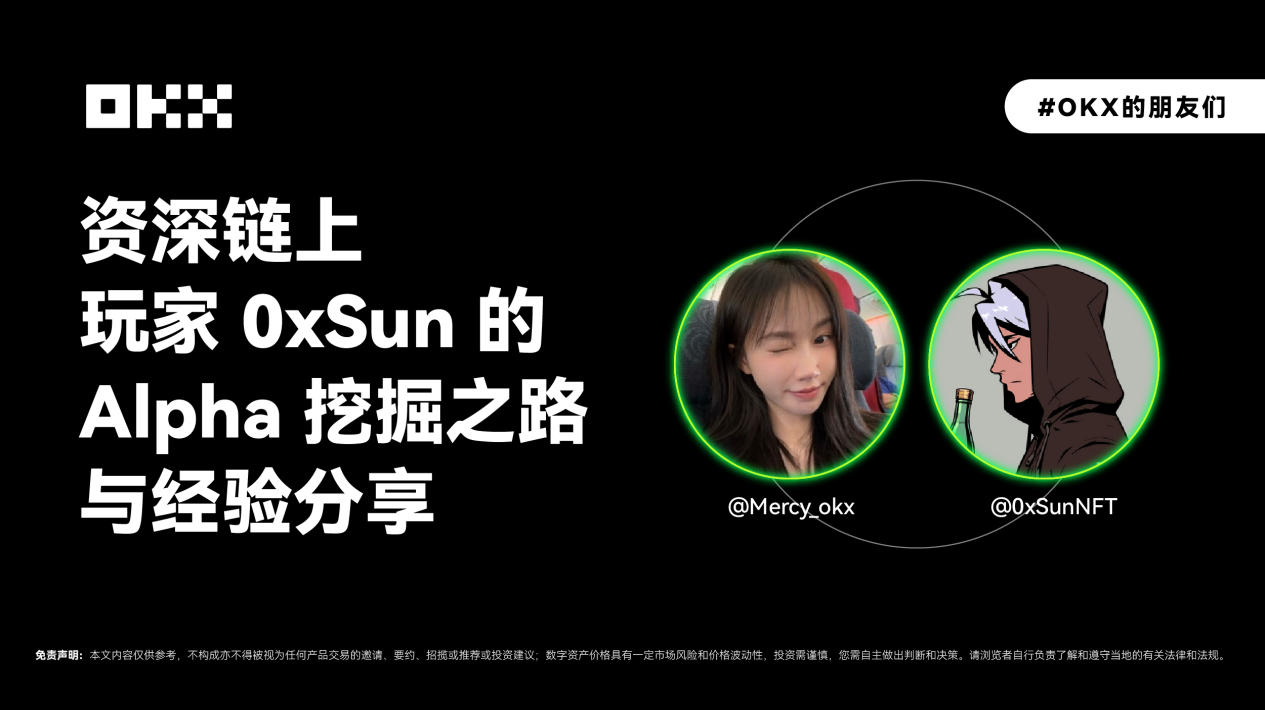
OKX Friends Episode 01 | Veteran On-Chain Player 0xSun's Journey and Insights on Alpha Discovery
TechFlow Selected TechFlow Selected
OKX Friends Episode 01 | Veteran On-Chain Player 0xSun's Journey and Insights on Alpha Discovery
The "Friends of OKX" series is a special feature produced by OKX and hosted by OKX's official community ambassador Mercy. It aims to share the professional journeys, industry insights, and lessons learned from KOLs with diverse backgrounds, offering valuable references for new users.
 Navigating Web3 tides with focused insights
Guest Message: Web3 is characterized by decentralization, openness, and fairness—an industry full of both opportunities and risks. OKX has long been one of the top-tier exchanges in the industry, and the OKX Wallet is currently my favorite multi-chain wallet. It's truly rare for OKX to excel in its centralized exchange business while simultaneously developing a user-friendly wallet product that brings great convenience.
0xSun, an experienced on-chain player, alpha trader, and discoverer of 100x "golden dog" projects. He first encountered blockchain during his graduate studies, entering the space amid the meme coin craze. During the last bull market, he achieved multiple-fold returns through meme trading. Notably, he earned nearly 200 ETH from the Monkey Land project.
In 0xSun’s view, his notable achievements stem primarily from two key advantages: First, his computer science background gives him unique technical insight and sensitivity when interacting with smart contracts and analyzing project functionalities. Second, extensive reading of English academic papers during graduate school enhanced his ability to retrieve information, summarize insights, and quickly assess project value. These skills enable him to rapidly understand new projects and make accurate judgments in the time-sensitive on-chain environment. Additionally, he emphasizes that personal interest drives his continuous progress, helping him develop a self-sustained methodology for on-chain alpha hunting.
Given his rich experience and representativeness of a broad player demographic, OKX has specially invited him as a guest speaker for the “Friends of OKX” series, hoping his insights will serve as valuable reference for many on-chain enthusiasts.
"Friends of OKX" is a special feature series produced by OKX and hosted by OKX Community Ambassador Mercy (@Mercy_okx), aiming to share KOLs’ professional journeys, industry insights, and lessons learned to help newcomers learn and grow.
I. Alpha Discovery Methodology
1. Mercy @Mercy_okx: How do you find effective and valuable information?
0xSun @0xSunNFT:
I mainly rely on three channels to obtain early-stage project and profit opportunity information: Twitter, on-chain monitoring, and source tracing.
1. Twitter: Most projects release updates via Twitter. I follow several high-value accounts—especially niche-focused ones with smaller followings. By tracking these sources, Twitter’s recommendation algorithm gradually surfaces more relevant content, making it a crucial information stream.
2. On-chain Monitoring: Tools like Dexscreener allow me to scan trending lists based on volume, number of trades, and other metrics to identify new tokens. I then dig deeper into their quality using Twitter or official websites. Combining this with wallet monitoring tools helps me spot what “smart money” is actively investing in, right as it happens.
3. Source Tracing: Monitoring newly deployed contracts and reviewing team backgrounds. This method is data-intensive and time-consuming, so it’s better suited for advanced users. For most players, Dexscreener and basic on-chain monitoring are sufficient.
Overall, each approach has strengths and weaknesses. When used together strategically, they can effectively uncover early projects and profitable opportunities.
2. Mercy @Mercy_okx: How do you evaluate a project’s potential value?
0xSun @0xSunNFT:
I assess projects based on five key factors:
- Narrative: Evaluate the project’s core concept and value proposition.
- Market Hype: Analyze the team’s marketing efforts and current momentum. Overhyped projects risk rug pulls; underhyped ones may lack traction.
- Token Distribution: Use on-chain analytics to check how much supply the team controls and whether it’s changing.
- Innovation Level: Assess whether the project introduces genuine innovation and at what narrative tier it operates.
- Team Execution: Watch for signs of price manipulation, sustained development activity, and ongoing operations.
While on-chain transparency allows clearer visibility into project details, it doesn’t guarantee safety. Teams can still manipulate markets in various ways. We should consider narrative strength, marketing effort, token concentration, and use on-chain tools to improve judgment accuracy. However, even then, we cannot achieve 100% certainty. Market direction is often shaped by a small group of influential actors—we can only aim to increase our hit rate, not perfectly predict outcomes.
Here’s a personal insight: Even within crypto circles, access to real “insider information” is extremely limited. There isn't someone whispering that a token will soon skyrocket. Only a few overseas influencers closely tied to project teams might have such knowledge. Alleged insider tips often carry risks—they may come from malicious actors or be deliberately leaked by teams to inflate expectations and trigger poor decisions among retail players. I strongly advise against over-relying on or exaggerating the value of so-called insider information.
3. Mercy @Mercy_okx: Any risk management tips you can share for on-chain activities?
0xSun @0xSunNFT:
On-chain spaces inherently involve high risk and high reward, so losses are common. Personally, my biggest losses this year came from staking in Zkasino and participating in Fomo’s presale. I invested $25,000 and 30 ETH into Zkasino, which ended up being rug-pulled—total loss. In Fomo’s presale, I initially put in 15 ETH, then added another 15 ETH after launch when prices dropped. Ultimately, all 30 ETH went to zero. During the NFT era, one painful moment was missing the KPR NFT mint. My friend and I had secured 300 whitelisted spots, but I set too low a gas fee trying to save costs, causing the transaction to fail. I lost 35 ETH in gas fees alone. A chance to earn 150 ETH vanished due to operational error. These experiences taught me the importance of on-chain risk control.
First, always recognize the highly volatile nature of the crypto market. Compared to traditional investments, crypto sees far greater swings and risks. On-chain transactions introduce additional threats—such as unscrupulous teams running off with presale funds or removing unlocked liquidity.
Second, don’t let the lure of high returns cloud your judgment. While outsized profits are possible, not everyone can easily succeed—especially newcomers facing numerous traps.
To better mitigate risks, here are specific suggestions:
1. Use contract auditing tools: Always run checks on smart contracts before engaging with any project.
2. Practice proper risk and position management: Never commit all your capital based on return expectations—even for promising projects, allocate funds prudently.
3. Stay vigilant at all times: Even seemingly trustworthy projects can go wrong. Always prepare for worst-case scenarios.
Finally, preserving principal is paramount. The crypto market offers endless opportunities—as long as your capital remains intact, you stay in the game. Safeguarding your funds is more important than chasing short-term gains.
II. Meme Development in the New Cycle
4. Mercy @Mercy_okx: What’s your take on meme developments in this cycle? Can you disclose your largest current holding?
0xSun @0xSunNFT:
This cycle shows clear fragmentation. Compared to the last one, both meme coins and VC-backed tokens have seen a significant increase in quantity. Previously, animal-themed memes were dominated by Doge (popularized by Musk) and Shib (linked to Ethereum co-founder Vitalik Buterin)—a relatively concentrated landscape.
This cycle is different. Players are generally more experienced, and meme coin fragmentation is particularly severe. Take recent uppercase/lowercase debates, or platforms like PumpFun launching hundreds, thousands, or even tens of thousands of new tokens daily—this dilutes attention and makes it hard for any single token to reach prior cycle highs. For example, Pepe, the current leading meme coin, despite strong performance, still lags behind Shib by several multiples in market cap. This is largely due to meme coin and overall token trading fragmentation.
A few days ago, I saw a statistic: stablecoin total value this cycle hasn’t significantly increased compared to the previous peak, yet the number of tokens has grown dozens of times over. This makes it nearly impossible for individual tokens to match earlier cycle valuations.
As for my current holdings, I’ve previously shared publicly—I’m mostly holding stablecoins now because I’m uncertain about future market direction and am staying cautious and observant.
5. Mercy @Mercy_okx: With USDT as base currency, we recommend OKX Earn products like “Stake & Save.” 0xSun, how are you currently allocating your USDT?
0xSun @0xSunNFT:
I believe you should first choose a sector, then allocate assets within it. For instance, if you plan to participate in airdrops or on-chain projects, you might need to acquire some ETH as seed capital. Then grow your portfolio in ETH-denominated terms within that ecosystem—a relatively stable strategy. You can later convert assets to stablecoins, BTC, or continue accumulating native tokens depending on market conditions. If focusing on secondary markets, you’ll also need to factor in market cycles.
III. Advice for Beginners
6. Mercy @Mercy_okx: If starting from scratch with only USDT, how would you allocate assets in the crypto space?
0xSun @0xSunNFT:
Start by choosing the sector you’re most passionate about, interested in, or skilled in. Whether it’s on-chain trading, farming airdrops, playing GameFi, or doing spot/derivatives trading on secondary markets—becoming proficient in just one area is already excellent. You don’t need to master everything.
When selecting a sector, I suggest following top influencers in each field or reading research reports to spark interest and identify your strengths. Then refine your focus through practice. Once chosen, allocate assets accordingly. For example, if targeting airdrops or on-chain projects, buying some ETH or other ecosystem tokens as initial capital may suffice—and for most beginners, this step alone could be enough. The primary goal for newcomers should be increasing crypto-denominated wealth to establish a positive feedback loop. For instance, focusing on the Solana ecosystem and operating in SOL terms means you benefit from compounding gains when the market turns favorable.
However, during bearish phases, beginners might consider converting part of their holdings into stablecoins and re-entering at better valuations. Alternatively, use profits to accumulate Bitcoin—both are relatively conservative strategies. As for altcoin trading on secondary markets, I recommend aligning with broader market trends and热点, participating in leading tokens of current narratives.
7. Mercy @Mercy_okx: As the industry evolves and expands, people’s perception and threshold for wealth effects rise. How can newcomers accelerate wealth accumulation?
0xSun @0xSunNFT:
Two aspects matter: choice and awareness.
First, **sector selection**. Consider this example: during last year’s Ordinals boom, if you placed two identical individuals in crypto—one playing NFTs, the other focusing on Ordinals—the Ordinals participant likely made 10x more. That’s not about skill—it’s about sector difference.
Second, the volatility on-chain is intense and demands strong psychological resilience. Even if you go all-in on an exchange-listed token, a 50% drop usually takes time. But on-chain, a project can go from launch to zero in seconds. For those unfamiliar, this feels indistinguishable from scams.
Therefore, you must first gain sufficient understanding of the space and mentally prepare yourself. Also consider whether you have enough time and energy to dedicate, and whether your trading style fits the environment. I know brilliant traders in secondary markets who tried on-chain trading but couldn’t keep pace—either due to lack of time for constant monitoring or because their style leans toward long-term holding rather than rapid rotation.
Plus, with today’s extreme fragmentation, very few projects can be held from start to finish for massive gains. Instead, success comes from continuously discovering new projects, capturing first-mover advantages, taking profits at appropriate levels, and repeating the cycle. The second key point is aligning with market trends—identify hotspots where capital and participants are flowing in, to truly capture industry alpha.
IV. On Getting Started with OKX Wallet and Product Experience
8. Mercy @Mercy_okx: As a seasoned on-chain player, when did you start using OKX Wallet, and what’s your experience been like?
0xSun @0xSunNFT:
I started using OKX Wallet during the Ordinals wave, and the user experience has been excellent. First, OKX Wallet supports a comprehensive range of blockchains. Normally, interacting with Bitcoin ecosystems, EVM chains, or SUI requires installing separate wallets—an inconvenient and time-consuming process. OKX Wallet eliminates this hassle with broad chain compatibility.
Second, OKX Wallet’s self-hosted nodes offer a major advantage. When transacting on SOL or less popular chains, other wallets or custom nodes may suffer delays or failures. OKX Wallet’s built-in nodes ensure smooth and reliable transaction broadcasting.
One standout experience was during the Cupidon token launch last year. I tried multiple wallets but failed to buy in—only succeeded instantly on OKX Wallet at 0.6. That performance was extremely satisfying. Plus, managing multi-chain assets and multiple wallets is incredibly convenient on OKX Wallet.
Risk Warning and Disclaimer
This article is for informational purposes only. The views expressed are those of the author and do not necessarily reflect OKX’s positions. This article does not constitute (i) investment advice or recommendations; (ii) an offer or solicitation to buy, sell, or hold digital assets; or (iii) financial, accounting, legal, or tax advice. We make no guarantees regarding the accuracy, completeness, or usefulness of the information provided. Holding digital assets—including stablecoins and NFTs—involves high risk and may result in significant price fluctuations. You should carefully consider whether trading or holding digital assets suits your financial situation. Please consult your legal/tax/investment professionals for personalized advice. You are solely responsible for understanding and complying with applicable local laws and regulations.
Join TechFlow official community to stay tuned
Telegram:https://t.me/TechFlowDaily
X (Twitter):https://x.com/TechFlowPost
X (Twitter) EN:https://x.com/BlockFlow_News
 OKX
OKX