Is Polymarket popular? But is it a good prediction tool?
TechFlow Selected TechFlow Selected
Is Polymarket popular? But is it a good prediction tool?
Don't overestimate Polymarket's efficiency.
 Navigating Web3 tides with focused insights
Author: Felipe Montealegre
Translation: Luffy, Foresight News
Once, while discussing Robert Kennedy's endorsement of Trump with a friend, one participant confidently claimed that Trump’s chances of winning had increased by 2%—because that’s what Polymarket was pricing in. It seemed like a solid observation, given how quickly the event unfolded and how few other news items could have influenced the market. If Polymarket were an efficient market, this argument would hold water.
The problem, however, is that Polymarket remains an inefficient, nascent market incapable of accurately reflecting small probability shifts (less than 5%).
In an efficient market, numerous investors trade based on new information. If you believe Robert Kennedy’s support increases Trump’s odds of winning by 10%, you’d leveraged-buy to capture that expected return. If you believe it decreases his odds, you’d leveraged-sell. The market then aggregates these informed predictions through weighted averaging, reflecting updated probabilities.
Polymarket’s issue is that prices are overly sensitive to relatively minor deviations from consensus. In the market below, I believe Trump’s baseline chance of winning is 50%, and Robert Kennedy’s endorsement raises it to 55%. But I can’t realistically place a $1 million bet to earn $100,000 (assuming my 50% → 55% prediction is correct), because buying $1 million worth of shares would drive the average price up by 62%. Even if the market eventually reprices to 55%, I’d still end up losing money due to slippage.
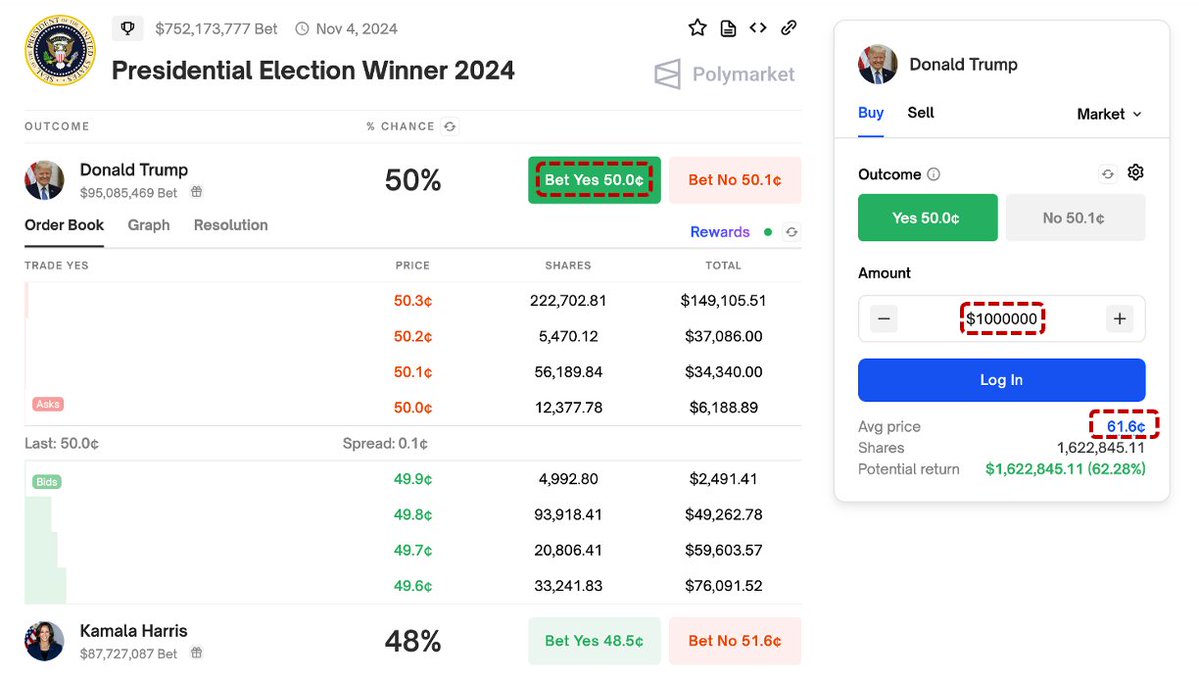
These issues could be resolved with better liquidity and the use of prediction tokens. With greater liquidity, I could place a $1 million bet when Trump’s odds are at 50% and exit at 55% without slippage, securing a 10% return. When a $1 million trade moves the market by less than 5%, the market becomes efficient for shifts under 5%.
Alternatively, leveraging prediction tokens could significantly boost Polymarket’s efficiency. I consider a 10% return on such a trade to be low: you must be right in your prediction while also bearing roughly 10% platform risk inherent to emerging crypto platforms. If you estimate an 80% chance of being correct and lose 5% if wrong, your expected return is only about 7%—which should qualify as a strong edge over market consensus. Yet even that remains too low.
Using Polymarket’s leverage, I can trade with 4x leverage, while keeping enough funds to cover 5% interest costs on lending platforms. This offers a much more appropriate capital return for researchers who invest time and effort into finding good trades and assume real risk.
In traditional markets, analysts discuss 20-basis-point interest rate changes because sufficient liquidity and leverage allow high returns from correctly predicting small moves. Polymarket can meaningfully discuss election probability shifts of around 20%, or even 10%, but it cannot reliably predict changes below the 5% threshold.
Critics argue that Polymarket is already large enough for the wisdom of crowds to function. The idea is that tens of thousands of small traders—including thousands from swing states—are constantly placing small bets on elections using the latest information. These traders may have biases and incomplete information, but their biases stem from diverse sources that cancel out, while the market aggregates many distinct information streams.
The flaw in this argument is that Polymarket has only about 4,000 daily active traders betting on the U.S. election, most of whom are concentrated in New York City and California and disproportionately follow the same Twitter accounts. Of these 4,000 traders, I estimate half aren’t conducting deep research per trade but are instead farming airdrops—trading merely to earn Polymarket tokens, as Polymarket may reward active traders with token airdrops. Furthermore, there’s a centralization problem: just 20 traders account for 95% of Polymarket’s trading volume.
Polymarket is an outstanding company and information source. I believe it outperforms polls, expert models, and many analytical articles in forecasting major political events. Polymarket has demonstrated the ability to anticipate big moves before mainstream media coverage. But that doesn’t mean Polymarket is a precise predictive tool.
Join TechFlow official community to stay tuned
Telegram:https://t.me/TechFlowDaily
X (Twitter):https://x.com/TechFlowPost
X (Twitter) EN:https://x.com/BlockFlow_News
 @TheiaResearch