Three Crypto VCs on Industry Cycles, Challenges, and Narratives: The Bull Market Is Still On — We’re on the Eve of a Mass Adoption Breakout
TechFlow Selected TechFlow Selected
Three Crypto VCs on Industry Cycles, Challenges, and Narratives: The Bull Market Is Still On — We’re on the Eve of a Mass Adoption Breakout
Under the backdrop of skyrocketing chaos levels, how can we perceive cyclicity more clearly?
 Navigating Web3 tides with focused insights
Editor: Wu Shuo Blockchain
Summary: Cycles and narratives have always been central themes in the global crypto market. In the past, the industry largely relied on Bitcoin halving events to gauge cycles and identify major narrative trends. However, with the approval of Bitcoin and Ethereum spot ETFs, the crypto market has become increasingly correlated with global financial markets, and the variables influencing its trajectory are multiplying.
Against a backdrop of rising volatility, clearly identifying cyclical patterns and uncovering future narrative trends is more critical than ever. Investment firms, as early detectors of innovative narratives, often possess a forward-looking perspective. With this in mind, OKX has specially launched the column "The Evolution of Crypto," inviting leading global crypto investment institutions to systematically share insights on current market cycles, emerging narratives, and key verticals—aiming to spark discussion and inspire new thinking.
Below is the first installment, featuring joint contributions from OKX Ventures, Hashed, and Animoca Digital Research on topics such as "challenges and opportunities in the current cycle." We hope their insights prove valuable. Note that the views expressed do not necessarily reflect those of Wu Shuo, and readers should strictly comply with local laws and regulations.
I. Cycle and Market Structure
1. What stage of the cycle is the current market in? How has the market structure changed compared to previous cycles?
OKX Ventures: We believe the industry cycle can be understood through three lenses:
First, the degree to which crypto is entering the mainstream. The crypto market continues to grow, maintaining a scale of around $2 trillion. Bitcoin and Ethereum ETFs have entered the trading scope of global financial markets, with Bitcoin ETF assets surpassing $60 billion. The rise of RWA (real-world assets), including government bond-related assets exceeding $1.8 billion, signals increasing integration between traditional finance and crypto.
Second, improvements in the startup ecosystem. Venture capital inflows are on the rise—Q2 2024 saw over $3 billion in total funding, a 28% quarter-on-quarter increase—indicating greater activity among investment institutions. Additionally, a steady influx of high-caliber founders, many with top-tier industry experience or elite academic backgrounds, continues to bring fresh momentum to the sector.
Third, mass user adoption. Infrastructure improvements across Ethereum, Layer2s, and high-performance public chains have created a more developer-friendly environment with abundant block space. User-facing applications in gaming, social platforms, and the Telegram ecosystem are enabling users to enter the crypto world seamlessly. Meanwhile, AI applications, intents, and account abstraction are lowering learning barriers. We stand at the cusp of a broad application breakout, and remain long-term optimistic.
Hashed: Crypto market cycles are influenced by macroeconomic conditions, policy shifts, and technological progress. What distinguishes this cycle is the active entry of institutional players, indicating that the industry is now operating within regulatory frameworks. As a result, the extreme volatility seen in prior cycles is unlikely to recur.
In this cycle, retail investors have not contributed significant new capital. However, the approval of Bitcoin ETFs has sparked renewed institutional interest, giving the market an upward appearance. Yet beyond a few top-tier assets like ETH, SOL, and TON, many other large-cap tokens are struggling. The legitimacy of individual tokens—especially application tokens—is facing unprecedented scrutiny.
Tokens not on institutional shortlists face serious challenges, explaining why many altcoins have failed to achieve the multi-bagger returns of previous cycles. Continued issuance of tokens lacking fundamentals or sound valuation logic remains a barrier to new capital inflows, as such tokens are viewed negatively by retail investors—particularly when issues like low float and high FDV arise.
Moreover, one key reason for constrained capital inflow lies in macro-level attention and asset allocation. Retail investors exert greater influence on public markets than expected. While they flooded into crypto from late 2020 to early 2022, they are now shifting en masse toward generative AI. Despite most AI startups not yet generating significant profits, they continue to raise large sums and command unproven valuations. This trend mirrors the price dynamics of major tokens from 2020 to 2022. From the perspective of attention economics, this helps explain why this crypto cycle hasn’t generated the same level of impact as before.
Animoca Digital Research: We believe the cryptocurrency market remained in a bull cycle as of August 2024. Although global financial markets have experienced recent volatility, the medium-term outlook remains positive. Compared to previous cycles, this one has not yet peaked. A recent ~30% correction falls well within historical norms and aligns with typical bull market adjustments.
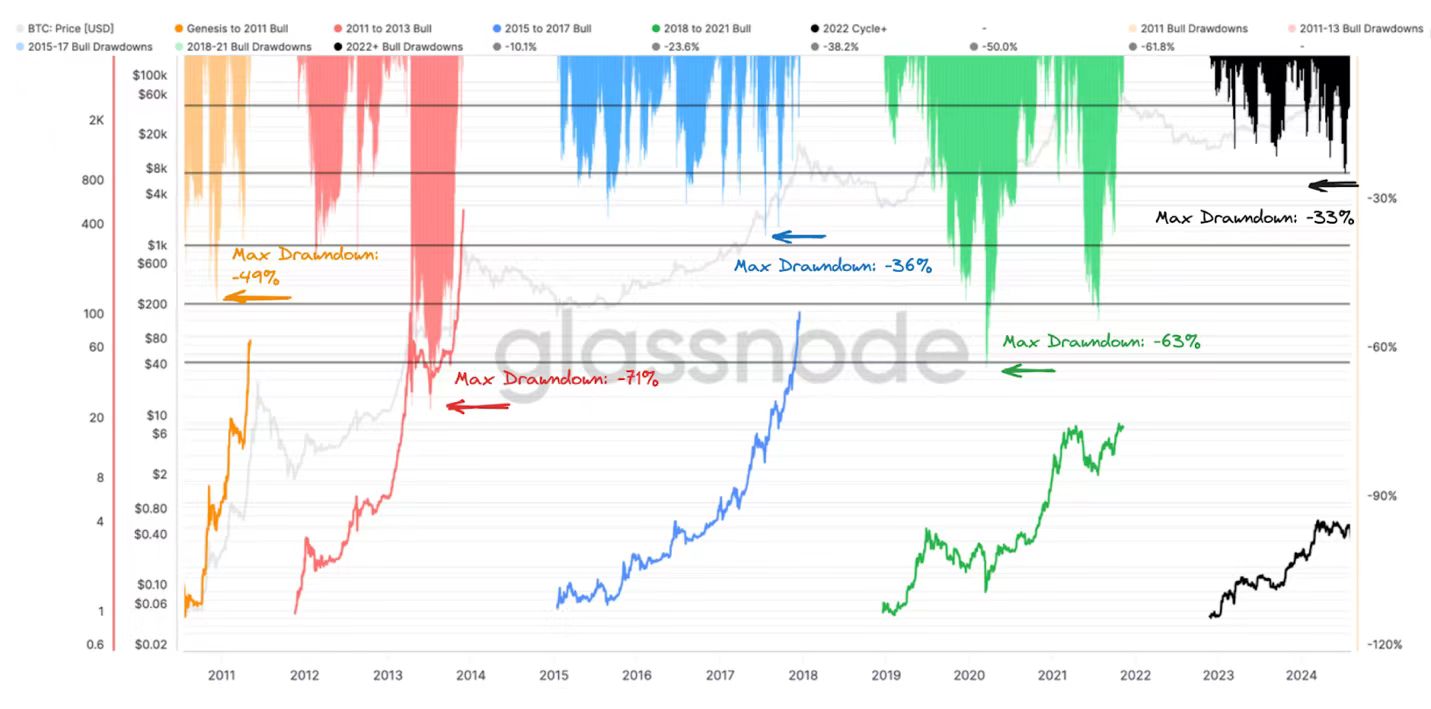
Despite recent fluctuations in TradFi markets, we observe several positive mid-term drivers for crypto:
a. German government sell-off: Large-scale forced sales in July liquidated leveraged long positions, leaving only strong spot holders. A new round of liquidations in August further cleared out leveraged positions.
b. ETF buying: Most crypto purchases come via BTC and ETH ETFs, showing that:
-
TradFi buyers understand asset volatility and are less sensitive to market swings. During recent volatility, trading volumes for both ETFs rose only slightly and remain far below historical highs.
-
TradFi buyers are price-sensitive; their purchase decisions depend heavily on price levels.
c. FTX liquidation: By year-end, FTX’s bankruptcy proceedings will release $10 billion into the market. While timing remains uncertain, this will have a positive market impact.
d. Fed rate cuts: Rising unemployment and cooling inflation increase the likelihood of rate cuts in September. Key indicators include U.S. Q2 GDP growth of 2.8%, unemployment rising to 4.3%, and inflation stabilizing between 3.1% and 3.5%.
2. Given the global context, what core issues must the crypto industry address?
OKX Ventures: Against the current macro backdrop, we see two core issues requiring attention:
First, the sustainability of technological innovation. While infrastructure has advanced significantly, enhancing network security while improving transaction efficiency and reducing costs remains a critical challenge. This requires not only continuous technical iteration but also close collaboration and co-innovation across the industry.
Second, education and cultural integration cannot be overlooked. Despite rapid expansion of the crypto user base, public understanding of the technology and its applications remains limited. Enhancing public crypto literacy is essential to help more ordinary users understand and participate in the ecosystem, thereby supporting healthy industry development.
Hashed: In the current environment, we believe the crypto industry must focus on solving two core problems.
First, blockchain should decentralize increasingly centralized technologies such as closed-source AI. This isn't just about AI—it's about the broader societal issue of excessive power concentrated in a few entities. Blockchain emerged from dissatisfaction with centralized governments, censorship, and financial control, driven by a desire for free value exchange and storage. These concerns are resurfacing, now extending to corporate and governmental centralization and censorship. AI—especially AGI—is a technology with profound potential and impact on human history. Due to its nature, it's treated as a national security concern, leading to higher barriers. If AI development is concentrated in a few centralized firms, large-scale surveillance risks emerge. If AI is inherently centralized, then addressing these issues in line with blockchain’s ethos—which stands in stark contrast—is a real problem the industry should strive to solve.
Second, crypto’s incentive mechanisms need evolution. Tokens, as tools for incentives and ownership, have yet to fulfill their potential. Poorly engineered token dynamics and imprecise price discovery prevent tokens from being effectively used to align incentives. Until this fundamental issue is resolved, the growth of token-based decentralized networks will face major constraints.
While various mechanisms have been designed and many protocols have experimented with incentive alignment, efficient and capital-effective incentive distribution and alignment have not yet been achieved. It’s no surprise, then, that more projects haven’t replaced traditional companies with tokens. We look forward to solutions that tackle these long-standing industry challenges. We support participants who understand the economic value of blockchain protocols and aim to replace traditional corporate structures with broader decentralized protocols.
Animoca Digital Research: Expanding use cases and user acquisition remain core industry challenges. This includes direct user onboarding—such as converting gamers into Web3 users or turning TON’s regular chat users into on-chain payment users—as well as enterprise-level applications, like penetrating traditional finance via RWA. These are all areas the industry must continue advancing. Many existing projects, especially infrastructure-focused ones, carry high valuations based on expectations of massive future usage. Only sustained growth in real users and actual usage can justify these valuations and transform tokens from speculative instruments in users’ hands into genuine mediums of exchange supporting decentralized collaborative networks—thereby realizing project value.
II. Future Challenges and Opportunities
Challenges:
OKX Ventures: One major challenge today is that despite significant investment in infrastructure, there are still few applications delivering tangible results and attracting large numbers of real users. Many infrastructures, while technically advanced, have not significantly improved end-user adoption or practical utility. Moreover, blockchain infrastructure faces the challenge of serving end users effectively—not merely serving as technical showcases. For example, despite promising technologies like FHE (fully homomorphic encryption) and ZK (zero-knowledge proofs), widespread adoption faces numerous hurdles. We must find a more effective balance between technology promotion and application development.
In practical terms, while DeFi (decentralized finance) has matured and expanded in scale over the past few years, it still lacks truly innovative products that meet specific needs. Many DeFi projects are exploring multi-chain operations, enhanced decentralization, integration of real-world assets, and derivatives. However, achieving perfect integration of liquidity and functionality across broader use cases requires ongoing effort and innovation.
Hashed: We see two core challenges for the crypto industry: regulatory scrutiny and infrastructure scalability.
First, regulatory uncertainty remains a major obstacle. While crypto technology is global, becoming a legitimate asset class requires compliance with regulations in major economies such as the U.S., China, South Korea, and Singapore. Regulatory differences are wide and evolving rapidly, increasing compliance complexity.
To address this, Hashed actively engages with regulators worldwide to promote clear, fair, and consistent regulatory frameworks. In 2022, Hashed launched Hashed Open Research (HOR) and Hashed Open Dialogue for Law (HODL) initiatives to foster dialogue between the blockchain community and governments, help our portfolio companies understand best regulatory practices, and collaborate with academia and industry experts to advance company development.
Second, infrastructure scalability is another major challenge. Bitcoin and Ethereum suffer from low efficiency, high fees, and slow processing under heavy transaction loads. While the Ethereum Foundation has improved mainnet scalability through upgrades, developing Layer 2 protocols and non-EVM L1 chains remains crucial. Hashed has invested in Layer 2 projects Taiko and zkSync, supports Solana’s efforts to boost throughput and reduce costs, and has backed ecosystem projects like Backpack. Hashed will continue identifying and investing in projects that drive growth and scalability in the crypto industry.
Animoca Digital Research: In our view, a key industry challenge is sustaining retail investor engagement in new projects. This year, after TGEs, fully diluted valuations (FDV) have dropped sharply, and controversies around token airdrop transparency have further dampened retail interest. Yet retail investors are vital sources of market liquidity, and their disengagement poses a threat to the healthy development of the crypto ecosystem.
To address this, VCs and exchanges should take proactive steps—such as jointly improving price discovery mechanisms. This could involve developing more sophisticated valuation models and introducing transparent, data-driven pricing processes. By enhancing the accuracy and reliability of project valuations, markets can build greater trust and confidence among users. Project teams should also focus on aligning project and community interests, establishing mechanisms for communities to better participate in network effects and share in network value.
Opportunities:
OKX Ventures: A major opportunity in this new cycle is leveraging crypto innovation to onboard Web2 users into Web3 and retain them effectively. Additionally, the convergence of AI and Web3 represents a significant frontier, particularly in improving transaction efficiency, enabling personalized user services, and building new products. For example, using AI to analyze and predict market trends, or employing AI-enhanced smart contracts to automate financial services.
Building on the challenges discussed earlier and the opportunities in this new cycle, OKX Ventures’ overall strategy is to optimize resource allocation and strengthen the rigor of project evaluation and investment decisions, ensuring capital flows to projects capable of driving real technological breakthroughs and user growth. We also seek innovative projects that bridge existing technologies with market demand—such as Web3 applications that effectively incorporate the strengths of Web2—to propel industry-wide advancement.
Additionally, we will maintain collaboration and communication with other industry participants, continuously refining our investment strategies to support industry development in this new cycle. For investment firms, staying at the forefront of innovation requires not only courage and vision, but also meticulous strategic planning and execution. We remain optimistic about industry development in this new cycle.
Hashed: We see two particularly meaningful opportunities over the next five years: tokenization of real-world assets (RWA) and crypto-enabled innovation from zero to one.
First, RWA tokenization can unlock accessibility and capital efficiency for illiquid assets—such as real estate, commodities, art, and even intellectual property. Tokenized assets enable fractional ownership, enhance liquidity, and democratize access to hard or intangible assets previously available only to select individuals or institutions. To advance this field, we seek teams with expertise in traditional assets and a commitment to tokenizing them. For example, Story Protocol offers open-source infrastructure that tokenizes IP, making it programmable in terms of origin, attribution, and monetization.
The second opportunity lies in supporting entrepreneurs who leverage blockchain to achieve “zero-to-one” innovation—redefining existing paradigms and creating entirely new markets. One area with potential is payments. Mobile and blockchain-powered payment systems could enable open finance and provide financial services to the unbanked. After all, blockchain enables fast settlement and low transaction costs, yet no clear winner has emerged in payments.
Another area is capital efficiency within the Bitcoin network. Despite Bitcoin’s $1 trillion market cap, less than 0.1% of its value is captured on-chain. There is immense opportunity in helping users generate yield and implement on-chain strategies. Ethena is a recent example: it tokenizes funding rates to create a “synthetic dollar” tool—the first native crypto internet bond. Ethena captures funding payments from CEX traders, tokenizes them into a neutral on-chain instrument, and enables cross-chain DeFi usage across DEXs, collateral lending markets, and derivatives trading.
Animoca Digital Research: In our view, Web3’s primary goal at this stage remains attracting and retaining users migrating from Web2 by delivering real value. We highlight three key directions:
First, the TON ecosystem. TON on Telegram and its Mini Apps framework offer seamless infrastructure for integrating Web3 functionality into everyday use. With over 900 million monthly active users and proven success in mini-apps and payments, TON has the potential to create a breakthrough application—akin to WeChat Pay’s “red envelope moment”—rapidly onboarding and retaining millions of users. Additionally, TONcoin’s integration into Telegram opens opportunities to improve advertising channels and user value-sharing mechanisms.
Second, GameFi. Animoca Brands’ Mocaverse has built a network of 700 million users and provides multiple powerful platforms. Projects that effectively integrate and leverage the Mocaverse ecosystem have strong potential for accelerated growth and increased digital asset value, making them more attractive investment targets.
Third, consumer hardware such as smartphones and smartwatches. These devices can come pre-installed with Web3 apps, simplifying user onboarding, and include airdrop mechanisms to incentivize new users. This is especially important in emerging markets with underdeveloped infrastructure, where Web3 can help nations transition into digital economies independent of traditional institutions.
III. Narratives Being Watched by OKX Ventures, Hashed, and Animoca Digital Research
OKX Ventures: OKX Ventures continues to broadly invest across AI, GameFi, DeFi, Web3, NFTs and Metaverse, and blockchain infrastructure, currently covering over 300 projects. Our investment decisions are guided by current market needs and future expectations, with key focus areas including infrastructure development, DeFi product innovation, and bridging the gap between Web2 users and the Web3 world.
From our portfolio, while infrastructure and DeFi remain core, we’ve also observed the rise of Web3 and gamified applications—reflecting a shift in the crypto market from purely financial tools to platforms offering richer user experiences. As technology matures and markets evolve, the crypto industry may further integrate into everyday life scenarios.
In the coming cycle, OKX Ventures believes that funding innovation in these key areas will drive continued industry progress and accelerate the maturity and widespread adoption of the crypto ecosystem. Our goal is to lead technological and business model innovation, delivering richer and more diverse Web3 experiences to users.
On infrastructure: We will continue allocating significant capital to high-performance, cost-efficient technical solutions. This includes parallel-processing technologies like MegaETH and Monad, purpose-built public chains (e.g., AI-specific chains), and privacy-enhancing technologies such as FHE (fully homomorphic encryption) and ZK (zero-knowledge proofs). These efficient infrastructures not only drive user growth but can also generate revenue, contributing to sustainable industry development.
On innovative DeFi: Given DeFi’s mature market and user base, our focus is on multi-chain interoperability, greater decentralization, integration of RWA, and development of complex financial derivatives.
On mass Web2 onboarding: In driving Web2-to-Web3 migration, we pay special attention to opportunities involving integration with high-traffic platforms. For instance, leveraging AI platforms like ChatGPT or harnessing social media power via Telegram allows Web3 projects to reach hundreds of millions of users unfamiliar with crypto—a massive growth opportunity for the entire industry.
Hashed: Our core narratives haven’t changed—what’s different is that the industry is maturing, allowing us to assess the real-world impact of these applications and infrastructures. We focus on applications and infrastructures that drive positive, meaningful behavioral and lifestyle changes, while cultivating a thriving ecosystem of genuine builders, users, and producers.
For example, our investment Axie Infinity pioneered a new business model, attracting a large player base across Southeast Asia and the Asia-Pacific region and providing them with substantial income. Through infrastructure like Katana DEX and Ronin Bridge, the Ronin ecosystem now boasts over 1.5 million daily active users and 3.8 million monthly active users, supporting high-quality games like Pixels and Apeiron.
Amid growing RWA adoption and mass migration from Web2 to Web3, we incubated Modhaus, a blockchain-powered entertainment studio managing the next-gen K-pop girl group TripleS, with plans to launch additional sub-units. Previously, fans could only passively engage through concerts, shows, or merchandise, with little say in governance. Modhaus uses blockchain, on-chain governance, and DAOs to change this. Fans vote using purchased photo cards (Objekts) to determine TripleS’s debut single—each vote called a Como—all activities transparently recorded on-chain.
Additionally, our investment Story Protocol has pioneered and commercialized programmable intellectual property (IP), drawing attention from media, entertainment, and blockchain builders. The Hollywood writers’ strike and disparities in Asian animation industries show that IP giants capture most derivative revenues without offering creators and stakeholders transparent, clear monetization paths. To address this centralization, Story Protocol’s IP graph enables any stakeholder—including original creators—to easily track, verify, and manage IP and derivative flows. Its three core modules—on-chain IP registration, licensing, and royalty management—are currently on testnet, inspiring media and entertainment stakeholders to explore blockchain solutions to opaque centralized systems, resulting in exponential user and builder growth ahead of mainnet launch.
Animoca Digital Research: The Web3 ecosystem has evolved from isolated silos to modular components and is now forming collaborative networks. This allows projects to focus on core value while leveraging capabilities from others—an essential expansion path. Coprocessors and intent-centric design are two innovations significantly enhancing Web3’s scalability and mass development potential, warranting close attention.
On Coprocessors
Coprocessors offload intensive on-chain queries and transactions to off-chain processing, returning results to smart contracts in a trustless manner. They provide a powerful framework for scalable, secure, and auditable management of digital asset states while preserving trustlessness, thus enhancing security in ownership, transfers, and other critical activities.
In GameFi, applications often require handling complex game mechanics, player interactions, and economic transactions. For example, an on-chain puzzle game might force users into tedious signing or verification steps at every move. With coprocessors, computation-heavy game logic moves off-chain, allowing the main chain to handle only final state confirmation. These innovations enable more complex gameplay and in-game economies—such as fully on-chain loyalty programs.
On Intent-Centric Design
Intent-centric design prioritizes user outcomes over process complexity, aiming to deliver desired results without burdening users with technical details.
In GameFi, this lowers the barrier for mainstream users to access and utilize Web3. Users can join Web3 games directly, without downloading wallets or managing gas fees; their digital identities and assets can seamlessly transfer across games; rewards can be used directly to pay for other services, eliminating conversion or transfer steps.
Join TechFlow official community to stay tuned
Telegram:https://t.me/TechFlowDaily
X (Twitter):https://x.com/TechFlowPost
X (Twitter) EN:https://x.com/BlockFlow_News
 吴说区块链
吴说区块链