How Sling, backed by USV with tens of millions in funding, profits from stablecoin cross-border transfers?
TechFlow Selected TechFlow Selected
How Sling, backed by USV with tens of millions in funding, profits from stablecoin cross-border transfers?
Sling focuses on cross-border money transfers, aiming to send low-cost remittances to nearly anyone in the world via Solana.
 Navigating Web3 tides with focused insights
By 1912212.eth, Foresight News
As the crypto market remains sluggish and depressed over an extended period, growing skepticism has emerged regarding the excessive focus on infrastructure development. While protocol-layer projects are abundant, genuinely impactful applications that solve real problems remain scarce. Perhaps stablecoins are one such underappreciated application.
Within various crypto narratives, stablecoins often appear somewhat dull—devoid of price volatility, offering no path to sudden wealth, and only drawing attention during black swan events when depegging fears spark panic and debate.
Yet stablecoins serve as a bridge between the traditional financial world and the crypto ecosystem. They enable the seamless flow of capital, making mutual benefit possible. For the crypto space, the growth of stablecoins also reflects the rapid expansion of the market itself.
Recently, Sling Money, a stablecoin payment platform, secured $15 million in Series A funding led by Union Square Ventures, with participation from Ribbit Capital and Slow Ventures. In a generally bearish market climate, what makes Sling stand out?
Focusing on Cross-Border Transfers
Sling specializes in cross-border money transfers, aiming to send payments instantly to nearly anyone worldwide at minimal cost—without relying on traditional banking infrastructure. Initially, it primarily used USDC on Solana as its transfer medium, but later switched to USDP for operational and cost efficiency. USDP is a regulated digital dollar issued by Paxos Trust Company in the United States and overseen by the New York State Department of Financial Services. Notably, the team has indicated that in certain future scenarios, users holding USDP may earn yield.
The Sling wallet is self-custodial, meaning users retain full ownership of their funds and private keys.
Sling has launched both iOS and Android apps. Users simply search for the recipient's name, enter the amount, and the system automatically converts it into the local currency—allowing recipients anywhere in the world to receive funds within seconds.
Currently, transfers on Sling are free, though the company plans to introduce fees in the future—the details of which will be disclosed later.
Mastering the Flow
After downloading and registering on the app, senders must first link their debit card to the platform before initiating transfers via search function.
If the recipient cannot be found through search, users can still send a Sling link via messaging apps, airdrops, or QR codes. Recipients can then claim the funds into their own Sling wallet.
At present, Sling supports over 50 countries and regions, primarily across Europe and Africa.
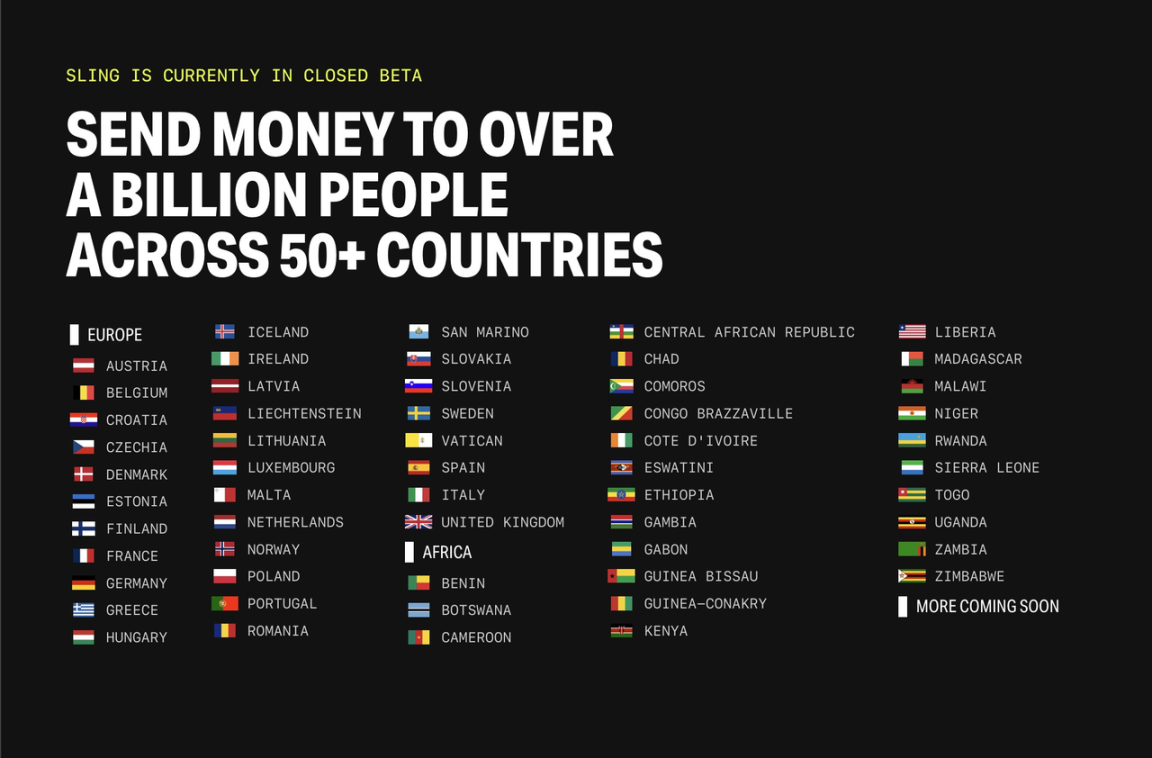
Sling plans to expand to more countries and regions in the future, increasing transaction frequency through debit card integrations and Solana Pay. Although major exchanges and some crypto wallets have already gained global traction on app platforms, differing national regulations and compliance requirements continue to act as constraints—leading to high costs and delays in cross-border payments. How Sling navigates this landscape going forward will be worth watching.
Join TechFlow official community to stay tuned
Telegram:https://t.me/TechFlowDaily
X (Twitter):https://x.com/TechFlowPost
X (Twitter) EN:https://x.com/BlockFlow_News
 Foresight News