BTC Ecosystem Pre-Launch Projects You Must Know for the Bull Market in the Second Half of the Year
TechFlow Selected TechFlow Selected
BTC Ecosystem Pre-Launch Projects You Must Know for the Bull Market in the Second Half of the Year
Exploring potential token issuance projects in the Bitcoin ecosystem to help everyone seize new opportunities in the bull market.
 Navigating Web3 tides with focused insights
Author: Viee, Core Contributor at Biteye
Editor: Crush, Core Contributor at Biteye
With the Federal Reserve increasingly likely to begin rate cuts in September, market liquidity is expected to improve significantly, driving a continuous influx of capital into the Bitcoin market. This surge of funds is poised to push Bitcoin's price higher, attracting even greater investor attention.
As Bitcoin’s price rises, it triggers a "rising tide lifts all boats" effect—investors become increasingly interested in various projects and applications within the Bitcoin ecosystem. This virtuous cycle of improved liquidity and rising prices will lay a solid foundation for the prosperity of the Bitcoin ecosystem.
Looking back at the period preceding last year’s bull run, the surge in popularity of Ordinals and the wealth effect generated by inscriptions redirected significant market attention toward the Bitcoin ecosystem. As the market gradually recovers, this article explores potential tokenized projects within the Bitcoin ecosystem, helping readers seize new opportunities in the upcoming bull market.
01 Project Overview
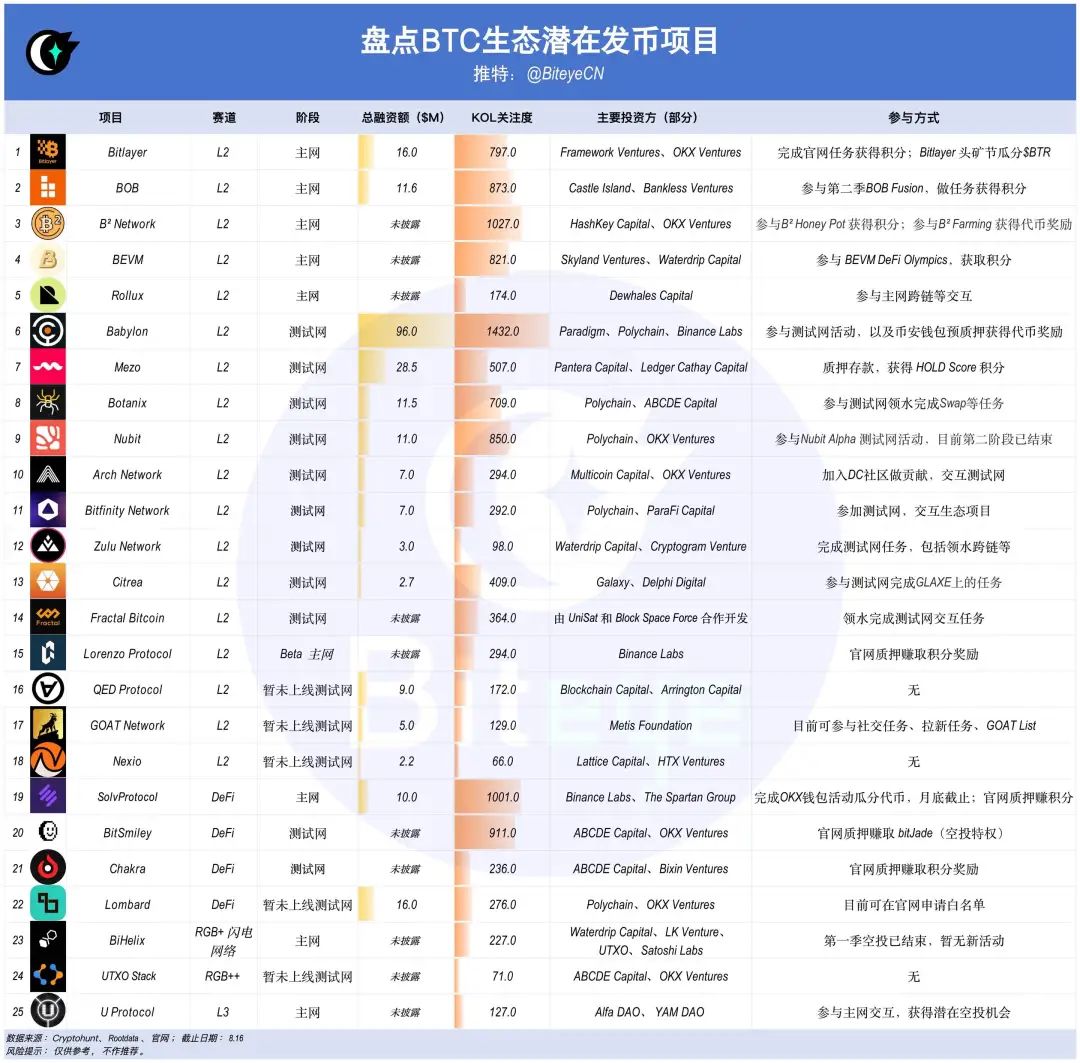
L2 Mainnets
1. Bitlayer: $16 million total funding from Framework Ventures, OKX Ventures, and others.
The first Bitcoin security-equivalent Layer 2 network based on BitVM, aiming to become Bitcoin’s computational layer. It introduces ultra-scalability while inheriting Bitcoin’s L1 security, offering users high throughput and low-cost transactions.
2. BOB (Build on Bitcoin): $11.6 million total funding from Castle Island, Bankless Ventures, and others.
A hybrid Layer 2 combining Bitcoin’s security with Ethereum’s smart contract flexibility, supporting Bitcoin ecosystem components such as Ordinals, Lightning, and Nostr.
3. B² Network: Funding undisclosed, backed by HashKey Capital, OKX Ventures, and others.
A zero-knowledge proof-based Bitcoin Layer 2 solution designed to enhance transaction speed and application diversity while ensuring security and supporting Turing-complete smart contracts.
4. BEVM: Funding undisclosed, backed by Skyland Ventures, Waterdrip Capital, and others.
A fully decentralized Bitcoin Layer 2 compatible with the Ethereum Virtual Machine (EVM), aiming to expand Bitcoin’s smart contract capabilities and use native BTC as gas.
5. Rollux: Funding undisclosed, backed by Dewhales Capital and others.
An EVM-compatible Optimistic Rollup platform built on Bitcoin, enhancing scalability and smart contract functionality, providing developers with a secure, low-cost environment for dApps.
L2 Testnets
1. Babylon: $96 million total funding from Paradigm, Polychain, Binance Labs, and others.
A Bitcoin staking protocol enabling users to lock BTC on the Bitcoin network to provide security for other PoS chains while earning staking rewards.
2. Mezo: $28.5 million total funding from Pantera Capital, Ledger Cathay Capital, and others.
An EVM-compatible economic layer for Bitcoin, aiming to drive a circular Bitcoin economy through applications that promote token usage, moving beyond Bitcoin’s role as just a “store of value.”
3. Botanix: $11.5 million total funding from Polychain, ABCDE Capital, and others.
A decentralized, Turing-complete L2 EVM built on Bitcoin, composed of the Ethereum Virtual Machine (EVM) and Spiderchain, combining Bitcoin’s security with EVM usability.
4. Nubit: $11 million total funding from Polychain, OKX Ventures, and others.
The first Data Availability (DA) layer for Bitcoin, designed to expand Bitcoin’s data capacity and support applications like Ordinals, Layer 2 solutions, and oracles, thereby broadening and improving the efficiency of the Bitcoin ecosystem.
5. Arch Network: $7 million total funding from Multicoin Capital, OKX Ventures, and others.
A Bitcoin Layer 2 utilizing a Rust-based zero-knowledge virtual machine (ArchVM) and a decentralized validator network, offering developers an efficient and scalable application environment.
6. Bitfinity Network: $7 million total funding from Polychain, ParaFi Capital, and others.
An EVM-compatible Bitcoin Layer 2 using Solidity and leveraging IC’s unique architecture and Chain Key technology, achieving performance comparable to traditional web services without requiring gas fees.
7. Zulu Network: $3 million total funding from Waterdrip Capital, Cryptogram Venture, and others.
A Bitcoin Layer 2 featuring a unique two-layer architecture. ZuluPrime (L2) enables EVM compatibility, while ZuluNexus (L3) acts as a third layer for Bitcoin, offering enhanced security guarantees.
8. Citrea: $2.7 million total funding from Galaxy, Delphi Digital, and others.
The first zero-knowledge proof-based Layer 2 in the Bitcoin ecosystem, utilizing a bidirectional peg architecture to deliver the first-ever general-purpose, trust-minimized Bitcoin L2 solution, expanding Bitcoin’s programmability and use cases.
9. Fractal Bitcoin: Funding undisclosed, co-developed by UniSat and Block Space Force.
A Layer 2 scaling solution based on Bitcoin’s core code, aiming to enhance transaction processing speed and capacity through recursive creation of infinite layers while maintaining full compatibility with the Bitcoin main chain.
L2 Pre-Testnets
1. Lorenzo Protocol: Funding undisclosed, backed by Binance Labs and others.
A decentralized liquid staking platform based on Babylon, aiming to offer users secure and convenient Bitcoin staking services. The protocol enables users to stake BTC and receive liquid staking tokens via its liquidity finance layer.
2. QED Protocol: $9 million total funding from Blockchain Capital, Arrington Capital, and others.
A zk-native execution layer on Bitcoin, focusing on zero-knowledge proof verification. Leveraging the Taproot upgrade, it supports widespread applications like decentralized exchanges and DeFi on Bitcoin, promising high-speed transactions and global state access.
3. GOAT Network: $5 million total funding from Metis Foundation and others.
The first Bitcoin Layer 2 solution featuring decentralized sequencer ownership and shared mining rewards, introducing unique OP technology to scale the Bitcoin network via Bitcoin rollups.
4. Nexio: $2.2 million total funding from Lattice Capital, HTX Ventures, and others.
An innovative Bitcoin scaling solution using parallelized rollup technology, aiming to support over 30,000 transactions per second while keeping fees under $0.01.
DeFi Mainnets
SolvProtocol: $10 million total funding from Binance Labs, The Spartan Group, and others.
A cross-chain base yield protocol offering denomination-in-BTC yield generation. Users can deposit BTC into SolvProtocol to receive Solvbtc.
DeFi Testnets
1. BitSmiley: Funding undisclosed, backed by ABCDE Capital, OKX Ventures, and others.
A stablecoin lending protocol built on the Bitcoin ecosystem, integrating over-collateralized stablecoins, trustless loans, and derivatives protocols to address the lack of stablecoin and lending infrastructure in the Bitcoin ecosystem.
2. Chakra: Funding undisclosed, backed by ABCDE Capital, Bixin Ventures, and others.
A zero-knowledge proof-powered Bitcoin restaking protocol using ZK-STARKs and middleware chains to eliminate trust issues with intermediaries. It has partnered with DA layer Nubit to modularly enhance the Bitcoin ecosystem.
DeFi Pre-Testnets
Lombard: $16 million total funding from Polychain, OKX Ventures, and others.
A Bitcoin restaking protocol enabling users to generate yield across chains without fragmenting liquidity, advancing the development of the Bitcoin staking ecosystem.
RGB+ Lightning Network Mainnets
BiHelix: Funding undisclosed, backed by Waterdrip Capital, LK Venture, UTXO, Satoshi Labs, and others.
A Bitcoin ecosystem infrastructure built on Bitcoin’s native blockchain, optimizing nodes using RGB protocol and the Lightning Network. The project aims to lower development barriers and expand Bitcoin’s use cases.
RGB++ Pre-Testnets
UTXO Stack: Funding undisclosed, backed by ABCDE Capital, OKX Ventures, and others.
A Bitcoin Layer 2 issuance platform based on the UTXO model, natively integrating RGB++ protocol capabilities to help developers rapidly deploy UTXO-based applications.
L3 Mainnets
U Protocol: Funding undisclosed, backed by Alfa DAO, YAM DAO, and others.
The first modular BitcoinFi Layer 3 infrastructure, offering features like uBTC and U Bitcoin Thunder Network, aiming to enhance Bitcoin’s liquidity and utility.
02 Summary
From a broader perspective, Bitcoin’s (BTC) value proposition has evolved over more than a decade, and its role as a store of value is now widely recognized.
Regulatory developments, ETF approvals, and macroeconomic factors like interest rate cuts have significantly influenced its market performance, indicating Bitcoin’s growing integration into traditional institutional portfolios.
As Bitcoin’s store-of-value narrative gains broader societal acceptance, the ecosystem of derivative financial products and innovations around it will continue to expand.
Despite potential scalability challenges with Layer 2 solutions and inherent difficulties stemming from the UTXO model, the Bitcoin sector will inevitably continue to mature and evolve—both a technological and societal imperative.
Join TechFlow official community to stay tuned
Telegram:https://t.me/TechFlowDaily
X (Twitter):https://x.com/TechFlowPost
X (Twitter) EN:https://x.com/BlockFlow_News
 @BiteyeCN