Ethereum great again? Unveiling EVM chain token launches in the second half of the year
TechFlow Selected TechFlow Selected
Ethereum great again? Unveiling EVM chain token launches in the second half of the year
This article will review some EVM public blockchains expected to launch tokens in the second half of the year.
 Navigating Web3 tides with focused insights
Author: Viee, Core Contributor at Biteye
Editor: Crush, Core Contributor at Biteye
Ethereum, as a pioneer in the blockchain industry, has experienced multiple fluctuations and challenges in recent years. However, with a growing number of projects launching, the EVM public chain ecosystem is regaining new vitality.
This article reviews several EVM-compatible public chains expected to issue tokens in the second half of the year.
01 Project Overview
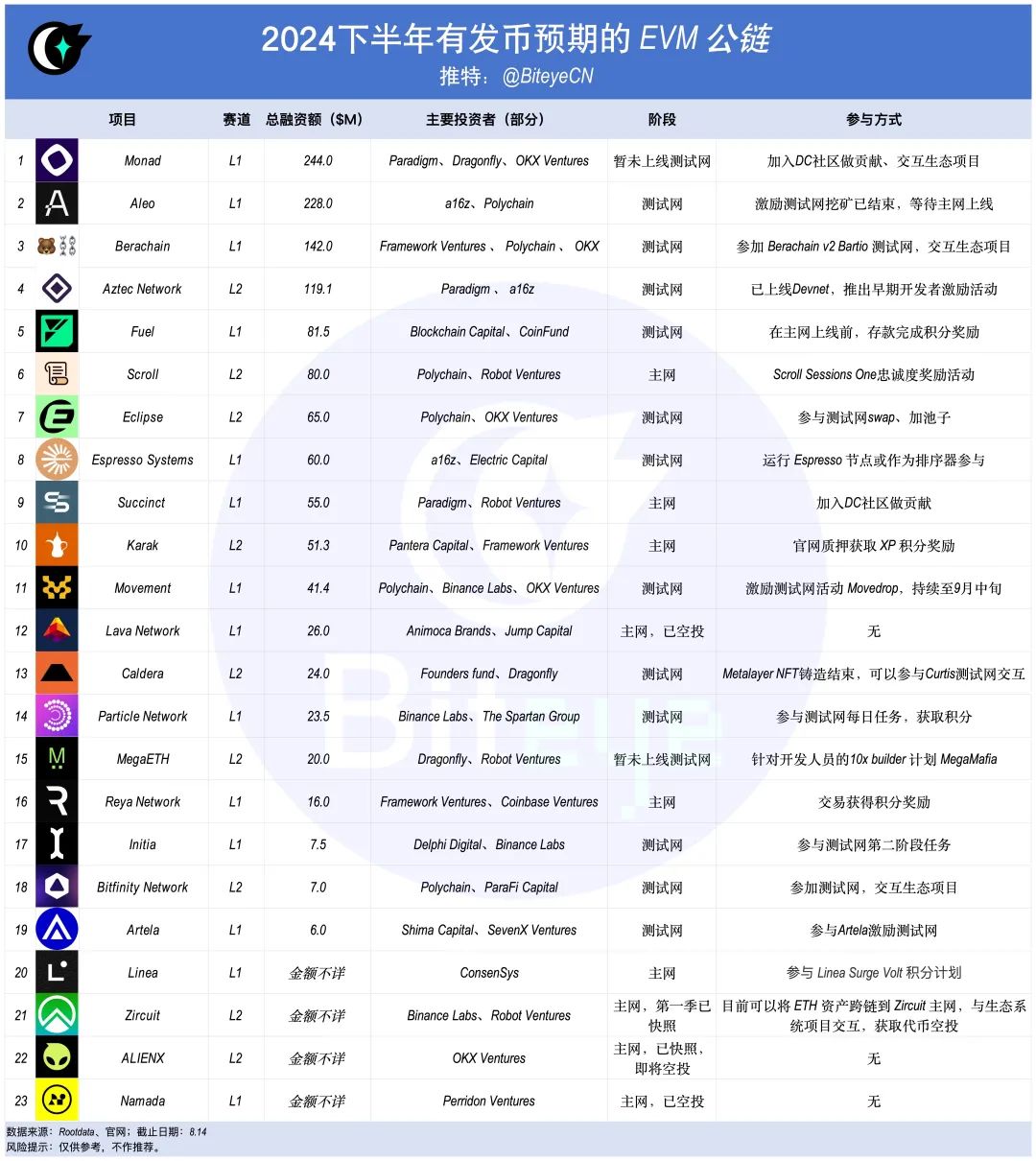
1. Monad: Total funding of $244 million, backed by Paradigm, Dragonfly, OKX Ventures, and others.
A high-performance blockchain platform compatible with the Ethereum Virtual Machine (EVM), aiming to significantly improve transaction speed and scalability through parallel execution technology, capable of processing over 10,000 transactions per second.
2. Aleo: Total funding of $228 million, backed by a16z, Polychain, and others.
A privacy-focused public chain based on zero-knowledge proof technology, designed to provide highly private smart contracts and decentralized applications.
3. Berachain: Total funding of $142 million, backed by Framework Ventures, Polychain, OKX, and others.
A high-performance EVM-compatible blockchain utilizing Proof-of-Liquidity consensus mechanism, aiming to promote the development of decentralized finance (DeFi) ecosystems.
4. Aztec Network: Total funding of $119 million, backed by Paradigm, a16z, and others.
The first private ZK-rollup on Ethereum, designed to provide privacy protection and scalability for decentralized applications.
5. Fuel: Total funding of $81.5 million, backed by Blockchain Capital, CoinFund, and others.
A modular execution layer specifically designed for Ethereum, aiming to achieve efficient blockchain scalability through parallel transaction execution and flexible throughput.
6. Scroll: Total funding of $80 million, backed by Polychain, Robot Ventures, and others.
An EVM-compatible zk-Rollup based on zero-knowledge proof technology, aiming to support decentralized application development by enhancing Ethereum's scalability and privacy protection. It allows users to verify transactions without revealing original data while achieving seamless compatibility with existing Ethereum infrastructure.
7. Eclipse: Total funding of $65 million, backed by Polychain, OKX Ventures, and others.
A high-performance Layer 2 solution built on Ethereum, leveraging the Solana Virtual Machine (SVM) for fast execution. It combines Ethereum’s security with Celestia’s data availability, supporting the development of decentralized applications with high transaction volume and low fees.
8. Espresso Systems: Total funding of $60 million, backed by a16z, Electric Capital, and others.
An EVM-compatible blockchain project utilizing zk-Rollup and PoS consensus mechanisms to provide scaling and privacy protection, delivering high-performance and secure infrastructure for Web3 application development.
9. Succinct: Total funding of $55 million, backed by Paradigm, Robot Ventures, and others.
A project aiming to establish the initial decentralized and permissionless interoperability layer for Ethereum, using proof-based cross-chain communication to enable developers to securely integrate this technology into upcoming dApp projects.
10. Karak: Total funding of $51.3 million, backed by Pantera Capital, Framework Ventures, and others.
A Layer 2 blockchain network focused on restaking, aiming to incentivize users to restake via points system for multi-layered yield generation, while supporting asset interactions across Ethereum mainnet and multiple other blockchain protocols.
11. Movement: Total funding of $41.4 million, backed by Polychain, Binance Labs, OKX Ventures, and others.
A Move-based zk-Rollup aiming to build and deploy infrastructure and applications using the Move programming language in distributed environments, compatible with the Ethereum ecosystem to enhance liquidity and interoperability across blockchains.
12. Lava Network: Total funding of $26 million, backed by Animoca Brands, Jump Capital, and others.
A modular blockchain data marketplace connecting blockchains and decentralized applications with node providers, offering flexible data storage and management solutions to improve data access efficiency and scalability.
13. Caldera: Total funding of $24 million, backed by Founders Fund, Dragonfly, and others.
A high-performance, customizable Layer 2 blockchain network focused on providing high-throughput and low-latency solutions for decentralized applications, enabling developers to rapidly create application-specific blockchains.
14. Particle Network: Total funding of $23.5 million, backed by Binance Labs, The Spartan Group, and others.
A modular blockchain project aiming to achieve cross-chain interoperability through chain abstraction, allowing users to seamlessly manage and trade assets across different blockchains, simplifying user experience.
15. MegaETH: Total funding of $20 million, backed by Dragonfly, Robot Ventures, and others.
A real-time blockchain fully compatible with Ethereum, aiming to deliver Web2-like performance through ultra-high transaction throughput and low-latency processing, supporting over 100,000 transactions per second.
16. Reya Network: Total funding of $16 million, backed by Framework Ventures, Coinbase Ventures, and others.
A modular Layer 2 solution optimized for trading scenarios, aiming to enhance liquidity and capital efficiency in cryptocurrency exchanges through a unique liquidity pool mechanism.
17. Initia: Total funding of $7.5 million, backed by Delphi Digital, Binance Labs, and others.
A modular full-stack Rollup network aiming to simplify user experience in multi-chain environments and optimize developers’ application-building capabilities by combining application-specific L2 infrastructures with innovative L1 blockchains.
18. Bitfinity Network: Total funding of $7 million, backed by Polychain, ParaFi Capital, and others.
An EVM-compatible blockchain built on the Internet Computer (IC), using threshold signature schemes for security and bringing new applications and use cases to the Bitcoin ecosystem through compatibility with the Ethereum ecosystem.
19. Artela: Total funding of $6 million, backed by Shima Capital, SevenX Ventures, and others.
A scalable blockchain network enhancing scalability and performance through parallel execution stacks and elastic block space technology, enabling developers to build feature-rich dApps within EVM environments and dynamically add WASM native extensions for complex use cases.
20. Linea: Funding amount undisclosed, backed by ConsenSys and others.
A high-performance Layer 2 network developed by ConsenSys, combining zero-knowledge proof technology with full EVM compatibility, aiming to enhance scalability and development efficiency for decentralized applications.
21. Zircuit: Funding amount undisclosed, backed by Binance Labs, Robot Ventures, and others.
A fully EVM-compatible zero-knowledge Rollup network combining Optimistic Rollups with zero-knowledge proofs, aiming to provide developers with high-performance and secure solutions.
22. ALIENX: Funding amount undisclosed, backed by OKX Ventures and others.
A high-performance blockchain driven by AI nodes, aiming to serve as infrastructure for NFTs and gaming, supporting users earning rewards by staking multiple crypto assets, and committed to improving network security and data credibility.
23. Namada: Funding amount undisclosed, backed by Perridon Ventures and others.
A Proof-of-Stake Layer 1 cross-chain privacy platform using CometBFT consensus, supporting confidential transfers of multiple assets and fully compatible with the IBC protocol to enhance privacy across multi-chain ecosystems.
02 Summary
As these EVM public chains continue to evolve, market confidence in the Ethereum ecosystem is gradually recovering.
Despite facing challenges such as technical compatibility and security, the emergence of new public chains is injecting fresh vitality into Ethereum’s future.
Overall, the second half of the year will be a critical period for EVM public chains launching tokens. Ethereum’s resurgence may well be realized through the support of these emerging chains.
Join TechFlow official community to stay tuned
Telegram:https://t.me/TechFlowDaily
X (Twitter):https://x.com/TechFlowPost
X (Twitter) EN:https://x.com/BlockFlow_News
 @BiteyeCN