Thoughts on Investment, Success, and Happiness: Focus on Long-term Returns Rather Than Short-term Stimulation
TechFlow Selected TechFlow Selected
Thoughts on Investment, Success, and Happiness: Focus on Long-term Returns Rather Than Short-term Stimulation
If you apply leverage and time, you can achieve compounding—your results accumulate on top of what you've already built.
 Navigating Web3 tides with focused insights
Author: ROUTE 2 FI
Translation: TechFlow
This is one of the better posts I’ve personally come across—a series of reflections on investing, success, and living a fulfilling life.
But first, how has your week been? After last week’s brutal Monday crash, are you doing okay?
I've spoken to many people, and surprisingly, a lot of them got badly burned.
A major issue many crypto investors face is unconsciously using the Martingale strategy, believing it will eventually pay off.
You buy when the price drops. Then it drops again, so you invest more. It drops once more—you add even more. Then, oh no, it drops again, and you throw in your last bit of money. To your shock, it crashes again. Even with low leverage (3–5x), you could be completely wiped out.
Ethereum ($ETH) dropped 17% in just four minutes on that Monday a week ago.
Now calculate what happens if you had 5x leverage on that position.
Linear Thinking vs. Exponential Thinking

If you put in x hours, you earn y money and produce z products/services.
That’s how most people think—at least initially. Their thinking is linear.
But is this really the right way to think?
When you apply leverage and time, you unlock compounding, where results build upon previous gains.
If you calculate 10 + 10 + 10 + 10 + 10 + 10 + 10 + 10 + 10, it’s easy to see the sum is 90.
But if I ask you to calculate a 10% return over 40 years, most people assume it's just 10% added forty times—totaling 400%.
But the answer isn’t 400%.
The answer is: 4,525%.
That means a $100,000 investment turns into $4,525,000 after 40 years.
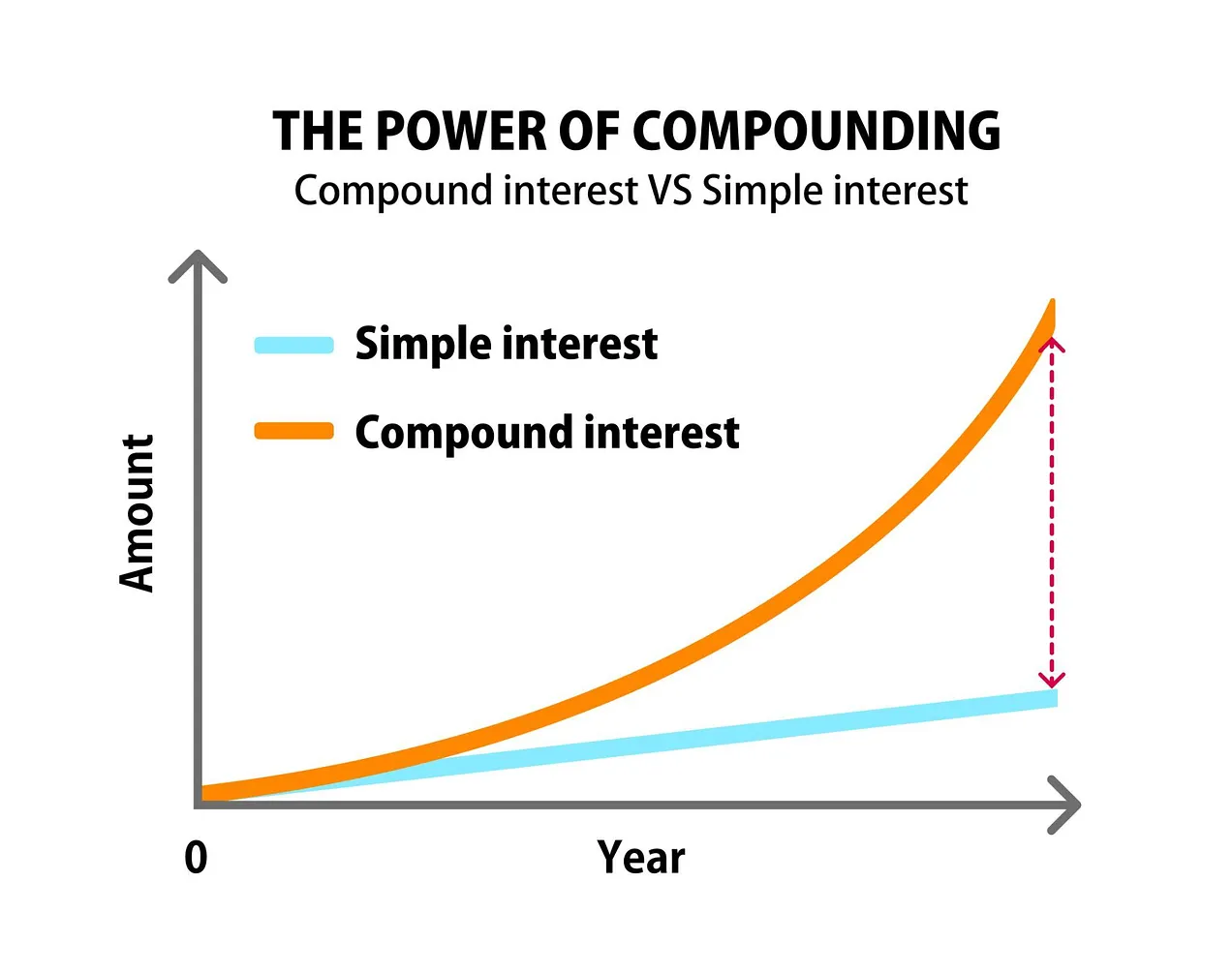
The principle of compounding is illustrated above. I won’t dive deeper—just wanted to show an example of exponential thinking.
Applying Leverage in Life
Most people view life too practically—they fail to see how leverage can shift you from a linear path to an exponential one.
Leverage comes in many forms: capital, technology, brand, network effects, and managing human talent.
Use these levers to break free from linear thinking. Take risks in life. Choose a career that allows for leverage and compounding. A typical 9-to-5 job without equity offers very limited upside.
Instead, try starting your own business or joining someone who already has. Look for roles with flexibility in career growth and equity compensation—roles where skills you learn can transfer to other areas or future ventures.
In modern society, I can't think of a better way to maximize leverage than building your personal brand. I’ve done it myself, and looking back at my journey, I’m amazed at what I’ve created.
People read my thoughts because I’m the one writing them. You want to learn about investing, crypto, and new yield opportunities from someone experienced in practice—not from your college professor.
Apply leverage everywhere. Start thinking in terms of years—and how your knowledge, skills, and mindset can compound through exponential growth. Think bigger. Those who believe they can change the world usually end up doing so.
On Taking Risks and Making Asymmetric Bets
I believe you should take big risks as long as your basic needs are met. I like the FIRE mindset (financial independence, retire early). The rule states: investment amount needed = monthly expenses × 12 months × 25.
This assumes a 10% average annual portfolio growth. Under those conditions, withdrawing 4% won’t erode your principal—your investments continue growing (assuming 10% annual return).
However, if you're young with few obligations and low expenses, taking risks makes sense.
Ask yourself: What’s the worst that can happen? Usually, the worst outcome is returning to square one. On the flip side, if you take the risk, you might multiply your current assets tenfold (this applies not only to money but also to skills and opportunities).
Pursue asymmetric bets (see my tweet example below):
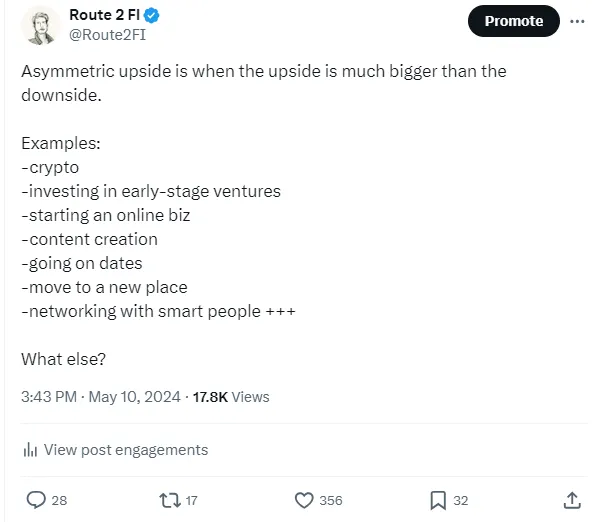
Route 2 FI: Asymmetric upside means potential rewards far outweigh risks.
For example:
-
Crypto investments
-
Investing in early-stage startups
-
Starting an online business
-
Content creation
-
Dating
-
Moving to a new city
-
Connecting with smart people
Asymmetric upside investments offer 10–100x returns if you win, but minimal loss if you fail.
Avoid investments where correct decisions yield small gains but wrong ones carry high risk.
Illustrated below:

Focus on long-term gains (years/decades) over short-term comfort (monthly salary). Of course, survival matters.
The problem is, many people grow comfortable in their jobs, making higher-potential endeavors seem increasingly unattractive as salaries rise.
Opportunity cost appears to increase. Yet, in reality, almost everyone (at least in Western countries) can return to their current or similar job with comparable pay even after failing at a new venture.
How Universal Basic Income Could Boost Entrepreneurship
Break free from hedonistic traps and focus on real passions or life missions. I read Rutger Bregman’s book “Utopia for Realists,” where he argues universal basic income (UBI) would stimulate entrepreneurship and creative growth in society.
The reason is simple. Suppose everyone receives $3,000 monthly into their bank account. Assume that covers basic living costs, so no extra work is needed for income.
UBI provides entrepreneurs with security. In places where UBI has been tested, startup rates rose by 301%. Data shows that for every 1 percentage point increase in entrepreneurship in a state, poverty rates dropped by 2%.
One common objection to UBI is that people will become lazy and depressed, doing nothing. While possible, I believe most people will pursue some passion.
Whether becoming experts in video games or TV shows, or launching startups, I believe UBI would ultimately generate positive outcomes and foster far more innovation than we see today.
What Do You Truly Want?
You may have heard this quote:
“Give me six hours to chop down a tree, and I will spend the first four sharpening the axe.”
I mention this because I think it’s crucial when making big decisions or choosing careers.
If you’re unsure what kind of work to focus on or what to prioritize next year, spending a few days crafting a solid plan is far better than jumping in blindly.

“Which way should I go from here?”
“That depends a good deal on where you want to get to,” said the Cat.
“I don’t much care where—” said Alice.
“Then it doesn’t matter which way you go,” said the Cat. —Lewis Carroll
As in *Alice in Wonderland*, if you don’t know where you’re going, any path will do.
The key is spending more time reflecting on what you truly want to do. Most people could create something beautiful—if only they believed in themselves.
In today’s social media world, watching short videos and TikToks about self-improvement is trendy, but few actually act. They watch, then do nothing. You might feel productive, but it’s no different from watching TV—just short-term dopamine hits.
Ask yourself: Are you doing anything that contributes to long-term growth, or are all your activities based on short-term pleasures (food, sex, exercise, feel-good videos/music, dating, gaming, drugs, alcohol)?

There’s nothing wrong with these activities, but don’t let life revolve entirely around them. After all, you’re not a monkey. You can delay gratification (think of the marshmallow experiment)—monkeys can’t.
Examples of long-term activities (that bring lasting happiness):
-
Learning a language
-
Starting a company/small business
-
Completing a marathon
-
Earning a degree
-
Living abroad
-
Writing a book
-
Learning career-changing skills
-
Investing
-
Losing weight
-
Building a personal brand
Why Being Exceptional in a Field Is Highly Beneficial
Another factor: finding your ultimate purpose is deeply engaging. When I worked 50–60 hours a week at a corporate job, I hated daily life. At first, I thought it was due to long hours.
But that wasn’t it. I hated working on things that didn’t impact my life. Now, every hour I invest in Route2FI (yes, it’s just me) eventually yields some return. Not always guaranteed—but the gains and losses are mine alone.
This motivates me immensely, because only I can make this story succeed. If I don’t show up, momentum stalls.
Interestingly, becoming top 10% in a field isn’t that hard. You just need to put in massive effort (work hard). But to reach top 1–2%, you must also work smart.
This is where I need improvement. Sometimes I wonder how much further I could go if I outsourced more—or stopped writing tweets or newsletters altogether.
Yet, I genuinely enjoy the process. At this point, I’m not trying to squeeze every dollar from markets or partnerships. I do it because it fulfills me. I’m writing these words now because I enjoy it. Writing is something I’ll always do—and won’t outsource.
Life is long, so boldly pursue what you want. Don’t settle for less. This applies to your career, partner, and friends. If you want luck in life, prepare for it. Interestingly, luck often finds you when you’re working hard.
Pause for a moment and consider this question:
“What do I truly want in life?”
You might respond with things you lack or currently miss. But let me ask you this:
How much effort have you put into getting what you want? How many hours have you invested? You want to build a successful TikTok brand but haven’t started because you think the market is too saturated?
Most people delay starting—or never start—because they don’t set small goals. They fixate on the end goal and conclude it’s unreachable without trying.
Acquire Specific Knowledge
Naval says you need specific knowledge—knowledge only you possess. The easiest way to build it is by creating a personal brand. As I mentioned earlier, people read my ideas because I’m the one who wrote them.
We could post this exact text under an unknown Twitter account—it wouldn’t get much attention. Not because the writing is bad, but because there’s no audience. However, if you repeat this practice (posting year after year), the right audience will find you.
That’s where I excel—consistency. I know I’m not the best writer. My work could improve with more editing, better graphics, or feedback before publishing. But instead of chasing perfection, I prefer to publish at 80–90% quality.
For me, this is the only way to get things done. Over time, I’ve grown quite content with this approach. I’m proud of the 100+ articles I’ve published. Had I chased perfection, I might have completed only 25% of that volume.
Acquire specific knowledge. Boldly share unique perspectives. Some will appreciate your distinct style. Define yourself by your strengths, not weaknesses. Imagine how exceptional you’d become if you focused solely on your natural talents.
You can become top 1% in a field. Instead of raising your sales skill from 45% to 50% (random example), focus on what you’re naturally gifted at to become the best.
Ensure you have enough money to make decisions based on what you truly want—not because you lack funds. Because in my view, the best scenario is when you’re intrinsically motivated. Yes, you can have high intrinsic motivation in a regular job, but if the employer stops paying, most people quit.
A powerful question: If money weren’t an issue, what would I do?
You can watch Alan Watts’ video below.

This deeply inspired me a decade ago:
It’s hard to excel at work you don’t care about.
Moreover, having a job you dislike makes full life satisfaction difficult. Strive to be the best at what you do. Be bold. Take risks in life—especially early in your career or in your twenties.
Make an effort to connect with people who are exceptional in their fields (for me, I met them on Twitter and am glad to know many in real life).
Consider this: the chance that your friends share your deep interest in a topic is slim. But on Twitter, there are thousands just like you, diving deep into the same niche.
Find them. Make them your friends. Trust me, it’ll be worth it.
Join TechFlow official community to stay tuned
Telegram:https://t.me/TechFlowDaily
X (Twitter):https://x.com/TechFlowPost
X (Twitter) EN:https://x.com/BlockFlow_News
 @Route2FI