








Russia Passes Cryptocurrency Mining Bill—Is BTC Mining Now Officially Legal?
TechFlow Selected TechFlow Selected
Russia Passes Cryptocurrency Mining Bill—Is BTC Mining Now Officially Legal?
Provide clear regulatory guidance and more favorable conditions for miners, mining companies, and related professionals entering Russia.
 Navigating Web3 tides with focused insights
Authors: Liu Honglin, Zhang Zihao, ManQin Law Firm
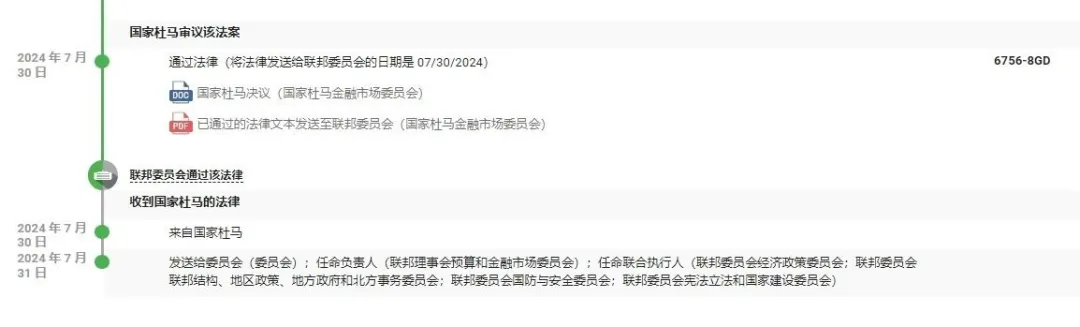
On July 30, 2024, Russia's legislative body, the State Duma, passed in its third reading the legislative amendment No. 237585-8, aimed at establishing a clear legal framework for regulating cryptocurrency trading and mining in Russia. Under Russian federal law, the bill must still be approved by the Federation Council and signed by the President to take effect. If enacted, cryptocurrency mining will be formally legalized in Russia starting November 1, 2024.

ManQin Law has summarized the provisions of this bill concerning cryptocurrency mining regulation, aiming to provide guidance for miners and mining enterprises considering establishing operations in Russia.
Overview of the Cryptocurrency Mining Bill
The regulation of cryptocurrency mining under this bill is established primarily through amendments to three existing laws: the "Federal Law on the Electric Power Industry" (the "Electricity Law"), the "Decision on Amendments and Repeals of Certain Laws Due to the Special Nature of the Electric Power Industry and the Adoption of the Federal Law on the Electric Power Industry" (the "Amendment Decision Based on the Electricity Law"), and the "Decision on Digital Financial Assets, Cryptocurrencies, and Amendments to Certain Legislative Acts" (the "Cryptocurrency Amendment Decision").
Overall, once effective, the main impacts of the bill on Russia’s cryptocurrency mining industry are as follows:
-
Legalization of cryptocurrency mining, allowing mining enterprises to establish and operate within Russia;
-
Russian Federation citizens may engage in cryptocurrency mining provided their electricity consumption does not exceed government-set limits;
-
Legal entities and individual entrepreneurs under Russian law may conduct cryptocurrency mining activities in permitted regions after obtaining required licenses and being listed in the "Register of Cryptocurrency Miners and Mining Infrastructure Operators";
-
Licensed entities are authorized to engage in cryptocurrency mining, operate mining infrastructure, and organize and manage mining pools;
-
Entities conducting mining activities without proper licensing or in regions where such activities are prohibited may face regulatory scrutiny and penalties;
-
The legislation also prohibits any entity from combining cryptocurrency mining with power transmission, grid operation and dispatch management, power generation, or electricity purchase and sale activities.
Amendments to the Electricity Law and Related Legislation
Article 26 of Russia's Electricity Law outlines procedures for connecting power generation and consumption facilities to the grid. Paragraph 1 of this article stipulates that grid operators may not arbitrarily reject technical connection applications. This bill expands the list of exceptions under which grid access may be denied:
-
Amended paragraph 8 allows grid operators to impose access restrictions based on the specific nature of an applicant's equipment, including cryptocurrency mining rigs, especially those planned for deployment in regions where mining is banned by the government. Furthermore, electricity consumers not listed in the "Register of Cryptocurrency Miners" or the "Register of Mining Infrastructure Operators" are also subject to these restrictions.
-
A new paragraph 9 states that if a power consumer engages in cryptocurrency mining in a prohibited region or operates without being listed in the relevant registers, courts shall order disconnection of such equipment from the grid, and connection fees will not be refunded.
Amendment to Article 28, Paragraph 5 ("Supervision of Reliability, Security, and Power Quality in the Electric Power Sector"): The revised provision states that miners and mining infrastructure operators who obtained grid access before this amendment takes effect must modify their power supply conditions if their operations are located in prohibited areas or if they fail to obtain required qualifications after the amendment becomes effective.
Article 38 of the Federal Electricity Law, "Measures to Ensure Reliability of Consumer Power Supply," Paragraph 8 allows competent authorities to implement full or partial restrictions on electricity consumption during shortages threatening the stability of Russia’s unified power system. The amendment adds explicit provisions enabling full or partial restrictions on electricity used for cryptocurrency mining, including indefinite, comprehensive restrictions on mining operations and mining infrastructure activities conducted in prohibited regions or without proper licensing.
Amendments to the "Amendment Decision Based on the Electricity Law" include the following addition: Legal entities and individual entrepreneurs are prohibited from combining cryptocurrency mining with power transmission, grid operation and dispatch management, power generation, or electricity purchase and sale activities.
Amendments to the Cryptocurrency Amendment Decision
In Part I "Definitions," the bill introduces definitions for key concepts related to cryptocurrency mining, including: cryptocurrency mining, mining pool, pool organizer, mining infrastructure, mining infrastructure operator, and address identifier.
Three new paragraphs are added to Article 14, "Circulation of Cryptocurrencies," granting the following powers: authority for the Russian federal government to regulate entities operating mining pools; authority for the federal government to prohibit mining activities in certain regions under specific circumstances; and authority for AML/CFT oversight bodies, national security agencies, and tax supervision authorities to carry out their duties under applicable laws.

Notably, a new Article 142, "Maintaining the Register of Cryptocurrency Miners and Mining Infrastructure Operators," introduces two licensing regimes: one for cryptocurrency miners and another for mining infrastructure operators. Key provisions include:
-
Natural persons registered as individual entrepreneurs under Federal Law No. 129-FZ "On State Registration of Legal Entities and Individual Entrepreneurs" dated August 8, 2001, and legal entities under Russian law may engage in cryptocurrency mining (including participation in mining pools) upon inclusion in the miner register.
-
Legal entities under Russian law and natural persons registered as individual entrepreneurs under Federal Law No. 129-FZ dated August 8, 2001, may act as mining infrastructure operators upon inclusion in the respective register.
Exemptions are also provided:
-
Russian Federation citizens who are not individual entrepreneurs may engage in cryptocurrency mining (including pool participation) without registration, provided their energy consumption does not exceed government-set limits.
Prohibited Circumstances:
-
Certain individuals are barred from engaging in cryptocurrency mining (including as pool members): those with unrehabilitated or unpaid criminal records in economic crimes, crimes against state authority, or intentional crimes of medium, serious, or particularly serious gravity; organizations and individuals listed for involvement in extremism or terrorism; and organizations and individuals whose funds or other assets have been frozen by anti-terrorism financing authorities.
Powers and Responsibilities of Relevant Authorities:
-
The Government of the Russian Federation sets requirements for the activities of mining infrastructure operators, including the nature and scope of services provided.
-
The Government of the Russian Federation establishes a federal executive agency responsible for formulating and implementing state policy and regulatory frameworks in the field of information technology, and for maintaining the registers of cryptocurrency miners and mining infrastructure operators.
-
Individuals engaged in cryptocurrency mining (including pool participants) are obligated to report information about received cryptocurrencies—including address identifiers—to an authorized agency designated by the Government of the Russian Federation at the time of receipt.
Additionally, Article 143, "Entities Organizing Mining Pool Activities" (Special Requirements for Pool Operators), includes the following:
-
Entities organizing mining pool activities may include:
-
Legal entities under Russian law;
-
Natural persons registered as individual entrepreneurs under Federal Law No. 129-FZ dated August 8, 2001; and
-
Russian Federation citizens who are not individual entrepreneurs.
-
Entities organizing mining pools may also simultaneously engage in cryptocurrency mining.
ManQin Law Summary
This legislative amendment consists of two major components: the legalization of cryptocurrency mining and the advancement of legal frameworks for cross-border and exchange-based cryptocurrency transactions. Since the onset of the Russia-Ukraine conflict, the United States and its allies have imposed multiple rounds of economic sanctions on Russia, significantly undermining its position in the global financial system. In this context, advancing cryptocurrency policy holds strategic importance for Russia.
For cryptocurrency mining professionals, this legislation provides clear regulatory guidance for establishing mining operations in Russia, offering more favorable conditions for miners and related industry participants. ManQin Law will continue to closely monitor global regulatory developments and provide compliance advice and support services to participants in the cryptocurrency industry.
Join TechFlow official community to stay tuned
Telegram:https://t.me/TechFlowDaily
X (Twitter):https://x.com/TechFlowPost
X (Twitter) EN:https://x.com/BlockFlow_News


