Ethereum Braid: Building a Censorship-Resistant Blockchain Future
TechFlow Selected TechFlow Selected
Ethereum Braid: Building a Censorship-Resistant Blockchain Future
At Paradigm's New York workshop, Max Resnick presented Braid—a method for achieving multi-block parallelization on Ethereum—and received a like from Vitalik.
 Navigating Web3 tides with focused insights
Author: Nicky, Foresight News
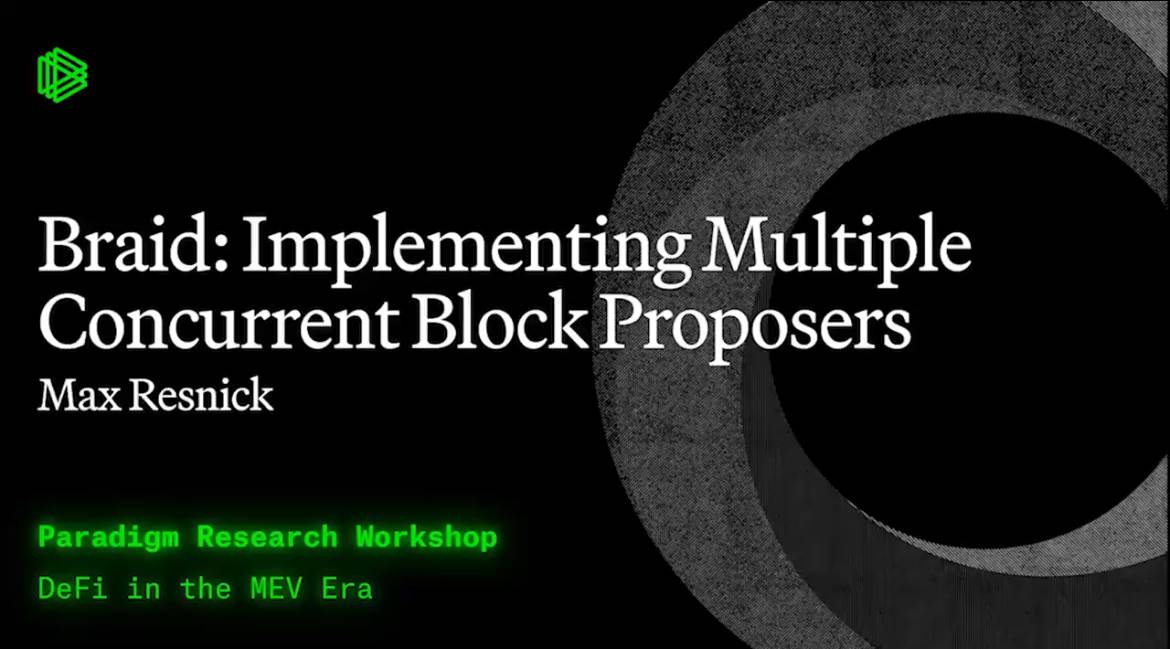
Amid the rapid development of blockchain technology, an increasingly prominent issue is how to achieve effective censorship resistance in environments reliant on consensus mechanisms. Most traditional blockchains are leader-driven, a design that grants leaders excessive power over transaction selection and ordering, leading to potential censorship risks. These risks not only threaten the transparency and fairness of blockchains but also limit their broader application as decentralized platforms. It is against this backdrop that Braid emerged, aiming to solve censorship issues within Ethereum.
Censorship resistance is crucial for the healthy development and widespread adoption of blockchain technology. First, it forms the foundation for ensuring blockchain transparency and fairness. The immutability and transparency of blockchains constitute their core value, and censorship directly undermines this value. Second, censorship resistance embodies the decentralized nature of blockchains. By achieving censorship resistance, Ethereum can truly become a decentralized network platform free from control by any single entity, supporting a broader range of users and applications.
Braid aims to build a censorship-resistant Ethereum system. Currently in its early stages, Braid has already demonstrated a unique design philosophy and technical potential. At its core, Braid leverages techniques such as multi-block parallelism and synchronized release to break the monopolistic control of a single leader over Ethereum, thereby ensuring free transaction flow and network fairness.
Key design principles of Braid include a multi-proposer model and synchronized release. The multi-proposer model introduces multiple concurrent proposers, increasing the cost of blocking transactions and thus enhancing Ethereum's censorship resistance. Synchronized release ensures all proposers act simultaneously based on the same information set, further improving system fairness and transparency. Additionally, Braid employs strategies like delayed execution, allowing multiple proposers to influence transaction states, thereby strengthening the stability and reliability of the Ethereum network.
Compared with existing solutions, Braid demonstrates distinct advantages. In multi-proposer LMD-Ghost (Latest Message Driven Ghost) consensus mechanisms, high-branching trees may need to be stored locally to resolve fork-choice issues. Meanwhile, Mysticeti (Sui), though nearing production deployment, faces limitations in elegantly managing validator counts. Compared to schemes like LMD-Ghost and Mysticeti (Sui), Braid not only achieves stronger censorship resistance but also preserves Ethereum’s transparency and fairness. Moreover, Braid’s design is simpler and more efficient, reducing implementation complexity and costs. These advantages position Braid as a strong candidate for addressing Ethereum’s censorship challenges.
In practice, Braid adopts a parallel multi-block approach, using a unified consensus mechanism to ensure consistency and coordination among chains. By running multiple parallel blocks, Braid decentralizes transaction processing, effectively mitigating censorship risks. Additionally, Braid has developed a technical tool called the "finality gadget" to handle transaction finalization. This tool extracts the union of transactions across all chains and reorders them to ensure transaction finality and consistency.
Compared to traditional blockchain designs, Braid offers significant advantages. First, it delivers stronger censorship resistance, safeguarding Ethereum’s transparency and fairness. Second, its design is more streamlined and efficient, lowering implementation barriers and costs. These strengths give Braid broad application potential. For instance, in domains requiring high transparency and fairness—such as auctions—Braid could serve as an ideal enabling solution.
As Ethereum co-founder Vitalik noted when sharing a related post about Braid: “It’s exciting to see progress like this! The topic of block construction seems to be gradually approaching a bright future.”
Indeed, every technological breakthrough and theoretical innovation represents a solid step toward a more ideal, decentralized blockchain world. We look forward to Ethereum overcoming all challenges through deeper research and iterative advancements, leading the blockchain industry into a brighter future.
Join TechFlow official community to stay tuned
Telegram:https://t.me/TechFlowDaily
X (Twitter):https://x.com/TechFlowPost
X (Twitter) EN:https://x.com/BlockFlow_News
 Foresight News