Quick Overview of Binance Labs' Season 7 Incubation Program's First Batch of Projects (with Early Interaction Guide)
TechFlow Selected TechFlow Selected
Quick Overview of Binance Labs' Season 7 Incubation Program's First Batch of Projects (with Early Interaction Guide)
New concepts emerge: new asset types LAT, fully homomorphic encryption...
 Navigating Web3 tides with focused insights
Written by Nan Zhi, Odaily Planet Daily
Yesterday, Binance Labs announced the first batch of projects selected for its seventh-season incubation program, including Astherus, CYCLE NETWORK, DILL, and EigenExplorer. These projects are relatively cutting-edge in concept and business model, with the first two already launching early engagement campaigns tied to potential future airdrops. This article by Odaily breaks down each protocol’s business model, features, and ongoing engagement activities.
Astherus: The Liquidity Hub for LRT Assets
Protocol Overview
The restaking market for BTC and ETH has a potential size of up to $20 billion and continues to grow rapidly. Restaking allows blockchain validators to deposit ETH or liquid staking tokens (LSTs) into platforms, earning APR rewards while securing networks. However, Astherus argues that most existing restaking protocols fail to seriously address one key question: What can restaked assets actually be used for?
According to its official materials, Astherus is building a comprehensive DApp ecosystem specifically for LSTs and liquid restaking tokens (LRTs). User assets not only earn staking APR but can also be utilized for spot and derivatives trading, stablecoin yield generation, and other profitable strategies. Astherus supports multi-chain restaking assets across Arbitrum, BNB Chain, Ethereum, and more.
The Astherus protocol consists of three modular layers:
-
DApp Layer: Includes various decentralized applications providing real-world use cases for restaked assets, such as the cryptocurrency spot and derivatives exchange AstherEx, and the DeFi/CeFi yield strategy protocol AstherEarn.
-
DeFi Infrastructure Layer: Aggregates liquidity from multiple LST and LRT pools, enabling the development of stablecoins, yield aggregation protocols, innovative derivatives clearinghouses, and allowing developers to easily build LST-based DApps.
-
L1 Chain: AstherLayer is a Layer 1 blockchain built using the Cosmos SDK, designed to interconnect with multiple other chains. Further details will be disclosed later.
Engagement Campaign
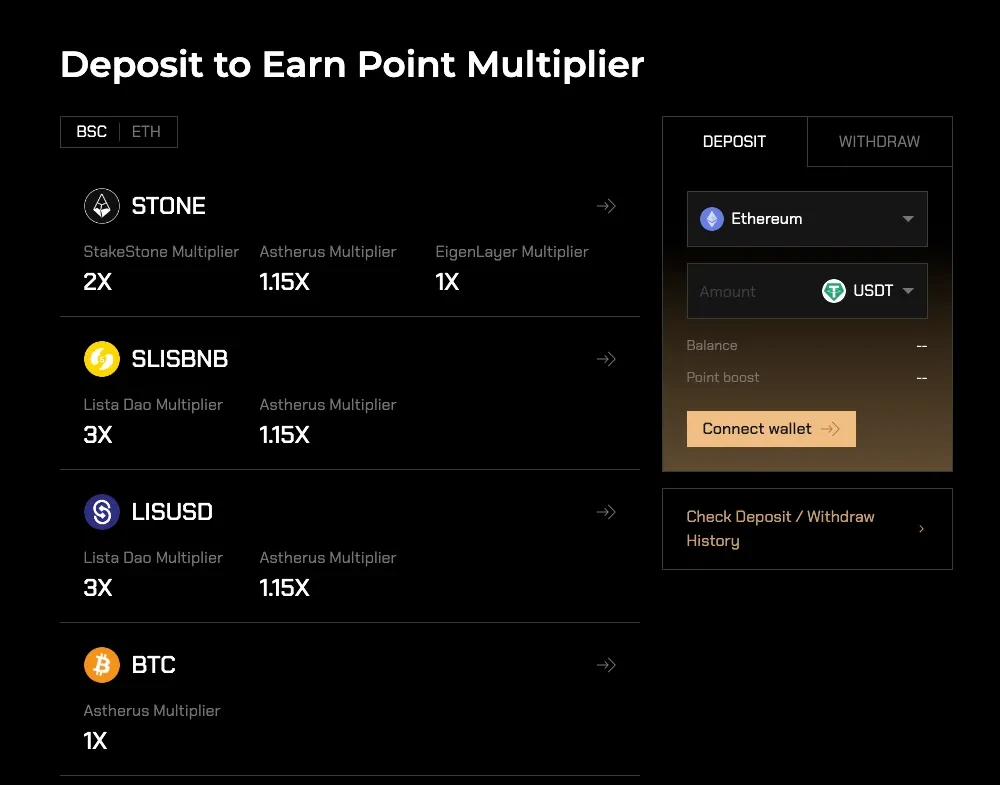
One month ago, Astherus launched its Stage 0 engagement campaign aimed at increasing the protocol's TVL, explicitly stating that points earned during the event are linked to potential future airdrops.
The process is simple—users just need to deposit specified assets into the protocol on either BNB Chain or Ethereum mainnet.
Supported assets include on BNB Chain: BNB, USDT, BTC, ETH, lisUSD, slisBNB, WBETH, STONE, CAKE, LISTA; and on Ethereum: USDT, BTC, ETH, USDC, rsETH.
Depositing slisBNB, lisUSD, LISTA, STONE, or rsETH grants an additional 15% bonus score.
(Odaily note: Binance today announced that deposits of slisBNB in its Web3 wallet will also count toward Launchpool participation, enabling triple benefits from a single asset.)
CYCLE NETWORK
According to Binance Labs, CYCLE NETWORK is a universal, secure, and verifiable chain abstraction that provides a bridgeless aggregated liquidity network for all blockchains—whether L1, L2, EVM, or non-EVM.
Vision, Features, and Characteristics
With the rapid advancement of Web3 and blockchain technology, numerous distinct blockchain platforms have emerged, each with its own protocols and assets. This has led to fragmented liquidity across different chains, negatively impacting user experience and operational efficiency.
In a multi-chain environment, users must rely on complex bridging solutions to manage their assets, while developers face the burden of redeploying applications across multiple ecosystems to meet diverse user needs. Additionally, cross-chain interactions carry inherent security risks and operational complexity.
Cycle Network aims to solve these challenges by offering an innovative solution for interoperability, security, and efficiency across blockchains. Leveraging Verifiable State Aggregation (VSA) technology, it builds a universal, secure, and verifiable on-chain abstraction architecture. In doing so, Cycle Network enables seamless interaction between different blockchain platforms without relying on traditional cross-chain bridges.
Key features of Cycle Network include:
-
Decentralized Application Central Infrastructure (DACI): Provides foundational infrastructure for decentralized application development and broader Web3 adoption.
-
Omni State Channel Indexer (OSCI): A decentralized multi-chain indexer enabling trustless verification and finality of the Cycle ledger state.
-
Zero-Knowledge Hardware Acceleration: Uses dedicated hardware to accelerate the generation and verification of zero-knowledge proofs (ZKPs), enhancing performance and scalability.
-
Fully Homomorphic Encryption (FHE): Enables computations on encrypted data without decryption, significantly improving data privacy and security.
Points System
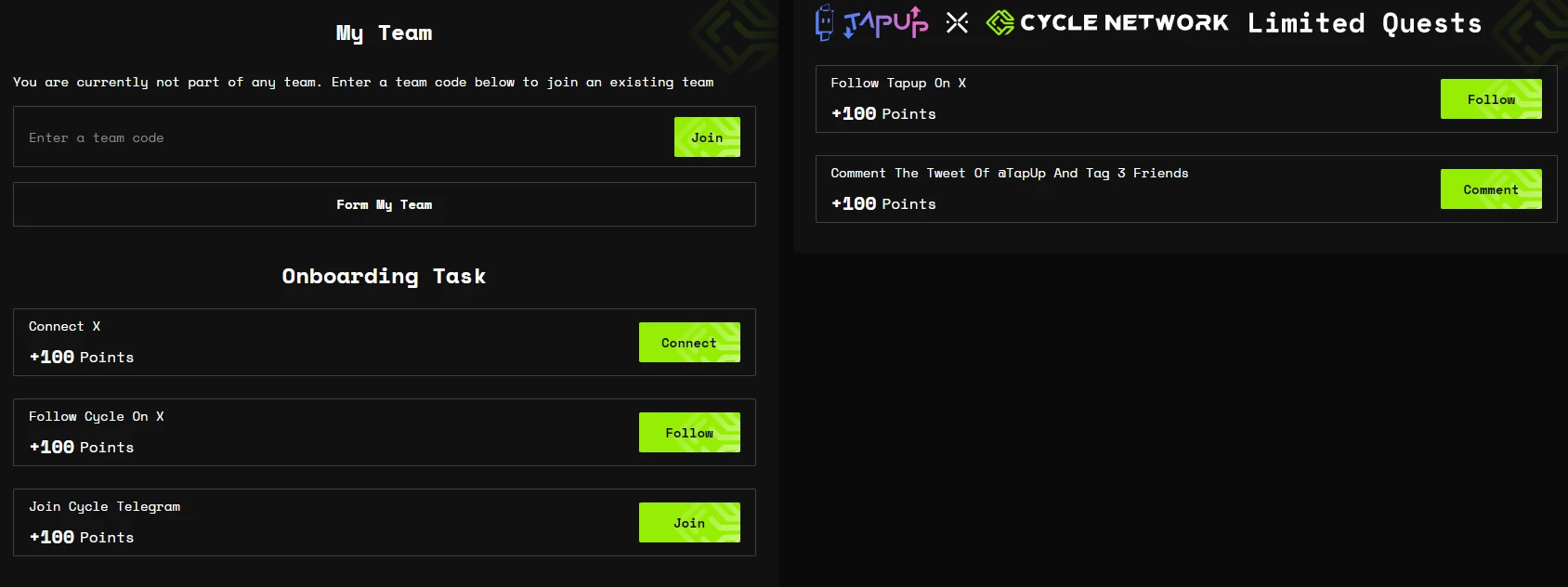
Currently, all engagement activities for Cycle Network are conducted through external partnerships. Previous collaborations included BEVM, Macaron, and IoTeX. The latest initiative is a joint campaign with TapUp, where completing tasks earns participants both Cycle Points and access to TapUp’s U token reward pool.
The participation process is straightforward—simply linking social media accounts and following required channels. As such, further details are omitted here.
DILL: Scaling DA Networks by 100x
Dill is a next-generation Data Availability (DA) network designed for high scalability and security. Aligned with Ethereum’s future roadmap and full sharding vision, Dill leverages core technologies such as subnet sharding, 2D Erasure Coding, KZG (Kate-Zaverucha-Goldberg) commitments, and Data Availability Sampling (DAS). It offers 10 to 100 times greater scalability than current DA networks.
Dill is a permissionless, decentralized Proof-of-Stake (PoS) network supporting millions of validators. It enables Bitcoin (BTC) staking and restaking to participate in PoS consensus, thereby enhancing overall network security.
Funding
On July 16, modular network DILL announced the completion of its Pre-Seed funding round, led by FSL Ecosystem, with participation from LayerZero Labs, Modular Capital, TN Lee (co-founder of Pendle), victorji.eth (from Manta), among others. The funding amount was not disclosed.
Reportedly, Dill is a data availability layer proposing a paradigm-shifting scalability solution. It uses the same tech stack as the Ethereum Go client to ensure high performance, with validity proofs secured via aggregated KZG polynomial commitments for fast finality. Given that applications generate vast amounts of user behavior data, data sovereignty is critical. In extreme cases, if a permissioned DA layer (e.g., one with only 100 nodes) ceases operation, most chains would become paralyzed. Dill enables any application chain user to run a light client and join the network permissionlessly, thus safeguarding product data sovereignty.
EigenExplorer: Another Layer of Abstraction or a New Asset Class?
EigenExplorer is a platform serving core entities within the EigenLayer ecosystem, including restakers, AVSs (Actively Validated Services), and Operators. It introduces a novel asset class called Liquid AVS Token (LAT), specifically designed for the EigenLayer ecosystem.
The introduction of LAT addresses a key limitation: currently, users cannot directly support AVSs. They must either route their staked assets through operators or use LRT platforms to control AVS participation and reward distribution. LAT allows users to bypass operators entirely, directly supporting any AVS of their choice.
Key features of LAT include:
-
Direct restaking into an AVS;
-
Automatic operator selection;
-
Remains a liquid token usable in other DeFi activities while maintaining staked status;
-
Enhances utility, efficiency, and user experience. Users can build customized liquid restaking portfolios aligned with their risk preferences and selectively support specific protocols instead of pooling stake contributions for general validation.
According to official tweets, the testnet is scheduled to launch in mid-August 2024.
Join TechFlow official community to stay tuned
Telegram:https://t.me/TechFlowDaily
X (Twitter):https://x.com/TechFlowPost
X (Twitter) EN:https://x.com/BlockFlow_News
 Odaily