








Polymarket: From Niche Finance to a New Way of Participating in Societal Transformations
TechFlow Selected TechFlow Selected
Polymarket: From Niche Finance to a New Way of Participating in Societal Transformations
Prediction markets, as a significant data source, may be the closest to the truth.
 Navigating Web3 tides with focused insights
Author: LAWRENCE
Compiled by: TechFlow
Origins
In the year 1503, a papal election was underway. Citizens of the Papal States awaited the coronation of a new pope, even as their state—surrounded by three hostile armies—was embroiled in turmoil due to the Italian Wars and the backdrop of the Protestant Reformation.
In Rome, many held their breath—not only because of the historical significance of the election, but also because they were betting on its outcome. Banks employed messengers ("sensali") to run across the city, relaying real-time wagers and shifting odds, as the 39 cardinal electors were sequestered until a new pope was chosen. After a tense day, Cardinal Piccolomini, the 30-to-100 favorite, was elected Pope Pius III, becoming the 215th leader of the Catholic Church. Many citizens wept—some from joy at winning bets, others from sorrow over financial ruin.

Yet for fervent gamblers, Pope Pius III’s reign lasted only 26 days before he succumbed to a leg ulcer infection. Another papal election was held within a month, giving Roman citizens another chance to recoup their losses.
Over the following decades, this pattern repeated itself—papal election betting became commonplace and an accepted activity among Romans. By the end of the 16th century, the phenomenon had grown so rampant that Pope Gregory XIV, the 229th pontiff, intervened decisively, threatening excommunication for anyone involved.
Yet history repeats itself. Election betting is like a hydra—often banned, but never gone. It resurged in the early 20th century. During the 1916 election between Charles Evans Hughes and Woodrow Wilson, the size of the betting pool swelled to what would be $280 million today.
Today, in the United States, such practices are highly regulated and require approval from the Commodity Futures Trading Commission (CFTC). More importantly, according to a 2012 ruling, regulated markets cannot offer contracts on political events. This has left a massive market gap—an enormous opportunity for emerging players.
Chaos Emerges
We live in a highly dramatized world where combative attitudes are often rewarded. The rise of short-form video platforms has amplified this trend, as our attention spans grow shorter in an information-overloaded world. In this era of instant gratification and material abundance (in developed nations), provocative content brings creators both attention and monetary rewards. The 2024 U.S. presidential election exemplifies this—it is one of the most contentious elections in decades, fueling the rise of prediction markets and driving audiences into a frenzy over their favored candidates.
From sports to entertainment, betting has always captured human attention. Now, prediction markets bring that allure into politics and increasingly niche events—and they may be here to stay.
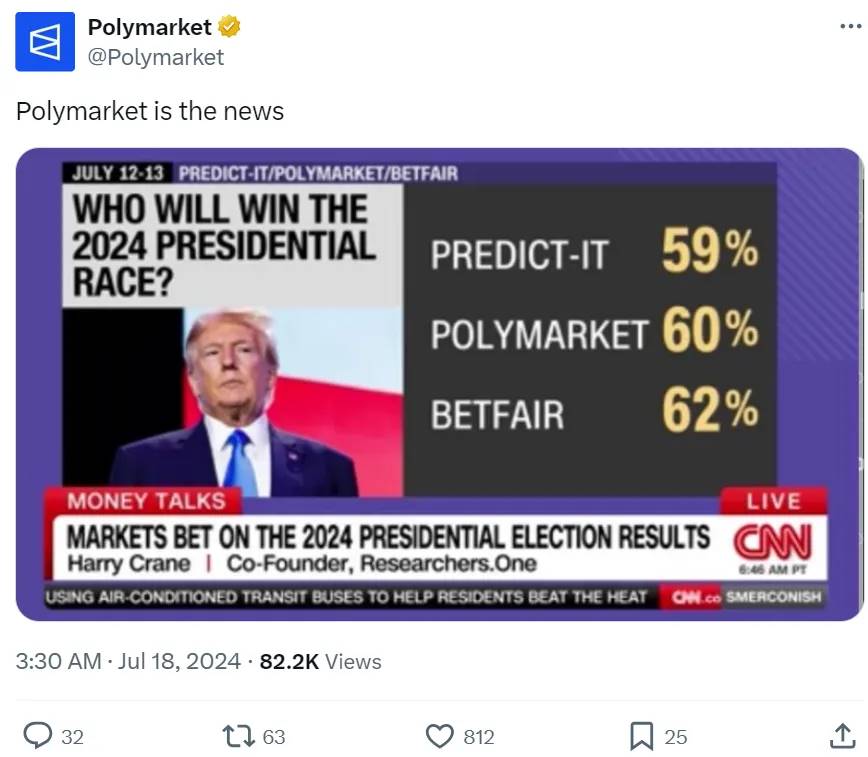
No other crypto application has drawn as much attention as Polymarket, one of the largest prediction markets in the world. While not the first crypto-based prediction market, Polymarket arrived at the right time and place, backed by an exceptional business development team and outstanding social marketing capabilities.
Chapter One: Genesis
The pioneer of crypto prediction markets was Augur, which allowed third parties to bet on event outcomes. Founded in 2015 and conducting an ICO ($REP) that same year, Augur was among the earliest protocols to launch an ICO. After three years of research, Augur launched on mainnet in 2018. Augur v2 launched in 2020, but on-chain activity did not significantly increase. At its peak, v2 barely surpassed $11 million in open interest; today, it stands at just $500,000.
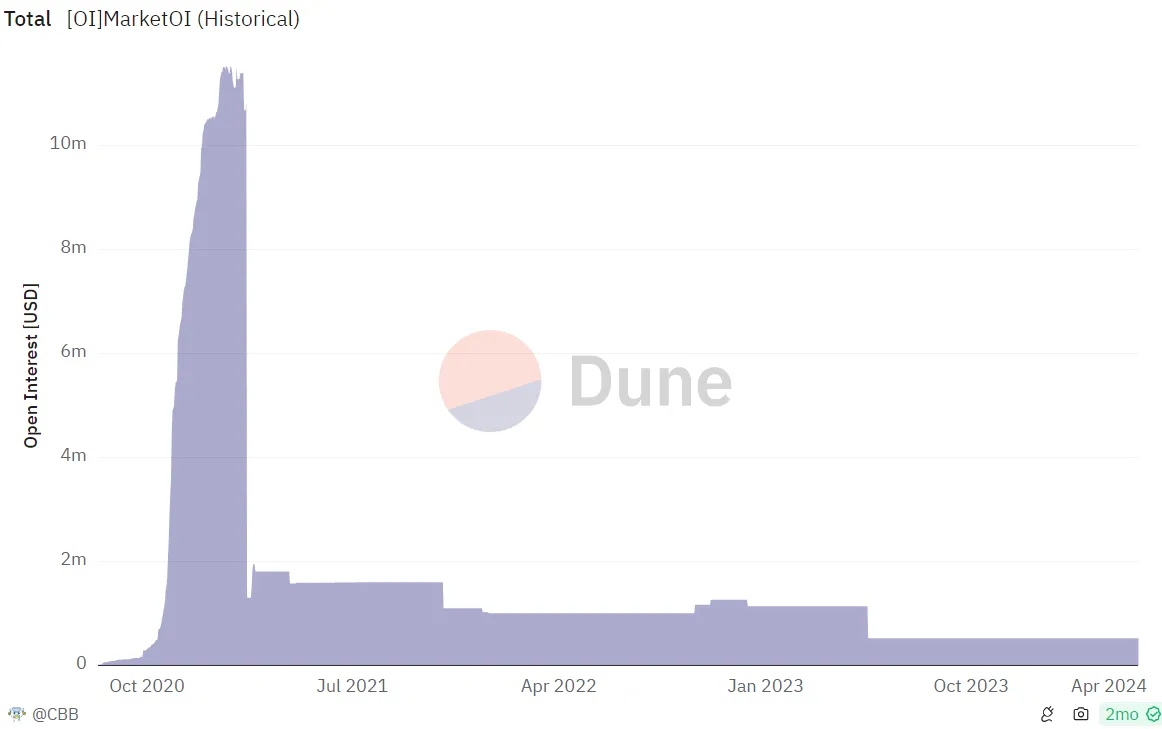
Note: The October 2020 spike correlates with the U.S. presidential election at the time
Chapter Two: Rise to Dominance
Polymarket emerged in 2020, launching under the shadow of Augur v2. Like Augur, Polymarket is a decentralized prediction market platform allowing users to trade on global events. After years of steady development, it truly broke through in 2023 with a controversial market betting on whether Titan—the submersible visiting the Titanic wreckage—would be found before running out of oxygen.
As of today (July 2024), Polymarket has grown into one of the world’s largest prediction markets, with over $283 million in open interest alone on the Biden vs. Trump presidential race—far exceeding all other betting platforms, including centralized rival Betfair (which has £31 million in open interest).
Polymarket’s operation is simple—users buy shares in markets, where prices reflect the current probability of an event (ranging from 0 to 1). These prices fluctuate based on real-time market and financial demand, representing the likelihood of an outcome. Notably, users can exit markets at any time, much like most liquid assets. The protocol also supports mutually exclusive markets with multiple binary questions, offering traders more sophisticated strategies.
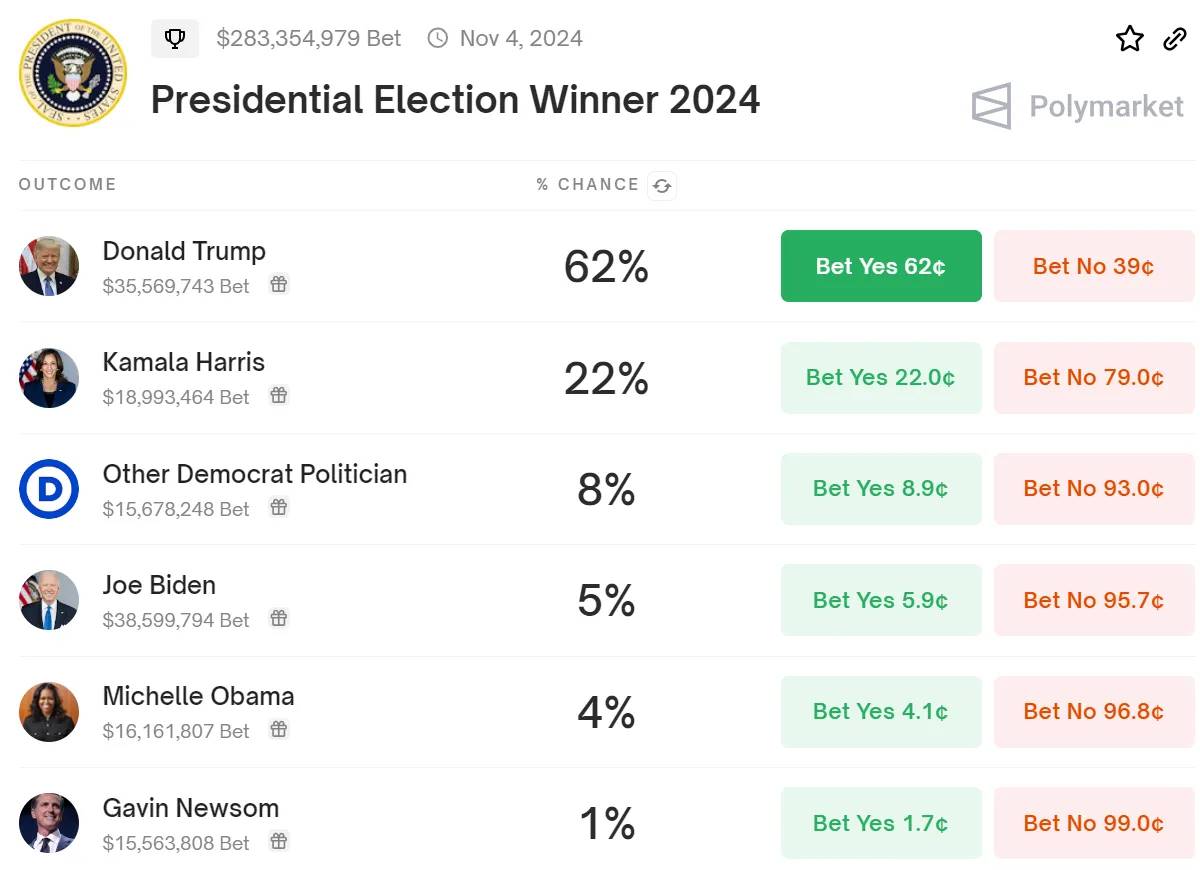
Polymarket's presidential winner pool
At its core, Polymarket operates as a hybrid decentralized prediction market, using USDC on Polygon to bypass KYC requirements. Architecturally, it is partially on-chain; order matching occurs off-chain via an order book, but all bets settle on Polygon. However, market creation is permissioned—users must apply through the team’s Discord for manual approval.
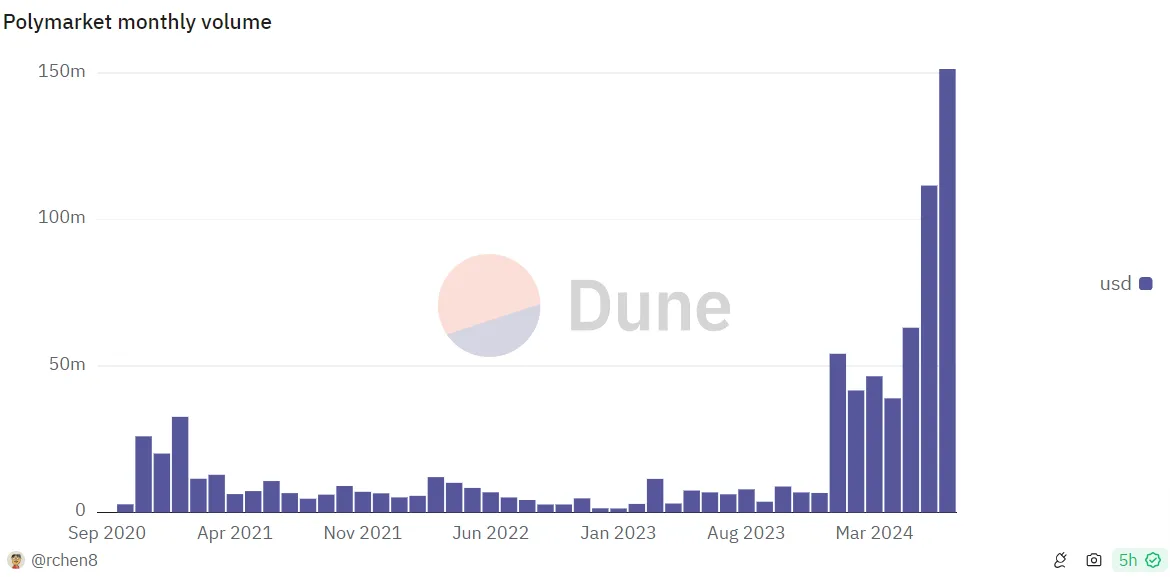
Polymarket’s growth began accelerating sharply in early 2024, reaching a record monthly trading volume of $151 million by July—up from $6 million during the same period last year. Monthly active users (MAU) surged to an astonishing 25,000, compared to just 1,000 in July 2023. 2024 also saw a wave of new user adoption, with over 70,000 new members joining in just the past three months.
Chapter Three: Trials
Polymarket’s success can arguably be attributed to two key factors:
a. Strong product-market fit (PMF) at the right time and place
Polarization in American politics, combined with our shrinking attention spans in an information-saturated world, has been amplified by social media, making us more obsessed with dramatic real-life events and the radicalization of everything.
While this polarization may not directly lead to political violence, it certainly fosters an environment conducive to it. From the January 6, 2021 Capitol riot (where Trump supporters stormed the building attempting to keep the then-president in power) to the failed assassination attempt on Trump in July 2024, such incidents have repeatedly occurred. While the U.S. may have avoided civil war, the endless stream of extremist rhetoric across social media suggests no end in sight.
Similarly, the rise of short-form video apps like TikTok has shortened user attention spans. The behavior of doomscrolling mirrors the mechanics of slot machines (“random reinforcement”), delivering constant dopamine hits and satisfaction.
b. A strong go-to-market (GTM) strategy to attract and retain users
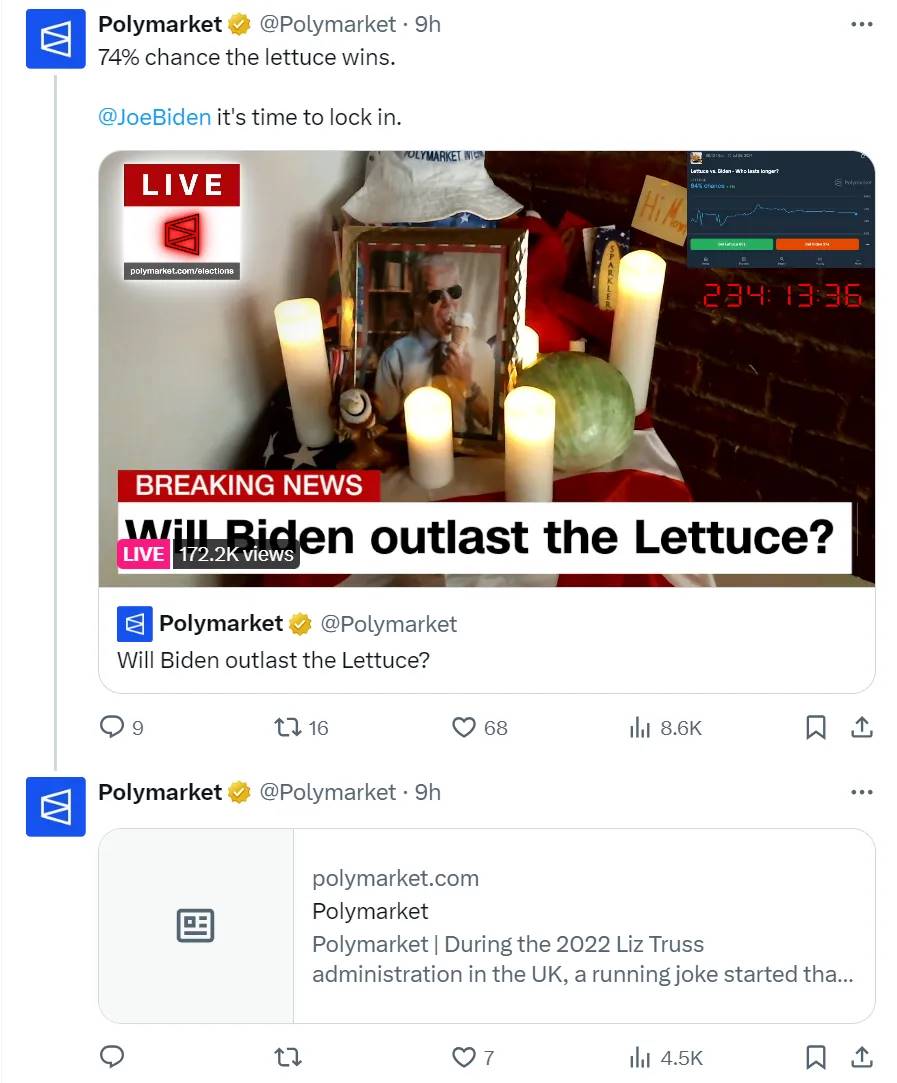
One of many tweets using memes to draw users to the platform
Polymarket’s Twitter marketing strategy stands out among competitors. With vibrant memes and witty punchlines, Polymarket has gained far greater visibility and engagement. Compared to typical competitor posts, Polymarket’s tweets are simply more compelling.
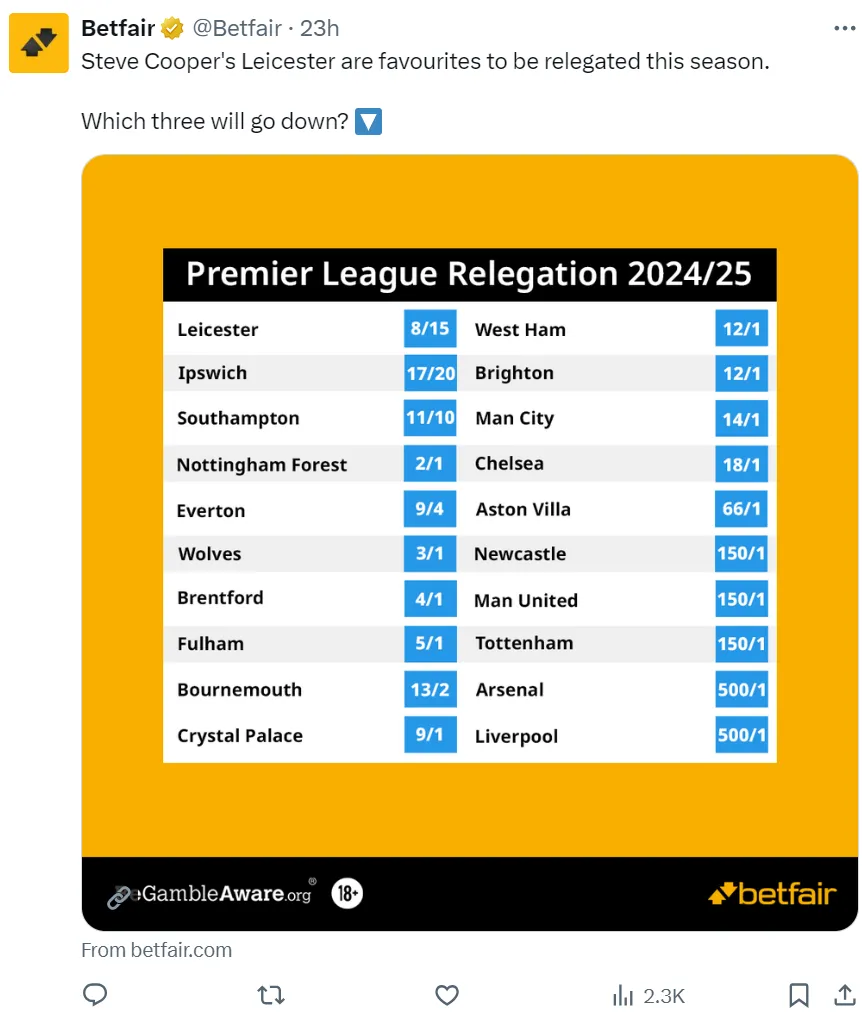
Polymarket’s viral spread has also driven organic marketing, helping not only with user retention but also increasing mindshare. This is especially critical given the cyclical nature of major events.
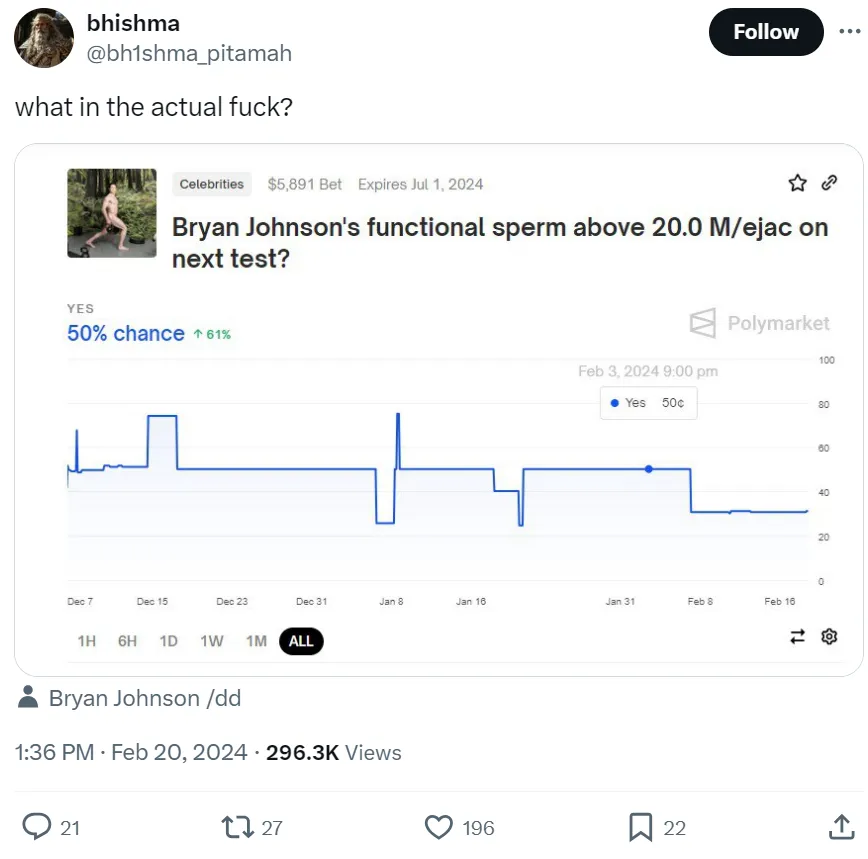
Organic marketing using shock value to make tweets go viral
Chapter Four: Warning Signs
Brightest light casts the longest shadow. Despite Polymarket’s mainstream attention, it still faces several potential challenges that management must carefully navigate.
a. Abnormal interest driven by the U.S. election; post-election trading volume may plummet
The post-election impact will be significant, with limited operational buffers. Aside from occasional major events, sports markets offer Polymarket an excellent revenue stream, though this space is already saturated and fragmented.
b. Niche and potentially "viral" markets can attract attention but also harmful traffic
Unusual markets like those around Bryan Johnson, while intriguing, carry risks of exposure to harmful traffic and insider trading. Insiders (or their associates) may know the outcome in advance and exploit it for financial gain. Thus, such markets may serve primarily as marketing tools rather than sources of actual financial profit.
c. Subjectivity in outcomes may polarize communities, leading Polymarket to favor the majority
In highly technical prediction markets, the protocol may lean toward catering to the majority view. The May 2024 ETH ETF prediction pool serves as a prime example. The controversy centered on the definition of “approval,” with disagreement over partial approval (the 19b-4 filing) versus full approval (both the 19b-4 and Form S-1 filings). After the SEC approved the 19b-4 filing, the market resolved as “yes,” sparking strong backlash from “no” buyers.
Nonetheless, I expect such issues to diminish over time, as the team gradually deploys pools with clearly defined “yes” and “no” scenarios.
Conclusion: Final Thoughts
Ultimately, prediction markets serve as a vital data source—one that may come closest to the truth. Driven by financial incentives within the mechanism, the substantial monetary stakes often outweigh individual expert opinions. They provide a powerful and unparalleled lens into future outcomes, shaping our understanding with remarkable accuracy.
Regulators may crack down on these markets, but their ability to do so is limited, as Polymarket operates primarily on-chain. And historically, demand will always exist.
The Eternal Game
It’s now 2036. People watch the year’s most anticipated events live through VR headsets. The U.S. presidential election, held every four years, has become the new sports league.
On election night, billions around the globe stare into their headsets—not just watching the broadcast, but interacting across multiple VR rooms, one of which features not only trash-talking functions but integrated prediction markets. Politics and major events are no longer dull or outdated—they’ve become electrifying, with trillions of dollars wagered in real time.

Inside VR within the metaverse
In this new world, prediction markets have evolved from niche financial instruments into mainstream entertainment, reflecting the deep integration of technology and culture. As we move forward in this hyper-connected world, the boundaries between political engagement and digital entertainment continue to blur, redefining how we experience and interact with global events. The transformation of prediction markets into such a central role underscores their profound impact on our collective consciousness and how we understand and anticipate the course of history.
Join TechFlow official community to stay tuned
Telegram:https://t.me/TechFlowDaily
X (Twitter):https://x.com/TechFlowPost
X (Twitter) EN:https://x.com/BlockFlow_News
 @ExcelMaxi


