








Eliminating MEV: A Deep Dive into Pyth Network's New Product, Express Relay
TechFlow Selected TechFlow Selected
Eliminating MEV: A Deep Dive into Pyth Network's New Product, Express Relay
Take back control, DeFi is different.
 Navigating Web3 tides with focused insights
A day in crypto feels like a year in the real world.
This saying not only refers to the rapid price movements in the crypto world but also reflects how quickly projects evolve and scale their operations.
What new developments might emerge when you revisit a project after just a few days?
Previously, top-tier oracle project Pyth Network quietly launched a countdown page on its official website, accompanied by a cryptic hint:
"Take back control—DeFi will never be the same."

On July 11, coinciding with EthCC, Pyth Network unveiled the mystery behind the countdown: a brand-new product called Express Relay, directly tackling MEV—the elusive yet frustrating issue lurking in crypto’s dark forest.
The "control" being reclaimed here actually refers to the value that DeFi protocols and users should rightfully receive but have been stripped away by MEV.
If you're a crypto builder or trader, you're likely familiar with how MEV inflates costs during transactions and protocol development.
But then again—why can an oracle project solve the MEV problem?
If Pyth's previous functionality was primarily applied before DeFi activities began (price feeds), now targeting MEV suggests that Pyth is expanding its services into the core of DeFi operations (trading/settlement).
From improving the data sources for DeFi protocols to enhancing the efficiency of the operations themselves—how exactly does Express Relay achieve this technically?
How viable is Pyth Network’s seemingly “distracted” business expansion?
In this article, we’ll dive deep into Express Relay to answer these questions.

Trapped in the Dark Forest: DeFi Protocols Under MEV Siege
To understand Express Relay, first let’s examine the problems facing today’s DeFi protocols.
There is a subtle yet very real reality:
Within crypto’s dark forest, DeFi protocols are actually vulnerable—they’re constantly hunted by MEV.
In this hunt, DeFi protocols and users collectively pay a higher price.
Here, rather than diving into a full MEV explainer, let’s use a common DeFi operation—liquidations—as an easy-to-understand example:
-
Liquidation begins: When a user becomes undercollateralized, DeFi protocols (e.g., lending platforms) trigger collateral liquidation.
-
Searchers mobilize: Specialized actors (searchers) detect and execute liquidations. They’re incentivized because protocols offer rewards—typically from fees or direct liquidation incentives—to encourage such actions.
-
Miners and MEV: Since miners (or validators) control transaction ordering, searchers must pay higher gas tips to ensure priority. This allows miners to extract more value.
-
Result: MEV emerges. Most of the reward paid by the DeFi protocol ends up in miners’ pockets—not with searchers or end users.
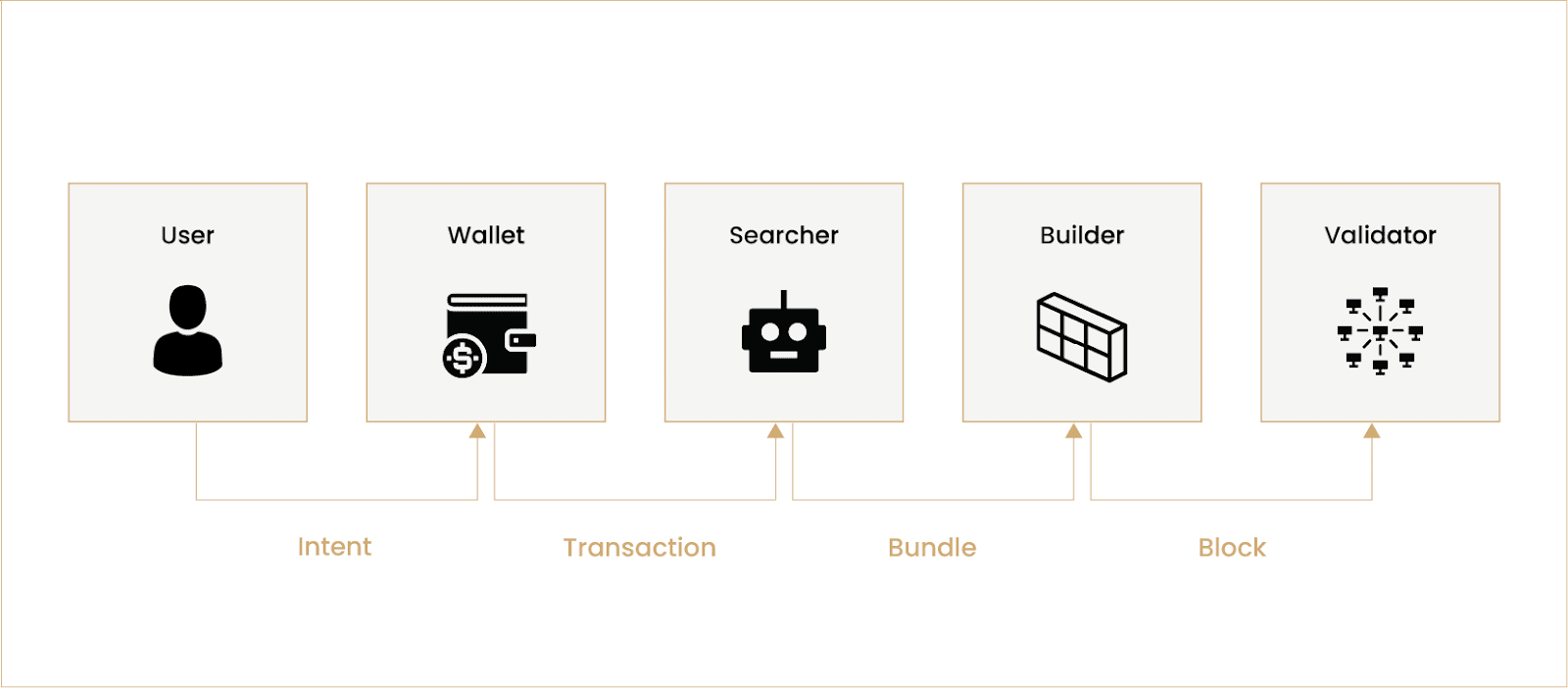
It’s similar to ordering food delivery at a higher price. Even if the meal itself hasn’t changed, platform and delivery fees increase the final cost.
For DeFi protocols, MEV causes them to fall into a trap of "overpaying" liquidation rewards—in other words, liquidations become more expensive:
Due to MEV extracting value, lending protocols must offer high rewards to attract searchers and ensure timely liquidations. These inflated rewards mean more funds go toward fees instead of improving protocol efficiency or yields.
Public data shows that Aave and Compound on Ethereum have liquidated nearly $2.5 billion worth of collateral historically. Of that, $2.35 billion was debt—meaning $150 million went to liquidation rewards, most of which ended up in miners' hands.
Compared to typical order book depths, a 4–5% liquidation bounty seems excessive.
When liquidation rewards are overpaid, these extra costs may eventually be passed on to users via higher interest rates or additional fees.
Beyond high costs, another critical issue is that emerging DeFi protocols struggle to find reliable liquidators.
Liquidations are fragmented across protocols, each with different interfaces, resulting in insufficient available liquidators.
As a result, many potential searchers hesitate to integrate as liquidators. This leads to low protocol availability and limited searcher diversity.
Thus, for new DeFi protocols, building a reliable, low-cost liquidation network is time-consuming and expensive. Developers must spend significant effort convincing searchers to adopt their protocol—all while still dealing with MEV.
In summary, within the invisible dark forest where end users remain unaware, we’ve always lacked a unified, open, and practical industry standard for processes like liquidations or other DeFi operations:
-
Redirecting value currently siphoned off by MEV to miners (validators) back to DeFi protocols, users, and searchers;
-
Enabling DeFi protocols to access a high-quality network of searchers for reliable liquidations.
And this is precisely why Pyth Express Relay was created.
Express Relay: Efficient Order Flow Auctions to Reclaim Leaked Value
Oracles are more than just oracles.
Douro Labs, the team behind Pyth Network, leveraged its experience building low-latency oracle protocols to experiment with solutions that make DeFi liquidations more cost-effective and minimize MEV impact.
That solution has now materialized as Pyth Express Relay (hereinafter "ER").
To quickly grasp what ER achieves, one sentence suffices:
MEV isn't unavoidable—and everyone can win.

To break it down by participant roles, here’s the TL;DR version of the benefits of using PER:
-
Protocols and users reclaim value previously captured by miners/validators
-
Developers can deploy applications faster
-
Searchers can easily participate in liquidations and other activities, benefiting both themselves and the ecosystem.
At the implementation level, ER’s design isolates part of the transaction flow through an off-chain, private order flow auction, reducing the MEV space available to miners.
Think of it this way: Express Relay directly connects DeFi protocols to its own dedicated network of searchers, allowing them to bid for transaction priority. The ordering of these transactions is determined in a separate auction outside miner control, eliminating their ability to extract MEV.
This means that before transactions reach miners for block inclusion, they’ve already been filtered, ordered, optimized, and bundled. By the time they reach miners, the value distribution is already settled.
By enabling DeFi protocols to auction priority for key operations, Express Relay ensures searchers compete more actively for transaction value. A direct benefit is that DeFi protocols can allocate funds more efficiently—for example, setting optimal liquidation rewards—and pass those savings on to users and other stakeholders.
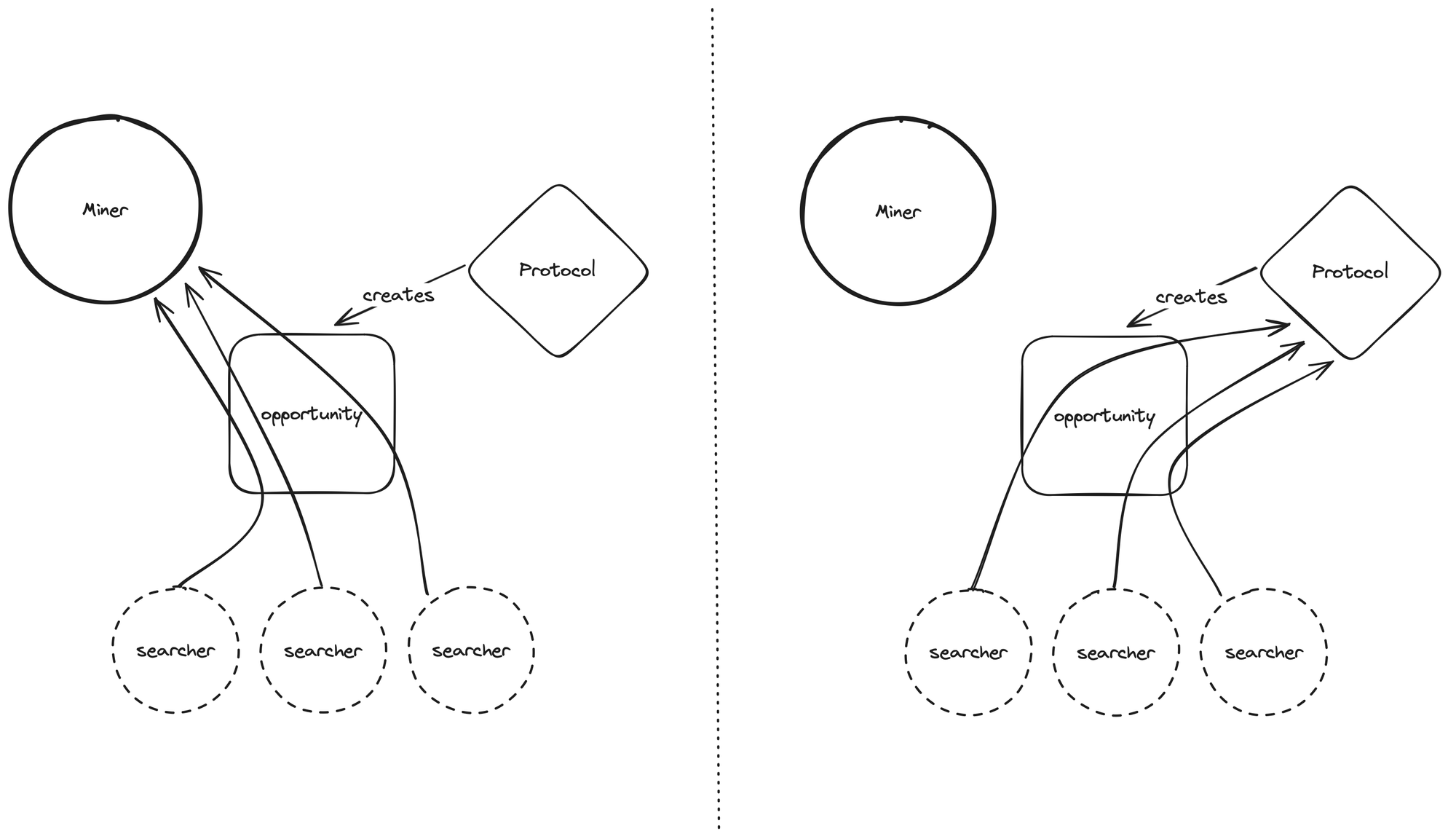
Still unclear? The diagram above abstracts away technical complexity and visually illustrates the difference between using and not using Express Relay:
On the left is the traditional workflow, where value created by the protocol leaks to block producers. In contrast, Express Relay removes miners’ ability to extract value from searchers scanning for opportunities, allowing DeFi protocols to capture most of the value directly from searchers.
In plain terms: transaction value no longer flows to miners.
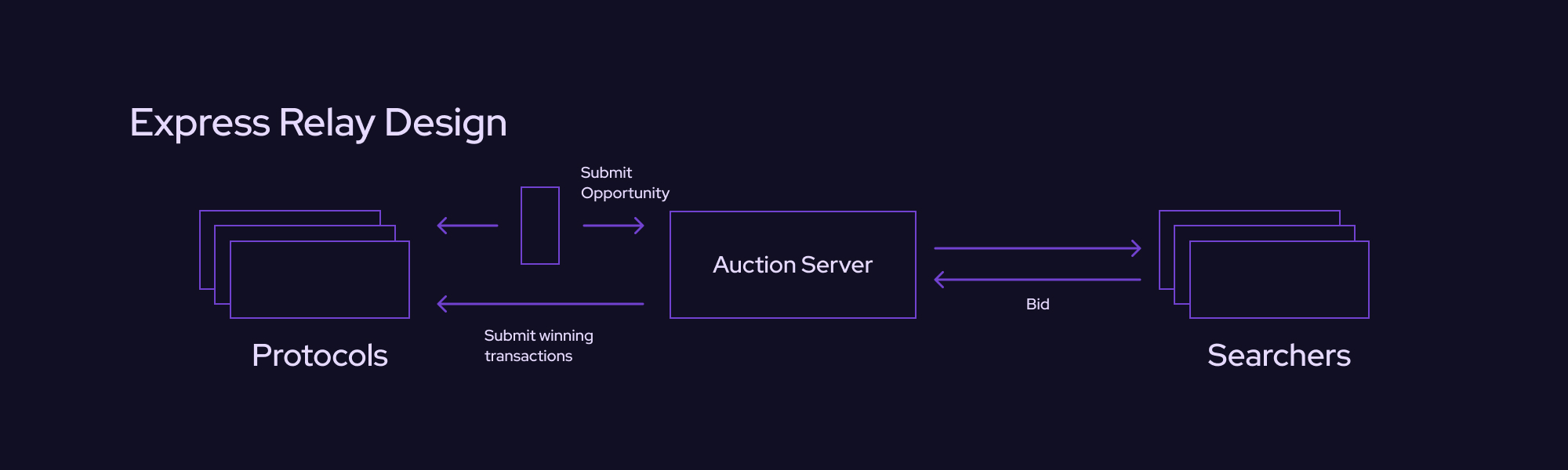
We can further clarify how Express Relay protects value through a concrete operational workflow.
Key Roles
-
Protocol: DeFi protocols submit transaction opportunities (e.g., arbitrage, liquidations) to the auction server.
-
Auction Server: Receives opportunities from protocols and broadcasts them to searchers. Searchers place bids. The server selects the highest bidder and returns the winning transaction to the protocol.
-
Searchers: Upon receiving opportunities from the auction server, searchers analyze and bid. Winning searchers submit their transactions to the server, which forwards them to the protocol.
Step-by-Step Process
-
Submit opportunity: Once a protocol identifies a transaction opportunity, it sends it to the auction server.
-
Bidding phase: The auction server displays the opportunity to all searchers. Searchers analyze and submit bids.
-
Select winner: Based on bids, the server picks the highest bidder. The winning searcher submits their transaction to the server.
-
Submit transaction: The auction server returns the winning transaction to the protocol, which bundles and submits it to the blockchain.
This isolated off-chain priority auction design securely connects DeFi protocols directly with searchers, enhancing market efficiency. Ultimately, Express Relay removes miners/validators from the MEV supply chain and gives protocols the keys to manage their own transaction priority—reclaiming control.
Plug-and-Play: No Need to Start From Scratch
It appears Express Relay solves our first mentioned issue: high DeFi liquidation costs.
But what about the second problem—emerging DeFi protocols struggling to find reliable liquidators? Express Relay’s answer is “plug-and-play.”
For early-stage protocols, Express Relay offers accelerated deployment: Without Express Relay, developers must build their own liquidation network and convince searchers to integrate. With Express Relay, new protocols can seamlessly connect to an established top-tier searcher network to meet their liquidation needs immediately.
Protocols don’t even need to sign paperwork—just call Pyth Express Relay’s contract and deploy. Their liquidation infrastructure is ready in no time.
Meanwhile, for searchers, Express Relay aggregates liquidations and other valuable transaction opportunities from multiple DeFi protocols into one place. Searchers can compete across all opportunities without writing custom integration code for each protocol. By lowering integration costs, Express Relay enables searchers to operate more efficiently and resolves the scarcity of liquidators.
You might ask: Sure, it’s easier for protocols—but what if miners/validators lose the MEV revenue they used to earn? Won’t they resist?
As more DeFi protocols and searchers adopt Express Relay, this technology could gradually become the industry standard. With rising adoption, miners will have to adapt, as most high-value transactions will flow through Express Relay or similar systems.
Moreover, given Pyth Network’s strong partnerships across the ecosystem, Express Relay could collaborate with major DeFi protocols to form a coalition promoting this technology, boosting its adoption and influence.
After all, who wouldn’t love a plug-and-play solution that benefits everyone involved?
Not Distracted—Scaling Up Strategically
To many, Pyth Network remains synonymous with oracles.
So it’s natural to question: Is venturing into MEV from oracle services really “mission drift”? Can they handle multiple roles effectively?
Quite the opposite.
The extensive partnerships mentioned earlier are already paying dividends for Express Relay. The existing oracle business acts like a pre-built network, creating massive, transferable network effects on both supply and demand sides.
On the supply side, consider the searcher network built by Express Relay: Top market makers who previously partnered with Pyth have confirmed their role as searchers in the new product.
Officially, Wintermute, Flow Traders, Flowdesk, Auros, Caladan, Tokka Labs, and Swaap Finance—seven leading market makers—are now onboard as searchers helping DeFi protocols with liquidations.

This means Express Relay faces almost no cold-start problem. These top-tier market makers are essentially “capital-backed early adopters,” forming the vanguard of this new searcher network.
This is an advantage no new MEV-focused project can match.
On the demand side, most projects already served by Pyth’s oracle offerings operate in lending, perps, and other DeFi sectors—areas that require both price feeds and liquidation support.
If both needs can be met by different products from the same provider—Pyth—why go elsewhere?
This mirrors Web2 traffic monetization—once you have users, you expand into adjacent services. For Pyth, its oracle business has already established a solid, legitimate, wide-reaching, and deeply collaborative foundation.
With 100+ data publishers, 500+ price feeds, 300+ integrated dApps, and support across 60 chains, the "pickaxe effect" works not only in airdrops but also in smooth business expansion.
The Future of a Multi-Role Star
In entertainment, actors often transition successfully into singing—"acting excellence leads to music career."
Similarly, with strong capabilities and synergistic services, Pyth Network is evolving into a multi-role player—from oracles to MEV—tackling multiple behind-the-scenes challenges that users rarely notice but protocols desperately need.
When a project becomes the master orchestrator behind crypto scenes, providing DeFi protocols with more efficient and cost-effective services, the backstage operations become smoother. Frontline participants gain better room to perform, and end users enjoy a superior experience.
Better Web3 is never about individual heroics—but the efforts of backstage players deserve recognition too.
To learn more about Pyth Express Relay, visit the official website.
Join TechFlow official community to stay tuned
Telegram:https://t.me/TechFlowDaily
X (Twitter):https://x.com/TechFlowPost
X (Twitter) EN:https://x.com/BlockFlow_News
 深潮TechFlow


