AO Protocol Unveiled: A Complete Guide from Technical Core to Staking Participation
TechFlow Selected TechFlow Selected
AO Protocol Unveiled: A Complete Guide from Technical Core to Staking Participation
The AO project demonstrates high technical stability and security, but permission control and boundary condition handling still require further strengthening.
 Navigating Web3 tides with focused insights
Authors: Mat, Riffi, Sylvia
Introduction
With the release of technical documentation, testnet token $CRED, and several memecoins, the AO ecosystem has attracted numerous active developers, demonstrating broad development potential. In today's rapidly evolving blockchain landscape, the AO protocol has emerged as an ideal platform for applications requiring massive data processing due to its significant advantages in high-concurrency handling and data storage.
After recognizing the project’s value, how can users participate?
By joining the AO testnet, readers can deposit stETH to receive AO tokens and gain early access to decentralized computing. This report will guide you through participating in AO's staking program, explaining the core features, development trajectory, and future prospects of the AO project—helping you seize opportunities and actively engage in this transformative technological advancement during the new era of decentralized computing.
Project Overview
1. AO Protocol Overview
AO is a decentralized computing system inspired by the Actor-Oriented Paradigm, capable of supporting a large number of parallel processes without being constrained by typical limitations of current decentralized computing models. Its key characteristics include:
-
Network verifiability and minimal trust requirements: The architecture is highly modular, easily integrable with existing smart contract platforms, allowing customization in computing resources, virtual machines, security mechanisms, and payment systems.
2. Core Features of AO
-
Single System Image: Hosted across heterogeneous nodes in a distributed network, enabling any number of parallel processes to coordinate via an open message-passing layer.
-
Unlimited Resource Utilization: Supports computational operations of arbitrary size and form while maintaining the network's own verifiability.
-
Modular Architecture: Users can choose their preferred virtual machine, messaging security guarantees, and payment options.
3. Key Functions of the AO Protocol
-
Parallel Processes: Supports any number of processes (contracts) running in parallel, inspired by the original actor model and Erlang.
-
Resource Utilization: Based on SmartWeave and LazyLedger (later renamed Celestia), uses a lazy evaluation architecture where nodes reach consensus on program state transitions without executing any computation.
-
Data Storage: Through Arweave, AO processes can seamlessly load and execute data of any size and write results back to the network.
-
Automated Contract Activation: Enables scheduled "cron" interactions, allowing contracts to automatically wake up and execute computations at set intervals.
4. Key Development Milestones of AO
Since AO announced the launch of its testnet on February 27, 2024, it has received enthusiastic market response, driving a significant rise in AR's price and attracting thousands of developers and users. The release of technical documentation (Cookbook), testnet token $CRED, and events like the AO online hackathon have further advanced the development and refinement of the AO ecosystem. Currently, AO subnets have launched a fully fair token release plan, incubated within the AR ecosystem already listed on exchanges such as Binance and OKX, positioning AO as a decentralized computing system. The relationship between AR and AO can be roughly compared to Filecoin and Dfinity, responsible for storage and high-performance computing scenarios respectively.
-
Release of Technical Documentation Cookbook: Includes conceptual explanations, operational principles, and developer tutorials. Translated by PermaDAO Developer Guild, available in both English and Chinese versions.
-
Launch of Testnet Token $CRED: Native token of the AO testnet, obtainable by completing bounty tasks.
-
Hosting of AO Online Hackathon – Hack The Weave: Lasting 11 days with multiple awards and a total prize pool exceeding $10,000.
-
Launch of Two AO Memecoins – $WHAT and $TRUNK: Released by a developer and community manager respectively, exchangeable using $CRED on the decentralized exchange Bark.
-
Gradual Enhancement of AO Social Application – AO Twitter: Features under development include chat rooms, profile avatars, bookmark collections, with plans to introduce MUD games in the future.
How to Participate in AO Staking
So how can one participate in AO staking? Below we provide a step-by-step guide:
1. Current Phase: Pre-Launch Stage (Ethereum Chain Staking Contract)
-
Staking Characteristics: Deposit and withdraw anytime; rewards calculated every 5 minutes, distributed once every 24 hours (non-transferable); more asset types will gradually become available for staking.
-
Awaiting Launch: Mainnet application phase.
2. Participation Process During Pre-Launch Stage
How to Deposit stETH to Receive AO
-
Start Time: June 18, 2024, 11:00 AM (Eastern Time, USA)
-
Reward Distribution: Rewards are distributed daily, with first-time recipients possibly waiting up to 24 hours to receive their initial reward.
Participation Steps
-
Go to the minting page on the AO website.
-
Click the Ethereum tab and connect your Ethereum wallet (Metamask or Rabby).
-
Enter the Arweave wallet address where you want to receive AO tokens.
-
Deposit stETH into the audited contract by entering the amount you wish to provide. (These tokens remain in a trustless contract on Ethereum and can be withdrawn at any time. If you don’t have stETH, you’ll need to swap other tokens to acquire some before depositing.)
-
Sign the transaction in your ETH wallet to deposit stETH into the contract.
-
You will receive AO tokens directly deposited into your specified Arweave wallet.

stETH Staking Interface Source: AO Official Website
3. Reward Estimation
Launch Valuation: At launch on February 8, 2025, circulating supply will be fixed at 15%. Given bullish market possibilities, different APR estimates are provided. Additionally, considering the potential appreciation of AR tokens themselves, the $AO market cap relative to $AR may decrease proportionally, thereby offering greater APR potential.
Factors Influencing Rewards
-
Release Volume: Refer to the official allocation of $AO based on percentage of total staked funds.
-
Total Staked Amount: Currently around $100 million, expected to increase over time.
4. Future Opportunities
Future phases will continue opening up. Once the permissionless ecosystem funding bridge goes live, developers will be able to earn corresponding AO token rewards by attracting users to deposit assets into their applications. This provides developers with a long-term, permissionless income stream without needing grants or external investments.
Persistent Web Ecosystem Development Association: Certain organizations and builders will share native yield generated from assets stored in the bridge. Funds will gradually diminish over time, aligning with the decay rate of network minting, supporting network bootstrapping while preserving its neutral shared protocol nature.
Through the detailed staking activity introduction above, readers can practically participate in AO’s staking program and enjoy the security and returns brought by decentralized computing and storage.

Why Choose AO for Participation and Staking?
After our in-depth analysis of AO’s technical composition and working principles, we anticipate its unique advantages in the field of decentralized computing and the vast potential they bring. We will elaborate further in the next section.
Technical Analysis
1. Building Blocks of AO
The AO system consists of three core components:
1.1 Messaging Unit (Messenger Unit)
-
Function: Responsible for message communication, delivering messages to compute units and coordinating computational outputs.
-
Role: Ensures efficient information exchange among Actors, serving as a key enabler of system-level parallel processing.
1.2 Scheduling Unit (Scheduler Unit)
-
Function: Responsible for scheduling and message ordering, uploading messages to Arweave.
-
Role: Manages message priority and sequence, ensuring overall system coordination and persistent data storage.
1.3 Compute Unit (Compute Unit)
-
Function: Handles computation and uploads results to Arweave.
-
Role: Executes specific computational tasks, forming the core computational power of the system.
2. How AO Works
AO orchestrates via blockchain technology, with each unit capable of operating as a horizontally scalable subnet to process massive transactions. This design enables high-performance computing, theoretically offering near-infinite computational capacity. Key aspects include:
-
High Concurrency: The Actor model allows a large number of parallel processes to run simultaneously, greatly enhancing system throughput.
-
Distributed Architecture: Each unit operates independently but achieves system-wide consistency through message passing and scheduler coordination.
-
Decentralized Storage: Data and computation results are permanently stored via Arweave, ensuring data security and reliability.
3. Core Objectives of AO
AO’s core objective is to deliver trustless and collaborative computing services without practical scale limits. This offers a new paradigm for applications leveraging blockchain technology. Compared to other high-performance blockchains (such as Solana, Aptos, and Sui), AO holds the following advantages:
-
Large-Scale Data Storage: AO supports storing vast amounts of data, such as AI models, giving it a distinct edge in big data and AI applications.
-
High-Concurrency Processing: Unlike Ethereum, which relies on a single shared memory space, AO allows unlimited parallel processes to run concurrently and collaborate via message passing, independent of centralized memory.
4. Comparison Between AO and Ethereum

Comparison Between AO and Ethereum Source: Compiled by WolfDAO
AO Computer and Ethereum EVM differ in architectural design, computational models, consensus mechanisms, logic execution, redundancy issues, parallelism, collaboration, and practicality. AO excels in high concurrency, distributed computing, and data storage, making it suitable for large-scale data processing and high-concurrent use cases. However, Ethereum EVM remains strong in smart contract execution and Turing completeness, having been widely adopted and battle-tested.
Therefore, AO Computer and Ethereum EVM are better seen as complementary rather than competing technologies. AO can serve as a powerful extension of Ethereum, leveraging its unique strengths in specific scenarios, though it is not yet ready to fully replace Ethereum EVM. Going forward, as blockchain technology evolves, both AO and Ethereum will continue playing vital roles in their respective domains, collectively advancing decentralized technology.
Tokenomics
AO is a subnet of the AR Network, serving an application-layer role within its ecosystem. AR currently has a market cap of $1,843,104,239 and is listed on all major exchanges including Binance and OKX (except Coinbase). AO Tokens ($AO) are entirely distributed through AR holder airdrops and ETH staking.
AO had no ICO or pre-allocation. Total supply is 21 million, halving every four years. AO is distributed every 5 minutes, with monthly issuance equal to 1.425% of remaining supply. As of June 13, 2024, AO's circulating supply was 1,038,700.
Token Allocation
-
Approximately 36% (100% for the first 4 months + 33.3% thereafter) of AO tokens are minted over time by Arweave token holders, incentivizing the security of AO’s foundational layer – Arweave.
-
Approximately 64% of AO tokens are minted over time to provide external yield and attract assets into AO, fueling its economic growth.
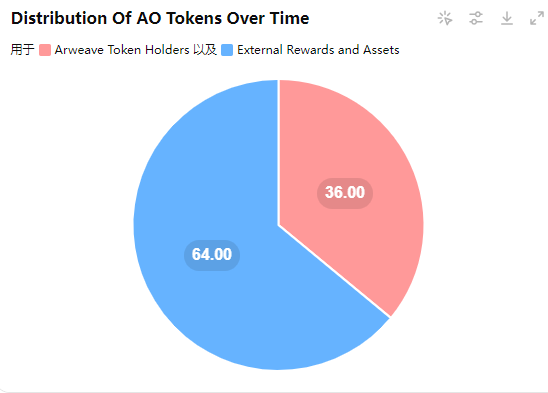
AO Token Allocation Composition Source: AO
Distribution Mechanism
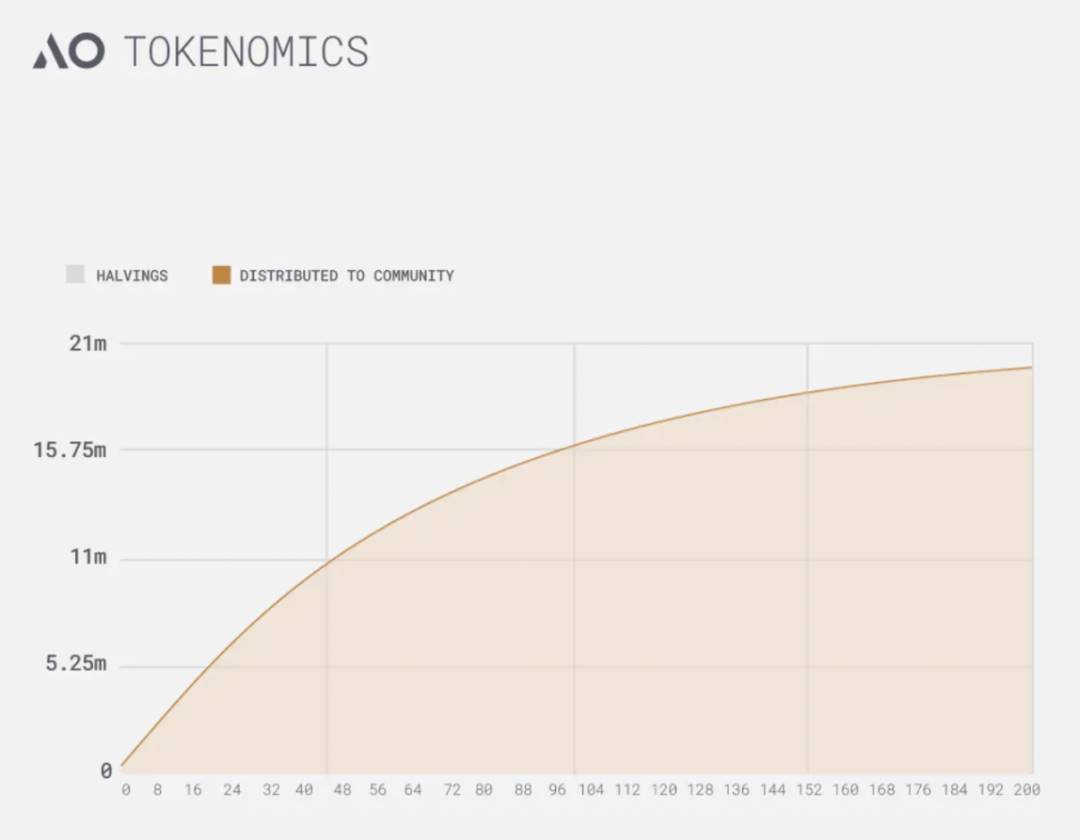
AO Token Unlock and Release Pattern Source: AO
-
AO began releasing at 1:00 PM Eastern Time on February 27, 2024. The initial 1,038,700 $AO released before June 18 were retroactively allocated to $AR holders.
-
Retroactive Airdrop (Completed): From 1:00 PM ET Feb 27, 2024 to 11:00 AM ET June 18, 2024 (Block 1372724), 100% of AO emissions were airdropped to on-chain AR holding addresses based on balance.
-
Transition Phase: First-Stage Airdrop (Starting June 18, 2024, 11:00 AM ET)
-
Represents 10% of total AO supply (3,150,000 - 1,038,700 = 2,111,300 $AO), ending around February 8, 2025, when AO unlocks.
-
AR Holding Mining: Holding AR on-chain entitles users to 33.3% of total AO distribution, allocated proportionally based on AR holdings relative to total supply.
-
ETH Mining: Staking stETH entitles users to 66.6% of total AO distribution, allocated proportionally based on stETH staked relative to total stETH amount.
AO Ecosystem Development
AO Ecosystem Landscape
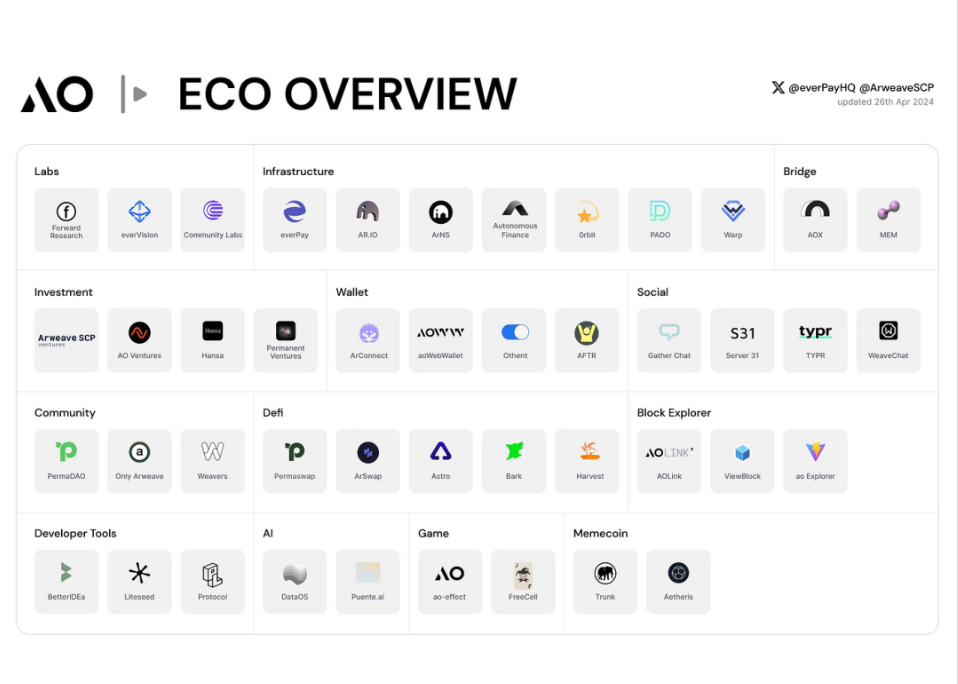
AO Ecosystem Landscape Composition Source: everpayHQ(x) / ArweaveSCP(x)
From the AO ecosystem map and its primary protocols, it is evident that the AO ecosystem spans multiple domains, forming a relatively complete blockchain ecosystem. By integrating a wide range of protocols and tools, AO has built a multifunctional, interconnected blockchain environment covering infrastructure, decentralized finance, social apps, gaming, prediction markets, and more. Its comprehensiveness and diversified services meet varied needs of users and developers alike, fostering a thriving ecosystem cycle and value creation.
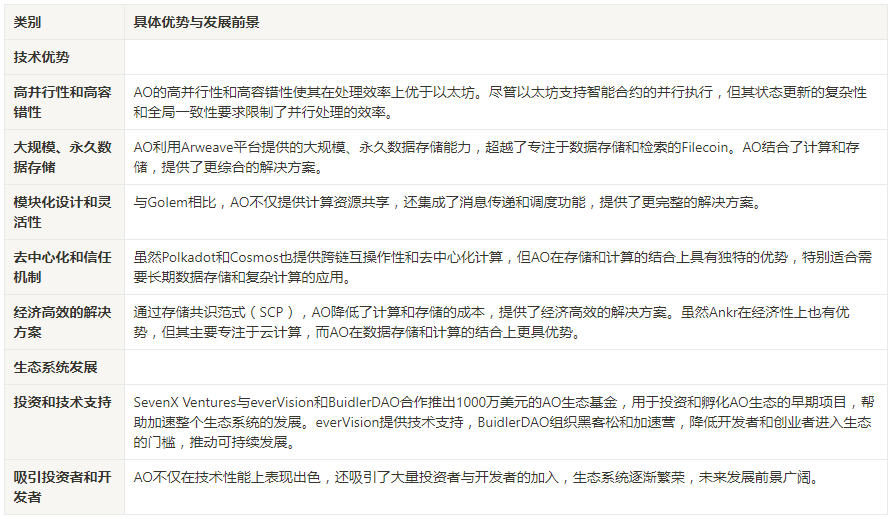
Project Advantages
As an emerging project in the fields of decentralized computing and decentralized applications (DApps), AO stands out with its advanced decentralized computing capabilities and extensive data storage, showing unique advantages and development potential compared to other Layer 1 blockchain projects.
Risk Analysis
1. Smart Contract Security
1.1 Code Quality and Contract Logic
Contract Address: https://etherscan.io/address/0xfE08D40Eee53d64936D3128838867c867602665c#code#L1
Join TechFlow official community to stay tuned Telegram:https://t.me/TechFlowDaily X (Twitter):https://x.com/TechFlowPost X (Twitter) EN:https://x.com/BlockFlow_News
 @10xWolfdao