SocialFi Exploration: Solana Actions & Blinks vs. Ethereum Farcaster & Lens
TechFlow Selected TechFlow Selected
SocialFi Exploration: Solana Actions & Blinks vs. Ethereum Farcaster & Lens
This article explores the latest innovations in the SocialFi space.
 Navigating Web3 tides with focused insights
Author: YBB Capital Researcher Ac-Core
TL;DR
-
Recently, Solana and Dialect jointly launched a new concept on Solana called "Actions and Blinks," enabling one-click Swap, voting, donations, Minting, and more via browser extensions.
-
Actions enable efficient execution of various operations and transactions, while Blinks ensure network consensus and consistency through time synchronization and sequential recording. Together, these concepts allow Solana to deliver high-performance, low-latency blockchain experiences.
-
The development of Blinks requires support from Web2 applications, immediately raising issues of trust, compatibility, and collaboration between Web2 and Web3.
-
Compared to Farcaster and Lens Protocol, Actions & Blinks rely more on Web2 apps for traffic, whereas the latter two depend more on on-chain security.
I. How Actions and Blinks Work
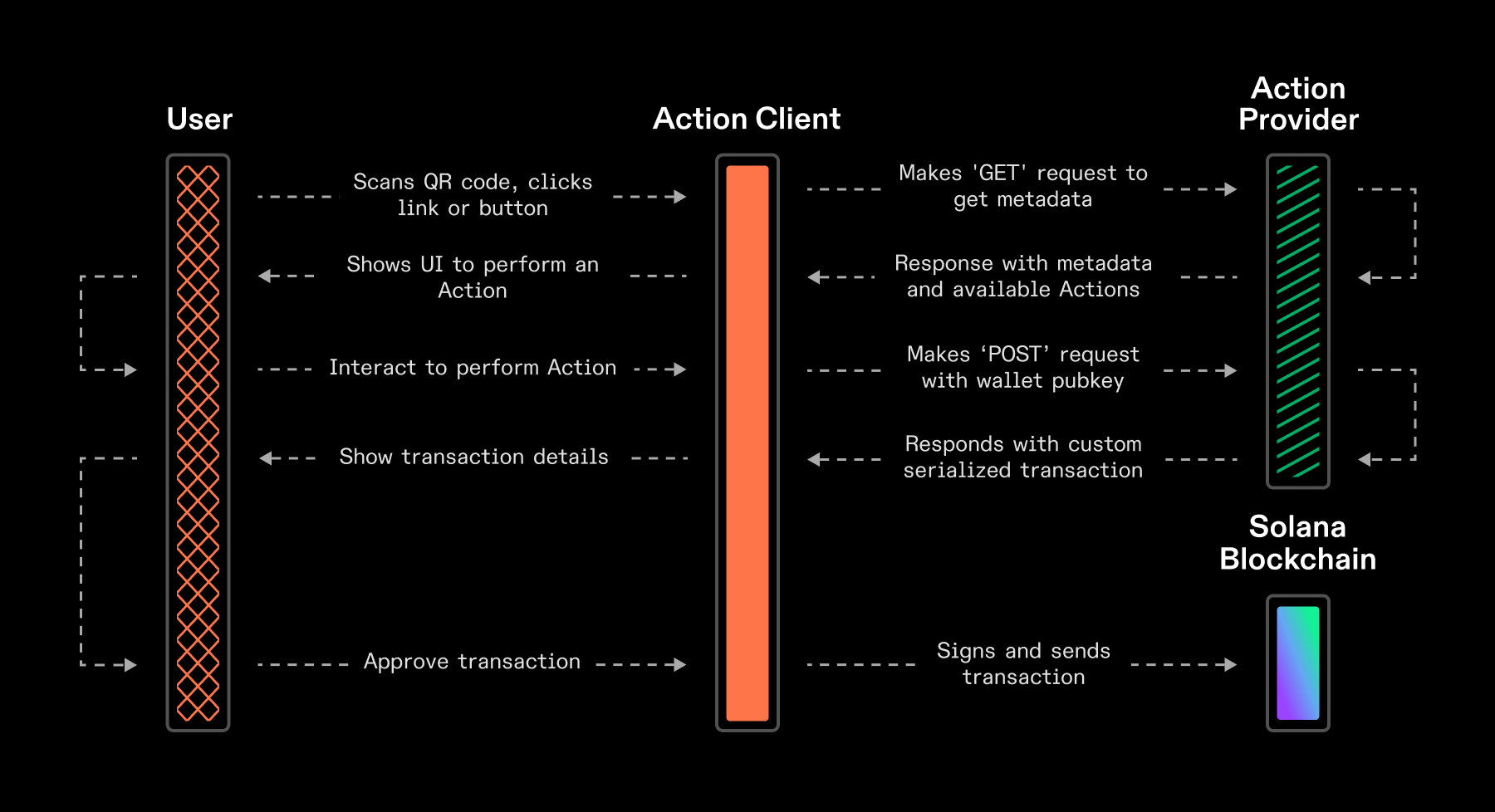
Image source: Solana docs (Solana Action lifecycle)
1.1 Actions (Solana Actions)
Official definition: Solana Actions are specification-compliant APIs that return transactions on the Solana blockchain, which can be previewed, signed, and sent across various contexts including QR codes, buttons + widgets (UI elements), and websites.
Actions can be simply understood as pending-signature transactions. More broadly, within the Solana network, Actions represent an abstraction of transaction processing mechanisms, covering transaction handling, contract execution, and data operations. In practice, users can use Actions to send transactions such as token transfers or purchasing digital assets, while developers leverage Actions to invoke and execute smart contracts, enabling complex on-chain logic.
-
Solana processes these tasks using "Transactions," each composed of a series of instructions executed between specific accounts. Through parallel processing and the Gulf Stream protocol, Solana forwards transactions in advance to validators, reducing confirmation latency. With fine-grained locking mechanisms, Solana can simultaneously process large volumes of non-conflicting transactions, significantly increasing system throughput.
-
Solana uses a Runtime to execute transaction and smart contract instructions, ensuring correctness of inputs, outputs, and states during execution. After initial execution, transactions wait for block confirmation; once agreed upon by a majority of validators, they are considered final. The Solana network can handle thousands of transactions per second with confirmation times under 400 milliseconds. Thanks to Pipeline and Gulf Stream mechanisms, network throughput and performance are further enhanced.
-
Actions are not limited to simple tasks—they can represent transactions, contract executions, or data processing. These operations resemble transactions or contract calls on other blockchains but offer unique advantages on Solana: first, efficient processing—Solana is designed to rapidly execute Actions at scale; second, low latency—thanks to Solana’s high-performance architecture, Action processing delays are minimal, supporting high-frequency transactions and applications; third, flexibility—Actions can perform complex operations like smart contract invocation, data storage, and retrieval (see extended links for more).
1.2 Blinks (Blockchain Links)
Official definition: Blinks convert any Solana Action into a shareable link enriched with metadata. Blinks allow Action-compatible clients (browser extension wallets, bots) to display enhanced functionality for users. On websites, Blinks can instantly trigger transaction previews in wallets without redirecting to dApps; in Discord, bots can expand Blinks into interactive button sets. This enables any web interface capable of displaying URLs to facilitate on-chain interactions.
In simple terms, Solana Blinks convert Solana Actions into shareable links (akin to HTTP links). When enabled in compatible wallets like Phantom, Backpack, or Solflare, websites and social media become venues for on-chain transactions, allowing any URL-enabled site to directly initiate Solana transactions.
Overall, although Solana Actions and Blinks are permissionless protocols/specifications, compared to intent-based solver systems, they still require client applications and wallets to ultimately assist users in signing transactions.
The direct goal of Actions & Blinks is to "HTTP-linkify" Solana's on-chain operations and integrate them into Web2 platforms like Twitter.
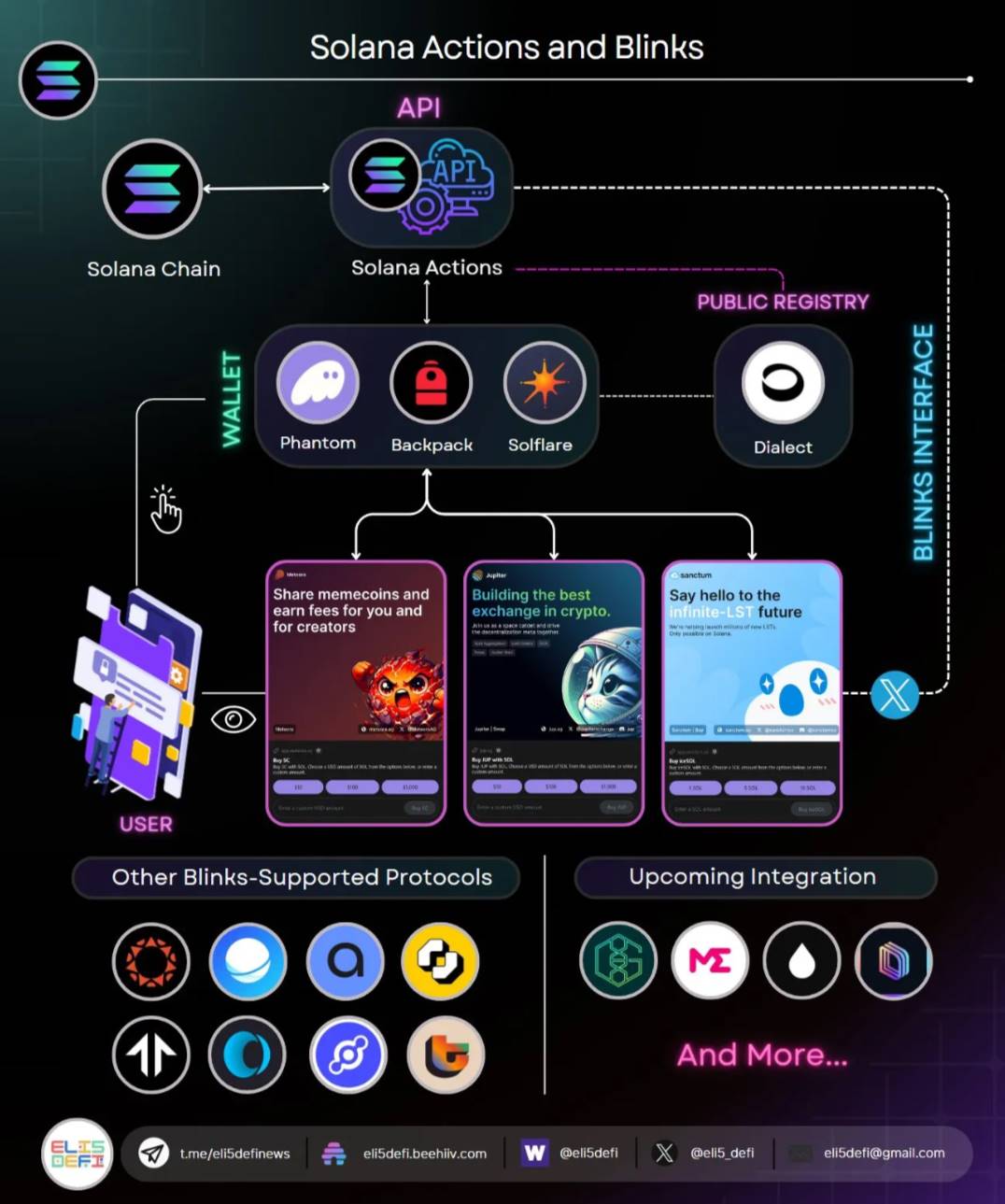
Image source: @eli5_defi
II. Decentralized Social Protocols on Ethereum
2.1 Farcaster Protocol
Farcaster is a decentralized social graph protocol built on Ethereum and Optimism, enabling applications to interconnect and engage users via decentralized technologies such as blockchain, peer-to-peer networks, and distributed ledgers. It allows seamless content migration and sharing across platforms without relying on centralized entities. Its open graph protocol automatically extracts content from posted links and injects interactive features, transforming shared links into interactive applications.
Decentralized Network: Farcaster relies on a decentralized network, eliminating single points of failure inherent in traditional centralized servers. It uses distributed ledger technology to ensure data security and transparency.
Public Key Cryptography: Each user has a public-private key pair. The public key identifies the user, while the private key signs user actions, ensuring data privacy and security.
Data Portability: User data is stored in decentralized storage systems rather than on single servers, giving users full control over their data and enabling cross-application migration.
Verifiable Identity: Public key cryptography ensures each user's identity is verifiable. Users prove account ownership through digital signatures.
Decentralized Identifiers (DID): Farcaster uses DIDs—public-key-based identifiers with high security and immutability—to identify users and content.
Data Consistency: To maintain data consistency across the network, Farcaster employs a blockchain-like consensus mechanism ("posts" act as nodes), ensuring all nodes agree on user data and actions, preserving integrity and consistency.
Decentralized Applications: Farcaster provides a development platform for building and deploying decentralized applications (DApps) that seamlessly integrate with the Farcaster network, offering diverse functionalities and services.
Security and Privacy: Farcaster emphasizes user data privacy and security. All data transmission and storage are encrypted, and users can choose to make content public or private.
With Farcaster's new Frames feature (independent yet integrated with Farcaster), "casts" (analogous to posts containing text, images, videos, and links) become interactive applications. Content is stored on a decentralized network, ensuring permanence and immutability. Each cast has a unique identifier, making it traceable, and user identities are verified via a decentralized authentication system. As a decentralized social protocol, Farcaster clients can seamlessly connect to Frames.
2.2 Core Principles Include Three Aspects
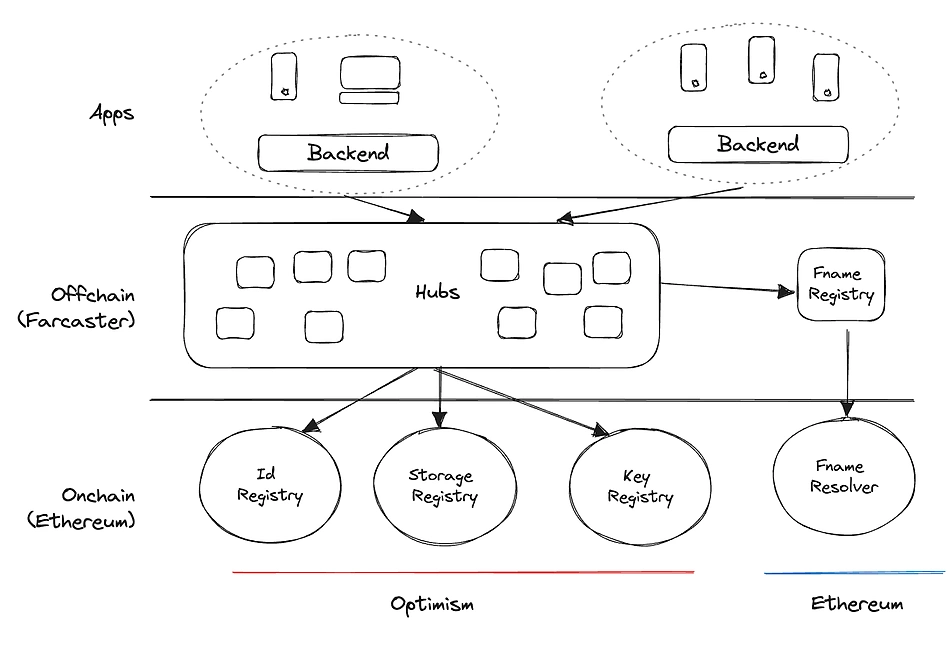
Image source: Architecture | Farcaster
Farcaster consists of three main layers: Identity Layer, Data Layer (Hubs), and Application Layer, each serving distinct functions.
Identity Layer
-
Function: Manages and verifies user identities, providing decentralized authentication to ensure uniqueness and security. Composed of four registries: Id Registry, Fname, Key Registry, and Storage Registry (refer to reference link 1).
-
Technical Principle: Uses Decentralized Identifiers (DID) based on public key cryptography. Each user has a unique DID for identification and verification. The public-private key model ensures only users control their identity information, enabling seamless identity migration and validation across apps and services.
Data Layer (Data Layer - Hubs)
-
Function: Stores and manages user-generated data, providing a decentralized data storage system to ensure security, integrity, and accessibility.
-
Technical Principle: Hubs are decentralized data storage nodes distributed across the network. Each Hub is an independent unit storing part of the data. Data is distributed across Hubs and protected with encryption, ensuring high availability, scalability, and user access/migration rights.
Application Layer
-
Function: Provides a platform for developing and deploying decentralized applications (DApps), supporting use cases like social networking, content publishing, and messaging.
-
Technical Principle: Developers use Farcaster’s APIs and tools to build DApps. The application layer integrates seamlessly with identity and data layers, ensuring secure identity verification and data management. DApps run on a decentralized network without reliance on centralized servers, enhancing reliability and security.
2.3 Summary
Solana's Actions & Blinks aim directly at tapping into Web2 application traffic channels. The intuitive potential impact: from a user perspective, simplifies transactions but increases risk of fund theft; from Solana’s perspective, greatly enhances breakout momentum and traffic effects, though risks remain regarding compatibility and support under Web2 regulatory scrutiny. Future advancements may come from Solana’s broader ecosystem, such as Layer2, SVM, and mobile operating systems.
In contrast, Ethereum’s Farcaster protocol downplays Web2 traffic acquisition, emphasizing censorship resistance and security, aligning more closely with native Web3 principles under the Farcaster + EVM model.
2.4 Lens Protocol
Image source: LensFrens
Lens Protocol is another decentralized social graph protocol aiming to give users full control over their social data and content. Through Lens Protocol, users can create, own, and manage their social graphs, which can seamlessly migrate across apps and platforms. The protocol uses non-fungible tokens (NFTs) to represent users’ social graphs and content, ensuring uniqueness and security. Compared to Farcaster on Ethereum, Lens Protocol shares some similarities and differences:
Similarities:
-
User Control: Users fully control their data and content in both protocols.
-
Identity Verification: Both use decentralized identifiers (DID) and cryptographic techniques to ensure secure and unique user identities.
Differences:
-
Technical Architecture:
-
Farcaster: Built on Ethereum (L1), divided into Identity Layer (managing user identity), Data Layer (Hubs – decentralized storage nodes), and Application Layer (DApp development platform), using offline Hubs for data propagation.
-
Lens Protocol: Based on Polygon (L2), uses NFTs to represent users' social graphs and content, with all activity stored in users’ wallets, emphasizing data ownership and portability.
-
-
Verification and Data Management:
-
Farcaster: Uses distributed storage nodes (Hubs) for data management, ensuring security and high availability. Requires annual handle renewal and uses delta graph for consensus.
-
Lens Protocol: Personal profile data as NFTs ensures uniqueness and security, no need for renewals.
-
-
Application Ecosystem:
-
Farcaster: Offers an integrated DApp development platform seamlessly connected to its identity and data layers.
-
Lens Protocol: Focuses on portability of social graphs and content, enabling seamless switching across platforms and applications.
-
From this comparison, Farcaster and Lens Protocol share similarities in user control and identity verification, but differ significantly in data storage and ecosystem design. Farcaster emphasizes layered architecture and decentralized storage, while Lens Protocol focuses on NFTs to achieve data portability and ownership.
III. Which Will Achieve Mass Adoption First?
From the above analysis, each approach has strengths and challenges. Solana leverages its high performance and ability to turn any website or app into a crypto transaction gateway, gaining early traction on social media platforms. Blinks generate links easily, quickly capturing attention and traffic—but reliance on Web2 comes at the cost of trading security for reach.
Launched in 2022, Lens Protocol has the longest track record. Its fully on-chain modular design offers strong extensibility and transparency, giving it an early market advantage. However, it now faces challenges related to cost, scalability, and fading market FOMO.
Farcaster’s strength lies in its foundational design, which best aligns with Web3 principles and achieves the highest level of decentralization. However, this brings technical complexity and user management challenges.
Join TechFlow official community to stay tuned
Telegram:https://t.me/TechFlowDaily
X (Twitter):https://x.com/TechFlowPost
X (Twitter) EN:https://x.com/BlockFlow_News
 @YBBCapital