ZKsync Launches Elastic Chain: Paradigm Innovation or Fake Demand?
TechFlow Selected TechFlow Selected
ZKsync Launches Elastic Chain: Paradigm Innovation or Fake Demand?
Bad news: ZKsync is suspected of wanting to kill Ethereum; good news: ZK might finally be saved.
 Navigating Web3 tides with focused insights
Author: Nan Zhi, Odaily Planet Daily
Yesterday, ZKsync announced the launch of Elastic Chain, an infinitely scalable ZK rollup network. First proposed in 2022 under the name "bridgeless hyperchain," ZKsync states this solution enables native, trustless, low-cost interoperability between ZK chains. Elastic Chain is not a new L1/L2 chain but rather a solution connecting various ZK networks. This article by Odaily will unpack its functions and features.
Project Background and Motivation
Ethereum's rollup-centric roadmap has successfully reduced transaction fees, increased transaction speed, and enhanced network throughput. However, as Layer 2s proliferate, liquidity fragmentation occurs, and redundant development across chains leads to inconsistent product quality and poor user experience.
Although official and third-party cross-chain bridges aim to solve liquidity issues, they still face high operational costs. ZKsync points out that because bridges must integrate liquidity from each chain, these costs are typically passed on to users—amounting to 1%-2% of transaction value—and will grow exponentially as the number of Layer 2s increases. ZKsync further notes that three of the largest DeFi hacks in terms of stolen funds involved cross-chain bridge vulnerabilities, resulting in over $2 billion in losses.
Therefore, ZKsync aims to create a solution where users can interact across chains without needing to route funds through bridges—enabling seamless, invisible interconnectivity across thousands of chains, allowing users to focus solely on the applications they're using.
Understanding Elastic Chain
According to the official definition, "ZKsync 3.0 (Elastic Chain) is an infinitely scalable network of ZK chains (including rollups, validiums, volitions, and other ZK-based solutions), secured by mathematics and offering seamless interoperability with a unified, intuitive UX." What characteristics does Elastic Chain offer, and how does it differ from unified solutions like Optimism’s Superchain?
Key features of Elastic Chain include:
-
Seamless cross-chain usage: Users can use the same address across multiple chains and require only one signature when interacting with any user or smart contract within the Elastic Chain ecosystem (eliminating the need for bridge-based fund transfers). Supports gas payments in any liquid token and allows DApps to sponsor transactions for fee-free user operations.
-
Elastic scalability: In economic terms, elasticity refers to the ability to proportionally increase supply in response to rising demand. Here, the elastic architecture allows blockchains to infinitely scale capacity by adding new instances to match usage demands. As more users join and transactions increase, the system can continue expanding without compromising performance, verifiability, or decentralization.
-
Mathematical security: All transactions are verified and executed by Ethereum, with no honest-majority assumption. ZKsync claims that in the long term, every transaction can be verified by any individual using just a smartphone.
Elastic Chain Architecture
Architecturally, Elastic Chain consists of three components: individual ZK chains, the ZK Gateway, and the ZK Router. The ZK Gateway is the most critical component—it acts as middleware inserted between ZK chains and the Ethereum mainnet. It charges fees to ZK chains and performs certain data processing tasks before publishing results to Layer 1.
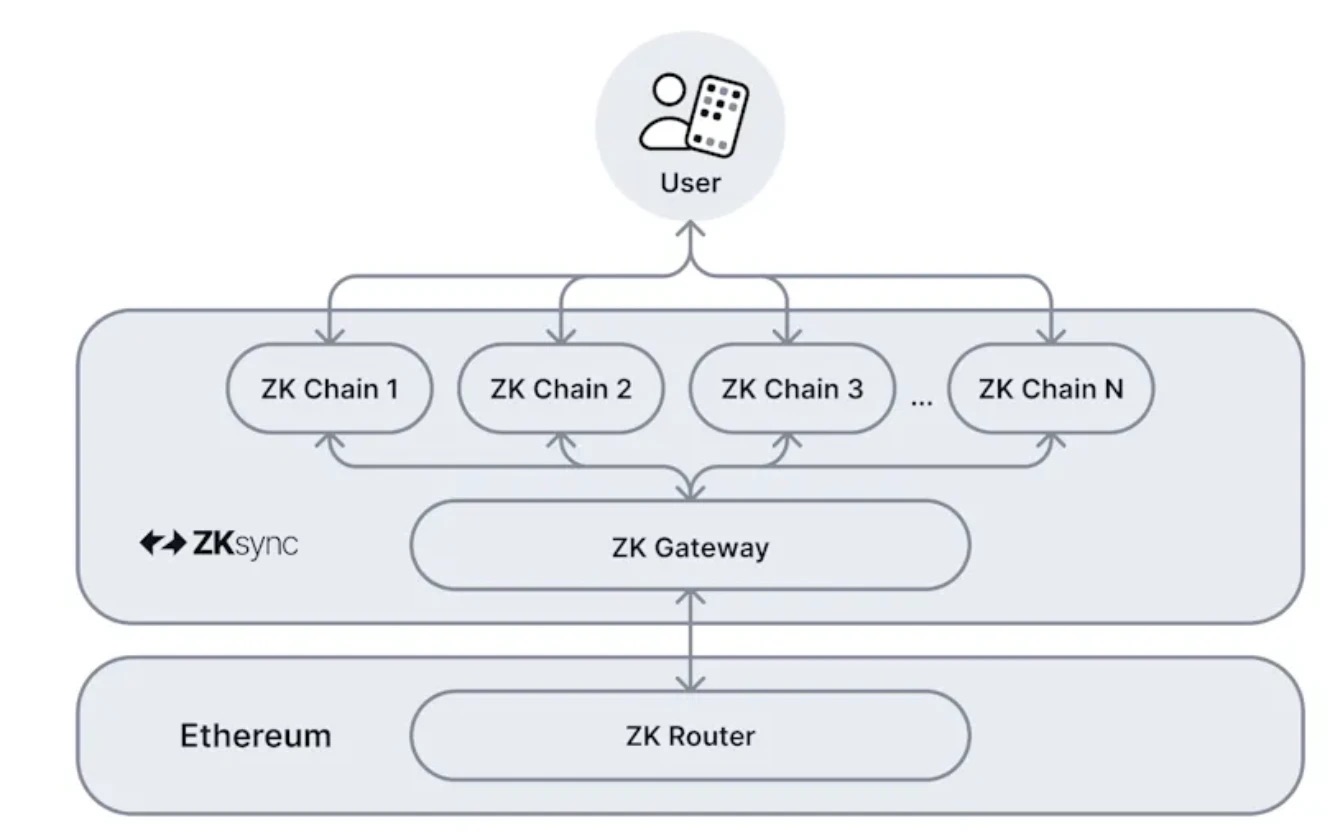
ZKsync states that by joining Elastic Chain, individual ZK chains achieve faster finality, reduce Ethereum's verification costs, remain independent, and can exit the Elastic Chain at any time.
However, joining Elastic Chain isn't free. The ZK Gateway is operated by a set of decentralized, trustless validators who must stake certain ERC-20 tokens (e.g., possibly the ZK token) to participate. These validators will charge fees for data sent to the gateway.
Competitive Comparison
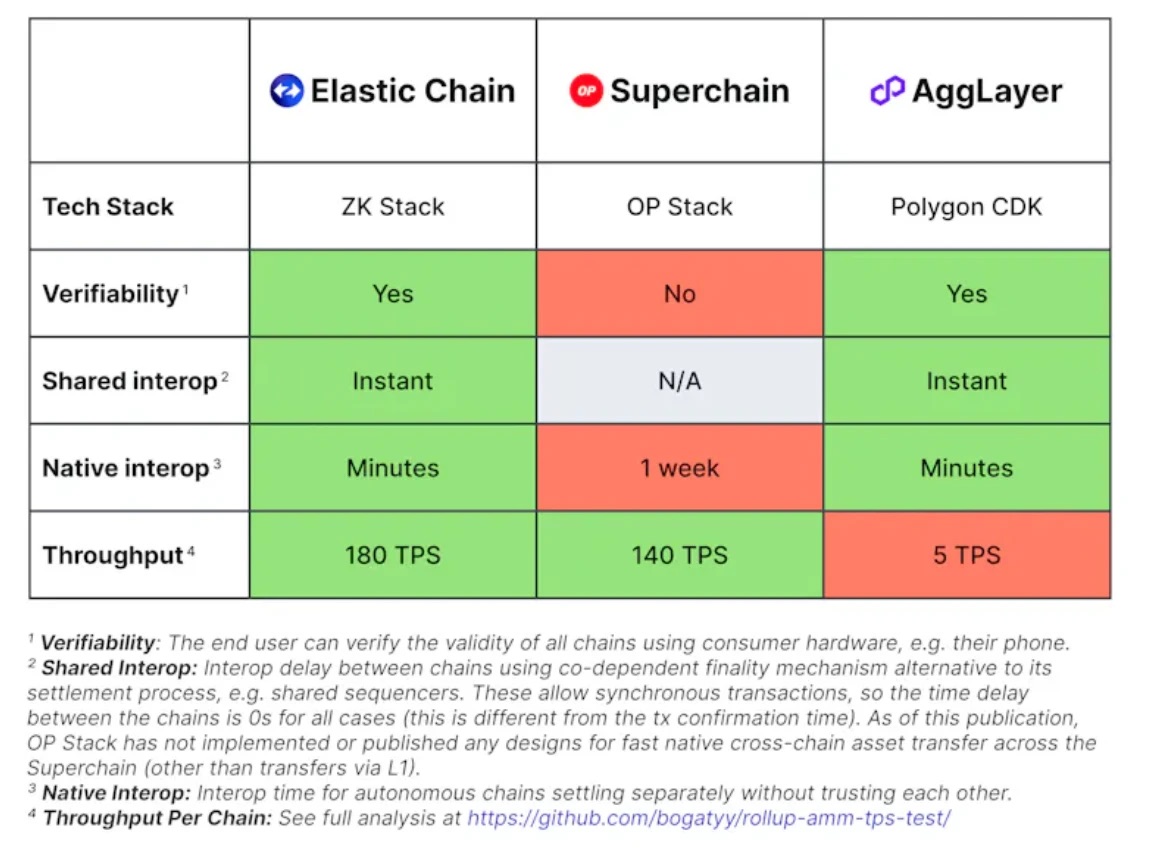
ZKsync compares Elastic Chain against other integrated solutions like Superchain and AggLayer across four dimensions, claiming superiority ("complete victory") in all. Key comparison points and data include:
-
Verifiability: Users can verify the validity of all chains using consumer-grade hardware such as smartphones.
-
Shared interoperability: Inter-chain interoperability latency is eliminated by replacing settlement processes (e.g., shared sequencers) with a common finality mechanism, enabling synchronous transactions. Thus, inter-chain time delay is 0 seconds in all cases. ZKsync notes that OP Stack has not yet released any design for fast cross-Superchain asset transfers.
(Odaily note: Since Elastic Chain involves each chain performing its own on-chain computation and then submitting results to the ZK Gateway, the chains are effectively independent and unconnected—hence no inter-chain latency.)
-
Native interoperability: Interoperability timing for independent chains that settle individually without mutual trust.
-
Throughput: Tested TPS using Uniswap.
Is ZKsync Trying to Replace Ethereum?
On the surface, Elastic Chain appears to be an effective solution to the current oversaturation of L1s and L2s. As chain deployment thresholds drop, existing protocols traditionally respond by continually adding support for new chains. With Elastic Chain, however, existing protocols can automatically connect to any newly joined chain or project on the network, saving development and marketing resources. For users, there’s no longer a need to transfer funds via bridges across different chains.
But digging deeper, Odaily Planet Daily believes this reflects a stagnation in crypto ecosystem development. Without breakthroughs in hardware or foundational technology, improvements in user experience come at the cost of sacrificing certain principles and trade-offs.
First, the claim that bridge operating costs will rise exponentially with the number of Layer 2s is a false premise—or at least irrelevant to most users. Most users don’t need or want to move funds across numerous chains. Capital and users are concentrated on a few dominant chains; many others are already ghost towns. Eliminating bridge steps won’t meaningfully attract users to these inactive ecosystems. Chains without compelling products won’t gain traction regardless of technical convenience. Letting dying ecosystems fade naturally is healthier than artificially propping them up.
Second, why do Layer 2s choose Ethereum as their DA or settlement layer? Beyond Ethereum’s canonical status, decentralization remains a key factor. While Ethereum could improve performance and lower fees, someone must uphold its core principles. From Solana being dubbed a "data center chain" in 2021 to the latest MegaETH claiming 100k TPS (but requiring extremely high-end hardware and operating with only one active sequencer), centralization continues to intensify.
Finally, the current model—with Ethereum sitting at the center as settlement layer collecting fees while Layer 2s operate as semi-autonomous fiefdoms—could shift. Whether Elastic Chain or another competitor captures significant market share, smaller ecosystems may feel compelled to join the network and pay taxes to this intermediary layer. Ethereum’s Layer 2 revenue would then depend on whoever becomes the dominant intermediary—creating a "kingmaker" dynamic where the central settlement layer is sidelined.
But there’s one silver lining: if participation as a validator ultimately requires staking the ZK token, perhaps ZK finally has a viable path forward.
Join TechFlow official community to stay tuned
Telegram:https://t.me/TechFlowDaily
X (Twitter):https://x.com/TechFlowPost
X (Twitter) EN:https://x.com/BlockFlow_News
 Odaily