








Pluralistic Governance: Who Holds the Power in a Decentralized Community? (Part 2)
TechFlow Selected TechFlow Selected
Pluralistic Governance: Who Holds the Power in a Decentralized Community? (Part 2)
Exploring DAO governance protocol design.
 Navigating Web3 tides with focused insights
Authors: Tobin South, Leon Erichsen, Shrey Jain, Petar Maymounkov, Scott Moore, E. Glen Weyl
Translated by: Tiao
Translator’s Note: The final three sections of "Pluralistic Management" contain extensive mathematical descriptions of the mechanism, which I also found challenging during translation. However, due to its formal and mathematical nature, it is amenable to implementation and iteration. Readers interested in decentralized community governance technologies will likely benefit from this.
This article comprises the last three sections of the paper on Pluralistic Management. For the previous part, see "Pluralistic Management: Who Decides in a Decentralized Community? (Part 1)"
Section 3: Model Details
The Pluralistic Management protocol defines two key subsystems: a prioritization subsystem and an approval subsystem. These coexist within a broader organizational structure where individuals earn management points that can be used to perform various actions. Points may be initially allocated at the organization's founding and naturally distributed as new members participate—thereby gradually diluting founders’ control over time. Points are stored in any simple ledger and modified through interactions with the protocol.
Additional considerations arise around the sharing, control, and visibility of these management points. Should organizations dynamically display each member’s score—effectively creating an implicit hierarchy of authority? Can individuals directly transfer points to others? Allowing such transfers could simplify onboarding for new members and enable graceful exits for veterans, but might weaken meritocratic governance and open doors to backroom deals or collusion. We revisit these open questions in the conclusion.
3.1 Prioritization
Overview: All issues appear on a kanban board. Members spend management points using quadratic funding mechanics to set issue priorities (e.g., if each member spends Pi points, total priority is (√Pi)²). Large point holders may contribute to a matching pool. Once contributions are made, priority and matching points are frozen; if approved via voting, they are awarded to contributors.
The first subsystem involves setting priorities via an issue board. Each major task or strategic challenge should have its own issue—similar to how most open-source projects operate on GitHub.
Each member can spend some of their management points to signal issue priority. This is dynamic—members may increase or withdraw points at any time. For every member i allocating Pi points toward prioritizing issue j, we compute total quadratic priority QPj as (∑√Pji)²—the same principle used in quadratic funding. We also incorporate the concept of a Matching Fund. The fund accumulates points from voting activity and can be further augmented by large point holders (such as early founders), who may choose to allocate points into the matching pool to incentivize new contributors.
In practice, the Matching Fund may not always have enough points to fully subsidize quadratic priority rewards. To address this, the Contribution Payout (CP) is proportionally adjusted based on available matching funds [2].
When a contribution is submitted, its payout should be frozen [3]. Then the contribution enters a voting process. If rejected, the issue returns to the board for alternative proposals.
3.2 Approval
Overview: Contribution voting allows any member to cast v votes at a cost of v². This is a standard single-question quadratic voting mechanism. Administrators may reserve points from issue rewards to incentivize members to predict the success probability of contributions and reward accurate predictions. This helps motivate low-point holders to understand broader organizational needs and conduct due diligence. Predictors receive a return of 2v, and administrators can adjust parameter K to reduce the relative cost of prediction versus voting.
Once a contribution is proposed, it enters a voting phase. Any member holding management points is eligible to vote. Under quadratic voting rules, casting v votes costs v² points. Members may vote either in favor or against, with opposition votes treated as negative values of v in outcome calculations. As with any quadratic voting system, there should be a defined time window for voting, after which outcomes are determined by net vote totals. In simple cases, all funds committed to the issue during prioritization go to the contributor. All points spent by members during voting flow directly into the general Matching Fund established for prioritization [4].
This voting mechanism is simple but costly. It enables members to use earned points to exert influence and shape project direction. However, early members with few points may find influencing votes disproportionately expensive relative to their holdings. This further implies that members with small point balances may lack incentive to perform due diligence—which is often labor-intensive—when evaluating whether a contribution suits the project.
To encourage low-authority members to participate and provide quality signals about contributions, administrators can add a predictive step that rewards voters. An administrator selects a parameter K to lower the cost of voting relative to prediction. Without prediction, voting costs Kv². With a concurrent prediction of v points, the cost becomes Kv² + v. Returns from correct predictions come out of the contribution payout and function like a fee incentivizing analysis of contributions.
Predictors may choose not to predict (at zero cost) or stake exactly v points, earning a return of 2v upon successful prediction [5] [6]. For large K (e.g., 1 or higher), the quadratic cost makes voting profitable only at very low point levels (though one can minimize losses by betting v when expecting passage likelihood above ½). When K=0, voting incurs no cost, and risk-neutral voters believing their side will win should bet as many points as possible. K=0 should be avoided; in fact, Theorem 3 shows K must be sufficiently high to prevent excessive erosion of expected contribution payouts. Administrators can gradually learn and tune K to encourage different behavioral patterns.
A crucial feature of this mechanism is that prediction rewards only benefit small votes. Due to the quadratic cost of voting, high-impact large votes are never profitable under reasonable non-zero K values. This ensures that highly influential members aren’t rewarded merely for knowing community preferences, reserving rewards for those who actively seek influence through appropriate engagement.

Section 4: Analysis of Protocol Properties
Here we analyze voting behavior under the protocol to demonstrate its properties and derive conditions and parameter choices needed to achieve certain goals or guarantees. We adopt the above framework and definitions, assuming individuals maximize personal utility defined as a linear combination of private preferences and future power derived from accumulating more management points. This setup resembles quasi-linear utility commonly used in mechanism design, applicable under certain conditions (e.g., as discussed by Buterin et al., 2019). While Gorokh et al. (2021) note this extension may roughly apply to long-running private-goods economies, its applicability in our primary context—public goods—is less clear. Nonetheless, it remains a standard starting point for analyzing behavior in such environments. We do not explicitly model “administrator” behavior—those who support others’ preferences via matching funds—but interpret their actions as driven by collective interest, whether altruistic, ideological, or unmodeled financial incentives (e.g., administrators may hold equity in the organization’s output) [7].
We support the above construction with a series of theorems and proofs, demonstrating the effects of specific parameter choices. First, consider the prediction step.
Theorem 1 (Individuals always bet either 0 or v points): For a given contribution vote, a rational individual aiming to maximize points, having cast v votes at cost v², will bet 0 points if success probability is below ½, and bet an additional v points if above ½.
Proof: After casting v votes, the return from the prediction round is 2w points. Since the outcome is binary, returns are either 2w or 0, so expected return is 2wp for success probability p. Subtracting costs, total expected profit is 2wp − Kv² − w = 2(p−½)w − Kv².
Conditional on v, expected profit increases linearly with w whenever p > ½. Given Kv² is already paid as fixed cost, individuals should maximize w whenever p > ½.
This yields the intuitive result: profit-maximizing predictors should bet maximum v when expected success exceeds 50%, otherwise bet nothing.
Regardless of strategy (see Figure 2), voting never yields positive returns when K=1. In practice, when voters deeply care about outcomes, the return from betting is negligible compared to quadratic costs. Typically, if voters believe their side will win, they can bet to minimize net cost. For smaller K, small voters can profit.
Indeed, for purely profit-maximizing individuals, there exists an optimal choice of v.
Theorem 2 (Optimal $v$): For a given K, a purely profit-maximizing individual should cast v=(p−½)/K votes, but only if p>½; otherwise, abstain. Using this result, we can ensure contribution payouts aren't excessively drained by prediction subsidies.
Theorem 3 (Avoid excessive depletion of contribution payouts): A conservative K can be chosen so that expenses for rewarding predictions do not exceed α fraction of the contribution payout.
Proof: Suppose N point-holding individuals are purely profit-maximizing, and K is fixed. If each accurately predicts and bets only when confident of success, then each individual who bets successfully will vote and bet at v=1/(2K), yielding a return of 1/K and profit of 2×(1/(2K)) − K×(1/(2K))² − (1/(2K)) = 1/(4K). Thus, total loss from contribution payout due to prioritization is N/K.
Since we want total expenditure ≤ αCPj, K must satisfy αCPj > N/K. This maximum payout occurs only if all point-holding members vote in the same direction.
Overexpenditure could occur: a large point holder knowing the vote will pass (assuming unanimous support) might cast a costly high-vote and prediction to further reduce the contribution payout—possibly to reduce rewards to contributors or their own voting costs. However, due to quadratic costs, such a vote would consume enormous points, making this scenario unlikely.
From this analysis, we see that for reasonable K > 0, small votes receive small rewards, while large votes remain highly costly. This is a key design effect: it imposes a quadratic penalty that encourages broader participation, especially rewarding small voters' decision-making input, while minimizing incentives for current large-point holders to simply accumulate more points.
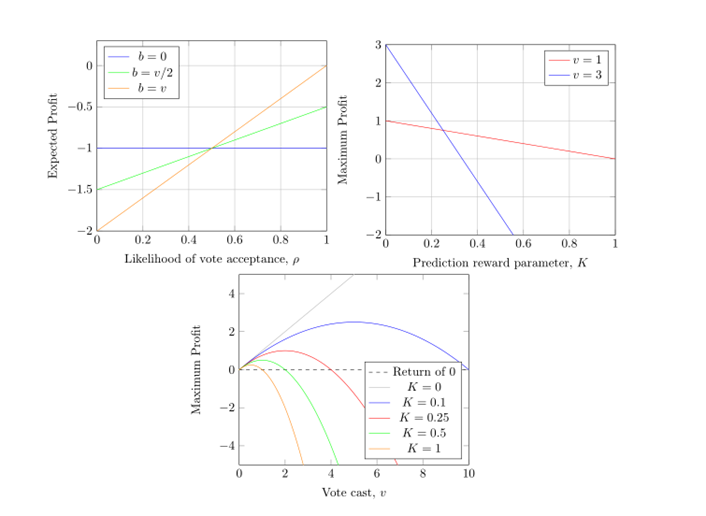
Figure 2: Top-left: optimal b value for maximizing profit under different p when K=v=1. If p>½, set b=v; else, b=0. When K=1, profits are strictly negative. Top-right: for smaller K, larger bets yield positive returns when correctly predicted. Choice of K can thus encourage or suppress pure profit-seeking behavior. Bottom: maximum profit for a member casting v votes and corresponding prediction.
4.1 Mixed Utility Analysis
While profit-maximization analysis helps clarify incentives and behaviors, clearly individuals don’t act solely to gain points. Indeed, the main motivation for gaining points is to influence future votes according to personal preferences or beliefs.
Instead, we define utility (U) as combining both point gains from a given vote and the individual’s valuation of preferred outcomes (γ) and a binary indicator of whether that outcome is achieved (A).
Formally:
U = γA + 2wp − Kv² − w
Maximizing this mixed utility still leads to optimal betting at either 0 or v (this follows naturally from d/dw γA = 0, meaning bets don’t affect outcome A).
Now consider individual pivotality, φ := dA/dv—the ability of an individual to change the outcome A. For notational convenience, define W = 1 if p > ½, else 0, simplifying derivatives with respect to w, which will be either v or 0.
Theorem 4 (Optimal v under mixed utility): For a given K, when outcome is unlikely (p < ½), individual should vote γφ/(2K); when outcome is likely, add extra (p−½)/K to capture bonus rewards.
Proof: Maximize mixed utility over v.
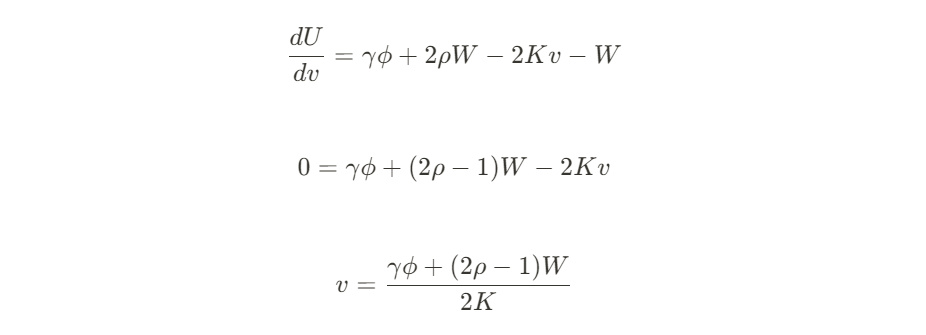
This result resembles Theorem 2, but with increased v when γ > 0. Essentially, if a member has no preference for outcome (γ = 0), they should vote as per pure profit maximization. If they do have a preference, they should choose v based on both desire intensity and their impact on the outcome.
4.2 A Detailed Example
Because these numbers and analyses may seem abstract, let’s illustrate with a constructed example.
Suppose a community has one founder with 2000 points and eight contributing members each with 1000 points. The total pool is 10,000 points. The founder creates a 1000-point Matching Fund to support new contributors. On the issue board, there are ten outstanding issues. Eight members (excluding the founder) assign one issue a priority level of 5 (each spending 25 points). The total point pool for this issue is Capj(t) = 5² × 8 = 200, and quadratic priority is QFJ(t) = (5 × 8)² = 1600. Since the matching pool lacks sufficient points, all contribution payouts are proportionally reduced. Assuming uniform priority settings across issues, reduction factor k = 0.1. Final contribution payout: CPj(t) = 200 + 100 = 300. All calculations are automatic—members only need to observe total rewards per issue.
A new member contributes to this issue and joins the community. High reward motivates her to pick this issue over others, though she joins out of interest. Management points are only useful within the current community.
During voting, no member wants to vote—they’ve already spent many points, and reviewing contributions is exhausting. To incentivize participation, the administrator (here, the founder) sets K = 0.1 to reward accurate predictions. Now all members review the contribution: 5 vote against, 5 in favor. With K = 0.1, each member’s cost is 0.1×5² + 5 = 7.5 (as each is highly confident). The founder casts an unnecessarily large vote of 12, costing 0.1×12² = 14.4. The vote passes. Each correct predictor receives 2×5 = 10 from the reward pool (totaling 40 points deducted from contribution payout—essentially a processing fee for voting and due diligence).
The contribution passes inspection. 40 points go to correct predictors, 260 points (300−40) go to the contributor, who now uses them in future votes. All voting points—26.4 + 7.5×8 = 86.4—are returned to the Matching Fund to incentivize future contributions.
Section 5: Open Questions
While theoretically flexible, Pluralistic Management faces practical challenges across different organizational contexts. Its adaptability to modern open-source environments and traditional hierarchies raises questions about real-world effectiveness and implementation strategies. This section delves into these nuances, inviting deeper exploration and collaborative research to tackle complexities arising when applying pluralistic management across diverse settings.
(1) When refining the quadratic voting mechanism in pluralistic management, it is critical to recognize and strategically address potential collusion among homogeneous socio-cultural groups within organizations (along dimensions like geography, department, role, origin, etc.). Drawing on foundational research (Miller et al.), this approach advocates for sophisticated mechanisms that actively mitigate disproportionate influence by specific groups. Such systems enhance fairness and promote genuinely diverse and representative decision-making, ensuring no single faction gains undue control—aligning better with the realities of complex organizational structures.
(2) Can we extend this method to create a multi-layered decision-making framework within organizations? This would involve developing independent yet interconnected systems for different organizational tiers (e.g., departments or teams), each with tailored voting mechanisms. Such a model could enable more localized and relevant decisions while maintaining alignment with broader organizational goals. Given its potential to integrate team-level dynamics with overall structure, this approach warrants further investigation.
(3) While rational actors may respond strongly to external incentives, overuse risks “motivation crowding”—where intrinsic motivation declines as extrinsic rewards dominate (Frey and Jegen, 2000). Though management points themselves aren’t monetary, decisions based on them must be made within the context of existing organizational culture.
(4) As salary-related studies often show: transparency in internal status hierarchies significantly affects contributor behavior (Cullen, 2023). While this may boost output, it could reduce collaboration and harm long-term objectives. Given its ease of implementation, pluralistic management offers a sandbox to compare how public versus private point records affect team performance.
(5) Currently, to prevent informal trading of management points—and thereby avoid marketization and pricing of managerial authority—individuals cannot directly transfer points to others. This prevents financialization of authority, making certain behaviors harder or impossible. For example, a founder cannot instantly onboard new members by sending points directly; instead, they must go through a complex PR-reward process subject to community voting (which also mitigates nepotism). Similarly, departing members cannot quickly transfer points unless they donate all points to the Matching Fund. Future research must evaluate implications before integrating direct point transfers into pluralistic management.
(6) Deciding when and how to promote employees is vital. Yet in large hierarchies, promotions often reflect performance in current roles rather than capacity to set high-level priorities—leading to poor management (Benson et al., 2018). Assessing how pluralistic management affects promotion outcomes—e.g., evaluating top contributors in administrative roles—would be valuable.
(7) Current pluralistic management design focuses on single organizations, communities, or projects. Many large organizations consist of multiple subunits—departments, divisions, or project teams. Future research could explore using pluralistic management to build partially nested versions, allowing individuals to exercise managerial authority within subunits while advancing in the broader workplace.
(8) Negative voting can provide useful signals but risks increasing polarization within groups (Weber, 2021). This has been empirically observed in quadratic funding rounds on platforms like Gitcoin (Buterin, 2020). Running pluralistic management instances with and without negative voting can further assess psychological impacts on cooperative behavior.
(9) When participants can influence prediction market outcomes, collusion risk rises (Ottaviani and Sørensen, 2007). Therefore, analyzing voting behavior under pluralistic management—with and without opportunities to predict outcomes—will help determine whether limits should be placed on prediction rewards.
Section 6: Conclusion
Pluralistic Management is a protocol that bridges the strengths of rigid managerial hierarchies and flat decentralized organizations, enabling dynamic allocation of managerial authority based on individuals’ long-term contributions to outcomes and decisions. By tuning the discount parameter in the voting-prediction mechanism, administrators can reward new or low-point members for conducting due diligence on new contributions, ensuring they meet expected standards or align with expectations of higher-authority members. This management approach leverages quadratic funding to elicit preferences from broad participation, creating a closed point system with no monetary value outside the organization—usable only within the project. While open questions remain regarding implementation choices and productivity outcomes, this protocol can be built using standard software practices and naturally integrated into open-source workflows. Overall, pluralistic management offers a dynamic, scalable method for allocating authority and rewarding participation across projects of any scope, mission, or scale.
Join TechFlow official community to stay tuned
Telegram:https://t.me/TechFlowDaily
X (Twitter):https://x.com/TechFlowPost
X (Twitter) EN:https://x.com/BlockFlow_News
 @SSRN
@SSRN











