Interpreting Everclear: The First Chain-Abstracted Clearing Layer Solving Cross-Chain Liquidity Fragmentation with Net Settlement
TechFlow Selected TechFlow Selected
Interpreting Everclear: The First Chain-Abstracted Clearing Layer Solving Cross-Chain Liquidity Fragmentation with Net Settlement
Everclear has the potential to become the standard solution for cross-chain settlement, bringing new possibilities to DeFi, payments, and lending.
 Navigating Web3 tides with focused insights
By TechFlow
During the vacuum period of meme mania and AI underperformance, what other promising narratives are worth watching?
Cross-chain abstraction is undoubtedly one of the most promising.
As the demand for "end users not caring about underlying blockchains, only wanting applications to work seamlessly" grows stronger, cross-chain abstraction and intent-based architectures are gaining widespread attention. Top projects, venture capital firms, and research institutions are actively exploring possibilities in this domain.
However, a major challenge facing cross-chain abstraction lies in fragmented cross-chain liquidity and the high cost of moving funds back and forth across chains, making asset transfers between different blockchains complex and expensive.
Following crypto's old tradition, projects that attempt to solve problems first tend to attract immediate attention.
Yesterday, Connext, originally known as a cross-chain communication protocol, announced its rebranding to Everclear and introduced a new primitive called "Clearing Layers" aimed at solving the high-cost issue of fund transfers within cross-chain abstraction and intent-based systems.
Following the announcement, the project’s token NEXT rose 20% within 24 hours—clearly signaling that the secondary market interpreted this strategic shift as positive news.
So what exactly is Everclear? And what real-world problems can this new concept of “Clearing Layer” actually solve?
Cross-Chain Intent: Sounds Great But Held Back by "Rebalancing"
To understand this, we need to start from the core idea behind chain abstraction and cross-chain intent.
Cross-chain intent refers to users’ desire to operate and transfer assets seamlessly across different blockchains.
You shouldn’t have to care which chain you’re on; going from A to B should just work.
But in reality, while this vision sounds ideal, there remains a gap between intention and execution.
First, cross-chain liquidity is severely fragmented. From the user’s perspective, assets are scattered across isolated chains, creating complex liquidity management challenges during cross-chain operations.
Second, the cost of “rebalancing” funds across chains is prohibitively high.
What is rebalancing?
From a business standpoint, rebalancing means reallocating funds across different blockchains to ensure sufficient liquidity exists on each chain to support user transactions.
Since demand and supply fluctuate constantly across chains, bridge operators and liquidity providers must frequently move funds between chains. To effectively rebalance, you may need to integrate with bridges, aggregators, CEXs, OTC desks, and every available liquidity source for each supported chain and asset.
These operations are not only complex but also incur high transaction and bridging fees.
And as the saying goes, the sheep pays for the wool—these costs ultimately get passed on to users, resulting in poor cross-chain experience and high costs.
Thus, between chains and local liquidity pools, everyone is playing a zero-sum game.
There’s an urgent need for a solution that can coordinate inter-chain fund flows and settlements—specifically, solve the rebalancing problem.
Everclear: Coordinating Inter-Chain Flow & Settlement via "Net Settlement"
Everclear’s proposed solution: net settlement.
The term might sound technical, but the following example makes it easy to grasp.
Previously, Connext observed that globally, about 80% of daily inflows and outflows between blockchains could be netted.
In simple terms, incoming and outgoing flows can offset each other.
For every $1 transferred into a chain, approximately $0.80 is withdrawn.
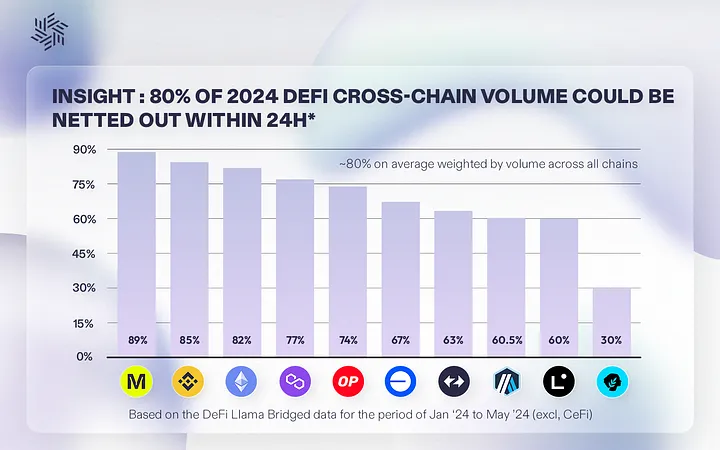
So if I deposit and you withdraw, these two separate actions result in a net inflow of $0.20 to the chain—but we’re still acting independently.
If existing participants could collaborate more easily, couldn’t we increase the net reserve on a given chain and thus solve the aforementioned rebalancing issue?
Therefore, net settlement is an optimized method for fund flow—it reduces unnecessary fund transfers by centrally calculating the net value of multiple transactions.
If User A wants to move assets from Chain X to Chain Y, and User B wants to move assets from Chain Y to Chain X, Everclear can internally adjust balances between Chain X and Chain Y through net settlement—without physically transferring funds—greatly reducing transaction costs and complexity.
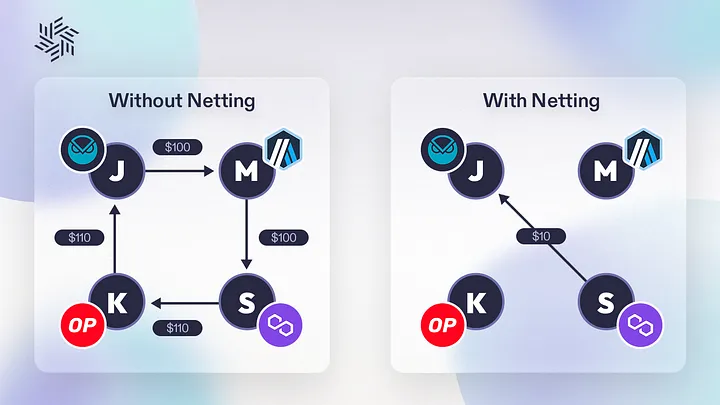
Specifically, Everclear works as follows:
-
Centralized Coordination: The Everclear system collects and analyzes all participants’ cross-chain transaction demands to identify offsetting transaction pairs.
-
Net Settlement: By computing the net value of these transactions, Everclear performs internal adjustments between chains, minimizing actual fund movement.
-
Liquidity Management: Using smart contracts and algorithms, Everclear automatically manages and adjusts liquidity across different chains to ensure sufficient funds are available for user transactions.
A simple example better illustrates the benefits of this approach.
-
Alice wants to transfer 100 DAI from Polygon to Gnosis.
-
Alice initiates the transfer via a cross-chain protocol supporting Everclear. The Everclear system calculates and optimizes execution.
-
Net Settlement: Everclear checks network-wide fund flows and discovers Bob wants to transfer 100 DAI from Gnosis to Polygon. These two transactions can now offset each other.
-
Ultimately, Alice’s 100 DAI are locked on Polygon, and Bob’s 100 DAI are locked on Gnosis. The system then releases equivalent DAI to each party on the opposite chain—eliminating the need for physical fund transfer.
Project Ecosystem Positioning and Future Value
Now that we understand how Everclear works, let’s examine its role within the broader chain abstraction ecosystem.
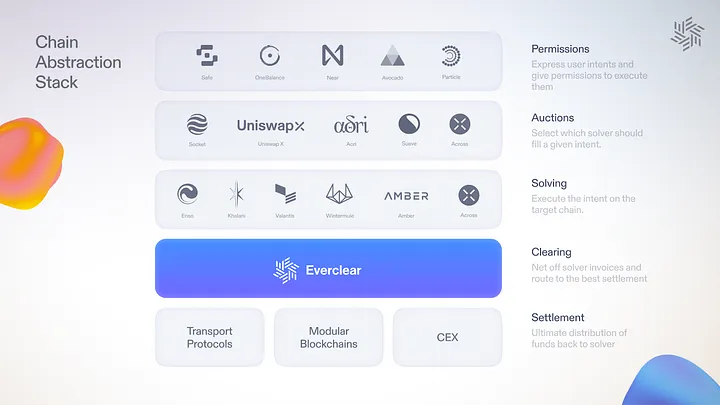
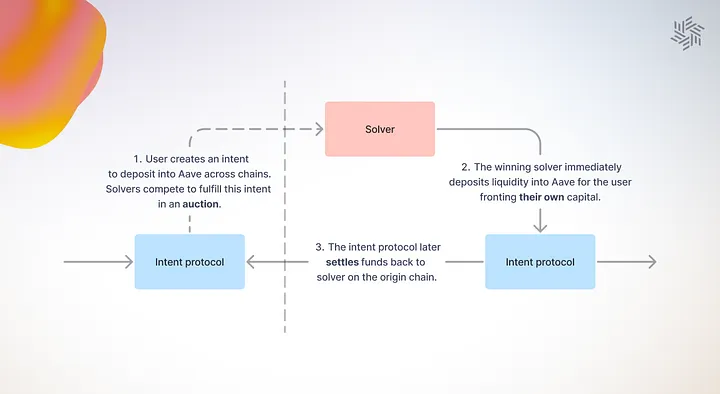
In today’s modular architecture paradigm, roles like permission layers, auctions, and solvers each play distinct parts in solving cross-chain intent challenges.
Everclear positions itself as a clearing layer beneath these three tiers, providing seamless liquidity to intent protocols and their upstream solvers.
This model resembles VISA, which provides clearing and settlement services for merchants and financial institutions.
According to its official blog, Everclear’s key advantages in this ecosystem include:
-
Reducing settlement costs and complexity by up to 10x through net settlement;
-
Supporting programmable settlement, enabling anyone to connect and coordinate across messaging protocols, token standards, canonical bridges, and any other mechanism used for settling user transactions;
-
Providing permissionless liquidity for new chains, serving as foundational support for intent-based bridges and chain abstraction applications.
Another notable aspect is Everclear’s adoption of Rollup design.
The project leverages Arbitrum Orbit rollups and collaborates with EigenDA and Gelato RaaS. Together, they function as a shared “computer,” delivering optimal clearing and settlement services for the ecosystem of protocols and solvers built atop.
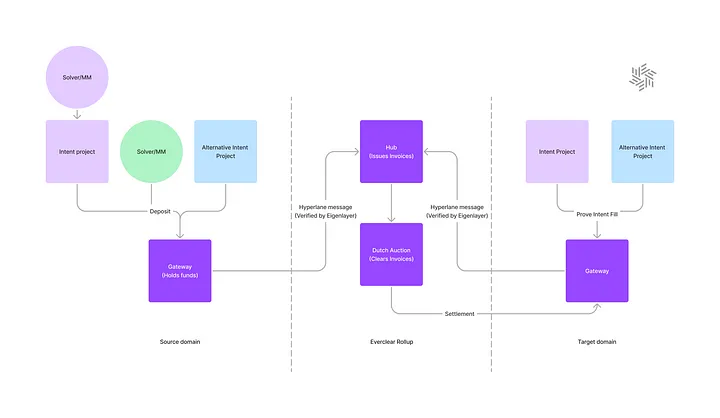
Users (intent protocols, solvers, CEXs, market makers, etc.) access Everclear by depositing funds into gateway contracts deployed on each supported chain. Then, the Everclear Rollup uses Hyperlane and its underlying AVS to batch-read the state of each gateway.
Currently, the Everclear testnet is live and ready for integration with solvers, market makers, and intent protocols.
On the branding front, Everclear will replace Connext as the new brand, though NEXT will remain Everclear’s native token, with mainnet launch scheduled for early Q3.
As a collaborative settlement layer, Everclear has already onboarded several partners, as shown below:
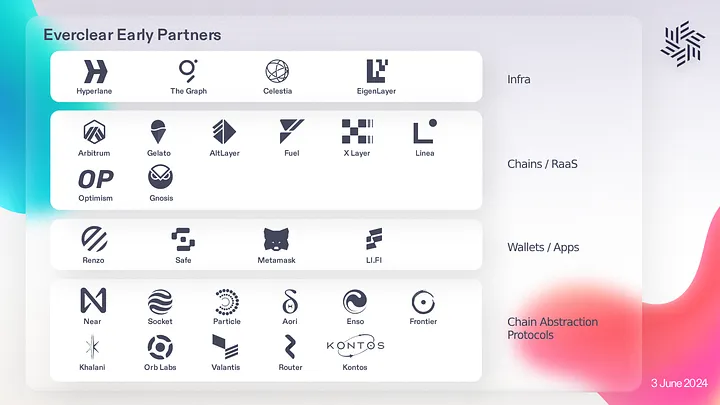
Overall, Everclear not only technically optimizes cross-chain liquidity but also plays a pivotal role in the ecosystem.
A strategy that brings everyone together for mutual benefit is clearly a strong choice amid today’s crypto market environment—where participants seek shovel-ready tools and warm抱团 (group huddling).
With mainnet launch approaching and further technical iterations underway, Everclear has the potential to become the standard solution for cross-chain settlement, unlocking new use cases in DeFi, payments, and lending.
That said, current liquidity may not yet be sufficient—market attention remains fixated on memes. Only when cross-chain demand surges will projects like Everclear achieve true self-sustainability.
Join TechFlow official community to stay tuned
Telegram:https://t.me/TechFlowDaily
X (Twitter):https://x.com/TechFlowPost
X (Twitter) EN:https://x.com/BlockFlow_News
 深潮TechFlow