Why Have Multiple Platforms Withdrawn Their Applications? Why Has the Hong Kong Exchange License Become a Hot Potato?
TechFlow Selected TechFlow Selected
Why Have Multiple Platforms Withdrawn Their Applications? Why Has the Hong Kong Exchange License Become a Hot Potato?
Currently, only two platforms have been licensed by the SFC, with 18 others in the application process.
 Navigating Web3 tides with focused insights
Author: An Shou Zheng Legal Services Limited
Multiple Platforms Withdraw Hong Kong License Applications
On May 26, according to the *Ming Pao*, the transitional period for licensing virtual asset service providers (VASPs) in Hong Kong will end by the end of this month, after which the Securities and Futures Commission (SFC) will decide whether existing operators can continue their business. Recently, several platforms including OKX and VAEX have withdrawn their license applications (see list below), citing high compliance costs and limited local market appeal. Industry insiders note that domestic platforms offer lower liquidity and fewer tradable tokens compared to overseas counterparts, and stricter regulations are key reasons behind these withdrawals.
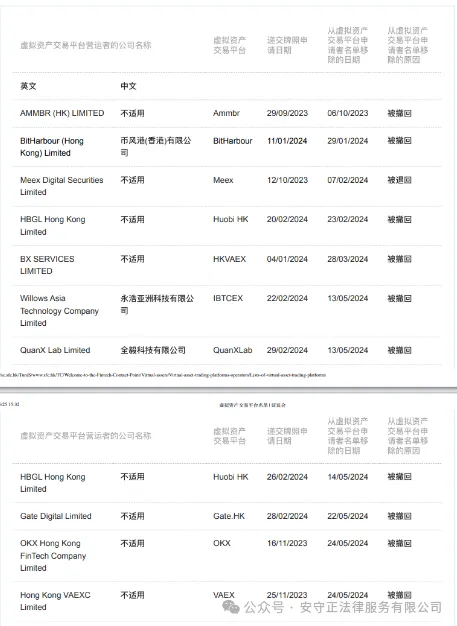
Currently, only two platforms hold SFC licenses, with 18 others still in the application pipeline. Industry experts suggest enhancing real-world tokenization use cases to boost market adoption and practical utility. Before examining the background of those withdrawing applications, let's first look at the current status of the few platforms that have obtained licenses.
1. OSL
OSL is the first platform to receive a license in Hong Kong, backed by BC Technology Group, Fidelity Investments (U.S.), and Singapore’s GIC.
Founded in 2018 as a digital asset trading platform within the Hong Kong-listed company “Brand China,” it rebranded to “BC Technology (http://00863.HK)” in 2019. In December 2020, OSL obtained Hong Kong SFC Type 1 (Securities Trading) and Type 7 (Automated Trading) licenses, offering digital asset trading services to professional investors across Asia-Pacific. Over subsequent years, OSL acquired VASP Types 4 and 9 licenses. Its operations now include SaaS, brokerage, exchange, and custodial services for institutional and retail clients. On August 3, 2023, BC Technology announced that its wholly owned subsidiary OSL had received SFC approval to upgrade its existing license, officially enabling retail investor access to Bitcoin, Ethereum, and other major cryptocurrencies.
2. Hashkey
Hashkey was founded by Xiao Feng, who played a significant role in introducing Ethereum to China and is often regarded as a pioneer of Ethereum in the region. The parent company, Wanxiang Group, enjoyed high visibility in mainland China in earlier years. CEO Deng Chao was an early member of Wanxiang, while COO Weng Xiaoqi previously served as CEO of Huobi Global during Li Lin’s tenure. Hashkey offers integrated services including exchange, securities brokerage, venture capital, Web3 infrastructure, and technology solutions, catering to institutions, family offices, funds, and qualified professional investors. Its exchange business operates as a full-service "one-stop shop."
3. HKVAX
The three co-founders of HKVAX are CEO Wu Weiliang, COO Fok Siu-leung, and CTO Liu Cheng. The first two are local Hong Kong professionals, while the CTO comes from internet giant Ant Financial. CEO Wu and COO Fok were formerly the CEO and compliance head, respectively, at CoinSuper Premium—the cryptocurrency trading platform under Hong Kong-based traditional financial group Pioneer Group. Prior to CoinSuper, CEO Wu collaborated with top-tier financial institutions such as Morgan Stanley, JPMorgan Chase, and Vanguard Asset Management, and served as Managing Director of CITIC Futures’ International Division. COO Fok specializes in compliance and leading licensing applications, having previously held roles as AML compliance lead for HSBC’s Global Private Banking and Private Wealth Solutions in Hong Kong and Asia. CTO Liu Cheng has extensive experience in financial product management and complex system R&D from his time at Alibaba and Ant Financial, and graduated from the University of Electronic Science and Technology of China.
4. VDX
Full name: Victory Fintech Limited ("Victory Digital Tech").
A partially owned subsidiary of Hong Kong-based brokerage firm Victory Securities. VDX’s core business is operating a virtual asset trading platform (VATP license pending). Meanwhile, Victory Securities focuses on virtual asset brokerage services—already holding an SFC Type 1 license—for regulated securities activities.
5. HKbitEX
HKbitEX is one of the three core business units under Tykhe Capital Group. According to official information, Tykhe Capital centers on tokenized assets, encompassing capital markets and wealth management, virtual asset exchanges, and Web3 SaaS and technology development. These operations are supported through subsidiaries operating under regulated or compliant Web3 infrastructure.
6. HK BGE
A wholly-owned subsidiary of HKE Holdings (01726.HK), a Hong Kong-listed company. HKE Holdings went public on April 18, 2018, with a current market cap of HK$2.289 billion. Originally engaged in comprehensive design and construction services for hospitals and clinics in Singapore, since May 2021, the group has diversified into building a full-fledged fintech platform covering various asset classes—including virtual assets, listed securities, bonds, and alternative investments.
From the list of licensed entities above, one can clearly see the arrogance of Hong Kong’s traditional finance sector. Regardless of user base size, influence, or platform scale, the SFC appears to prioritize connections over merit. Without strong ties, you won’t get a license. Even some of the currently licensed exchanges barely have any user traction.
SFC Responds
On May 28, the Hong Kong Securities and Futures Commission issued a statement marking the end of the non-prosecution period for virtual asset trading platforms. The SFC reminded the public that the transitional arrangement allowing unlicensed VASPs to operate without contravening the Anti-Money Laundering and Counter-Terrorist Financing Ordinance (Cap. 615) will expire on June 1, 2024. All virtual asset trading platforms operating in Hong Kong must either obtain an SFC license or qualify as “deemed-licensed” applicants under the new regulatory regime. Operating a VASP without proper authorization constitutes a criminal offense, and the SFC will take all appropriate actions against violators.
The SFC urges investors to trade virtual assets only on platforms officially licensed by the SFC and to verify their status via the “List of Licensed Virtual Asset Trading Platforms” on the SFC website.
Additionally, investors should be aware that “deemed-licensed” applicants are not formally licensed by the SFC. These platforms were already operating in Hong Kong before the implementation of the new licensing regime under the AML ordinance. While they have committed to strengthening policies, procedures, systems, and controls to meet SFC requirements, they must demonstrate effective implementation and results acceptable to the SFC.
Regarding deemed-licensed applicants, the SFC emphasized that both the platforms and their ultimate owners must fully comply with all regulatory requirements and licensing conditions. Until the SFC is satisfied with the actual implementation and effectiveness of their compliance measures and grants formal licensing, the SFC does not expect these platforms to actively promote their services or establish business relationships with new retail customers.
The SFC also reminds all virtual asset platforms and their ultimate owners to comply with all applicable laws and regulations, including but not limited to preventing access by residents of mainland China to any virtual asset-related services, and taking all necessary steps to ensure controlling entities and affiliates also adhere to relevant rules.
The deemed-licensed arrangement aims to balance investor protection with market development. As such, it is temporary. If material breaches of key investor protection regulations are identified, the SFC will swiftly reject the license application of any deemed-licensed applicant.
In the coming months, while deemed-licensed applicants continue their licensing process, the SFC will conduct on-site inspections to assess compliance with regulatory standards, focusing particularly on customer asset safeguards and Know-Your-Customer (KYC) procedures. These inspections aim to protect investor interests, and findings will directly impact licensing decisions. Should serious violations related to investor protection be found during inspections, the SFC will promptly reject the relevant license application and may take further regulatory actions as appropriate.
On May 29, local media *Wen Wei Po* reported that the Hong Kong government will maintain close communication with the SFC to expedite processing of all platform applications, providing citizens and investors with more secure investment options. Looking ahead, Hong Kong plans to further refine its regulatory framework, including oversight of over-the-counter (OTC) virtual asset service providers, aiming to build a robust ecosystem for responsible and sustainable industry growth.
The SFC reiterated that although deemed-licensed platforms have pledged to enhance their policies, procedures, systems, and monitoring mechanisms to align with SFC regulations, they must prove that these enhancements are effectively implemented and yield satisfactory outcomes. Until formal licensing is granted, the SFC does not anticipate these platforms actively promoting services or acquiring new retail clients.
Where Is Hong Kong’s Crypto Market Headed?
Strictly speaking, Hong Kong’s reluctance to grant licenses to exchanges founded by mainland Chinese entrepreneurs is the result of multiple competing interests.
The Hong Kong government has its own considerations. Their delay in licensing mainland-affiliated exchanges isn’t due to concerns about scale, security, or professionalism, but rather stems from issues of control. For example, despite large capital volumes and Merkle trees or proof-of-reserves mechanisms, these funds remain outside Hong Kong’s regulatory reach. The government cannot accept an exchange operating under its license yet remaining beyond supervision, nor risk its reputation by endorsing such entities.
Although exchanges have shown willingness to compromise and demonstrated goodwill, every operator knows clearly: goodwill has limits. If demonstrating cooperation requires bearing compliance costs far exceeding the value of the Hong Kong market, the deal simply isn’t worth it. Another issue is the black-box system problem. While exchanges may disclose or connect parts of their data to authorities, overall, the government remains largely blind to their full datasets. What regulators see is only what the exchanges choose to show—or even fabricated data.
Then there’s the legacy compliance issue. Virtually every major exchange has issued its own exchange token. Whether issuing such tokens constitutes issuing securities—and thus raises compliance risks—is unclear. There's uncertainty over whether granting a license today could later backfire if the same platform faces shutdowns elsewhere over similar issues, dragging Hong Kong into reputational fallout.
The most critical factor, however, lies in the United States. Suppose Hong Kong grants licenses to these exchanges, only for the U.S. to impose sanctions afterward—as happened recently with CZ. That would leave Hong Kong in an awkward position, given that the essence of Hong Kong’s financial system remains subservient to Wall Street.
Therefore, until the U.S. signals flexibility, Hong Kong will find it difficult to open the floodgates. Any opening would require compelling incentives. In contrast, locally operated exchanges face none of these external constraints. Above are some of the reasons, from the Hong Kong government’s perspective, explaining the current situation.
Has the Hong Kong License Become a Hot Potato?
With mainland entrepreneurs stepping back, the ball returns to the Hong Kong government and local players—but it’s a hot one. For local forces, this is truly a hot potato. They thought the license would bring windfall profits, only to end up shooting themselves in the foot.

Holding a Hong Kong license doesn’t mean you can operate globally—it only permits serving Hong Kong users. Despite Hong Kong being part of China, you’re still prohibited from serving mainland users, as crypto exchanges are illegal there. And Hong Kong itself has just 7.5 million people.
Thus, local players seem left with only one option: sell out. But the real loser here is the Hong Kong government. Two years ago, when it announced plans to regulate crypto, market enthusiasm was sky-high. But due to inflexible positioning and questionable decisions, momentum has completely died down—no matter how hard they try, nothing stirs. This opportunity may seem big, but the actual market is tiny: only a handful of potential buyers care about the Hong Kong license.
Running an exchange isn’t something anyone can do. It requires surviving market trials and achieving consensus before seeking a license makes sense. Only those who’ve emerged victorious from fierce competition and achieved meaningful scale should bother applying—and they can be counted on two hands. Now, not only are these players halting applications, they’re actively withdrawing them. How embarrassing is that for the Hong Kong government?
Even worse, local players are now turning against each other. If one of these six officially sells its license (via equity injection, shell sale, etc.), others will surely follow, given how tough running an exchange really is. If so, the licenses issued by the SFC become tools enriching local elites. After three years of buildup, Hong Kong’s grand plan ends in silence.
A once-promising hand has been played terribly (some references adapted from Encrypted Intelligence Orange).

Who would’ve thought? In the crypto market, Chinese entrepreneurs, using wisdom forged under socialism, ended up teaching a lesson to decaying capitalism.
Join TechFlow official community to stay tuned
Telegram:https://t.me/TechFlowDaily
X (Twitter):https://x.com/TechFlowPost
X (Twitter) EN:https://x.com/BlockFlow_News
 @anzhengsecurity