








Interview with Keone, Founder of Monad: Monad is Like the Child of Ethereum and Solana
TechFlow Selected TechFlow Selected
Interview with Keone, Founder of Monad: Monad is Like the Child of Ethereum and Solana
Keone Hon demonstrated the breakthrough progress made by the Monad team in blockchain performance optimization.
 Navigating Web3 tides with focused insights
Compiled & Translated by TechFlow
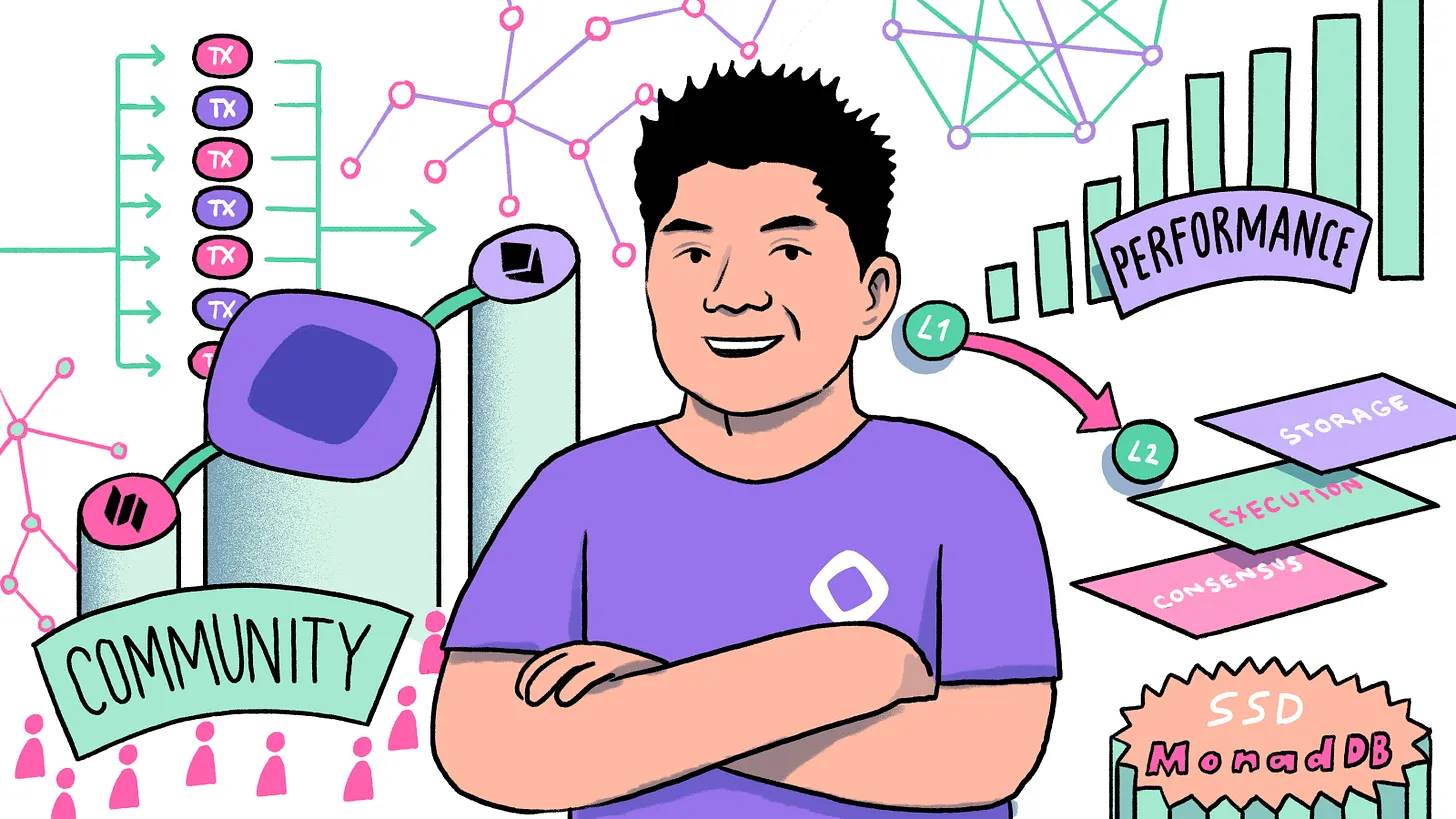
Host: SAURABH DESHPANDE, Writer at Decentralised.co
Guest: Keone Hon, Founder of Monad
Podcast Source: Decentralised.co
Original Title: "Podcast Episode: Keone From Monad"
Release Date: May 23, 2024
Key Takeaways
Keone Hon, founder of Monad, detailed the team's breakthrough progress in blockchain performance optimization through an in-depth technical discussion. The four key innovations of Monad include:
-
Parallelized Transactions: Using an optimistic parallel execution algorithm to process multiple transactions simultaneously, increasing transaction throughput and processing speed.
-
Deferred Execution: Separating consensus from execution, allowing both processes to run in parallel, making full use of block time and improving overall execution efficiency.
-
Custom State Database – Monad DB: Storing Merkle trees directly on SSDs to reduce read amplification and improve state access efficiency.
-
High-performance Consensus Mechanism – Monad BFT: Based on the HotStuff consensus mechanism, featuring linear communication complexity and pipelined voting stages, supporting synchronization across hundreds of globally distributed nodes.
Keone stated, "Monad is like the 'child' of Ethereum and Solana."
Background of Keone Hon
-
Professional Experience: Keone is co-founder and CEO of Monad Labs. He has nearly a decade of experience in high-frequency trading, focusing on building high-performance trading systems. In 2021, he joined Jump Crypto, primarily working on DeFi projects based on Solana. At that time, Keone realized the need for higher-performance EVM execution, but most scalability efforts were focused on Layer 2 solutions, data availability, and other directions—important areas, yet no one was dedicated to making the execution system itself, as well as its upper and lower layers, more efficient.
Why Do We Need Monad?
-
In early 2022, Keone co-founded Monad with two other co-founders. Monad is a fully bytecode-compatible EVM Layer 1 blockchain, capable of over 10,000 TPS throughput and single-slot finality.
-
Monad rebuilt three major layers from scratch within Ethereum—the storage layer, execution layer, and consensus layer. It introduced innovations including parallel execution and a high-performance state storage system, which provides parallel state access and a high-throughput consensus mechanism—Monad BFT. It achieves true performance gains through deferred execution.
Monad’s design aims to solve the following issues:
-
Demand for High-Frequency Trading: Traditional high-frequency trading systems require processing large volumes of orders in extremely short times. Latency and efficiency are critical. Existing blockchains cannot meet this demand.
-
Reducing Transaction Fees: High transaction fees on existing blockchains (e.g., Ethereum) impact market efficiency, especially for market makers and high-frequency traders, where frequent quote updates are too costly.
-
Improving User Experience: High fees and slippage on current DeFi platforms negatively affect ordinary users’ trading experience. Monad aims to provide a more efficient and lower-cost trading environment.
-
Keone’s idea was to build a high-performance blockchain enabling more centralized-style trading.
Monad’s Future Vision
-
Keone said that while Monad’s initial focus is on crypto-native applications and assets, in the long term, he believes blockchains can serve as more efficient settlement mechanisms for various financial transactions, including traditional assets. Advantages of Monad include:
-
More efficient settlement: applicable to financial transactions such as stocks, bonds, and mortgages.
-
Greater transparency: making transaction processes more open and transparent.
-
Composability: different applications and smart contracts can interoperate, building new functionalities like "Lego blocks".
-
Self-regulation: ultimately enabling decentralized finance (DeFi) to offer better trading experiences than centralized exchanges (CeFi), closing the gap in execution quality and cost.
Innovations of Monad
Monad vs. Ethereum & Solana
-
Monad actually integrates certain aspects of Ethereum. Monad emphasizes full compatibility with Ethereum, ensuring bytecode-level EVM compatibility and Ethereum RPC compatibility, reducing difficulties for developer migration.
-
Monad shares similarities with Solana in terms of high performance and optimization, although there are differences in execution parallelization and transaction formats. Monad combines Ethereum’s compatibility with Solana’s high performance to create a unique advantage.
-
In summary, it's as if Solana and Ethereum had a child—and that child is Monad.
Monad’s First Innovation – Parallelized Transactions
-
Keone noted that current Ethereum and compatible blockchains have limitations—transactions are executed serially. This approach is far removed from how modern multi-processor, multi-threaded computers operate. Modern computers can run multiple threads simultaneously, increasing processing efficiency. However, Ethereum’s single-threaded execution limits its scalability and performance. Serial execution ensures all nodes reach consistent states by processing transactions sequentially (e.g., from 1 to 200), guaranteeing deterministic outcomes and node synchronization. While simple and easy to implement deterministically during early system design, this model is inefficient.
-
Keone explained that Monad introduces an optimistic parallel execution algorithm, allowing a batch of transactions to run simultaneously from the same starting point, tracking each transaction’s inputs and outputs. During execution, the system generates a batch of pending results—one per transaction. These pending results are then processed sequentially according to the original order, checking whether inputs have changed. If inputs remain unchanged, the result is committed; otherwise, the transaction is re-executed.
-
Parallel execution improves transaction processing performance, reduces system latency, and enables more efficient handling of large transaction volumes.
Monad’s Second Innovation – Deferred Execution
-
Keone said that Monad’s second innovation is deferred execution—splitting consensus and execution into separate processing pipelines.
-
Keone noted that Monad also innovates in consensus. The leader orders transactions, and nodes reach consensus on the official transaction order without requiring immediate execution—all nodes need only agree on transaction ordering and validity.
-
-
In Monad, a long list of transactions is divided into individual threads that can be executed in parallel, each generating a pending result containing the input and output lists of the transaction. After generating pending results, the system processes them step-by-step in the original transaction order. If a pending result’s input has no conflict, it is committed immediately; if there is a conflict, the transaction is re-executed.
-
In Monad, the consensus process first reaches agreement on transaction order (i.e., consensus). Execution is moved out of the critical path of consensus into a separate pipeline, which then handles transaction processing. By separating consensus and execution, Monad can dedicate more time to actual transaction execution, significantly improving block processing capacity.
Monad’s Third Innovation – Custom State Database: Monad DB
-
Keone mentioned in the interview that in existing Ethereum clients, state is stored in Merkle trees embedded within other databases (e.g., LevelDB or RocksDB). This nested structure causes read amplification—accessing one node of the Merkle tree triggers a series of additional disk lookups, leading to inefficiency. When executing smart contracts, the biggest bottleneck is state access, not computation itself. Computation is relatively light and fast on CPU, but retrieving state variables from SSDs is slow.
-
The Monad team designed a method to store Merkle trees directly on SSDs, thereby reducing read amplification and improving access efficiency. SSDs offer high bandwidth, and MonadDB’s design leverages this more effectively. During parallel transaction execution, the system needs to retrieve many dependencies from the SSD—efficient use of SSD bandwidth makes queries faster.
-
Keone said that directly storing Merkle trees reduces lookup counts, speeds up state access, and optimizes overall execution performance. The parallel execution algorithm involves two phases:
-
Phase One: The parallel execution algorithm first pulls all transaction dependencies from the SSD into memory. This ensures that even if a transaction needs re-execution, its dependencies are already in memory, speeding up lookups.
-
Phase Two: After generating pending results, the system processes them in the original transaction order. If inputs haven’t changed, results are committed immediately; if inputs have changed, the transaction is re-executed. Each transaction runs at most twice, and re-execution is low-cost because state variables are already in memory.
-
-
Keone noted that any application on Ethereum has associated state storage. For example, in Aave, user deposit balances accrue interest over time, and this data must be stored in the Merkle tree linked to the Aave smart contract. Therefore, any smart contract using state storage will benefit from Monad DB’s efficient state access.
Monad’s Fourth Innovation – High-Performance Consensus: Monad BFT
-
Keone said that Monad’s fourth innovation lies at the top of the stack. He views the storage layer as the foundation, the execution layer as the middle, and Monad BFT (responsible for node synchronization and consensus) as the top layer. Monad BFT is a derivative of the HotStuff consensus mechanism, enabling hundreds of globally distributed nodes to stay synchronized and efficiently support large-scale decentralized networks.
-
Keone provided a brief explanation of HotStuff: HotStuff is an algorithm with linear communication complexity. In HotStuff, the leader sends block proposals directly to all validator nodes, who then send their votes to the next leader. Communication complexity grows linearly with the number of nodes, not quadratically. This design avoids situations like Tendermint, where every node must message every other node—causing communication complexity to grow quadratically with node count, limiting network scale.
-
Monad BFT improves upon HotStuff by pipelining the voting stages. Specifically, voting phases for different blocks can piggyback on each other—for example, Block 1’s B-phase can build directly on Block 2’s A-phase. This increases consensus efficiency and reduces latency.
Importance of Community
-
Keone believes that community is crypto’s “superpower” and is crucial to its development. Technology needs community-driven scale to reach more users.
-
Keone said that community building is a core part of Monad’s strategy. The team spent significant time studying the most successful crypto communities and realized that in early stages, community *is* the product.
-
Monad focuses on providing enjoyable experiences for community members rather than burdensome tasks. Keone emphasized avoiding meaningless task platforms, spam, and bots, encouraging authentic connections and interactions.
-
Keone believes that people who care about Monad’s mission and are excited about updates and technical sharing form a decentralized community. Enthusiastic crypto natives—whether trading NFTs, collecting NFTs, trading memes, or trying the latest apps—are vital parts of the community.
-
Keone believes that critical feedback is beneficial when community members disagree on product vision. Communities around Solana and Ethereum often engage in intense technical debates, which are essential for healthy project development. Active discussions and critical feedback show that the community cares about the project’s direction, indicating that the project is on the right track and becoming increasingly decentralized and community-driven.
Future of L1 and L2
-
Room for L1 Development:
-
Keone believes there will always be room in the market for new L1 technological advancements, requiring continuous improvements in execution and consensus mechanisms. Currently, Ethereum’s consensus mechanism is unusually overloaded, leaving ample room for improvement.
-
L1s can still make meaningful contributions across many domains, pushing forward the overall technological frontier.
-
-
Validity and Economic Value of L2s:
-
Keone believes launching a purpose-built L2 is relatively easy and reasonable. Having many L2s is acceptable, though each may carry smaller economic value since their goal is rapid deployment for specific purposes.
-
Strong cross-chain bridges connecting L1 and L2 ensure inheritance of assets and security, making the existence of multiple L2s rational.
-
Advice on Fundraising
-
Keone advises founders to spend significant time crafting a detailed strategy document in their first fundraising round, clearly outlining key challenges and major work areas. The pitch should be a distilled version of this document, clearly presenting plans and rationale.
-
For subsequent fundraising rounds, Keone believes it’s important to build mindshare—getting people to care about the product. Show current status and future direction, not just product usage, but also brand building and capturing mental real estate.
Monad Testnet and Mainnet Expectations
-
Keone said that the Monad team plans to launch the testnet in a few months, followed shortly by the mainnet. Users can expect a fully EVM-compatible system delivering over 10,000 TPS throughput, a thriving ecosystem with both familiar applications and those leveraging the new performance capabilities.
Join TechFlow official community to stay tuned
Telegram:https://t.me/TechFlowDaily
X (Twitter):https://x.com/TechFlowPost
X (Twitter) EN:https://x.com/BlockFlow_News
 @Decentralisedco






