








Understanding Modular User Security Layer: GoPlus
TechFlow Selected TechFlow Selected
Understanding Modular User Security Layer: GoPlus
GoPlus has achieved significant data growth due to its robust security capabilities and high-quality services, reflecting broad market recognition.
 Navigating Web3 tides with focused insights
Author: Wilson Lee, Core Contributor at Biteye
Editor: Crush, Core Contributor at Biteye
*Approximately 6,500 words, estimated reading time: 10 minutes
01 Introduction
Security remains a timeless core topic in the Web3 industry. Characteristics such as anonymity, decentralization, and "Code is Law" ensure absolute freedom in the crypto world but also perpetuate risks like fraud and hacking—posing significant challenges for users lacking technical knowledge or on-chain experience.
In this market cycle driven primarily by ETFs, the underperformance of altcoins relative to the broader market, along with on-chain wealth-generation stories like Bome, have drawn more users onto the blockchain in search of alpha opportunities.
According to data from Token Terminal, daily active users on major L1 blockchains have remained near historical highs for an extended period. The large-scale increase in on-chain daily active users inevitably elevates the importance of security within the industry.
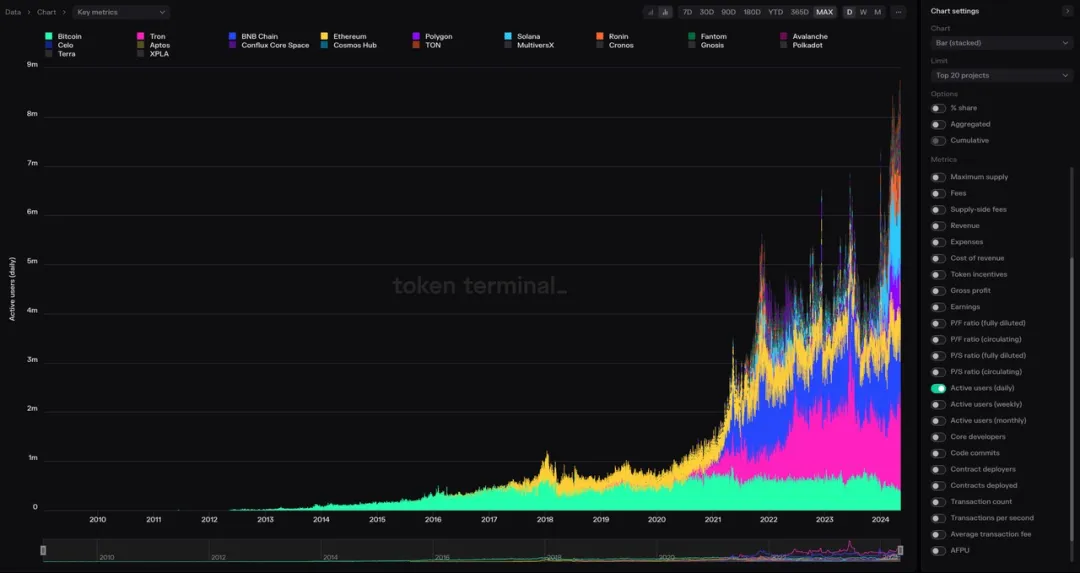
(Source: https://tokenterminal.com/terminal/markets/blockchains-l1)
As a leading player in Web3 security, GoPlus has consistently focused on protecting users and achieved substantial growth. Since 2022, its user security data usage has increased over 5,000-fold, with daily API calls reaching 21 million.
With growing security data accumulation and increasing demand, GoPlus is evolving into a modular user security layer and building a comprehensive security ecosystem, extending protection across more use cases in Web3.
02 Products and Architecture
Through continuous iteration, GoPlus has evolved into a fully architected security network. From bottom to top, it consists of three layers: Fundamental Layers, SecWare Ecosystem, and Network Service Entrance. This structure ensures system-level security while enabling a rich developer ecosystem, excellent scalability, and an optimal user experience.
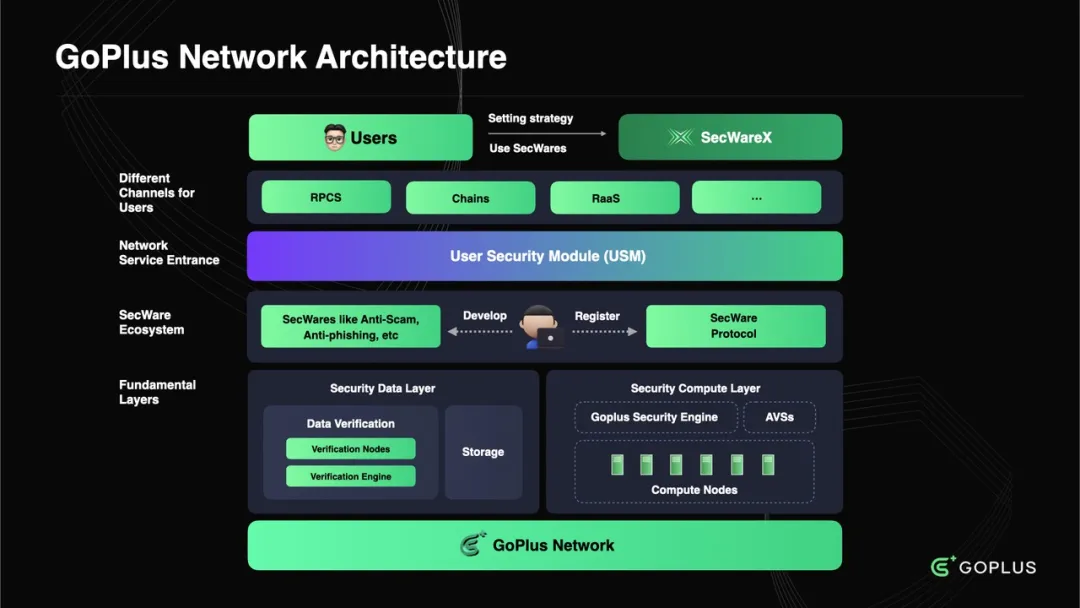
(Source: https://whitepaper.gopluslabs.io/goplus-network/goplus-network/architecture-overview)
Fundamental Layers
The Fundamental Layers form the core of GoPlus’s security system—a decentralized network comprising two modules: data and computation. These layers not only ensure the security and robustness of the GoPlus network itself but also permissionlessly attract more developers to co-build the security ecosystem.
Security Data Layer: Collects, processes, and stores security-related data in a decentralized manner to guarantee data integrity, authenticity, and reliability.
The Security Data Layer allows any developer to join the network and provide corresponding security solutions based on users’ security needs at different stages of the transaction lifecycle (e.g., anti-fraud, anti-phishing, anti-MEV).
This open, permissionless model greatly encourages participation and collaboration among security developers, data providers, and compute node operators, enabling rapid upgrades to address emerging threats.
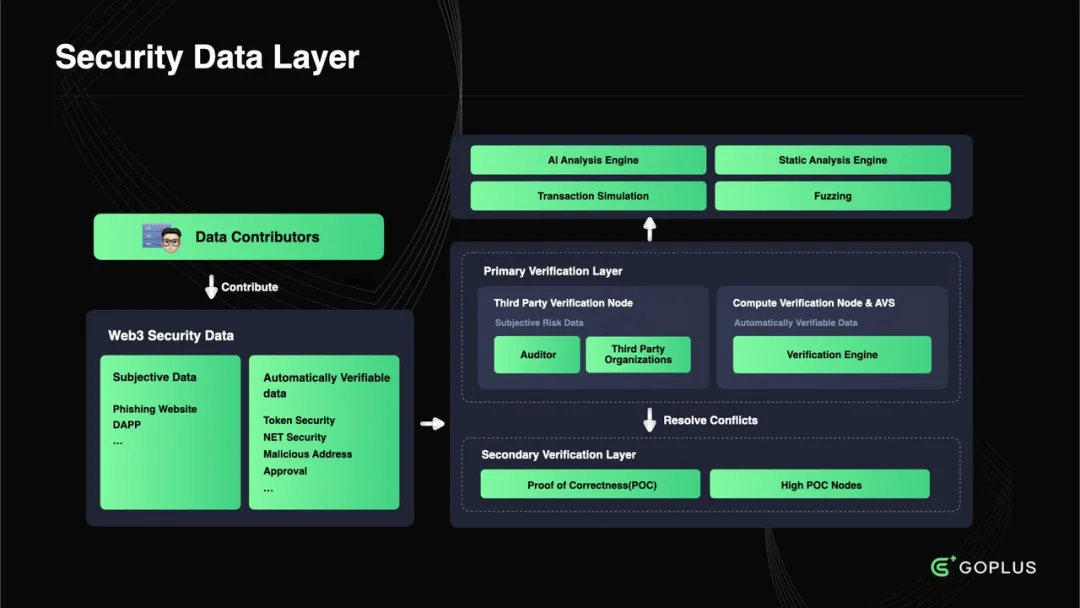
(Source: https://whitepaper.gopluslabs.io/goplus-network/goplus-network/security-data-layer)
Security Compute Layer: Comprised of multiple distributed nodes responsible for executing security-related computations and verifications—such as validating transaction risk analysis, detecting potential threats, and simulating transactions. GoPlus refers to these nodes as Security Compute Nodes (SCNs).
By distributing computational workloads across multiple nodes, the network achieves higher scalability, fault tolerance, and resistance to single points of failure.
At the coordination and incentive level for distributed nodes, GoPlus introduces a staking mechanism and leverages EigenLayer's Actively Validated Services (AVS) to ensure fair allocation and efficient management of computing resources, while enhancing the credibility of computation results through external AVS systems.
SecWare Ecosystem
GoPlus offers specialized services tailored to different stages of the user transaction lifecycle—such as anti-fraud, anti-phishing, and anti-MEV. These services are collectively known as SecWare (Security Software). The SecWare Ecosystem, as the name suggests, serves as the middleware layer that builds security services on top of the foundational layers and delivers them to end-users.
The SecWare Protocol is the core of the SecWare Ecosystem. It consists of multiple smart contracts that define interactions and relationships between users, developers, and their respective security services.
-
SecWare Creation: Developers register their security services (e.g., anti-scam, anti-phishing, anti-MEV) on the SecWare Protocol to create SecWare instances. The registration includes providing basic information such as service description, pricing, and service-level agreements (SLA). These SecWare instances represent actual security software on-chain, making them accessible and usable within blockchain environments.
-
User Purchase, Usage, and Management: Users can log into SecWareX using their wallet address to access their SecHub (personal security center)—a control panel for managing security services and policies. Through SecHub, users can browse, bind, or purchase needed SecWare services. Binding a SecWare grants access to its features, while purchasing unlocks additional privileges or premium services. Users can also configure and manage bound SecWare services within SecHub, adjusting parameters and setting conditions under which each service should be activated—enabling personalized optimization of security strategies.
-
Revenue and Profit Distribution: All profits generated from SecWare purchases flow into a revenue pool. Developers earn profit shares based on their SecWare’s usage and performance. The revenue pool automatically distributes earnings according to predefined rules and service performance, creating an incentive mechanism that encourages high-quality service development.
-
Staking and Penalty Mechanism: To ensure SecWare quality and reliability and prevent malicious behavior, the protocol implements staking and penalty mechanisms. Developers must stake a certain amount of tokens when creating a SecWare instance—an economic commitment to deliver reliable and effective security services. If a SecWare fails to meet SLA requirements or is found to be malicious, part of the staked tokens may be slashed as punishment. This mechanism incentivizes developers to uphold high standards and comply with protocol rules.
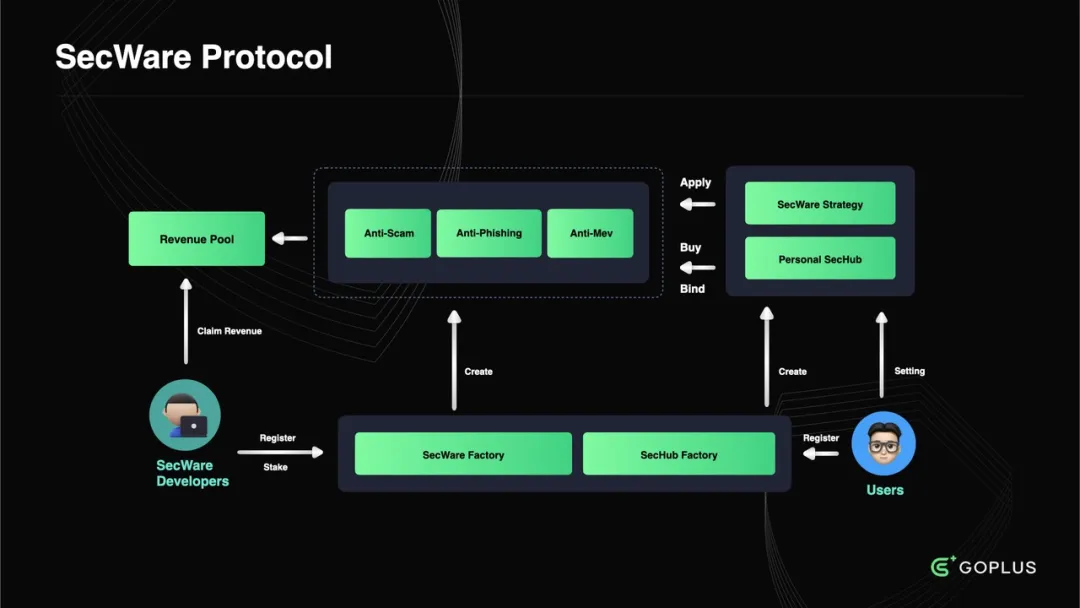
(Source: https://whitepaper.gopluslabs.io/goplus-network/secware/secware-protocol)
On the product side, GoPlus launched SecWareX in March this year, built on the SecWare Protocol, aiming to offer comprehensive protection throughout users' crypto journeys.
SecWareX fully leverages the advantages of the SecWare Protocol, enabling security developers to create customized solutions for over 100 Web3 security scenarios, while allowing users to access, manage, and customize these solutions via a dedicated dashboard—Personal SecHub—ensuring strong protection at every stage of their on-chain interactions.
Currently, SecWareX offers four main features: Multi-chain Wallet Scanner, Personal Security Hub, SecWare Marketplace, and Security Task Center.
-
Multi-chain Wallet Scanner: One of SecWareX’s core functions, offering comprehensive security health checks for user wallets across different blockchain networks. It automatically scans wallets, assesses risks related to assets, interactions, and potential threats, and provides a security score and detailed report to help users effectively manage and mitigate risks.
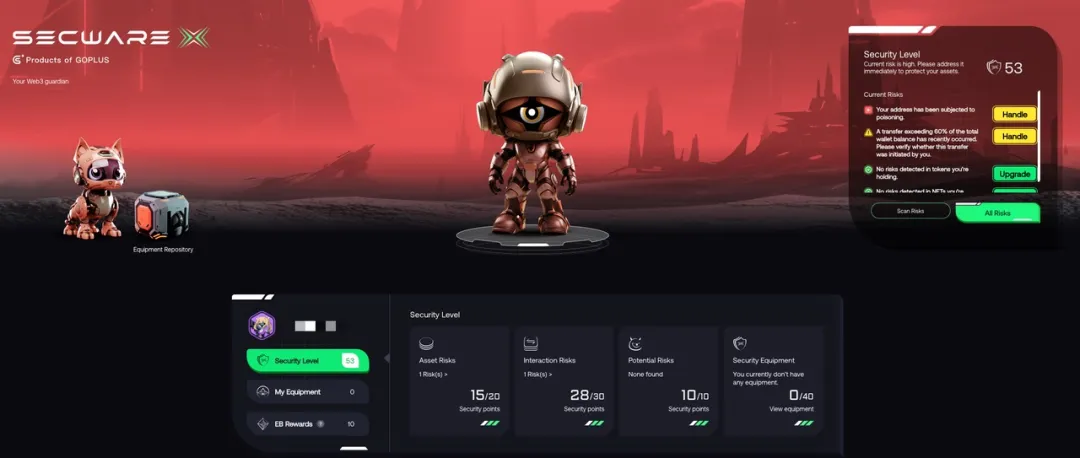
(Source: https://secwarex.io/)
-
Personal Security Hub (Personal SecHub): Acts as a central control panel where users can bind, manage, and customize various SecWare services. It supports multi-chain configurations, allowing users to adjust security settings per blockchain to adapt to each network’s unique characteristics and risks. Additionally, SecHub offers real-time transaction alerts, security data analytics, and visual dashboards, enhancing user control and responsiveness. Currently, GoPlus has opened access to only the first 10,000 users.
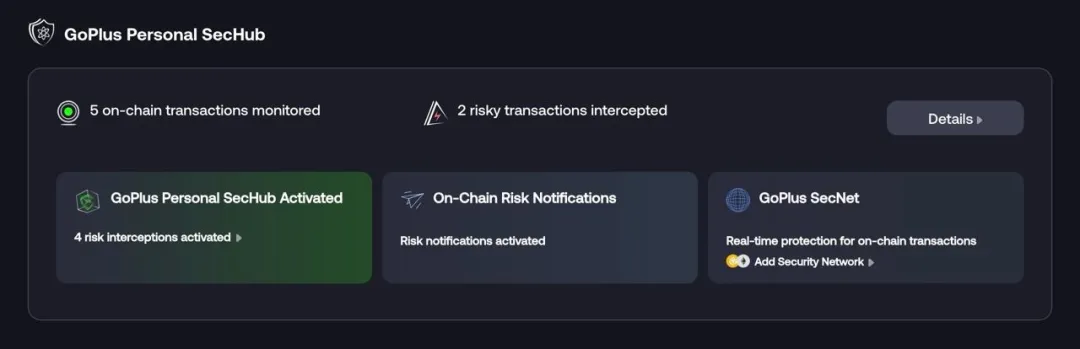
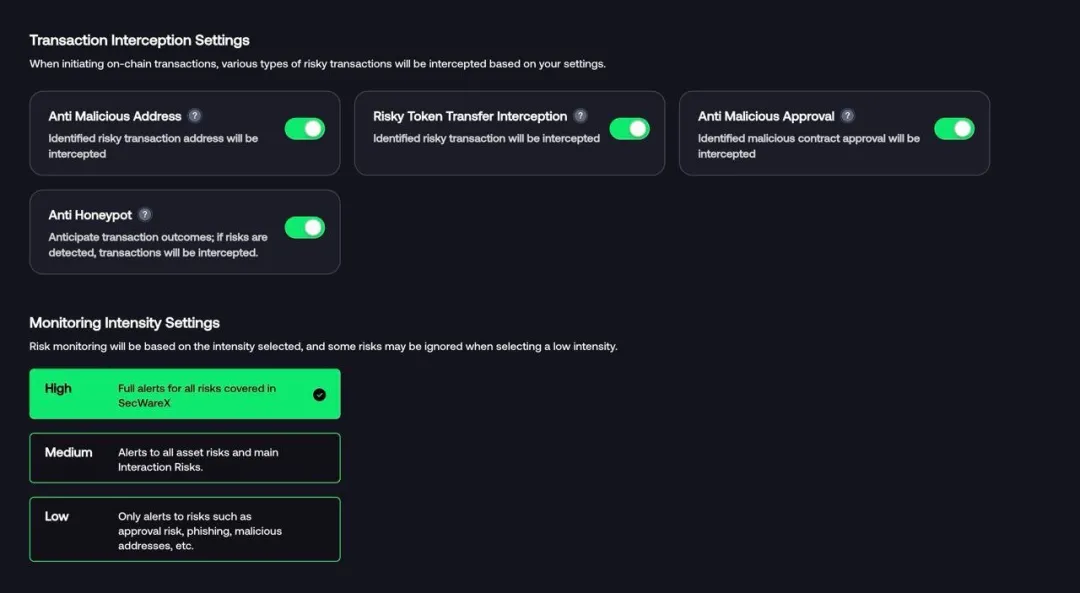
(Source: https://secwarex.io/user)
-
SecWare Marketplace: Allows users to discover, compare, and acquire suitable security services (SecWares) to strengthen asset protection.
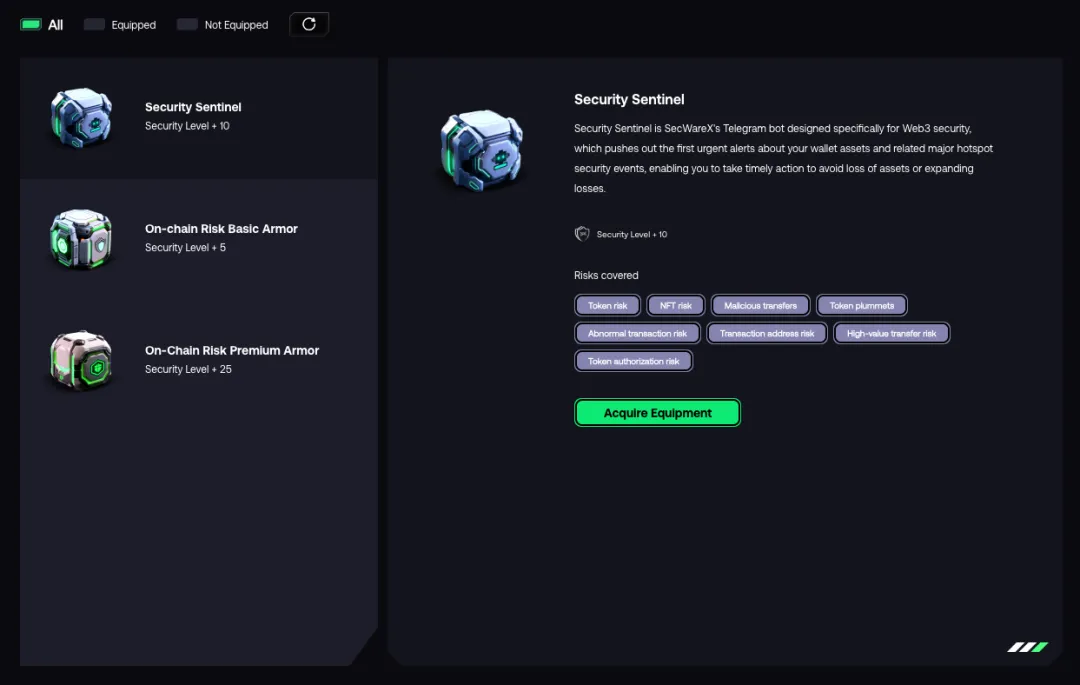
(Source: https://secwarex.io/equipment)
-
Security Task Center: Offers an interactive and rewarding platform where users learn, practice, and master essential security skills through gamified experiences while earning valuable incentives. The Task Center also rapidly disseminates security risks and threat intelligence via social media, leveraging community power to minimize losses for a wider audience.
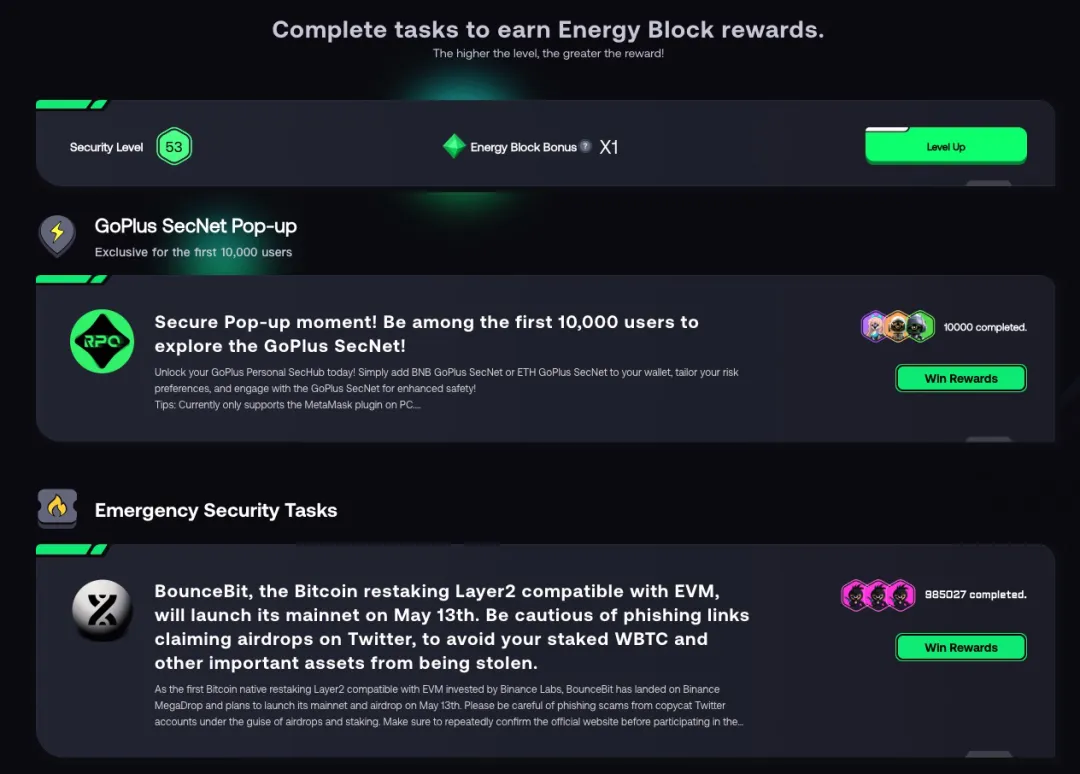
(Source: https://secwarex.io/)
Through these features, SecWareX not only enhances user protection over assets and interactions but also actively involves users in the broader Web3 security ecosystem through education and hands-on practice.
Network Service Entrance
USM (User Security Module) serves as the Network Service Entrance, directly integrating GoPlus’s security capabilities into dApps, wallets, RPCs, and chains at multiple levels, thereby comprehensively securing user interactions. USM is essentially an SDK, enabling the GoPlus network to seamlessly integrate into various ecosystem layers, deliver security services, and even function as a module in modular blockchains and RaaS platforms.
In ecosystems integrated with USM, user-initiated transactions are first intercepted and forwarded to SecWare. Leveraging GoPlus’s open security data and compute layers, SecWare performs real-time risk assessments using advanced AI algorithms. The evaluation results are then sent back to USM.
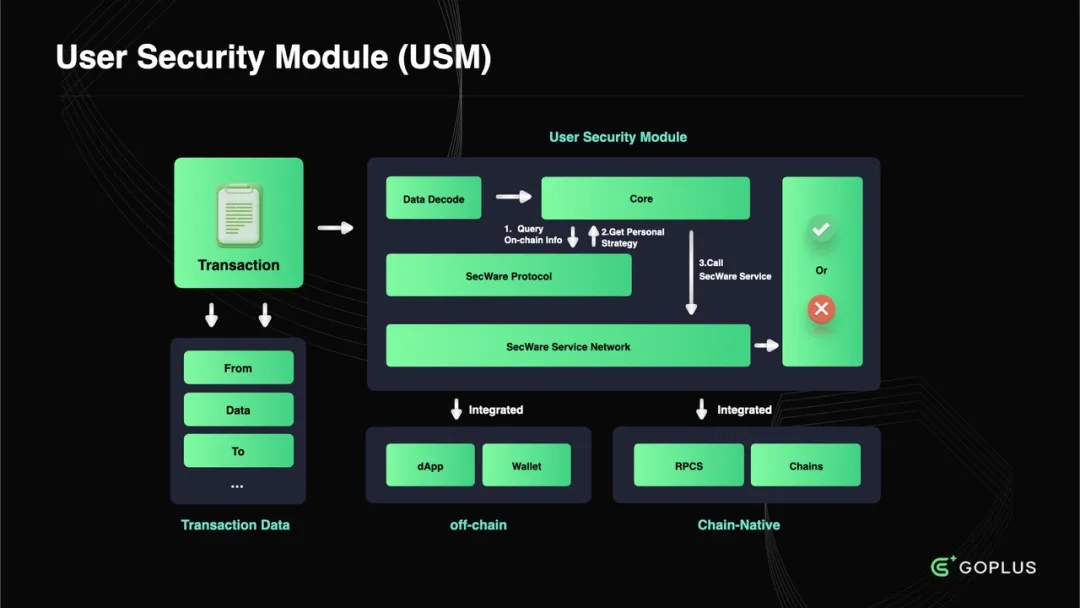
(Source: https://whitepaper.gopluslabs.io/goplus-network/user-security-module/architecture-overview)
In terms of depth of integration, USM is designed to secure users across all interaction phases. Using the Web3 User Security Lifecycle (USLC) framework, USM provides protection before, during, and after user interactions:
-
Pre-interaction: Before users begin interacting, the assessment mechanism helps identify potential threats.
-
During interaction: When users generate and sign transactions, these are sent via RPC nodes to the mempool for validation. Before being validated and broadcasted, USM can still intercept transactions to protect assets.
-
Post-interaction: After transactions are broadcast and recorded on the ledger, USM analyzes residual risks—revoking unnecessary permissions, monitoring abnormal activities, ensuring response plans exist for vulnerabilities—to eliminate latent threats.
Through this comprehensive approach, USM provides not only technical protection but also deep, seamless risk control across all stages of user transactions, ensuring safety in the Web3 world.
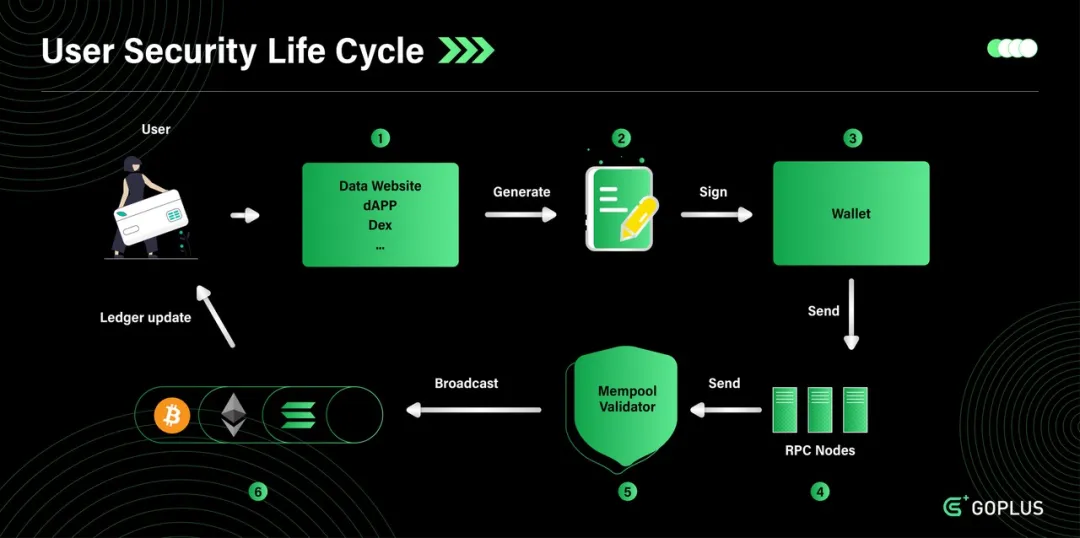
(Source: https://whitepaper.gopluslabs.io/goplus-network/user-security-module/user-security-life-cycle)
Currently, GoPlus has also launched its own secure RPC service, SecNet, aiming to provide users with seamless and secure interaction methods.
By connecting to SecNet RPC endpoints, users can directly access GoPlus’s powerful security features without prior deployment. The currently available SecNet networks include Ethereum Mainnet and BNB Chain.
The Fundamental Layers provide GoPlus with a secure and trustworthy foundation; the SecWare Ecosystem fosters a rich environment for users and developers; and USM ensures GoPlus integrates into user security across multiple dimensions.
GoPlus’s envisioned security ecosystem is taking shape, enabling users to receive comprehensive, multi-layered protection.
03 Governance and Incentive Mechanisms
The GoPlus network is fundamentally a decentralized platform that requires robust governance and incentive mechanisms to drive positive ecosystem development. Key participants—including data providers, node contributors, and SecWare developers—will collectively shape the ecosystem through this framework.
-
Data Contributors: Provide high-quality security data to help developers and partners build effective security products and services. GoPlus operates a reward system for data contributors, offering token rewards and reputation gains within the community.
-
Compute Node Contributors: Supply necessary computing power, operate reliable nodes, and maintain and strengthen the network infrastructure. GoPlus similarly rewards compute node contributors with token distributions to incentivize resource provision.
-
SecWare Developers: Design and develop cutting-edge security services, transforming raw security data into practical tools. They leverage the network’s collective computing power to deliver robust protection. In addition to revenue from SecWare sales, developers can earn rewards from GoPlus incentive programs to sustain high-quality service delivery.
Users are the primary source of revenue for the GoPlus ecosystem. Each time a user utilizes a SecWare service, they pay a security gas fee to ensure the continuous operation of these services.
For contributors—whether SecWare developers or compute node operators—a certain amount of tokens must be staked with the GoPlus Foundation to uphold ecosystem security and reputation.
These staked tokens serve both as economic incentives to ensure participants maintain system integrity and as a security mechanism to deter malicious activity and enhance overall network stability. For governance voting, users must stake tokens to gain voting weight.
Voting weight is directly proportional to the number of staked tokens, ensuring voters have sufficient commitment and responsibility toward the ecosystem.
Through these mechanisms, GoPlus ensures ecosystem vitality while motivating contributors and users to participate in its ongoing growth.
04 Project Roadmap
GoPlus has a forward-looking and detailed roadmap for future development.
Q2–Q3 2024:
-
Launch of Secure RPC Service – GoPlus SecNet: Initial version covering Ethereum and BNB Chain, enabling broad access for SecWareX users to real-time on-chain risk control.
-
SecHub Launch: Rollout of the personal security hub module, offering customizable risk preference settings and personalized security strategy configuration.
-
Open SecWare Protocol: Aimed at building the GoPlus developer ecosystem, enabling more services to serve users via SecWareX; the team plans to widely open the ecosystem to interested security service companies and developers.
-
Security Gas Service Model: Introduce the project token $GPS and Energy Blocks as gas for security services, establishing a circular economic model.
Q4 2024:
-
Launch of Security Data Layer: Enable data contributors to become data contributor nodes via staking; launch a data validation system to ensure data integrity and reliability.
-
Release of USM: Launch the USM SDK, enabling integration into various RPCs and sequencers across chains, expanding the scale and scope of security services, and fostering partnerships with modular blockchains and RaaS platforms.
-
Support More Blockchains: Expand support to a broader range of blockchains, enhancing GoPlus’s adaptability and compatibility in multi-chain environments.
Q1 2025:
-
Launch of Security Compute Layer: Enable more developers in the GoPlus ecosystem to deploy their services on the network and introduce incentive programs for compute layer nodes.
-
Partial Open-Sourcing of GoPlus Security Engine: Open the developer platform and Playground to encourage community involvement and development.
-
Launch of SecWare Developer Platform: Allow developers to freely and autonomously develop, deploy, and publish their own SecWares.
05
Team Background
Core team members bring extensive experience in both traditional cybersecurity and the crypto space. Most have backgrounds in Web2 security, and some were among China’s earliest dApp developers, with years of accumulated expertise in security data.
Additionally, the team possesses a highly international perspective, with members from China, Turkey, the United States, Greece, and other countries—providing natural advantages in serving a global Web3 user base.
GoPlus has also attracted investment from numerous top-tier institutions, reflecting strong market recognition.
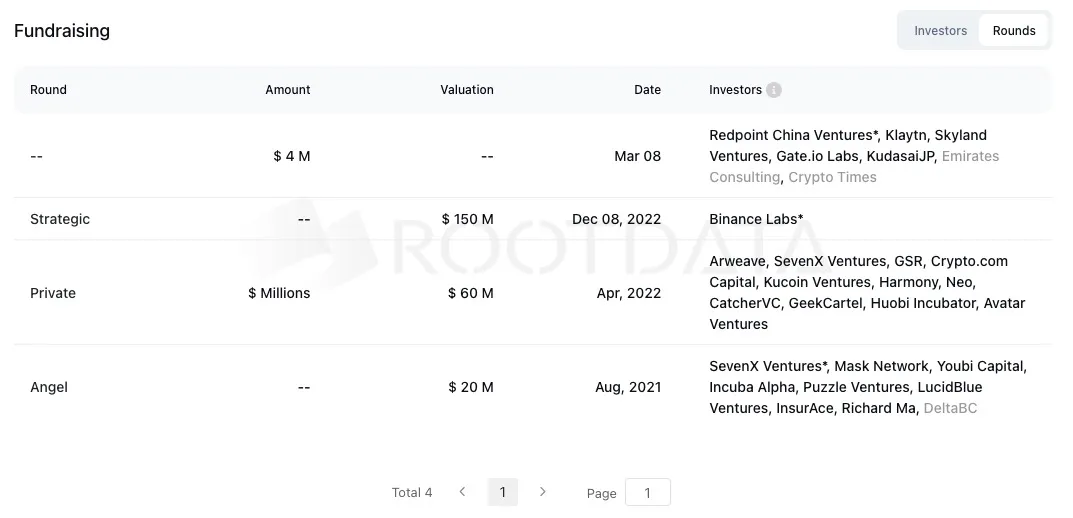
(Source: https://www.rootdata.com/Projects/detail/GoPlus%20Security?k=MzgxNw%3D%3D)
06 Conclusion and Outlook
GoPlus has achieved significant data growth due to its strong security capabilities and high-quality services, indicating broad market recognition.
As more users engage in on-chain interactions, GoPlus’s role as a security guardian will become increasingly prominent—presenting both a massive opportunity and a significant challenge.
With the GoPlus ecosystem beginning to take shape, the positive interactions among ecosystem developers, node and data contributors, and users will inevitably drive continuous growth and resilience, delivering sustained high-quality services.
We have good reason to believe GoPlus will continue to succeed in the next phase—excited to see what comes next.
Join TechFlow official community to stay tuned
Telegram:https://t.me/TechFlowDaily
X (Twitter):https://x.com/TechFlowPost
X (Twitter) EN:https://x.com/BlockFlow_News
 @BiteyeCN


