Bitcoin L2 Showdown: A Dialogue Among Different Schools of Thought — In Conversation with Bitlayer, CKB, and Bool Network (Part 1)
TechFlow Selected TechFlow Selected
Bitcoin L2 Showdown: A Dialogue Among Different Schools of Thought — In Conversation with Bitlayer, CKB, and Bool Network (Part 1)
This episode's guest discussed technology, values, perspectives on capital markets and prominent projects such as the Lightning Network and RGB, trustless cross-chain bridges, and pathways for breaking through in the Bitcoin ecosystem.
 Navigating Web3 tides with focused insights
Author: Faust
Host & Guests: Jomosis, Geek Web3; Kevin He, Co-Founder of Bitlayer; Baiyu, CKB Eco Fund Partner; Kai, Researcher at Bool Network
1. Jomosis: Could each guest briefly introduce yourselves?
Kevin: I'm Kevin, co-founder of Bitlayer. Previously, I've mainly worked on public chains and Layer2 projects, having launched four public chains in total. I’ve also built an Ethereum ZK-Rollup and an MPC-based asset management platform. As for Bitlayer, we aim to turn BitVM from a concept into reality—specifically solving the state validation problem of Bitcoin Layer2s on Layer1—and building a trustless two-way cross-chain bridge based on this verification capability. Additionally, we want to support multiple VMs beyond just the EVM ecosystem, delivering better experiences for developers and users.
Baiyu: I'm Baiyu, partner at CKB Eco Fund. Most people know CKB as a PoW and UTXO-based public chain. Since late last year, we’ve transitioned into becoming a Bitcoin Layer2. The core idea is that CKB was already a UTXO smart contract platform, fully isomorphic with Bitcoin, and also uses PoW. Furthermore, we introduced RGB++, which defines the concept of isomorphic binding—enabling UTXO assets like RGB, Runes, and Atomicals to be bound directly onto CKB or other UTXO chains without requiring cross-chain bridges.
Kai: I'm Kai, a researcher at Bool Network. Bool Network isn't a traditional Layer2—it’s a third-party infrastructure providing secure, trusted cross-chain mechanisms for Layer2s. Using MPC, TEE, our self-developed privacy-preserving ring VRF, and trusted verification methods, we ensure the security of assets bridged between L1 and L2. We also offer forced withdrawal and asset redemption features specifically for Bitcoin Layer2s.
2. Jomosis: What are your views on the current development landscape of the Bitcoin ecosystem?
Kevin: First, I think most possible BTC Layer2 models have already emerged. The key issue now is whether people believe your Layer2 is sufficiently secure—that's crucial. In terms of technical approaches, there are different paths: on-chain verification versus off-chain verification. On-chain verification means validating Layer2 transactions directly on the Bitcoin mainnet. Off-chain verification includes client-side validation, isomorphic binding, multi-sig, PoS, and others. Overall, we're seeing far more diverse technical schools compared to six months ago.
Regarding the broader development of the Bitcoin ecosystem, since we’re currently fundraising, we can clearly feel that most major players in capital markets have already made moves—very few institutions remain completely inactive. In the West, especially North America, large funds often invest in only one direction or one project. From a fundraising perspective, there won’t be many significant new entrants into the Bitcoin ecosystem—most institutional players have already placed their bets, and any new teams may struggle to raise funds.
The situation today is much clearer than it was half a year ago. Looking at user adoption or market performance, we might now be entering a consolidation phase. Some public chains and BTC Layer2s have launched but haven’t attracted strong user data or vibrant ecosystems. So where should the Bitcoin ecosystem go next? Beyond simple asset narratives, can we develop new compelling stories? Will old narratives still work in this new cycle? These questions remain to be validated by the market.
Baiyu: I think the trend is becoming increasingly clear. But curiously, retail sentiment in the secondary market seems completely opposite to what’s happening in the primary market. Even within CKB, I’ve noticed this shift. Previously, the Bitcoin ecosystem was largely driven by fair launches and retail participation—with almost no institutional involvement. Eastern markets were significantly hotter than Western ones, and retail enthusiasm far exceeded VC interest. Now, things seem to be reversing.
First, fair launches—whether Runes or others—haven’t performed as well as initially expected. Second, while some EVM-compatible BTC Layer2s from the East have started listing on exchanges, their post-listing performance hasn’t been particularly strong. However, we see major Western capital firms like Multicoin and Polychain backing certain EVM-compatible BTC Layer2s—such as BoB, Botanix, and recently Arch.
I believe in the primary market, there's growing recognition that the Bitcoin ecosystem represents a beta-level opportunity—a massive one at that. Everyone is positioning themselves accordingly, and many projects are preparing to launch. This clarity is evident.
Within the Bitcoin ecosystem itself, I agree with Kevin earlier—more professional teams are entering. Their entrance implies that the internal logic of the Bitcoin ecosystem must now make sense. Today, different technical schools each have coherent frameworks that stand on solid ground.
For example, on-chain verification models attempt to replicate Ethereum Layer2 approaches using BitVM, then building OPR or ZKR on top—bringing over many elements from the Ethereum Rollup ecosystem. This is less crude than earlier Bitcoin Layer2 attempts that simply used multi-sig bridges. Even future bridges will strive toward decentralization—while perhaps not achieving ZK-level security, they can still rely on economic game theory to maintain security.
Then there’s CKB—we view all non-on-chain verification essentially as client-side validation (CSV). Different CSV solutions can be ranked by security level. CKB has its own RGB++ approach. Meanwhile, heavyweight players like Lightning Labs are issuing assets via Taproot Assets—a very early-stage technology. Notably, Lightning Labs has become much more proactive compared to its previously laid-back stance, actively exploring ways to reuse Taproot Asset-issued tokens within the Lightning Network. That aligns closely with our vision—we also want RGB++ assets integrated into the Lightning Network.
From this angle, the Bitcoin ecosystem truly represents a big opportunity—one that is already widely recognized in the primary market, among capital allocators, and in the West. Our UTXO Stack recently received positive feedback when pitching to Western institutions. Altogether, I believe the Bitcoin ecosystem is becoming increasingly defined and mature.
Kai: Technically speaking, I believe solution designs are now largely converging. There’s increasing standardization and clarity around what constitutes a Bitcoin Layer2—for instance, inheriting certain properties or settlement mechanisms from the Bitcoin mainnet, supporting features like forced withdrawals similar to Ethereum Layer2s. There’s likely now broad consensus on what qualifies as a Bitcoin Layer2 and what does not.
3. Jomosis: What conditions should a BTC Layer2 meet in your view? Please share your reference metrics for evaluating Bitcoin Layer2s. Also, what do you see as the significance or value of Bitcoin Layer2s?
Kevin: Right now, my perspective is broader. Theoretically, anything that extends a certain capability of Layer1—be it performance, decentralization, or TPS—could be considered a Layer2. Some even argue that CEXs qualify as Layer2s. As for required conditions, I believe that as long as users recognize its security, it can be a good Layer2. It doesn’t need to be overly complicated.
Looking at the so-called standards previously proposed by Bitcoin Magazine—using BTC as gas token, dependency on Bitcoin, and if issuing a token, ideally making it Bitcoin-related—different people hold varying opinions.
At Bitlayer, since we aim to perform verification on the BTC chain, we consider settlement on Bitcoin as critically important. Teams building sidechains, however, may prioritize using BTC as gas above all else.
Overall, these “required conditions” are truly subjective. Every project or individual holds different views. We take a more traditional or technically purist stance—following broader community consensus on Layer2 security—so we emphasize on-chain verification as particularly critical.
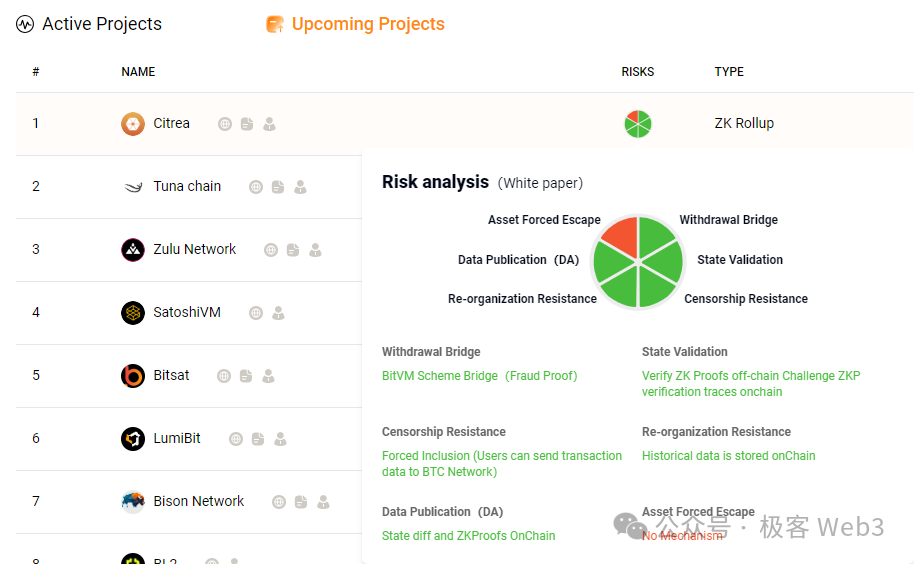
(BTCEden's analysis of security risks in Bitcoin Layer2s)
Baiyu: This is exactly what makes the Bitcoin ecosystem interesting. I don’t think there’s a single definitive standard for Bitcoin L2s. It’s not up to Bitcoin Magazine to dictate. With so many technical approaches out there, each team emphasizes different aspects—perspectives naturally vary. Regarding CKB’s viewpoint, our architect Jan wrote a tweet earlier this year highlighting a core idea: the Bitcoin ecosystem should function as an elastic, layered monetary system. Bitcoin is like gold or central bank money, then it gets distributed outward—this form of currency flows wherever it needs to go.
Thus, CEXs count as Bitcoin Layer2s, the Lightning Network counts, sidechains count—all places where Bitcoin can be used as payment. So I believe anything meeting these criteria qualifies as a Bitcoin Layer2. At its core, it’s a monetary system—you must acknowledge Bitcoin as a primary payment instrument within your system and recognize the value of this currency. That’s most important.
Secondly, we have additional considerations. We highly value inheriting Bitcoin’s design philosophy and values—like PoW principles and UTXO architecture. We believe these represent Satoshi’s most important innovations—things that didn’t exist before.
These characteristics enable user experiences close to Bitcoin Layer1, which we consider significant. Others, like Liquid sidechains, also use UTXO and extend opcodes—though they’re consortium chains, they still try to maintain consistency with Bitcoin Layer1. This alignment matters to us.
In summary, since Bitcoin is fundamentally a monetary system, it shouldn’t constantly change like Ethereum. There’s no need to add unnecessary features. Ideally, it avoids hard forks and soft forks altogether. Of course, we can use Bitcoin’s UTXO model as a coloring mechanism to issue colored coins and slightly expand Bitcoin’s functionality, turning BTC into an asset issuance platform. But going too far risks undermining the entire system’s security and stability.
Kai: The previous two speakers have broader definitions of Layer2, representing a generalized view. My understanding differs. A true Layer2 should not have its own native token (especially not a gas token). You can’t just issue an asset and map Bitcoin onto it and call it a Layer2—that’s not valid.
Second, its security and trustlessness must be guaranteed by Bitcoin itself. On top of that, you can build your own execution environment—extending Bitcoin Script’s limitations due to its non-Turing completeness—enabling meaningful DeFi or asset protocols.
Therefore, I believe two criteria define a real Layer2: no independent native token, and no independent consensus mechanism. Only projects meeting both qualify. Further, Bitcoin Layer2s can unlock existing use cases—digital assets, for example. Currently, holding large amounts of Bitcoin doesn’t allow flexible interaction with DeFi protocols like on Ethereum. You’d need to move to a CEX, leaving the trustless, decentralized environment and introducing various security risks. A true Layer2 could foster a richer application ecosystem.
4. Jomosis: Next, we’d like to hear your thoughts on entrepreneurship itself. What challenges must a Bitcoin Layer2 project overcome to succeed? And is a strong technical narrative a necessary condition?
Baiyu: I think entrepreneurship requires many conditions—it’s inherently a high-risk endeavor, almost accidental. Building a Bitcoin Layer2 is essentially building a public chain, which demands even more. You're not just launching a project—you're creating an entire ecosystem and growing it. A public chain is like a digital community, a vast network involving governance culture and many complex social dynamics—far more intricate than typical startups.
Of course, technology is extremely important. Without it, the blockchain industry wouldn’t exist. Bitcoin itself had genius design—introducing blockchain and PoW consensus, transforming digitally transmitted messages into money. That was revolutionary. Before Bitcoin, everything relied on centralized banking systems—mapping fiat into digital form dependent on centralized issuers. But Satoshi created BTC from scratch—an achievement enabled by contributions across disciplines, with technology at its core.
Sometimes I feel this cycle has regressed too much toward Web2 mentality—just assembling teams and hyping tokens. Many reactively claim "technology doesn’t matter," a view I strongly disagree with. Without technology, there’s no Web3 and no progress. However, technology shouldn’t justify seed-round valuations of hundreds of millions—or even billions—of dollars. That feels like “the emperor’s new clothes.” It’s that specific notion I oppose.
But from CKB team’s own lessons learned, beyond technology, market and marketing efforts are essential. Projects must meet market demand. This is something the Bitcoin community should reflect on. If Bitcoin continues strict fundamentalism—recognizing no coins except BTC, clinging solely to ideological purity—people will eventually realize Ethereum evolved with EVM, account models, PoS, and countless DEXs—all aggressively serving user needs. In contrast, Bitcoin risks being forgotten.
Fortunately, this cycle shows the Bitcoin ecosystem beginning to embrace such changes and address market needs. So beyond technology, fulfilling user and market demands is absolutely essential.
Kevin: I strongly agree. Historically, we’ve never seen a public chain or Layer2 without technical narrative or technological soul achieve significant success. Over the past one to two years, especially after Ethereum Layer2 technologies matured, some operation-focused projects emerged. But most haven’t weathered a bear market yet, so we can’t determine whether they’ll survive into the next bull run.
Thus, the technological foundation is vital. Without tech, there’s no soul, no innovation—and ultimately, you fail both your community and stakeholders.
Overall, technical narrative is the soul. We’ve observed that over the past cycle, capital, markets, and users have grown increasingly intolerant of delayed tech adoption. Some ZK projects that were huge in the last cycle now have much lower visibility. Why? Because they failed to gain actual user adoption—endlessly talking about “endgame” scenarios without winning user trust. This echoes Baiyu’s point: technology exists to solve problems, and those problems must be user problems. Everything must return to user needs.
Regarding the essence of Bitcoin Layer2—if viewed as a business—the revenue model is simple: transaction fees collected minus operational expenses equals profit. Based on this model, how do you maximize fee income? By enabling high-frequency applications. How to reduce costs? Through optimizations built atop security—essentially balancing security and operating expenses, such as choosing alternative DA layers.
Returning to the original question, I believe for any Layer2 or public chain: short-term depends on TVL, mid-term on ecosystem, long-term on technology. Let’s focus on the first two.
Short-term: without TVL, it’s nearly impossible to build any real ecosystem. Most blockchain applications today are finance-related. Without TVL, you’re just “stir-frying empty rice”—a painful experience. Mid-term: ecosystem growth. How do you build an ecosystem? How do you define it? This alone could fill an entire discussion session.
To summarize: technology is essential, but it must eventually be implemented. Ultimately, you need to attract users and achieve real adoption. For sustainability, the ecosystem itself must thrive.
Join TechFlow official community to stay tuned
Telegram:https://t.me/TechFlowDaily
X (Twitter):https://x.com/TechFlowPost
X (Twitter) EN:https://x.com/BlockFlow_News
 @godrealmx